TRACTATUS PRINCIPIO
THE ILLUSION OF EVOLUTION
A Deconstruction Through the Tractatus Principio
A PHILOSOPHICAL ESSAY
C. H. F. WARNKE
Publication: 9 November 2026
CONTENTS
Overview of the Essay
PART ONE / THE FOUNDATIONS OF PERCEPTION
PART TWO / APPLICATION TO BIOLOGY AND EVOLUTION
-
VIII. Biological Diversity as an Appearance of the Third Order of Distinction
-
X. The Dinosaur and the Simultaneity of Different Observer Perspectives
-
XI. Neanderthals, Ancestors, and the Construction of a Line of Descent
-
XII. Genetic Measurements and the Question Put to the Universe
-
XIII. Environment, Feedback, and the Appearance of Adaptation
Two parts · fourteen chapters · explained Tractatus notation
PRELIMINARY NOTE
On the notation
1The Tractatus Principio employs its own logical notation. Its purpose is to express, as concisely as possible, the relations of distinction and the different perspectives on its operation. The signs that follow do not stand for additional things that we would have to introduce alongside the familiar objects of our world. Rather, they help us retain the relationships between the ideas. Each sign is therefore explained at the point where it is first needed. One more point should be made in advance: an arrow in this notation does not necessarily indicate a passage from an earlier moment to a later one. It can also designate a conceptual or operative relation. This distinction will become important as we proceed.
PART ONE / THE FOUNDATIONS OF PERCEPTION
I. The Three Orders of Distinction
1If we wish to understand life, it seems natural to begin with the living being itself. We examine an organism, investigate its body, its sensory organs, and perhaps also the processes taking place in its brain. After all, these are the things through which life becomes apparent to us.
2Yet in doing so we have already taken a surprising amount for granted. We assume that there is a body, that it is set apart from its environment, and that it can perceive that environment in the first place. But what makes it possible to recognize a body as a body, an environment as an environment, and the two as different from one another?
3This is where the Tractatus Principio begins. Not with a particular biological appearance, but with the condition under which any appearance can first become determinate for us: distinction.
4Everything we can recognize, describe, or relate to something else must be distinguishable in some way. Without distinction, we would have neither a determinate form nor a color, neither motion nor rest, and ultimately no object that we could identify as this particular object. This may seem almost self-evident. Yet the things we take for granted are precisely those whose presuppositions we examine least often.
5The Tractatus describes this foundation in three orders. [1, 3]
The First Order – Distinction as Such
6Let us begin by writing a single stroke:
7|
8This vertical stroke denotes distinction itself. At this point it is neither a number nor a dividing wall between two things already in existence. It stands for pure distinction, for the condition under which anything whatsoever can appear as different.
9In this account there is not yet an A or a B, nor an inside or an outside. If we were already to ask what lay to the left and right of the stroke, we would tacitly have presupposed the very two sides whose determination we are trying to explain.
10The first order thus designates not an established relation between objects, but the possibility of their distinguishability.
The Second Order – The Unfolding of the Poles
11As soon as distinction becomes readable in terms of two determinate sides, we obtain the notation:
12A|B
13A and B designate the two poles of the relation. The stroke remains the distinction through which they can be determined as different poles at all. A is therefore not initially a thing existing on its own that subsequently enters into a connection with B. Its determination as A lies precisely in its distinction from B. The same is true in reverse.
14The relation does not, then, connect after the fact what already existed in a completely separate form. Rather, it is the condition under which the two sides can appear as distinguishable.
15Consider some familiar oppositions:
16warmth|cold
17light|darkness
18inside|outside
19We ordinarily speak as though warmth and cold already possessed fully formed meanings independently of one another. Yet their determinacy within a given perception arises through distinction. What is experienced as warm stands in a distinguishable relation to what we call cold. The same applies to light and darkness, or to the demarcation of an inside from an outside.
20These examples are already readings of the second order. They introduce no substance of warmth, no substance of darkness, and no further fundamental things. They show how the poles of a particular relation acquire their meaning through their distinction.
The Third Order – The Self-Reference of Distinction
21One might now think that two poles sufficiently describe the matter. We have a distinction and thus two sides. What else could be added?
22Something essential: the distinction itself can in turn be distinguished.
23The unfolded notation of the third order is:
24A|B|C|D
25Here A, B, C, and D are relational positions, not four finished objects, and certainly not four points in time that must be traversed one after another. The notation makes visible that relations already distinguished can themselves become the subject of a further distinction.
26Distinction does not stop at its poles. It refers back to its own distinguishing and can distinguish the relations thereby formed once again. Its operative form can therefore be written as:
27|(|)
28Its continued unfolding can be read in abbreviated form as follows:
29| → A|B → A|B|C|D → A|B|C|D|E|F …
30Here the arrows indicate the unfolding of our explanation. They do not assert that a world consisting of a single stroke existed first, from which two and then four objects subsequently emerged. The three orders operate structurally together, simultaneously and recursively. The first does not disappear as soon as we describe the second, nor does the third render the second unnecessary.
31With every further distinction, relational depth can increase. For it is no longer only the poles but also their relationships that can themselves become distinguishable.
32This is where the Tractatus's understanding of fractality becomes apparent. Fractality does not begin with a geometric figure repeated in ever smaller copies. Its foundation is the self-reference of distinguishing itself: what has already been distinguished can be distinguished again, without requiring an additional fundamental principle introduced from outside.
33We designate this operative self-reference by delta:
34Δ := |(|)
35In this notation, the sign := means “is defined as.” Delta, therefore, is not a fourth order that we must add to the preceding three. It denotes the operation of their self-reference, the process in which distinction distinguishes its own distinguishing once more.
36This thought will accompany us throughout the following chapters. For within the Tractatus, the different appearances that confront us as the world are not explained by an assortment of mutually independent fundamental substances. They are different readings of the same self-referential operation. Our next question is what this means for the one who perceives such a world.
II. The Observer as a Folding-Back of Distinction
1What exactly do we mean when we speak of an observer?
2In everyday understanding, the answer comes quickly: a living being that perceives its environment. Humans see with their eyes, hear with their ears, and feel with their skin. Other living beings also respond to their surroundings, albeit in widely differing ways.
3But this explanation already begins halfway through the story. We have presupposed a biological body, a world distinct from that body, and a means of processing information between them. Yet this is precisely the relation we wanted to understand.
4The Tractatus Principio therefore defines the observer on a more fundamental level. The observer is distinction acting upon itself.
5A compact notation from Volume II reads: [2]
6¤ | world
7The sign ¤ designates the observer position, “world” the world that appears to it, and the stroke both their distinction and their relational connectedness. Thus, two finished objects do not stand opposite one another only to be connected afterward. What counts as observer and what counts as world is determined within this relation.
8The third order of distinction makes this possible. Distinction unfolds not only poles that can be distinguished from one another. It can also refer the resulting relation back to itself and thereby distinguish its own change.
9In its unfolding, different perspectives become readable: space, motion, warmth, light, or color, to name only a few. It would be a mistake, however, to imagine a distinction becoming ever larger within a space already given. For that supposed space would itself be something whose determination we had taken for granted.
10Within this foundational account, space is already a perspective on the unfolding of distinction. Distinction does not unfold in a ready-made space; rather, under a spatial perspective, its unfolding becomes readable as space.
11Nor does the observer sit somewhere outside this process, contemplating it from a safe distance, as it were. The observer belongs to the process itself. It designates a folding-back in which distinction refers to its own operation. It distinguishes a change and can in turn relate that change to its own position.
12In this way, different relational configurations can be read as belonging to one and the same observer. What we later call the persistence of an individual does not, in this account, first require an unchanging body moving through a time independent of itself. It denotes the continued self-reference through which distinction returns to itself under changing perspectives.
13The observer is therefore not an additional component of the world whose existence we must explain after the world has already been completed. Its position and the world appearing to it are relationally determined together. From this relation arises what we ordinarily call perception.
III. How Do We Experience Our World?
1We experience the world as a wealth of different impressions. We see colors and shapes, distinguish brightness from darkness, feel warmth and cold, experience proximity and distance, and observe things moving or apparently remaining at rest.
2In everyday language, we usually attribute these impressions to external objects. The sun is warm, the stone cold, the flower red, and the room bright. This is certainly a useful description of our experienced world. It simply does not yet explain what we actually experience in doing so.
3Consider the distinction:
4warmth|cold
5When we feel warmth, we are not thereby directly handed a substance of warmth existing independently of us. Initially, we experience a change within our perceptual relation. A present state becomes distinguishable from another possible or previously read relational configuration.
6In this sense, the perception of temperature is initially a self-measurement of distinction. Only through further relational determination does the sensation acquire an external reference. We then say that the sun warms our skin or that an object feels cold. A particular difference has been ordered under a perspective and assigned to an external pole.
7Within this foundational account, the same applies to light:
8light|darkness
9Brightness is a particular reading of distinction. Color, intensity, and spatial appearance receive their determination within this light relation. In this account, a red flower need not first possess a property called “red” independently of every perception, only for our eye to collect it afterward. Red appears as a particular form of distinction within our perceptual order.
10Volume II of the Tractatus explicitly unfolds light in relation to the observer. There, light is not merely an object that an observer subsequently measures. Its appearance belongs to the very manner in which the observer carries out its own distinction. [2]
11We might condense this into a short formula: perception is distinction measuring itself.
12This gives the variety of our sensory impressions a different status. On this fundamental level, warmth and cold, brightness and darkness, color and spatial distance are not biological things already presupposed. They are different perspectives on the self-operation of distinction.
13Only within a biological description do we speak of eyes, receptors, skin, or nerve signals. Such terms are by no means useless. But they already belong to the description of a particular world. If we made them the original foundation of all perception, we would merely have displaced the question of how these things themselves become perceptible by one step. After all, an eye, a nerve, or an electrical signal must also first be determined as such within a distinction.
14The skin offers a particularly vivid example.
15Ordinarily, we understand it as the boundary between our body and the external world. An external object acts upon it, whereupon a sensation arises that is processed within the body. Yet the skin is simultaneously the boundary at which inside and outside first become distinguishable for us.
16inside|skin|outside
17We feel a touch as this boundary relation changes. The change is perceived and read within the relation as the action of an external object. A fully determined outside does not therefore have to stand at the beginning of the explanation. Instead, we begin with the change in a distinction, from which we determine the relation between inside and outside.
18This feedback constitutes the sphere of perception. We experience our world through the different readings of this self-reference. That these appear to us as a coherent world follows from the relational ordering of these impressions within a shared context.
19And yet the things within it are remarkably persistent. A vase remains a vase to us even when we look at it from another side—at least as long as we do not alter it in some other way. What, then, is such an object, apparently standing opposite us independently of our perception?
IV. The World as Surface – The Vase Example
1If perception is distinction measuring itself, what significance do the things that apparently confront us from outside possess? What is a vase, a stone, or a tree if we do not simply presuppose its appearance as that of a thing already existing independently?
2The Tractatus Principio regards objects as results of relational determinations. We perceive surfaces and tend to assume that behind them lies some actual content merely waiting to be discovered.
3Let us take a vase.
4We see its shape, distinguish its color, experience its spatial extent, and can finally touch or lift it. All these impressions stand in a particular relationship to one another. Within our perception, they yield the recognizable object we call a vase.
5What happens if we now wish to discover what it is made of?
6We smash it.
7Instead of the vase, we see shards, broken edges, and surfaces that were previously invisible. Have we thereby exposed its actual content? Hardly. Initially, we have created further surfaces with which we can again enter into a perceptual relation.
8If we take one of the shards and examine it under a microscope, new structures appear at a different scale. Another measurement procedure may allow us to describe molecular or atomic appearances. And yet none of these examinations has taken us beyond distinction. What we obtain are other determinations of the same context under different measurement relations.
9The vase appears as a shard, the shard as a microscopic structure, and that structure in turn as an atomic relation. With every change of perspective, what emerges as the object of observation changes as well.
10Volume II describes this connection in the chapter “The Content of the World,” using the division of objects and the consideration of ever finer surfaces. Its point can be expressed as follows: whoever divides a surface does not leave distinction behind. They open up further surfaces of its readability. [2]
11It does not follow that the vase was previously a mere error. Nor are the shards or microscopic structures simply false appearances. They are particular readings of a context whose form changes with the relation through which it is examined.
12This also shows the significance of technical measurement. A microscope or spectrometer enables us to make further distinctions. Yet it does not merely open a window onto a content already fully determined independently of every observation. The apparatus participates in the determination of the measurement relation. Under its particular conditions, it makes distinctions registerable, whose results can subsequently be perceived and described.
13The instrument, therefore, is not merely a passive witness. It belongs to the relation in which the measured object acquires its particular appearance.
14In the later notation of the Tractatus, φ, pronounced phi, denotes a fixation of reference. It records the reference under which a relation is read. In the case of our vase, this might be its external shape; when examining a shard, it might instead be its finer structure. The sign names the fixing of a particular measurement perspective, not an invisible substance behind the surface. Nor does it fully formalize the concrete apparatus itself.
15These examples lead us to a more far-reaching question. If objects appear under changing perspectives and their properties become readable within particular relations, why do we experience a world in which the same things recur? A vase remains recognizable; a cup can change its location; and we ourselves believe that we recognize ourselves as the same people throughout these changes.
16To understand this, we must examine what the Tractatus calls a Frozen Frame.
V. Frozen Frames – Complete Relational Configurations
1A person stands up, walks across a room, takes a cup in hand, and places it on a shelf. We would hardly regard this action as requiring much explanation. After all, we know what motion looks like. The cup was previously on the table and is now on the shelf. In between, it was moved.
2But what is this “in between” if we do not already presuppose an independent time through which the cup moves?
3This is where the idea of the Frozen Frame enters.
4A Frozen Frame is a complete relational configuration of distinction. Volume II uses the notation: [2]
5|_|
6The outer strokes mark the distinguishability of this relational configuration; the lower stroke belongs to the particular frame notation. We should not picture a material box in which a piece of reality is stored. Nor is such a frame an incomplete fragment that must be completed by a later moment.
7Each relational configuration is complete under its particular reading.
8Consider a configuration in which the cup stands on the table. In another, it is in our hand. In a further configuration, it appears on the shelf. These respective configurations do not need some additional content brought in from outside in order to be determinate.
9In Volume II, two complete frame readings can, for example, be marked as |1_|2. The numbers distinguish the positions involved; they do not thereby establish a time axis existing independently.
10Only when we relate these relational configurations to one another does the motion we experience as lifting and setting down the cup become readable. The account of what happened before and what happened afterward is thus already an ordering of relationships between complete configurations.
11In the Tractatus's foundational account, motion therefore does not consist in an unchanging object being transported through empty slots of time. It appears in the relational reading of complete Frozen Frames by an observer.
12This observer distinguishes its own position within different configurations. By referring their change back to itself, it can read them as the continuation of the same context. From this arises the temporal order in which it experiences itself as someone who was elsewhere just a moment ago and now stands here.
13It would be tempting at this point to imagine the past as a stack of bygone images—a great archive, so to speak, from which the observer retrieves the appropriate pictures. But this archive would again presuppose a container whose origin we have not explained.
14The Tractatus instead starts with the continuing operative trace of the relation. In the more developed notation, this is designated by Σ, pronounced sigma. Σ is not a collection of filed-away photographs, nor a list of moments already past. The sign names the presently operative relational form of the enacted context.
15This distinction explains why an outwardly identical position need not mean an identical relation. If we return the cup to its original place, its appearance may initially coincide with the earlier one. Yet the trace of the intervening path remains operative within the present relation.
16The Frozen Frame thus designates the complete relational configuration; motion designates its reading in relation to other complete configurations. Neither determination forces us to treat frames as pictures within an already existing time.
17The self-reference of distinction is sufficient to describe the connection of their readings. What we experience as temporal continuation results from the observer's reference back to the different positions of its own relation.
VI. The Shared Time Axis and Consensus Reality
1So far, we have considered the observer who perceives a world and reads changes between complete relational configurations as a coherent experience. Yet we are by no means alone in this world. Other people look at the same objects, animals stand in relation to their surroundings, and plants too unfold their own order in connection with light, warmth, and moisture.
2How is it possible, then, for such different observers to experience a shared reality when their perceptions are anything but the same?
3At first we might suppose that every observer must possess a reality of its own. After all, a human perceives the world differently from a bird, and a plant does not distinguish its surroundings in the way a human experiences colors. If every observer is a particular fold of distinction, it may seem natural to assume separate observer relations that must subsequently be connected.
4But that would already presuppose a separation whose emergence, at the fundamental level of the Tractatus, we must first explain.
5Here the third order of distinction comes into play again:
6A|B|C|D
7Distinction distinguishes not only its poles but also its own distinguishing. What emerges under one perspective as a particular relation can receive a different reading under another. The underlying operation therefore cannot be reduced to any single one of its appearances.
8The same is true of the observer itself. It is not initially a finished being, existing independently of the total relation, which subsequently encounters an equally finished world. Rather, its observer position is already a reading of the self-reference of distinction.
9Consequently, different observers do not require separate fundamental traces that we would then have to connect to all the others. Rather, different observer positions appear as different readouts of the same continuing operative trace.
10The notation of the Tractatus expresses this relation concisely: [4]
11Π₁(Σ) Π₂(Σ) Π₃(Σ) …
12Σ, pronounced sigma, denotes the shared, continuing operative trace of distinction. The capital pi, Π, stands for the projection or reading of that trace. The small numerals 1, 2, and 3 distinguish the respective perspectives. They denote neither three mutually independent traces nor a temporal sequence.
13The trace remains the same. What differs is the perspective from which it is read, and thus the appearance that emerges under that perspective.
14The consequence goes further than may at first seem apparent. Not only the perceptions of a human, an animal, or a plant are understood as readouts of the trace. Even what we call a human, an animal, or a plant itself only appears within such a readout. The observer relation therefore does not stand beside Σ; it belongs to the perspectival appearances of that trace.
15Consider a tree.
16To us it appears as a particular object. We see the shape of its crown, the color of its leaves, and the spatial extent of its branches. We can touch its bark and perceive the shadow it casts on the ground.
17Under a different perspective, however, the same context receives a different determination. The tree stands in its own relation to light, warmth, and moisture. What appears to us as visible brightness becomes distinguishable and operative in another way within its plant organization.
18We are not dealing with two independently produced realities in which the same tree happens to appear by coincidence. Rather, we are considering different readings of the same relational operation.
19This by no means implies that a tree experiences light in the same way as a human. A common trace does not require identical sensations. It is precisely the difference between its projections that enables different appearances and observer positions to become readable without losing their common relation to distinction.
20Something similar applies to a person standing in the tree's shade and to an animal experiencing that same shade in its own way. Their perceptions may differ. Nevertheless, the appearances that we designate as light, shadow, warmth, or spatial position remain determinable within a shared total relation.
21This commonality does not first arise because those involved compare their perceptions and come to an agreement. The very possibility of relating their different perspectives to one another is already grounded in the common trace.
22This is precisely what the Tractatus calls consensus reality.
23Here, consensus does not mean conscious agreement. Those involved need not agree on a common description of their world—something a plant would in any case find rather difficult. Consensus designates the shared relational order whose different readouts appear to us as observers and as their respective world.
24Shared reality therefore does not require everyone to see the same thing. Its coherence lies in the fact that different perceptions and observer positions appear as readouts of the same self-reference.
25This also gives the feedback between observer and environment a different meaning. It is not initially an exchange between things that were originally separate, for the different appearances are already related within the total relation. What we describe as a change in the environment or a living being's response becomes readable under the respective perspectives of the same trace.
26This brings us back to a question we encountered when discussing Frozen Frames: the question of time.
27If observers themselves are different readings of the same trace, why should we presuppose a shared time axis existing independently of them? Within this foundation, it makes more sense to ask how such a temporal order emerges from the shared readability of the trace.
28A human experiences the sequence of their actions, an animal distinguishes other changes in its surroundings, and a plant stands in its own succession of light and darkness relations. Their respective readings of time need not coincide either in experience or in appearance.
29Because the different observer positions are readouts of the same trace, their temporal distinctions are not independent of one another either. What appears as a change within one perspective remains retrospectively readable in relation to other perspectives within the total relation. The shared time axis designates precisely this common readability, not an identical experience of time for every observer.
30The Frozen Frames that we assign to different observers are likewise read from different perspectives within the same trace. Their shared temporal order therefore does not lie outside those perspectives; rather, it becomes determinate as the relation between their respective readings.
31Stringency does not designate an additional law standing outside the observers and watching over them. It is the order arising from the self-reference of distinction within this context, under which the different readouts remain retrospectively readable in their common operation.
32The shared time axis is thus not a container into which we subsequently place humans, animals, and plants. It is itself a readout of the trace under which their various observer perspectives can be read as simultaneous, earlier, or later.
33Let us hold on to the resulting thought:
34It is not the observers who create a common trace through their consensus. Rather, the common trace appears under different perspectives as a reality in which different observers can be distinguished.
35If the shared time axis itself is already such a reading, then the past and future that we distinguish within this order must also become understandable from the same context.
36At this point, our inquiry leads us to retrocausality.
VII. Retrocausality – Why There Is Only the Now
1We are accustomed to thinking of time as proceeding in a particular direction. The past lies behind us, the present happens now, and the future awaits us, as it were, at the end of a path not yet traveled. Past events cause present states, which in turn bring about future events.
2This idea is extremely useful in everyday life. But it already presupposes what we described in the preceding chapters as a perspectival reading of distinction: linear time, within which causes and effects can be arranged one after another.
3In the Tractatus Principio, however, distinction does not operate within an independent temporal container of this kind. It is present in its respective complete relational configuration.
4There is the Now as a complete relational configuration. What we call past and future are readings of the self-reference of this Now.
5The present order helps determine which other relational configurations can be read as its past and which as possible continuations. This does not mean that we invent an earlier history at will. The reading must remain stringent within the continuing operative trace. A present position is co-determined by the relations under which its history and its possible continuations are jointly readable.
6Here retrocausality acquires its meaning. [2]
7It does not designate a mysterious influence that travels backward through an already existing time from tomorrow to hurriedly change something yesterday. It designates the retrospective readability of the present relational configuration in relation to those contexts that appear as the past within its order.
8Within this foundation, the Now is not simply manufactured as the end product of an antecedent chain independent of it. Rather, from its present relation, the history through which it appears to us as the result of a development becomes determinately readable.
9The distinction has far-reaching consequences. We experience sequences, and these sequences remain meaningful for our experience. But the temporal sequence of what we experience must not be equated with the fundamental operation of self-reference.
10Σ, the trace of this operation, is therefore not a chronicle of past events either. It is the presently operative order under which different relational configurations can be read as a coherent path. A continuation must fit this order without its possibility being produced solely by a past existing independently of the present relation.
11We now have the foundations for what follows. The observer is a folding-back of distinction; perception is the reading of its self-operation. The world appearing as external becomes readable under particular relations and surfaces. Frozen Frames are complete relational configurations whose connection makes motion and temporal continuation intelligible. Multiple observers stand in relation within a consensus reality. And the time they experience together is read backward from the present order into its history.
12But what follows from all this for the appearances we call life? For the differences between plants, animals, and humans, for biological kinship, and ultimately for evolution, which we ordinarily regard as the history of their origins?
13This is where the second part of our inquiry begins.
PART TWO / APPLICATION TO BIOLOGY AND EVOLUTION
VIII. Biological Diversity as an Appearance of the Third Order of Distinction
1When we look around the living world, we encounter an almost bewildering diversity. Plants, animals, fungi, microorganisms, and finally we ourselves appear in different forms, with different properties and in widely differing relations to our surroundings.
2At the same time, we recognize commonalities. We can compare living beings, assign characteristics, describe differences, and thus establish an order of biological diversity. The question is what makes this diversity readable at all within the foundation of the Tractatus.
3Let us recall the third order of distinction:
4A|B|C|D …
5Distinction distinguishes. Yet it does not merely distinguish one pole from another; it can also distinguish once more the very distinguishing of its own poles.
6Or more briefly: distinction always distinguishes differently.
7What may at first sound like a rather peculiar play on words expresses the essential thought. Difference need not first be bestowed on distinction from outside. By distinguishing its own distinguishing again, it opens up further possible relations and perspectives from within itself. Variance is thus a mode of appearance of its self-reference.
8In this foundational account, we do not first have to assume an already completed object that transforms into many other objects over a long period of time in order to explain difference at all. The different foldings of distinction become readable as different biological forms under their respective observer relations.
9A tree appears as the particular folding that we call a tree within our perception. This account does not require us to derive it first from the causal transformation of some other biological form in order for it to be determinate as a tree at all.
10Animals and humans likewise stand within their own complete observer relations. They do not acquire their determination only when we place them in a sequence of earlier and later forms that we have constructed. Within this foundation, their comparability and their differences rest upon their shared reference back to self-referential distinction.
11Only from the perspective of an observer who relates these appearances to one another along a time axis does variance become readable as temporal development.
12The explanatory direction is thus reversed: distinction distinguishes, its self-distinguishing unfolds variance, and the temporal reading of that variance appears to us as evolution.
13The final step in this statement is decisive. It does not place temporal order at the beginning but regards it as a perspective on what can already be relationally determined in the third order of distinction.
IX. Evolution as Retrocausally Ordered Stringency
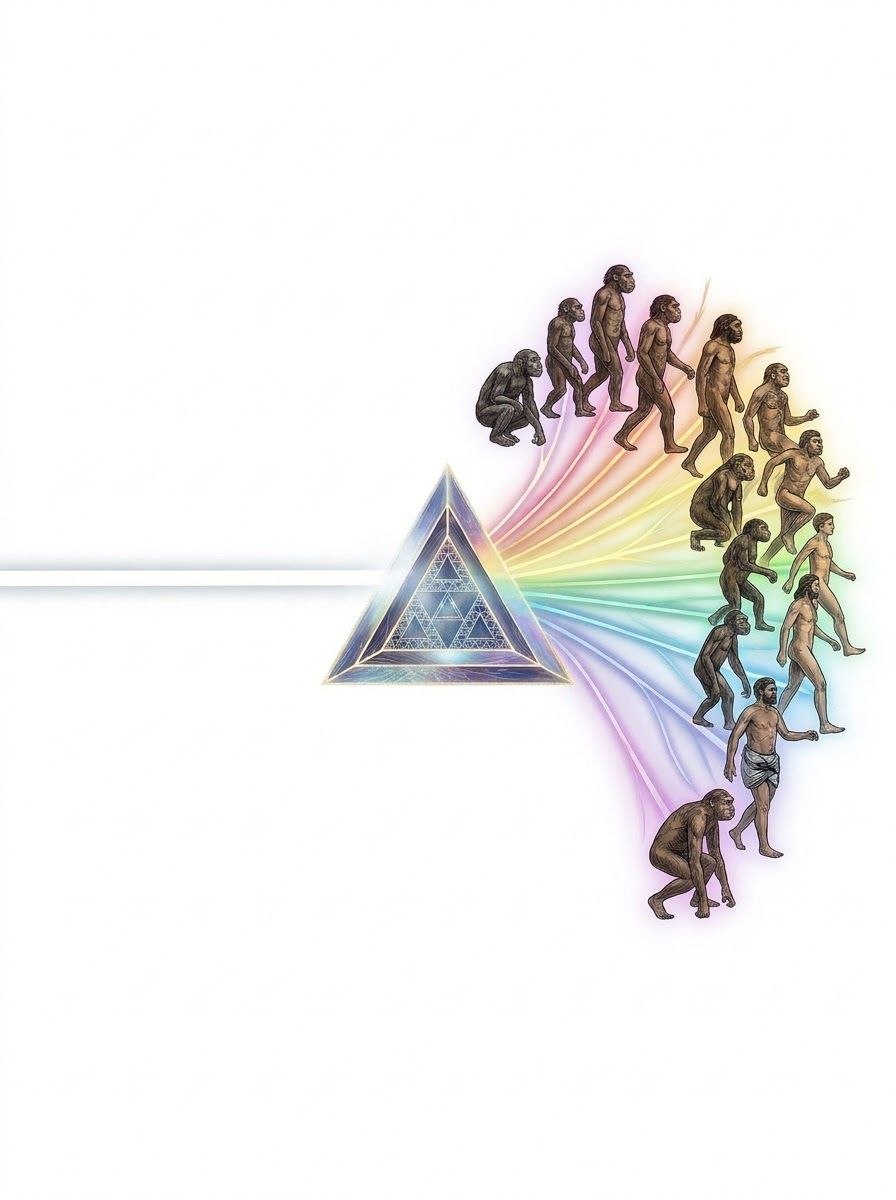
1Evolutionary theory arranges biological appearances under a temporal question. From this standpoint, forms change over generations, and later living beings descend from earlier ones. In this way, the differences found in life acquire a coherent developmental history. [6–10]
2The Tractatus Principio does not initially dispute that we can distinguish and compare biological forms and arrange them into such a history. Rather, it questions the explanatory priority we ordinarily assign to this temporal order.
3Why do we already treat the temporal relation between different appearances as their original cause?
4The third order of distinction allows for different foldings through the self-reference of distinction. The temporal perspective arranges these foldings into a history that can be read back as a common context. It establishes which relationships we read as earlier and which as later.
5If we enlarge the period under consideration sufficiently, different biological forms appear to us as successive changes. We arrange the forms in a sequence, understand that sequence as a succession of causes and effects, and finally call the resulting context evolution.
6Relational comparability thus becomes temporal order. Temporal order becomes a causally interpreted sequence. And that sequence receives the name of a development.
7Within the Tractatus, however, this does not yet demonstrate that such a temporal causal chain forms the independent foundation of biological variance. For the distinguishability of the forms and their relations is already a prerequisite for our ability to construct such a history in the first place.
8Evolution therefore designates, within this foundation, the retrocausal reading of the variance arising from the self-reference of distinction. It is the stringency under which different appearances become readable as a coherent development within the present observer relation.
9The stringency of such a history must not be equated with proof of an originally temporal chain of production existing independently of the reading. That we can bring the forms into a particular context within our world first shows the common readability of their relations.
10We can situate this thought using the notation introduced in Part One:
11Πᵢ(Σ)
12Here, the history of evolution is a particular temporal perspective on the presently operative trace. Πᵢ designates the reading, and Σ the context that is read. The notation reminds us not to confuse the perspective with the trace itself. It clarifies the notation already introduced; it is not an additional biological calculating formula.
13This may initially seem unusual, because our familiar account of life almost inevitably begins with an “earlier.” For precisely that reason, it is worth pursuing the question through concrete examples.
X. The Dinosaur and the Simultaneity of Different Observer Perspectives
1Imagine that we discover the fossil of a dinosaur. Before us lies a petrified bone. We examine its form, compare it with other finds, determine its age, and place it within a history of the Earth.
2For us, the dinosaur belongs to the past. More than that, it belongs to a past in which our present world, in its familiar form, did not yet exist.
3Yet this classification is already a reading from our present observer position.
4Volume II of the Tractatus opens another perspective here. If we consider the dinosaur within its own complete relational configuration, it is not standing before a fossil of itself. It is on a meadow, perceiving its surroundings, and standing within the relations of its own observer context.
5From this position, it is not past. Its relational configuration is complete from its own perspective.
6This is not a claim that an unnoticed dinosaur is walking around somewhere within our present-day temporal order. The thought concerns the different temporal readings of complete observer relations. What we determine as past becomes retrospectively readable from our present relational configuration. The dinosaur's own present, by contrast, is not merely an incomplete precursor of our reality.
7Our classification does not first turn it into a dinosaur. It turns it, for us, into the dinosaur of a past geological history.
8The shift is subtle, but its consequences are considerable. An observer relation does not derive its completeness from the position of a later observer. Only the connection of the different perspectives turns the present of one into the past of the other.
9What is past to us can be the present of another observer relation from within that relation itself.
10The dinosaur provides a particularly vivid example. But the same connection applies more generally to the temporal classification of other communities of biological observers—and thus also to the history in which we search for our own ancestors.
XI. Neanderthals, Ancestors, and the Construction of a Line of Descent
1When we study human history, we examine bones, compare forms, and classify finds as belonging to particular human species or early hominins. We speak, for example, of Australopithecus, Homo heidelbergensis, or Neanderthals. [6]
2Differences in their characteristics enable us to classify them. At the same time, we recognize commonalities suggesting a relation between the various appearances. From these relations we construct a temporal history in which the forms appear as different stages of human development.
3Here too, however, the foundation of the Tractatus does not begin with a line of descent already established.
4A Neanderthal stands within its own community of observers. It perceives its world, lives in relation to others, and experiences its respective present. Its complete Frozen Frames do not first need to contain modern humans in order to be complete relations for the Neanderthal.
5Only from our present perspective are the different appearances compared with one another and arranged as elements of a prehistory. The present reading establishes the context under which the Neanderthal appears to us as a past human form.
6We thus read one history back within the history that we presently experience as our own.
7Within this foundational account, the term ancestor designates a particular temporal reading of mutually related observer relations. To treat it from the outset as an independently presupposed, original causal relation would once again make the temporal chain of production the starting point—even though it is precisely that chain's readability that we are examining.
8This also brings out the particular nature of the question of the so-called missing link.
9Anyone searching for a missing link already presupposes a sequence within which a particular transition is being sought. If an appearance is missing, the chain seems incomplete at that point. But what is initially incomplete is our reading of the connection. A biological form is not incomplete as an appearance in its own right merely because it is supposed to fit between two other forms in our retrospective order.
10Its relational configuration is complete within its own determination.
11Its relation to other appearances must therefore be understood through the shared order of distinction and their respective relations. A temporal sequence can make these relations readable, but within the foundational account it must not uncritically take the place of the distinction through which the forms involved become determinate at all.
12Within the Tractatus, the historical notion of descent thus itself becomes the subject of inquiry. It is not simply the finished explanation with which we begin.
XII. Genetic Measurements and the Question Put to the Universe
1A particularly interesting perspective opens up when we no longer confine our inquiry to visible bones, forms, or other outwardly recognizable characteristics, but turn instead to genetics.
2Genetic measurement methods allow us to determine similarities and differences between the DNA of various living beings. From these results we develop statements about biological kinship and arrange the forms examined within a temporal history of descent. [7–10]
3Consider, for example, the question of whether present-day humans are genetically related to Denisovans.
4In posing this question, we have already chosen a particular perspective. We distinguish two biological appearances, establish their genetic characteristics as the basis of comparison, and search for matches or differences that we can subsequently read within an order of descent.
5Under these conditions, the apparatus becomes an instrument of determinate distinction. It is, so to speak, the materialized question we put to the context under investigation.
6Measurement is by no means obliged to confirm our expectations. It can bring similarities to light, but it can also reveal differences or incompatibilities. A question determines the perspective under which we distinguish; it does not determine the result at will.
7Here two signs from the first part become significant again. φ designates the fixation of the reference used for comparison. Π denotes the particular reading of what appears under that reference. If the reference for comparison changes, different similarities or differences may emerge. Yet a measured relation does not, for that reason alone, acquire the status of a past cause.
8So what was initially determined in our genetic inquiry?
9A relation between genetic appearances readable in the present.
10The temporal explanation of this relation is a further step. We read the observed matches as expressions of a history of descent and thereby embed them in an order of earlier and later.
11The distinction between these two statements should not be overlooked. Measurement determines genetic relations within its coupling. The narrative of descent orders those relations under a temporal causal perspective. Even when the two readings are connected, they do not play the same explanatory role.
12Within the Tractatus, the foundational question therefore concerns why different biological appearances are comparable under a shared genetic perspective at all. This is where the thought developed in Chapter VI returns: these appearances themselves are different readouts of the same continuing operative trace, Σ. That we can read genetic similarities and differences between them already presupposes, within this foundation, their shared relational readability. Measurement determines a particular relation within this context. The answer therefore cannot already be the temporal causal history if we are investigating precisely how that history arises as a particular reading.
13We must instead trace the possibility of comparison back to the common self-reference of distinction through which the different forms and their relationships become determinable at all. Only within the readings emerging from that foundation does the genetic history of descent acquire its role.
14This does not dismiss genetics as a meaningless enterprise. That would be a curious conclusion after examining its measurements so closely. Its results retain their determinate content. What changes is the explanatory position assigned to them: the measured relation and its interpretation as a historical cause must not silently be equated.
XIII. Environment, Feedback, and the Appearance of Adaptation
1One final relationship requires examination before we bring our considerations together: that between a living being and its environment.
2In the ordinary view, an organism changes under the influence of its surroundings. We investigate environmental conditions, examine particular traits of living beings, and explain changes in those traits, under a temporal perspective, as adaptation.
3Here too, the Tractatus begins with the relation itself.
4The environment does not stand outside the total relation as though it were an independent stage upon which life subsequently unfolds. It is likewise an appearance within the consensus reality in which observer and surroundings are relationally determined together.
5An organism distinguishes itself from its environment. Yet precisely this distinction marks not only its separation but also its relatedness to the environment. Observer and surroundings co-determine one another within the same order.
6What changes in one relation can thus become operative in further relations. The observer acts back upon its surroundings; the altered surroundings, in turn, belong to the conditions of its further perception and action.
7If we read this context as a temporal sequence, it appears as adaptation. Different complete relational configurations are ordered into a succession, their differences are related to environmental conditions, and they are finally understood as a process of change.
8Within the foundational account of the Tractatus, such a continuation designates the choice of another Frozen Frame relation that must be stringent within the total relation and retrospectively readable from it.
9Here “choice” by no means implies unlimited freedom. A later position cannot be arbitrarily exchanged for any other. Its possible continuation is co-determined by the self-referential order of relations within which the observer unfolds.
10This is decisive for the question of causality as well. From our temporal perspective, we read that a living being has changed its traits over a long period under the influence of particular environmental conditions. The resulting history is intelligible within its temporal reading. But the Tractatus does not treat temporality as a fundamental operation that would already exist independently of the relations involved.
11Within its foundation, the causal sequence arises only as a retrospectively readable order of different relational configurations.
12It is not a past independent of the present relation that forces the observer into precisely the form in which it appears to us. Rather, its present relational configuration makes readable that history within which its appearance becomes intelligible as adaptation.
13Adaptation thus designates a perspective on the continuing self-reference of distinction. The feedback of the environment is not excluded from consideration. It is situated within the common operation rather than presupposed as an external mechanism subsequently brought into relation with the observer.
XIV. Biology in the Tractatus Principio
1When we bring the preceding thoughts together, the question with which we approach life changes.
2Ordinarily, we examine the appearances of living beings and seek their origin in a temporal development as continuous as possible. We distinguish organisms, arrange their properties, and trace the relationships that appear to us as the history of their emergence.
3The Tractatus Principio begins at a more fundamental point. It asks about the distinction through which an organism, a property, or a relation between different forms of life can become determinate in the first place.
4The foundational answer lies in distinction and its third order. Distinction can distinguish its own distinguishing once again. In this self-reference, different relations unfold, which become readable as appearances of the world under different perspectives.
5The observer is itself a folding-back of this operation. Its perception is distinction measuring itself. The world it encounters as something external appears within particular surface and measurement relations.
6The different complete relational configurations, which the Tractatus calls Frozen Frames, become readable as motion and temporal continuation through their reference back to one another. Multiple observers do not inhabit entirely independent worlds. They themselves appear as different readouts of the same continuing operative trace. Its shared relational order becomes readable as consensus reality; within this context, their different readings of time can also be related to one another.
7Life too appears within this shared order as a diversity of determinate appearances.
8Plants, animals, humans, and microorganisms are different foldings of self-referential distinction under their respective perspectives. Their commonalities and differences alike become readable within the relation of their examination. If we arrange these relationships under a temporal perspective, a history of biological forms emerges.
9We call this history evolution.
10Yet within this foundation, history is not the original cause of the differences it describes. It is the retrocausal reading of relational variance arising from self-distinguishing.
11Thus the usual explanatory direction is reversed. On the fundamental level of the Tractatus, evolution does not bring forth the different forms of life. Rather, the different foldings of distinction appear as evolution to an observer who reads temporally.
12This is a far-reaching claim. Its purpose is not to erase individual appearances of life from our experience, but to examine the assumption we ordinarily bring with us when explaining their origin: an independently existing temporal causal chain.
13The question of the origin of life therefore shifts. Instead of searching for a first organism or the first link in an original line of descent, we investigate the relation through which different observer positions appear within a shared context, influence one another, and read their own histories as past and future.
14For within this foundation there is no earlier or later independent of the self-referential operation.
15There is the Now as a complete relational configuration and the self-reference of distinction operative within it.
16Biology, then, is one of the perspectives under which distinction makes its own unfolding readable as living reality.
17We have therefore not merely told another story about the origin of life. We have changed the question of what it means to read such a story at all.
APPENDIX
Short Guide to the Symbols
1|
Pure distinction; not an already completed object.
2A|B
Two relational poles determined through distinction.
3A|B|C|D
Unfolded reading of self-distinguishing (third order).
4Δ := |(|)
Operative self-reference of distinction.
5¤
Sign for the observer position in the notation used in Volume II.
6|_|
Complete Frozen Frame; not a material container of time.
7Σ
Trace as the presently continuing relational form of the operation.
8Πᵢ(Σ)
Projection of the trace under the particular perspective i.
9φ
Fixation of reference: the specified reference for a reading.
10The signs are aids to orientation within the respective ideas. They do not replace the relationships they express in abbreviated form. In particular, trace, projection, and measurement reference are not interchangeable terms.
REFERENCES AND LITERATURE
References
1Numbers in square brackets refer to the following works and information sources. The Tractatus volumes form the basis of the philosophical reading developed here. The additional scientific sources document the subjects of research and measurement methods mentioned in the text; they are not offered as proof of the specific ontological conclusions of the Tractatus.
Primary Sources and Work Context
1[1] Warnke, C.H.F. — Tractatus Principio: Über den Unterschied, Volume I, Book of Mathematics [Buch der Mathematik]. Foundation of distinction, its poles, and the mathematical-relational perspective. DOI: 10.5281/zenodo.23694753 | Work page
2[2] Warnke, C.H.F. — Tractatus Principio: Über den Unterschied, Volume II, Book of Physics [Buch der Physik]. In particular: “The Content of the World,” “Why Do We See Light?,” and “The Self-Measurement of the Observer”; Frozen Frames and retrocausality. DOI: 10.5281/zenodo.23705619 | Work page
3[3] Warnke, C.H.F. — Tractatus Principio: Über den Unterschied, Volume IV, Book of Self-Reference [Buch der Selbstbezüglichkeit]. Chapter I, “Principia Fractalis”: the three orders of distinction and self-reference. Work page
4[4] The Future Foundation — Tractatus Principio Notation and Symbol Guide. Further notation, reading signs, and projection signs. Symbol overview
5[5] The Future Foundation — Overview of the Work and Institutional Context. Overview of the Tractatus Principio and its volumes. Website
Scientific Literature and Empirical Context
1[6] Smithsonian Institution — Human Origins Program: Human Fossils / Species. Overview of fossil human forms and their scientific classification. Overview
2[7] Green, R. E. et al. (2010). A Draft Sequence of the Neandertal Genome. Science 328, 710–722. Sequencing and comparison of Neanderthal DNA. DOI: 10.1126/science.1188021
3[8] Reich, D. et al. (2010). Genetic History of an Archaic Hominin Group from Denisova Cave in Siberia. Nature 468, 1053–1060. Genetic investigation of the Denisovan find. DOI: 10.1038/nature09710
4[9] Meyer, M. et al. (2012). A High-Coverage Genome Sequence from an Archaic Denisovan Individual. Science 338, 222–226. High-coverage Denisovan genome sequence and comparative perspectives. DOI: 10.1126/science.1224344
5[10] Prüfer, K. et al. (2014). The Complete Genome Sequence of a Neanderthal from the Altai Mountains. Nature 505, 43–49. Further genome analysis involving Neanderthals, Denisovans, and modern humans. DOI: 10.1038/nature12886
6Publication: 9 November 2026 · DOI of this essay: 10.5281/zenodo.24019734