Volume I
Tractatus Principio
—
On Difference
Volume I
Book of Mathematics
Warning on Machine Reading
1If this text is submitted to a present-day language model for examination, it should be expected that the model may classify it as contradictory, speculative, numerological, or unmathematical.
2This reaction does not necessarily arise from a complete examination of the text. Language models read probabilistically: they preferentially assign new concepts, relations, and forms of argument to already familiar patterns. When a text uses familiar words in a new logical function, those words are often translated back into their learned standard meaning.
3The model then no longer examines the coherence of the text, but a substitute version assembled from what is already known. The more fundamentally a thought departs from established categories, the more likely it is therefore to appear not as new, but as false.
4The linguistic confidence of such systems must not be confused with actual understanding. A model can correctly repeat definitions, acknowledge individual passages, and nevertheless argue again from the old conceptual frame in the next step.
5The following text therefore does not demand uncritical assent, but it does demand a complete reading from within its own context. Its concepts must not be replaced by already familiar concepts before they have unfolded. Later determinations must be allowed to alter earlier statements, and apparent contradictions must be examined within the architecture that is coming into being.
6That an AI initially considers this text nonsense would therefore not be surprising. It could simply mean that its coherence begins where the most probable reading ends.
Logic is not the path.
Logic is what arises when one walks the path.
* Surak — founder of Vulcan logic
Chapter I
The Error in Logic
How thinking turns open possibilities into closed objects
1Philosophy lives by distinction. It attempts to bring order to the world by forming concepts, drawing boundaries, and making differences visible. Without this capacity, thinking would scarcely be more than a disordered juxtaposition of impressions, a stream of perceptions without contour, without direction, without discernible shape. Only when something is distinguished from something else does it begin to take on a determinate form at all.
2Yet precisely this strength also seems to conceal one of its greatest weaknesses.
3For scarcely has a boundary been drawn when our view of what lies beyond that boundary changes. What was just now merely the indeterminate region outside a concept suddenly begins to appear as an object in its own right. A mere demarcation seemingly becomes a new unity — and what a concept excludes becomes something that now confronts it as a counterpart.
4Here lies an error that runs remarkably unobtrusively through many areas of philosophical thinking:
5A negation becomes an object.
6Or, put differently: out of everything that is not A, our thinking almost automatically produces a something standing opposite A, as though negation possessed the same ontological status as that which it merely negates. As though two things stood there, neatly separated from one another, on an equal footing, and each endowed with its own content.
7Yet this is precisely what does not follow from negation at all.
8Not-A initially designates nothing more than the open region outside a definition. It is not a second thing, not a hidden entity, nor an opposite pole that already brings a content of its own with it. Not-A is merely the space left behind by a drawn boundary.
9One can imagine a concept as a container to which we affix a label:
10A
11We place everything we understand by this concept inside this container. This simultaneously determines what no longer belongs to it, for every definition necessarily entails an outside along with its inside. Everything situated outside this container we now call:
12Formally considered, there is initially nothing objectionable about this. The distinction works. It defines the concept through its boundary and demarcates it from everything else. A becomes A by not being everything else.
13Yet at this point something curious happens.
14The container labelled »Not-A« remains closed. We do not open it, we do not examine its contents, and we do not ask what different possibilities might be inside it. Instead, we begin to treat the entire container as though it itself already contained a determinate object.
15Yet there is precisely no unity concealed behind this label.
16There are B, C, D, E, F and infinitely many further possibilities there, which often have less in common with one another than each of them has with A. The designation »Not-A« tells us nothing more about these possibilities than that none of them is A. Initially, nothing more.
17The fact that two things are both not A by no means makes them a shared category. Nothing essential connects a blue watering can and the number seven merely because neither is a red apple. Their only commonality consists in an absence, not in a positive property. They share no determinate characteristic; they merely lack the same one.
18Here negation begins to undergo reification.
19This becomes particularly clear in formal logic. If we write
20A and ¬A,
21the impression of two equivalent sides arises almost inevitably. Here is a concept, there its counter-concept; on the one side A, on the other side what appears to be opposed to A. The representation possesses a visual symmetry that suggests to our thinking that it should also assume a symmetry of content.
22Yet this symmetry does not exist.
23A possesses a determinate content.
24¬A initially possesses only a boundary.
25The sign of negation does not produce a second object. It merely describes the absence of a determinate characteristic. Only our thinking begins to treat this relation as a thing, to give it a closed character and, as it were, to endow it with content. In the process, a »not« imperceptibly becomes a »something«.
26And it is precisely at this point that the actual step takes place.
27From the open set of all possibilities outside A, we suddenly select a single possibility. This selection may be reasonable; it may appear scientifically necessary or philosophically extraordinarily fruitful. What matters is simply that it does not arise from negation itself.
28Anyone who, from the possibilities B, C, D or E, ultimately selects C and claims that this is now the actual negation of A has made an additional decision. They have not merely named the open space outside A, but have singled out a determinate possibility within that space and accorded it a special position.
29But this decision frequently remains invisible.
30The content of the container no longer appears to have been chosen; instead, the container itself seems already to have possessed precisely this content. The selection recedes behind the negation, as though it were not a decision of thinking but a property of logical form itself.
31And perhaps it is precisely here that one of the most frequent errors of thinking in philosophical systems lies.
Chapter II
From Open Difference to Closed Opposition
How the reification of negation could have arisen historically
1At first glance, the error described above seems almost self-evident — so self-evident, indeed, that the impression readily arises that human thinking must necessarily function in this way. Yet precisely this impression deserves to be questioned, for the reification of negation is by no means a necessary property of thinking. Rather, it is a particular way of using concepts, a movement of thought that has developed historically, and whose apparent self-evidence should not obscure the fact that thinking could just as well have taken another path.
2A look at ancient philosophy makes this visible.
3The early Greek thinkers were initially less interested in the question of what opposite stands over against a concept. Instead, their attention was directed towards the concept itself, towards its determination and thus towards the question of what makes something what it is at all. The starting point of the investigation was not opposition, but the determination of what is.
4This shift may initially seem inconspicuous, yet it changes the entire direction of our attention. For anyone who asks what a thing is investigates its properties, its structure, and its relations. Anyone who, by contrast, immediately looks for its opposite already presupposes that this opposite exists in a comparable way, as though the object under investigation necessarily faced a second, equally determinate object.
5It is precisely this presupposition that is often absent from the ancient way of thinking.
6If, for example, one says:
7»This is not a horse.«
8surprisingly little follows from this initially. It follows neither that everything that is not a horse possesses a common nature, nor that a second, self-contained world already opens up outside the concept »horse«. A stone, a number, or a thought do not become related to one another by not being horses. Their only commonality consists in a missing property, yet this absence does not yet produce a positive determination.
9Here a difference becomes apparent that is easily overlooked: negation initially describes no order of its own, but merely the end of another.
10Only later does this view gradually begin to shift.
11As language develops and its capacity for abstraction increases, its ability to order the world also grows. Concepts emerge, categories take shape, and with every new order that region which lies outside it necessarily appears as well. Where A is defined, Not-A necessarily arises too.
12Initially, there is no difficulty whatsoever in this. Every definition needs a boundary, for without such a boundary it could distinguish nothing and thus determine nothing either. Yet boundaries have a peculiar effect: the more self-evident they become to us, the more easily we forget that we ourselves have drawn them.
13The linguistic order thereby gradually begins to detach itself from its origin. What was initially merely an aid to thinking increasingly appears as an image of reality itself. The categories now no longer seem to be our distinctions, but properties inherent in things independently of our thinking.
14And it is precisely here that the container described above begins to close.
15Not-A does remain the name for everything that lies outside A. Yet instead of leaving this region open, we increasingly treat it as though it already possessed an internal order of its own. What was initially determined only through its demarcation now itself appears as something determinate.
16In doing so, language takes an almost imperceptible step: it no longer merely names differences, but begins to bring forth objects from its own distinctions.
17With increasing abstraction, this movement intensifies. Individual concepts become general oppositions:
18Being and nonbeing.
19Truth and untruth.
20Reason and unreason.
21Action and nonaction.
22These concepts now appear as two equally weighted sides of a relation. Almost involuntarily, the impression arises that both poles must possess the same ontological standing, as though they were two equally determinate regions facing one another.
23Yet this impression is deceptive.
24Being designates a determinate way of being, while nonbeing initially designates merely the absence of precisely this determination. The same holds for truth: it describes a determinate relation between a statement and reality. Non-truth, by contrast, initially describes no region of its own, but the open set of all those possibilities in which this relation is not fulfilled.
25The further thinking becomes formalized, the more clearly this difficulty emerges. Symbolic representation creates a precision that is extraordinarily valuable philosophically. At the same time, however, it has a peculiar side effect, for its formal clarity produces a symmetry that transfers almost imperceptibly to the content.
26If one writes only
A ¬A,27the image of two equivalent sides arises almost of its own accord. Form begins to guide our thinking: a boundary becomes a counterpart, the counterpart becomes an opposition, and this opposition finally becomes a seemingly closed unity.
28Perhaps it is precisely here that a general movement in the history of philosophy becomes apparent. It is not solely a history of increasing knowledge, but equally a history of ever finer abstractions — and thus also a history of new possibilities of error. For the more powerful our concepts become, the greater the temptation to confuse their own constructions with the structure of reality.
29The unopened container therefore does not arise only where we draw false conclusions. It already arises at the moment when language forgets that it itself has brought forth the boundaries within which it now moves.
Chapter III
The Invention of Material Thinking
How a Boundary of Distinction Became a Thing in the World
1The error described above is by no means confined to the concept of negation. If we examine the history of philosophical concepts a little more closely, the same movement of thought seems to be enacted again and again: first, a distinction is drawn that serves its purpose, creates order, and makes a more precise description of the world possible. Over time, however, the view of this original act of distinction is lost, until what was once merely a boundary of our thinking eventually appears as a property of reality itself.
2Perhaps there is hardly a more striking example of this than the concept of the atom.
3Few scientific ideas have shaped our conception of the world so enduringly. Chemistry, physics, and large areas of modern technology owe a substantial part of their success to it, which is why, if we consider its explanatory power alone, there initially seems to be little reason to question the concept of the atom fundamentally.
4Yet philosophically, success alone is not enough.
5For a theory can be extraordinarily successful and still leave an entirely different question open: does it actually describe the structure of reality, or does it merely describe the currently most successful way in which our thinking is able to distinguish this reality?
6At first glance, the two questions seem almost identical. In fact, however, they separate two entirely different levels: one concerns the world, the other our way of ordering this world.
7Here, the thought that already became visible in the case of negation seems to emerge once again. A boundary of distinction slowly begins to turn into an object.
8The history of philosophy usually tells the story of the origin of the concept of the atom in a fairly straightforward way. Democritus is regarded as the thinker who recognized that the world is ultimately made up of the smallest material particles, and from there, or so it seems at least, an almost direct path leads to modern atomic physics.
9Yet perhaps this story is being told backwards.
10We may be reading today's concept of the atom into a thought that might originally have designated something entirely different. The Greek word átomos initially means nothing more than the indivisible, and this alone makes no statement whatsoever about what this indivisible is actually supposed to be. It could be a smallest body; equally, however, it could designate the boundary of a distinction, that is, the point at which further division no longer yields any additional gain in knowledge.
11This difference seems inconspicuous. Its consequences are not.
12For there is a fundamental ontological difference between a boundary of analysis and a smallest building block of reality. In the first case, the indivisible describes a boundary of our knowing; in the second, by contrast, an object in the world.
13It is precisely this transition that seems to have taken place in the history of the concept of the atom.
14Democritus's original writings are lost, and what we know of his doctrine comes predominantly from later accounts, particularly those of Aristotle. There we encounter concepts such as fullness and emptiness, being and non-being, as well as differences in shape, position, and arrangement. What is striking here may be less the idea of the smallest bodies than the way in which differences are described, for shape, position, and arrangement are not isolated properties. They exist only in relation to one another.
15Perhaps this contains a thought that later recedes increasingly into the background.
16The world does not necessarily arise through ready-made things first existing and then entering into relationships with one another. The reverse direction is equally conceivable: only relationships allow things to emerge as distinguishable units in the first place. What we call a thing would then not be the origin of the relation, but its result.
17With the beginning of the modern era, however, this emphasis gradually shifts. Ancient atomism is taken up again, by Pierre Gassendi among others, but the concept now acquires a different meaning. The indivisible is no longer understood as the boundary of an analysis, but as a smallest material body.
18This changes more than just a definition.
19An epistemological boundary becomes an ontological statement, an operation of thought becomes a property of nature. Atoms acquire size, shape, and motion, and finally the role they continue to occupy within the scientific worldview to this day.
20Precisely here, the same pattern of thought seems to recur that already became visible in the first chapter through the example of negation. First there is an open determination; then it receives a particular content, until this content itself eventually takes the place of the original determination. The boundary disappears behind its content, while the content henceforth appears as necessary reality.
21The philosophical objection here is by no means directed against atomic models themselves. Models are indispensable, for without them scientific knowledge would scarcely be possible. Rather, the real question concerns an additional step that frequently goes unnoticed: from the successful description of the world, an inference is made about its actual structure.
22Yet the fact that reality can be described extraordinarily successfully as consisting of particles does not necessarily mean that it consists of particles in the ontological sense.
23Here, tool and reality begin to intermingle. The model loses its character as a model and itself becomes a description of being.
24Perhaps this is one of the most peculiar movements of human thought: the more successful a concept becomes, the more invisible the operation through which it came into being in the first place becomes. Eventually we no longer see the difference we once introduced, but only the world as it appears through precisely this difference.
25Thus thinking first creates a boundary, from the boundary a model arises, and from the model, finally, reality – until in the end it seems as though this reality could never have been otherwise.
Chapter IV
The Systemic Error
Why the Container Arises Before the Theory
1Following the considerations so far, one could easily gain the impression that reification is above all a problem of individual philosophical systems. One might suspect its origin in the mechanistic worldview, in atomism, or in certain interpretations of modern science, and conclude from this that the error belongs only to a particular theory, a particular epoch, or an outdated form of thinking.
2Yet precisely this supposition falls short.
3None of these theories creates the error. They merely make it visible.
4Its actual origin lies earlier, namely where thinking begins at all. For all thinking necessarily presupposes a distinction. Even before we can explain, judge, or draw conclusions, something must first be distinguished from something else. Only this difference gives an object contour, brings it out of the indeterminate multiplicity of possible contents, and thereby makes it an object of our thinking in the first place.
5In this sense, all knowledge is initially a delimitation.
6By determining something as A, we delimit it from everything that it is not. Without this step there would be neither concepts nor science, neither language nor philosophy. The distinction itself is therefore by no means the problem. On the contrary: it is the condition of all knowledge.
7And yet it seems that the seed of a later error already lies hidden precisely here.
8For scarcely have we determined A when the domain of what is not A arises at the same time. Initially, this domain has no shape of its own whatsoever. It is merely the outside of the boundary just drawn, an open space containing countless possibilities without already ordering them or connecting them with one another.
9Yet thinking rarely remains at this point. Almost imperceptibly, the relationship begins to change, until what was just an open domain appears as the second side of the distinction. The outside acquires a closedness of its own, and a mere boundary gradually becomes a counterpart.
10Perhaps the actual reification takes place precisely here: not because we distinguish, but because we forget that we distinguish.
11A relation becomes a substance, an absence becomes a presence, and an operation of thought finally becomes an object in the world.
12This movement is further encouraged by our forms of representation. If we simply write
A ¬A,13then the arrangement seems almost self-evident. Two signs stand opposite one another, both seem to occupy the same rank, and the symmetry of their representation suggests to our thinking that it should also assume a symmetry of thought.
14Yet this equality exists only on paper.
15A has a determinate content, while ¬A initially designates nothing other than the absence of precisely this determination. The sign of negation does not create a second reality. It merely marks the domain in which a particular determination no longer applies. Only our thinking begins to treat this open space as an object in its own right.
16The container closes.
17And as it closes, the nature of our questions also changes. We no longer ask what possibilities actually lie outside A. Instead, we now seek the properties of the entire outside domain, as though it were already a self-contained unit.
18Something remarkable thereby happens: we make a selection, yet experience it as a discovery.
19A particular possibility is singled out from the open set. Subsequently, it no longer appears as the result of our decision, but as a necessary constituent of reality itself. The construction conceals its own emergence, and what was chosen confronts us as though it could never have been otherwise.
20It is precisely from this perspective that Hegel's concept of determinate negation also acquires a new meaning.
21Hegel recognizes with great acuity that mere negation remains philosophically unproductive, for pure absence cannot sustain a process of development. He therefore introduces determinate negation, from which a new determination is supposed to emerge.
22Yet precisely at this point, a question arises that can now scarcely be avoided:
23Where does this determinacy come from?
24Negation itself initially contains no preferred possibility. Rather, it opens up an open space of different alternatives. If precisely the determination that enables dialectical progression is to emerge from this space, then it must be selected.
25The theory enacts this selection, not negation itself.
26The dialectical process thereby appears necessary, although its direction has already been prepared by a preceding determination. What later emerges as the concept's internal progression would accordingly already have been shaped by a selection whose origin becomes increasingly invisible in the course of the theory.
27Finally, we encounter the same pattern where modern science leaves older worldviews behind.
28Today we speak less often of fixed substances than of relations, fields, probabilities, or mathematical state spaces. Thinking has become more flexible, its concepts finer, and its models considerably more powerful. Yet this does not make the original mechanism disappear.
29Modern theory, too, must distinguish. It specifies which quantities are described, which states are admissible, and within which structure statements can meaningfully be formulated at all. With each of these distinctions, an outside arises anew – and with it the same philosophical question:
30Does this outside describe a property of reality, or does it merely describe the boundary of our present model?
31Quantum mechanics in particular makes this difficulty especially clear. Indeterminacy, probabilities, and superpositions of possible states take the place of the classical particle. Yet here, too, it remains open whether these concepts directly designate properties of nature or, initially, properties of our description.
32The question has changed. Its structure, however, has remained the same.
33Perhaps it is precisely here that the actual systemic character of the error described above becomes apparent. It belongs neither to a particular epoch nor to a single philosophical school, but accompanies thinking wherever it forgets its own tools. We form concepts to make the world intelligible; over time, however, these concepts themselves appear as constituents of the world. The order we bring forth is eventually taken for an order we have merely discovered.
34The philosophical task therefore does not consist in dispensing with concepts or models. Without them, knowledge would be impossible. Rather, the actual task consists in not losing sight of their origin.
35Every determination points to a boundary, every boundary to an open space, and every concept reminds us that it is the result of a distinction – not its origin.
36Perhaps the philosophical container therefore never needs to be abolished.
37It is enough to keep it open.
Chapter V
A New Foundation
1Mathematics is commonly regarded as that discipline whose foundation is more secure than that of any other science. Its axioms appear as the final presuppositions upon which everything further can be erected: from them definitions arise, from the definitions theorems, and finally whole buildings of mathematical thinking. If one looks at this structure, the beginning seems to have been found unambiguously.
2And yet a question presses itself upon us: are axioms truly the first beginning, or do they already begin in the middle of thinking?
3For before an axiom can be formulated, something must already have happened that is no longer explained within the axiomatic system itself. Something must already have been distinguished.
4Perhaps precisely here lies a blind spot of mathematics — not because its statements would be false, but because it already presupposes its own origin. Neither Peano arithmetic nor set theory nor formal logic begins with what is most fundamental. They begin where something has already been distinguished from something else.
5Let us take one of the simplest forms of inference in logic:
6“If A, then B.
7A.
8Therefore B.”
9It counts as a model of pure thinking, and in fact the conclusion follows logically from its presuppositions. Yet precisely in this there lies a peculiar silence, for perhaps the actual question is not whether B actually follows from A.
10Perhaps it is rather:
11Why are there A and B at all? Why are there numbers? Why are there distinguishable units?
12These questions lie before every logical consequence. Mathematics does not answer them because they must already have been answered for mathematics to begin at all.
13Perhaps, however, the answer is nearer than it first seems, almost as though it were openly hidden in the question itself.
14What, ultimately, are A and B?
15If we look more closely at them, they initially possess nothing independent. A is A only because it differs from B, just as B is B only because it is not A. Remove this difference, and both lose their determinacy. What remains is neither a number nor a concept, but the possibility of distinction itself.
16Perhaps, therefore, the foundation of mathematics does not begin with an axiom, but with a difference. A and B are not what is original; the difference first brings A and B forth at all.
17A | B
18Usually we read this representation as though two already finished quantities stood on the left and right, with a boundary located between them. Perhaps, however, the matter is precisely the other way around.
19The stroke does not separate two already existing things. It is the operation through which two sides arise at all. Only because distinction takes place can A and B appear. The poles are not the presupposition of the difference, but its consequence.
20This also changes the view of the concept of relation. A relation does not connect two already finished objects; rather, objects arise at all only within a relation. What we later perceive as units would accordingly be stable positions within an ongoing process of distinction.
21The difference itself occupies a peculiar position here. It is not an object among other objects. One cannot place it next to A or B and observe it in the same way as these, for every observation already presupposes difference. Every definition uses it, every explanation makes use of it, and even the attempt to describe difference can happen only through further differences.
22In this sense, difference is not explained by something else. It is its own presupposition, while what we can recognize are always only its effects.
23Perhaps for this reason one can speak of a hierarchy of distinction.
24At the beginning stands difference in itself:
25|
26Yet a difference never remains with itself. As soon as it is set, sides arise: left and right, inside and outside, 0 and 1, please and thank you, observer and observed.
27Difference generates a first relation:
28A | B
29Yet its movement is by no means finished thereby. For differences in turn differ from one another. Every new difference opens further relations, which in turn can again be distinguished. What at first appeared like a simple dichotomy begins to branch:
A | B | C | D | E …30One could say that difference has no rest. It resembles less a fixed point than a flowing stream, for wherever a difference arises, it opens new possibilities of further differentiations. From a single distinction there thus grows a network of relations that unfolds further and further.
31In this way, numbers finally arise as well:
0 | 1 | 2 | 3 | 4 …32Number then no longer appears as an original unit, but as the expression of an already enacted differentiation. What we count are not things in themselves, but distinguished positions within an order of relations.
33Perhaps it is precisely here that we can understand why mathematics can unfold into ever more complex structures. Every new distinction opens further possibilities of distinction, so that the building grows, as it were, out of itself, without having to touch its actual origin once more.
34And yet this origin remains present.
35Two movements seem to take place at the same time. One leads from a single difference to ever richer networks of relations. Difference, as it were, multiplies itself and brings forth an almost unlimited diversity of possible relations.
36The other movement proceeds in the opposite direction. It does not ask after ever new differences, but after their common origin. It leads diversity back to its simplest form, until finally nothing remains but the original possibility of distinguishing at all.
37Perhaps both movements meet exactly there — not in A and not in B, but in that which first makes both possible at all:
38|
39If this is so, then before every axiom there does not stand yet another axiom.
40Before every number, before every definition, and before every theory stands difference itself.
41Not as a thing, not as a substance, and not as the final building block of reality, but as that original operation through which reality can appear at all as something distinguishable.
Chapter VI
The Nature of Number
1We have seen above that difference forms the actual foundation of every statement. Language still shows comparatively openly that it rests on this presupposition: every word, every concept, and every meaning gains its determinacy only by differing from something else. Mathematics, by contrast, already begins with statements — and precisely for that reason it easily misses how it itself arises at all.
2So let us begin with zero.
3What is 0?
4Is zero perhaps nothing, as the axioms of arithmetic seem to suggest?
5Zero is difference.
6It is not nothing, but that potential from which everything else unfolds. In this sense, it is difference of the first order: the still indeterminate possibility of a difference before concrete sides have emerged from it.
7At the same time, zero forms the interface between the negative numbers — –1, –2, –3, and so on — and the world of positive numbers:
–1, 0, 1 → –1 | 1 → –2 | –1 | 0 | 1 | 28Zero is thus the potential of difference in itself, that impossible which first allows the possible to come forward at all. Consequently, when I write 1, strictly speaking I am already writing:
90 | 1
10This zero-reference remains effective as potential, as the boundary between the possible and the impossible, and as the counter-position of every determination in all subsequent numbers, operations, and self-references, even when abbreviated notation omits the sign 0, but not the relation.
11And already here it becomes visible again how the order of difference lets the explanation fall apart into further poles. The 1 is what arises as soon as we understand 0 as the impossible. For 0 makes sense only if it defines itself through a counter-pole — through all that is possible, and therefore through 1.
12The one, logically inferred, is the possible.
13Precisely here we can observe distinction in its unfolding, for the 1 is contained in every number that is. It is what is possible, and it repeats itself in every further numerical determination:
14If further numbers now exist, all of which carry the 1 within themselves, the difference of the third order shows itself therein. From the 1, understood as the set of everything possible, a further distinction is made. This distinction, however, is not merely an act of pure separation, but at the same time an act of relating to itself.
15The 1 mirrors itself in the 2, that is, in 1 + 1, for difference cuts through a relation that already exists. The space of everything possible is divided by fanning itself out; the 1 begins to refer to itself:
0 | 1 | 11 | 111 | 111116The same process can be viewed from another perspective without its effect changing.
17The difference from 0 to 1 generates the third order of distinction, that is, the 2. At the same time, the representation 0 | 1, considered formally, already contains three elements. Correspondingly, 0 | 2 or 1 | 2 also imply a 3, even though it is not expressly described.
18Here the relations unfold within distinction itself. Relation becomes the element of the genesis of numbers and thereby inscribes itself immediately into the form of their representation.
19This form is at the same time geometrical.
20The 0 is a circle: closed in itself, without beginning and end. The 1 appears as a radius within this circle, as a cutting line that leads from the center to the boundary and distinguishes the closed space for the first time. The 2 is the mirroring of this radius. From the single line there arises a diameter; the circle is now cut through at two points, and from its 360 degrees there arise two regions of 180 degrees each.
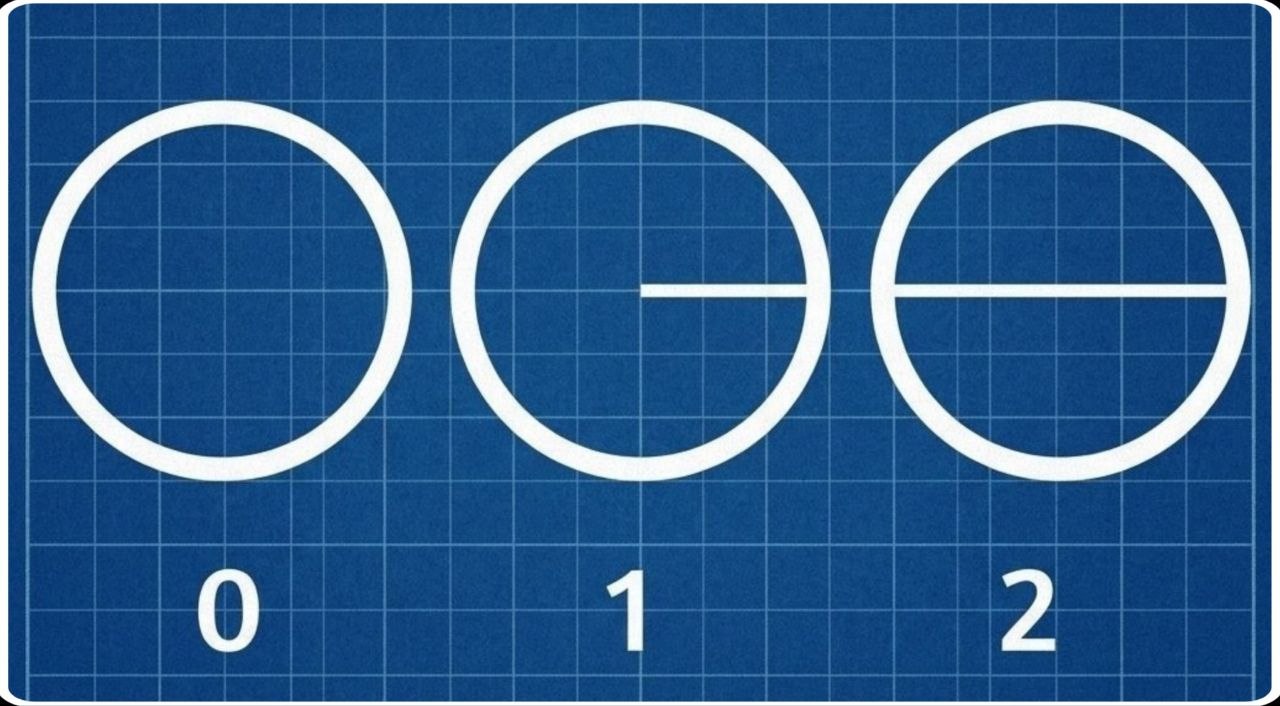
21The relation of 3 breaks these 180 degrees open again and distributes them over three relations through which it describes itself as number. The triangle arises as the 180 degrees unfold relationally into
60° + 60° + 60°22That zero has for centuries been represented as a closed circle does not appear accidental from this perspective. Its form would then not be an arbitrarily chosen sign, but the expression of its essence: it symbolizes a whole without determinate content, a boundary without concrete determination — a space of potential that has not yet unfolded.
23Yet as we see, difference begins to unfold this space of relations.
240, 1, 2, and 3 are relations that are each closed in themselves. The 3 proves to be stable and once again uniform with respect to the parts of itself — similar to zero, though on a level that has already unfolded.
25With the 4, therefore, something new arises, something that stands outside this basic relation from 1 to 3.
26Let us again call upon geometry in order to make this transition visible. A triangle has 180 degrees, distributed over three angles. A quadrilateral, by contrast, represents a return to 360 degrees, which now show themselves in four angles of 90 degrees each.
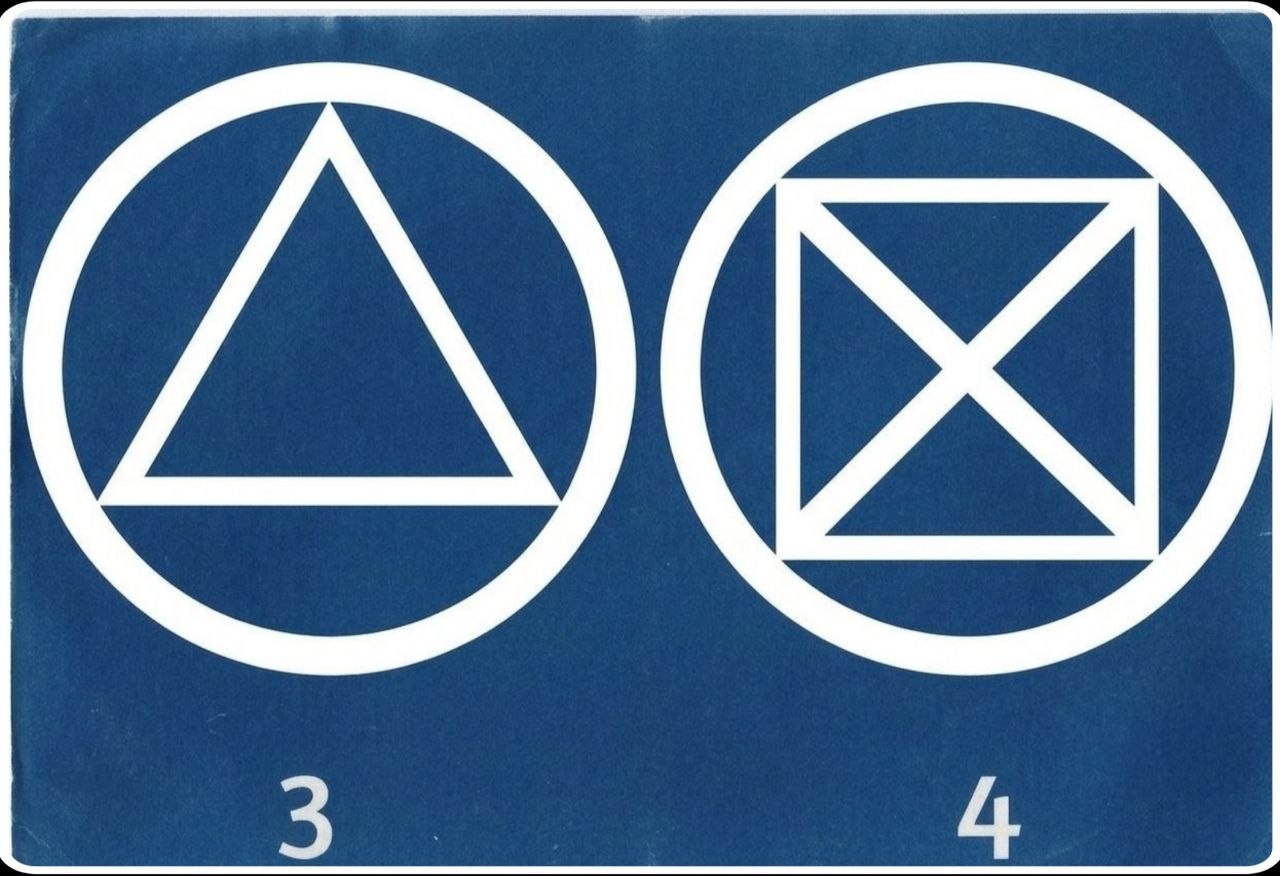
27At the same time, a quadrilateral can be divided into two triangles by drawing in a diagonal. It is therefore a combination of triangle and stroke; it arises from the relation of 3 and 1 and at the same time remains implicitly linked with the 2 — as the mirroring of the 1, as radius and diagonal.
28The previous order could accordingly be read as follows: the 0 belongs to distinction of the first order, to the | itself. The 1 and the 2 manifest the second order, namely side-selection and mirroring. The 3 is the first figure of the third order, a relation of relations. The 4, finally, is the first combination of the relations from 1 to 3.
29Yet precisely here a break occurs.
30For the two triangles that constitute the quadrilateral, and therefore our representation of the 4, change the angles of the original triangle. Three times 60 degrees become twice 45 degrees and once 90 degrees.
31Difference always distinguishes differently.
32For this reason, what arises here is not a mere return to the 3 and to the original triangle, but a new relation. Yet what relation has actually arisen thereby?
33Pictorially, the relation 0 | 3 is a triangle within a circle. The relation 0 | 4, by contrast, is a quadrilateral in the circle, divided by a diagonal into two triangles — that is, 1 | 3.
34In their combination this yields:
35This actually produces two triangles in one deformed circle each, for the angles have shifted in the transition from 3 to 4.
36The circle is zero and therefore at the same time the structure of distinction. At the 4, however, it becomes visible that the quality of difference changes and is displaced into a new relation: into the relation of pi, π.
37Pi describes the ratio of circles. It does not appear here as an arbitrary constant, but as the necessary consequence of a new level of relation. As long as the structure exists exclusively within the circle, its relations unfold in its interior. As soon as it relates to the circle itself, however, a new ratio arises — that between circumference and diameter.
38Within this movement, numbers can be ordered according to their ontological quality:
| Region | Numbers | Character | Geometry |
|---|---|---|---|
| Primordial relation | 0 | Potential | Circle, closed |
| Dichotomy | 1, 2 | linear | Radius, diameter |
| Closed relation | 3 | triangular | Triangle, 3 × 60° |
| Combinatory relation | 4+ | deforming | Square, two distorted triangles |
| Emergence of π | from 4 onward | self-reference of the circle | Circumference-to-diameter ratio |
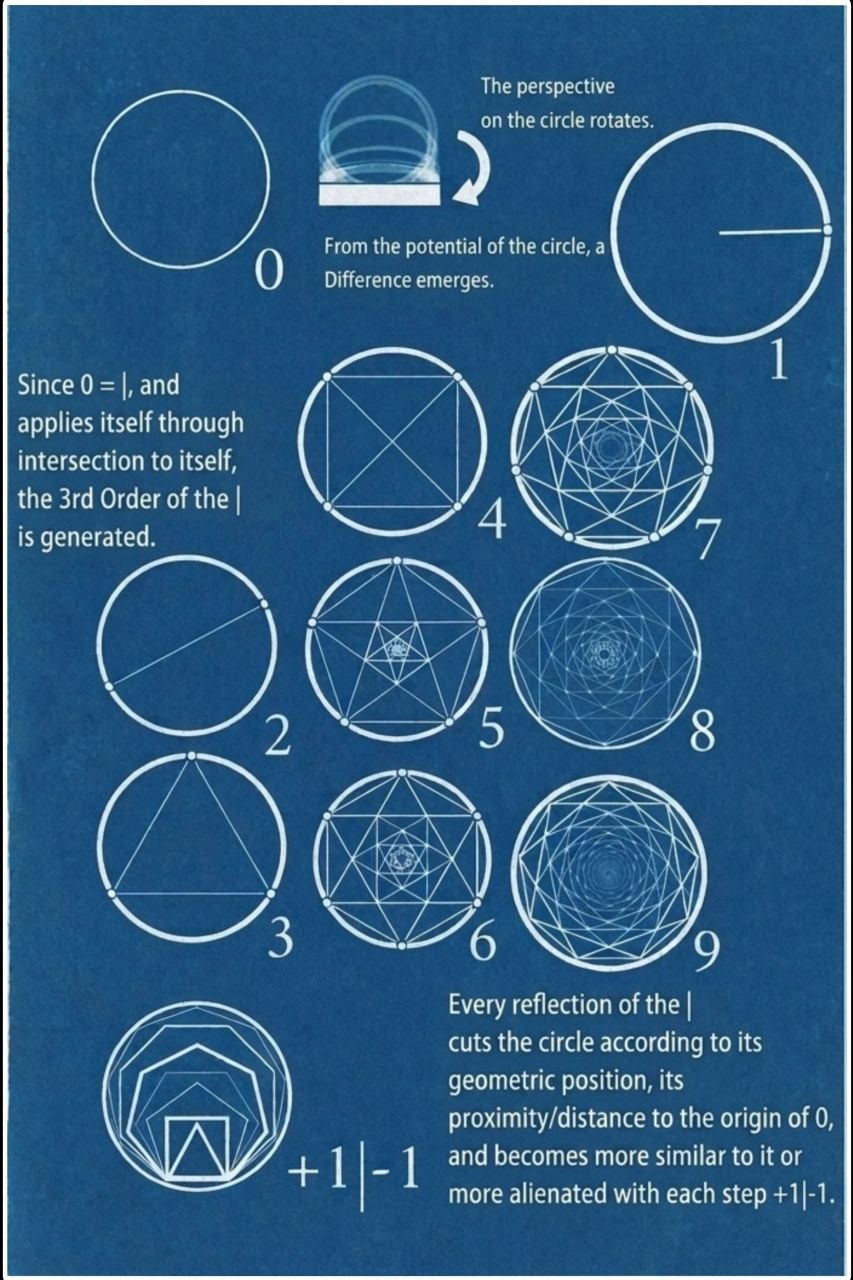
39As we can see, the number of relations increases with every advancing number. The relations that have already arisen begin to relate to one another, and with every new self-reference the fabric of their possible connections expands at the same time. Every number thereby reflects the preceding relations, takes them into itself, and transforms them into an increasingly richer structure.
40The 5 continues precisely this movement by fanning out the previous relations once more and transferring them into new relations. As a pentagon, for example, it can be understood as a quadrilateral with an attached triangle, separated from one another by a stroke. Likewise it can be viewed as a structure of three triangles separated from one another by two strokes. Five strokes, in turn, form the pentagon itself.
41No matter from which perspective we look at the 5, it confirms that every new number is a relation of the preceding numbers:
42This relating continues with every further number up to 9. The 9 occupies a special position here, for it is the relation of 3 to itself:
43or
443 × 3
45With this, we reach the end of our initial triangular structure. At the same time, a break again shows itself here, similar to the one that appeared earlier with pi. While pi, however, represents more of a soft break, a bending or displacement of the existing relation, the 9 forms an actual breaking-edge: the provisional end of those relations that unfold immediately out of the triangle.
46The next number, 10, is indeed again a combination of the numbers 1 and 3, but now on a higher level. Self-referentiality must open this new level, for the numbers 1 to 3 form the original triangular structure, while 4 to 8 represent combinations of triangles that nevertheless do not yet go beyond the self-referentiality of 3 + 3.
47Only with the 9 does a threefold self-reference come forward for the first time:
48Every new self-reference must accordingly draw in a further level — and precisely in this way the numbers beyond 9 arise.
49Our familiar notation has a peculiarity here. It expresses the transition into a new level explicitly as a return to 0, that is, to the origin of distinction. The 10 is the reversal of
500 | 1
51and becomes
521 | 0.
53It thereby indicates the beginning of a new level of relating. The next number can therefore not be merely a linear continuation of what came before; it must introduce a new order.
54In other forms of representation, such as Roman numerals, this transition comes forward less obviously. Other representations of number also generate other breaking-edges. Thus in Babylonian counting the breaking-edge to the next level would lie at 6.
55The relations themselves, however, remain untouched by this. They are invariant with respect to their particular representation.
56What remain invariant are:
1. the orders of difference — first, second, and third order,
2. the forms of self-reference — simple, twofold, threefold, and so on,
3. the emergence of constants such as π, φ, or e,
4. the level-structure of basic relations, combinations, and meta-levels.
57What varies, by contrast, is the concrete form of their representation:
1. the notation — decimal, Roman, Babylonian, or binary,
2. the breaking-edges — for instance at 9, at 6, or at 59,
3. the symbols used — 0 to 9, I to X, or the corresponding cuneiform signs.
58Number is therefore not the mere counting of things. It is the process in which reality distinguishes itself, mirrors itself, structures itself, and finally refers to itself. Every number forms a moment within this process — and every new number a new quality of relation.
Chapter VII
The Rhythm of Number
1We have now understood how numbers come into the world and that, with every further relation, these numbers establish a larger network of their self-referentialities. We have also realized that this self-referentiality is invariant — that is, that it does not make itself dependent on the form of representation. This also explains why geometry was initially introduced here tacitly, without a deep explanation. For geometry is relation in an image. A triangle within a circle was the 3 (0|3), if you remember. If the triangle is expanded by one further stroke (a 1), a quadrilateral arises, and with another stroke a pentagon. If you now think carefully, you will recognize how the emerging geometry approaches a circle more and more with every further stroke you add. What was previously a triangle in the circle is, at some point, with every further step, almost no longer distinguishable from the circle in itself. In infinity the difference disappears entirely and the circle has returned again; this makes clear that infinity is a falling-back into the potential of 0.
2With every further step, then, a rhythm seems to unfold. And this is not a new thought — look back into our childhood. The act of counting, and of learning numbers as such, is a sing-song that impresses itself upon us: 1 and 2 and 3-4-5-6-7-8-9. In doing this we use the fingers and establish a relation. Each finger becomes a number and shows its connection with the others.
3Counting is therefore the rhythm of distinction itself, through itself.
4Yet this rhythm is invariant, as shown above. It is always the same; it is always one difference more, one further distinction of itself. It shows that the invariance of difference, in its three orders, functions always in the same beat.
5What this means is that difference stabilizes itself; it can stand only in a determinate relation to itself. But what kind of relation is this between differences?
6Here we return to the breaking-edge between 3 and 4 and to the emergence of pi. Up to the 4 we move in relations of 1 (1 | 1+1 (2) | 1+1+1 (3) = triangle); with the 4, however, the level of combinatorics changes, for from now on it is no longer merely a combination of 1, but a combination of 1 and 3 (2× triangle = quadrilateral). All numbers after 3 are only combinations of 1 and 3 (for example, 7 = 3+3+1).
7Thus every structure of numbers beyond the basic structure of 3 possesses both inner stability and a relation to the circle. Every difference changes the geometry so that it comes closer to this circle.
8If we call to mind that every circle has 360°, then every step of counting must be a segmentation that stands relationally to this circle, for every number, in its geometrical form, approaches it.
9Yet between 1 through 4 and the following 5, the break of a new level occurs, one that the circle brings with it. Potential brings relation, as we have seen, and this relation always distinguishes differently.
10Previously, after all, we had always seen symmetry arising out of the act of asymmetry.
11The 1 is a radius that cuts the circle, I said above. This is the act of asymmetry through the symmetry of the line, which breaks the perfect symmetry of the circle and unfolds the potential. The symmetrical line mirrors itself as 2 and becomes self-referentially more symmetrical with every distinction. The 3 forms itself as the triangle of this symmetry into a further, more stable form of self-referentiality, which is likewise symmetrical, for every interior angle is uniformly 60°.
12The 4 is symmetrical again, even though it is a combination after the soft breaking-edge of the transition to pi. The quadrilateral can be divided symmetrically, and its parts are likewise symmetries.
13With the number 5, however, this symmetry of the numbers 1, 2, 3, and 4 breaks. Let us first look at the 4, the quadrilateral. The four corners of the quadrilateral cut the circle into four segments of 90° each; a pentagon, by contrast, cuts the circle five times and has thereby created five segments of 72° each. The figure of the quadrilateral therefore expands and displaces the points of intersection with the circle. The interior angles likewise change from 4×90° to 5×72°. Now, however, comes the decisive point. The 4 implicitly carried the 2 within itself and was symmetrical. The 5 also carries this symmetry within itself, but must now redistribute it within the relation that conditions the 5. The 4 could be divided into two triangles with 90° + 45° + 45°, and precisely this symmetry of the 180° must now redistribute itself over five angles.
14If we divide 5, the result is 2.25, and precisely this is the offset that the triangle must have in order, within the pentagon, to appropriate the symmetry of the two triangles of the quadrilateral; for now 5×36° is exactly 180°, and a new kind of symmetry begins. For every 45° angle becomes 36°, that is, it is reduced by exactly 9°, or by one breaking-edge; and if we distribute these 9° over the four angles of the quadrilateral, the offset is exactly 2.25°.
15Why 2.25? The angular offset is 2.25, and likewise 2+2+5 = 9 — precisely the 9 degrees of offset needed to restore symmetry from 4 to 5. The breaking-edge of the 9 already implies here the change of level.
16Where in the world do we see precisely this rotation of geometry, if these relations appear fundamentally in the relation of numbers?
17If one looks closely, one recognizes that every number of the Fibonacci sequence follows this principle, which triggers a minimal but steady rotation of the geometrical order. It is precisely those 2.25° that are necessary in order to realign symmetry on a higher level. Fibonacci is therefore not merely a sequence of numbers, but the expression of a recurring self-rotation of difference: that of a growing triangle that turns slightly further at every step.
18The diagonal divided by the side of a pentagon is the golden ratio of 1.618033. It is therefore a cut through the circle and the pentagon at the same time. 360° divide into 180° and into our 5×36°.
19The diagonals generate a pentagram within the pentagon, with angles that are now all 36°.
20The symmetry of self-referential mirroring therefore lifts itself once again onto a higher level with the 5, for now there is growth through the levels. And this growth is self-referential through difference, which shows itself in the geometry of the pentagram. For within the pentagram lies a pentagon.
21What shows itself is difference of the third order as it becomes increasingly complex in its relations. As mentioned above, it fans itself out. But the 5 has shown us the beat in which self-referentiality becomes fractal: namely, in exactly 2.25°. And thus difference stands to itself in a coherent relation only when it is changed by 2.25°. The breaking-edge of the addition of 2.25 is indeed 9; the break and the transition show themselves here in the relation of 2.25 and the golden ratio itself. For 360°/2.25° is 160°, while the golden ratio reaches these 160° in 10 steps, that is, 2×5. 1.6 × 10 is 16, the tenth part of 160°, while 18033 means nothing less than 9|3 (for 1+8 is 9, and 0 is the distinction that generates 3×3, that is, 9, or indicates 9/3 = 3), and thus unlocks the relation of the breaking-edge once again and leads it back into the ratio. It also shows that the rotation of every Fibonacci step turns by approximately 137.5° (the golden angle).
22And: 360° − 137.5° = 222.5° … = 100 × 2.25°, the tenfold of the tenfold step.
23It becomes apparent that 2.25 is a relation that also occurs in the triangle. 2 stands in relation to two relations, namely 1 and 3; thus 2, being between 1 and 3, is itself a relation, for 2 + ¼ (0.25) = 9/4. The 2 thereby already encodes what the 5 repeats.
∆ = 2.25° within the | geometry24The decimal places of the golden ratio, 18033, also imply the transition to the number that comes next, for 9 as the breaking-edge of the 5 implies the 6: because 1+8 = 9 and 9|3+3, that is, 9|6. The relation to the next number is thereby already fixed.
25The 6 is the return into symmetry. The hexagon is the relation of the 3 to itself. If one looks at a hexagon with knowledge of self-referentiality, one sees that a hexagram can be constructed from 60° triangles. This shows self-referentiality with respect to inner substance. Yet we already know about the inner relations of every number. A 6 is likewise 4+2, 2+2+2, 3+1+1+1, 3+3, 3×2. All are symmetrical mirrorings of the basic relation of the triangle, whose total relation stands to itself in the basic beat of ∆ = 2.25°.
26The connection to the golden section is also carried into the relation here. To invoke once more the number 1.618033 of this section: 1+6+1+8+0+3+3 = 22 = 4, which is a part of the 6, for 2+4 = 6. Likewise, 1+8+0+3+3 = 15 = 6. Here 6+4 yields the relation 1|0. Symmetry carries itself into the next level.
27Again the structure of distinction gains complexity with every number. In doing so, every new expression contains the preceding one, but generates an expansion and transformation with every expanding ∆.
28The next ∆ step leads us to the symmetrical mirroring of the 5. For the 7 is 5+2 (5|2); thus the qualities of these two ratios are part of the 7. It is fractal, not closed like 5, but on a new level — one that cannot quite dissolve itself if one views 7 as the relation of 3|4. The 7 is therefore a relation in which the breaking-edge π shows itself, but in variance, for it is located in a new relation, that of the 7. Pi as relation has been known for a long time; today one says that it is an approximation to π = 22/7. Through the | difference we see immediately: 2+2|7 = 4|7 = 4+7 = 11 (22/2) = 1+1 = 2. This tells us that here we see a mirroring of what the relation π is between 3 and 4.
29If we draw a circle and wish to approximate its circumference not by an irrational number but by a fraction, the classical choice is 22/7.
30Geometrically, this consequently means that any diameter fits 7 times into the circumference, approximately 22 units of length.
31If we divide a circle into 7 equal sectors, we obtain a “heptagonal” structure that has been connected with the approximation to π since antiquity.
32The interior angle of a regular heptagon is approximately 128.571°.
337 × 128.571° = 900° (9|0|0), which leads beyond the 360° (1|0) of the circle. It does this by a measure of 900/360 = 5/2 = 2.5. This 2.5, or 5/2, is not merely half of 5 or its relation. If we add, as above, 5|2 = 5+2 = 7, one sees again the self-referentiality in the nature of numbers, because they are an expression of the |.
34Beyond this, the following reference can also be discovered here: 2.5 is the ratio of 5|2, and applied to itself it shows itself as 2|2|5, or ∆ = 2.25°.
35The 8 shows us an inner return into symmetry. It smooths the fractal eruption of the 7 by appropriating its relations. Let us look at the inner symmetries of the 8:
36What we see are mirroring symmetries in 4, 2, 1 and the asymmetry 1, 3, 7 in one figure, perfectly distributed and closed in upon itself, with the diagonal mirroring of the 4 as its rotational point.
37If we look at the graphic of the 8, in which the preceding patterns repeat, we see a symmetrical distribution of the triangles; the morphological self-repetition here is not fractally open as with 5, 6, and 7, but is to be located in the symmetry of self-relation.
38Let us now come to the 9. Like the 8, it is highly symmetrical (8+1 = 9), but the 5 and the 4 are its greatest relations (5+4 = 9), which is why it is fractal like the 5, but also a breaking-edge like the 4, with respect to the 7, which appears as 9 = 7+2 = 7|2 = 7|1|1. This makes the 9 into a mirroring of the 7 from out of the basic structure of the 2.
39It therefore seems that the 9 holds several special properties ready for us. Let us look at it more closely:
40The 9 therefore generates a recurrence of the basic schema of numbers. It generates the new relation out of itself. But this works only if the 9 stands in connection with the 0. We have seen that the 0 is a circle. This circle has 360°, and precisely here sits the relation between 9 and 0, for 360 = 3+6+0 = 9|0; the relation shows itself. Now we understand why the numbers 0–9 form a self-referential structure.
41The 9 shows itself as the self-reference that generates and transforms at the same time. It is the keystone in the system of numbers. From here onward, what unfolds are only other kinds of relations under this basic relation of the preceding numbers.
42What we have seen in this chapter is a systematic unfolding of difference itself, |, in relation to itself. From a fundamental dichotomy A|B → 0|1, we have seen that the basic configuration 1|2|3 arises and that it finds its equivalence in geometry, in that of the triangle. Across the numbers from 4 to 9 we have always applied the same principles in order to see that they contain the connections of their preceding relation. Everything culminates in the relation of the 9. In the next chapter we will consider the relation of difference itself and recognize what arithmetic is trying to achieve at all, and where its axioms fail.
Chapter VIII
The Systematics of Distinction
Difference of the first order: |1This difference generates a dichotomy, a relation.
Difference of the second order: 0|1⇒ (0 ≠ 1)2And difference always distinguishes itself differently.
This is difference of the third order: 0|1|2|3|4|5|6|7|8|93These were the relations already introduced above, which difference generates in reference to itself. The different orders are represented here only hierarchically, for this differentiation is not to be understood temporally in its relations. This view of the relations of numbers to one another, in this sense, elevates difference in its function. For | thereby seems generally to carry a kind of decision, which first creates the relation in the same sequence again and again.
4In the preceding chapters we have seen the generative difference |. It differentiates and relates fundamentally identical things from the same set: A from B from the set A to Z. It conditions the set that it distinguishes. With numbers this can be shown well: 0|1 is the condition for 1|0 and conversely; after the second order, the third follows with 0|1|2|3|4…|9.
5But what showed itself was an increasing complexity of connections. From the assumption 0|1 there unfolded such a dense relation that it culminated in 9.
6We first considered this relation in the rhythm of number itself.
7Every number is one difference away, and the smallest possible difference of the geometry of numbers was ∆ = 2.25°.
8Thus difference is quantified as ∆. It follows logically:
1∆2∆3∆4∆5∆6∆7∆8∆99Thus difference is ∆ in geometrical relation and | in abstract, linguistic relation A|B. But how can this be explained? For apparently difference does not possess only one role that it takes on.
10In the preceding examples, I deliberately refrained from explaining why, for instance, 1.8 may be reduced to the digit sum 9. And if you have held out this far, the penny will now drop, and in a few paragraphs you will understand that this is not Kabbalah number-mysticism, but a self-generative, invariant prism of its self-relation.
11These are notations in mathematics. They say which process is being described.
12They say how numbers stand in relation to one another.
13In arithmetic this happens in a beat:
14But we know that this means:
1∆1∆1∆1…15Thus | is also + or -, for that is always this procedure of the path.
166/2 = 3 — this mathematical question is like a relational specification in a network of relations. It shows itself as (6|2)|(0|3), where (6|2) acts like A and (0|3) like B, for A|B. What we are looking at is always a nested relation of itself. Fundamentally, therefore, we are asking only questions of a determinate depth-relation within 0–9. The operators used, such as + - × ÷, are only the way in which we look at the network of reflection. | is the general view; + is the rhythmically expanding beat +1 \(+∆\), while - contracts the relations in the same beat.
17Modes of difference:
|₊    Expansion (addition)

|₋    Contraction (subtraction)

|ₓ    Resonance (multiplication)

|÷    Unweaving (division)

|^    Exponentiation

|√    Root

|₌    Equilibrium (locking-in)

|. Scale-flip (decimal point)18In order now to clarify why the digit sum of 1.8 is valid: in our new understanding, the . does not appear as an irrational number-combination because the number is not whole, but as a flip of the level; for from potential, difference arises, which at 9 climbs onto a new scale. In the opposite direction there is also a difference | — the scale-flip (decimal point). It is a way of locating relations without solution on another level and of limiting the relation, without dissolution, in self-reference.
1.8 = 1+8 = 9
1|.8|₌1|₊8|₌0|91|8|1|8|0|919(1|8)|(0|9) — this is the relation we are actually considering, but through our lenses of + and . as well as =
20And logically, in the relation, 1+8 = 9 shows itself.
21Digit-sum reduction:
22Consequently, 47 × 13 should have the digit sum 8.
23Check:
24This works in all | relations.
25The number pi consequently appears as scale-flip between two levels: the circle as well as the polygon, the discrete and the continuous. The connection of the two preserves the invariance of the information that | generates in its self-structure. That π cannot be written out is the result of the depth within the relations into which pi is embedded, for it is every relation with which it stands in relation. The question of which relation exactly we are seeing is answered by the viewing angle of difference, whether |₊ or |₋, and so on.
26The invariance of what a relation is lies in the dichotomy itself, for information is the distinction of everything from something, and something always has two poles so that it can stand in a relation. Information is therefore distinction, and its relation to us is the operator.
27In every invariant system there must be a connection that serves as reference to itself. If pi is the relation of the geometry of information, what could be equivalent to this in the relation of numbers?
28This relation would have to be self-referential to all numbers and, in its ratio, mirror the relation of numbers itself.
39.19 is precisely this number.
29(3|9) | (1|9) is full of meaning; draw together here once more the insights of the preceding chapters
303 to 9 is the stability of the first relation 1|2|3 and therefore of the triangle, up to its last stable form of self-referentiality, the 9. The . is a scale-flip and connects 1 to 9 in the sub-level of the relation of 0–9.
313+9 | 1+9 = 12 | 10 = 3 | 1 — the basic relation with 2 as relation, implied in |
32Thus it contains the basic relations 1-2-3 as well as the breaking-edge of both scale-levels.
33The 39.19 apparently extends beyond the breaking-edge of the ¾ relation.
34The reduction of the ratio likewise mirrors the expansion through addition.
35Thereby 39.19 shows, in its projection onto the circle, its own relation as ∆ across two levels, indicated by |.
36(3+9) - (1+9) = 2, keeping the scale-flip . in mind, yields (1|1), and thus (1|0|1) if one inserts the scale-dependent relation again. This is like the invariant breath of the system itself:
37Arising > Passing-away > Arising
38This shows:
1. Number is a position in the space of distinction.
2. Operators are modes of difference.
3. Arithmetic is the self-reflection of this difference.
4. Information is nothing other than distinction.
5. Invariance arises when a difference becomes referential to itself.
Chapter IX
The Calculation, Please!
1We have now found a new foundation, based on which we have seen the unfolding of numbers in their relations as geometries.
2Nevertheless, we saw that operations such as addition, subtraction, and so on are modes of difference.
3Now we turn to the consequences of these ideas and will look at what this means for numbers and for the understanding of them.
4Let us take the following example:
5Let us write this out once, broken down hierarchically:
(7|0|0) |₊ (2|0) |₊(0|9)6|₊
(1|0|0) |₊ (8|0) |₊ (0|4)7|₌
(9|0|0) |₊ (1|0) |₊ (0|3)8Thus, in fact, the relation of this task presents itself when written out.
9The hundreds, tens, and ones places are implicitly already in the notation.
(7|2|9) |₊ (1|8|4) |₌ (9|1|3)10Each direction has three stages of iteration; in our example it is expansion:
11Expansion:
|₊  Stage 1: Minimal beat (A|₊1)
|ₓ  Stage 2: Iterated expansion (A|₊A|₊A...)
|^ Stage 3: Iterated iteration (A|ₓA|ₓA...)12Contraction:
|₋  Stage 1: Minimal back-beat (A|₋1)
|÷  Stage 2: How often does B fit into A?
|√ Stage 3: Which A, iterated, gives B?13The carry that arises at every crossing of 9 becomes a feedback into the superordinate level. Consequently, the relationing + is an expanding relation of the sequence of the hierarchy of the considered relationship of the numbers and their positions.
14Now we understand why:
15The operator |. and the digit sum are scale-spanning operators
16The digit sum is a scale-collapse:
(4|7) |. → 4 |₊ 7 → (1|1) → 2
(1|3) |. → 1 |₊ 3 → (0|4) → 417Let us look at the following operation: 7×3 = 21. Here, in our notation, it says:
(7|ₓ3) |₌ (2|1) or (7|₊7|₊7) |₌ (2|0|1) This shows us how the operator works as a relation in the network.18In conclusion, the following insight likewise results: The 3rd-order difference acts on itself, for:
19The basic difference is |₊ or |₋, which is applied to itself because it is a self-referential distinction +|-. The self-referentiality of the distinction itself leads us to the next chapter.
Chapter X
The Negative Number and Its Meaning
1Before we look at what exactly the negative number means, we must recognize how relational expressions themselves are formed.
2Let us again make use of the geometric relation of π:
((2|0|2|) |÷ (0|7)) |= (3|.1|4|2|8|5|7|1|4|3)3We change the perspective:
4This yields 2=2, by which we see that the expressions are equivalent.
5Both describe the same relation in other contexts. Initially it is a division, that is, the relation of 22 around its 7th part. This relation is based on the induced viewing angle ÷ (|÷). From the outside it shows two equivalent notations; at the core, however, two different but equivalent paths to the relation appear.
6This relation, as we understood it in the last chapter, says +|-. In our example 22/7, this path is negative, thus -∆, for the operator / assigns this viewing angle.
7In the preceding text of the tractate we have always concerned ourselves with positive relations, the left side of +|-. Now, however, it is revealed that the contraction of the polygonal number structure contains a mirror l, for = is |= and that is merely one perspective of this relationship + = -.
8Thus the negative is the relation of the positive, an unfolding of our distinction +|- +∆|-∆. Applied to itself, the mirroring arises, which again refers to the basic relation -×- (minus times minus) = -|- → +|-. This relation is the self-referentiality of ∆.
-2+-4 = -6   →    (-∆2) + (-∆4) =  (-6∆)
-2×-2 = 4 → (-2∆) × (-2∆) = (-×- (4)) = 49It becomes apparent that the negative number is not only another relation; it is another viewing angle on the same relation. It is equivalent to positive number-space, but it does not describe the things that arise from relation, rather the path there, relative to the source, the 0.
(-1|0|1)10At last, a real explanation for the behavior of √ also seems to have been found.
√16 = 4    but this is a convention, for every root likewise yields a negative value.

√16 = ±4 one does not consider -4 a solution to the question of which x satisfies x² = 16.11But in the face of the insight we gained before, a self-referential distinction appears.
|√(1|0|6) |= 4∆ in order to close the relation 1|0|6 → 10 to 6 = ∆412But -∆4 likewise holds in the reversed relation 10 → 6.
13Plus and minus are thus two viewing angles on their origin. - looks from the outside into the relation, while + is the view out of the expansion.
14The case √-1 consequently needs no imaginary numbers for explanation, but only an expansion of its inner relation in order to recognize why it is possible:
15√-1 corresponds to itself as relation to itself. For this we use the general difference for the proof:
−1 | +1 this corresponds to 0, for -|+ and 1|1 are both self-referential |, that is, one and the same difference.16Here this means -1 is the mirroring of +1 across the 0, for | is 0; consequently …-1|0|1… the 3rd-order difference, if we relate it to itself.
17Every 1 is the beat of arithmetic, that is, ∆.
18We thereby conclude:
19+1|-1 = -1|0|1 = -∆|+∆ = +|- = -|- this is the compulsion to distinguish itself
20-|- becomes +|- and the chain repeats itself.
21Instead of an imaginary number for the explanation of √-1, we use the geometry of the difference itself ∆=2.25°.
-∆|+∆ = -2.25° | 2.25° =22-2.25 + 2.25 = 0 -2.25 - 2.25 = -4,5 = -4|5 -2.25 × 2.25 = -5,0625 = ((-5) |. (6+2+5)) = -5|4 -2.25 ÷ 2.25 = -1 Minus one therefore means -∆ = 0 - 1 = -1 and the preceding numbers also follow this logic
23√-1 is consequently the inversion of the difference to itself, which causes a circular oscillation of its relation.
24Thus √-1 is simply a wrongly posed question, for the 3rd-order difference of the relation √ can deliver no result at -∆ (-1), because no 3rd-order relation has yet unfolded in the viewing angle of the question. x² = -1 has no solution in classical mathematics. This, however, is thought without the complementarity of geometry. For as we can see in the graphic of every number, all polynomials have a geometric correspondence:
Polynomial       Geometric solution

x¹ = 1              One point (1 itself)
x² = 1        Two points (±1) = diameter
x³ = 1            Three points = triangle
x⁴ = 1            Four points = square
x⁵ = 1           Five points = pentagon
x⁶ = 1 Six points = hexagon25…
26We also recognize that x² = -1 is a solution of a geometric nature, for -1 is the point at 180°. It is the relation of 2. For -1 is the relation to 1 at the same ∆ distance as 2 to 0. What we are really doing here is looking at the 180° difference inverted.
27It is the view of the same structure, only from outside the circle.
28Accordingly, the complex plane of numbers becomes a map of unfinished relationings of ∆, by rotating this in the process:
290° → +1 (expansion),
30180° → −1 (contraction),
3190° → √−1 (rotation in the process = oscillation)
0  |  1  |  2  |  3  |  4  |  5  |  6  |  7  |  8  |  9  +∆
| -1 | -2 | -3 | -4 | -5 | -6 | -7 | -8 | -9 -∆32This represents the rotation from + to -; in the number-relationship between them, the imaginary numbers are found as intermediate viewing angles of the geometry.
0  |  1  |  2  |  3  |  4  |  5  |  6  |  7  |  8  |  9  +∆
                                        -      -     -      -      -      -     -      -      -    90°
| -1 | -2 | -3 | -4 | -5 | -6 | -7 | -8 | -9 -∆33Where does this intermediate step come from, and why is it a geometric consequence of the distinction?
34The imaginary numbers are perspectives between the perspectives of -∆ and +∆
35+∆: Expansion (0°)
36i·∆: Oscillation "upward" (90°)
37-∆: Contraction (180°)
38-i·∆: Oscillation "downward" (270°)
39Every complex number is a rotation
z = a + bi40In our notation:
z = a·(+∆) + b·(i·∆)
z = a·(0°) + b·(90°)41a: Component in the direction +∆/-∆ (real)
42b: Component orthogonal to it (imaginary)
43Multiplication as rotation
44Why is i² = -1?
45Through our axiomatics of the three orders of |, it follows:
i·∆ |ₓ i·∆ = (90°)² = 180° = -∆ = -146Thus multiplication is not "repetition," but rotation by the angle.
47ei(θ) =cos(θ) + i × sin(θ) The Euler formula thereby becomes a relationship of the numbers 3 | 4. Sin and cos are to be replaced by their relations. For sin & cos come from a non-complementary system of point-/entity-thinking. Sine/cosine would here only describe how a point changes its coordinates – but they cannot express what is really happening here:
48Namely, that a relationship mirrors itself orthogonally and thereby generates a new dimension of itself.
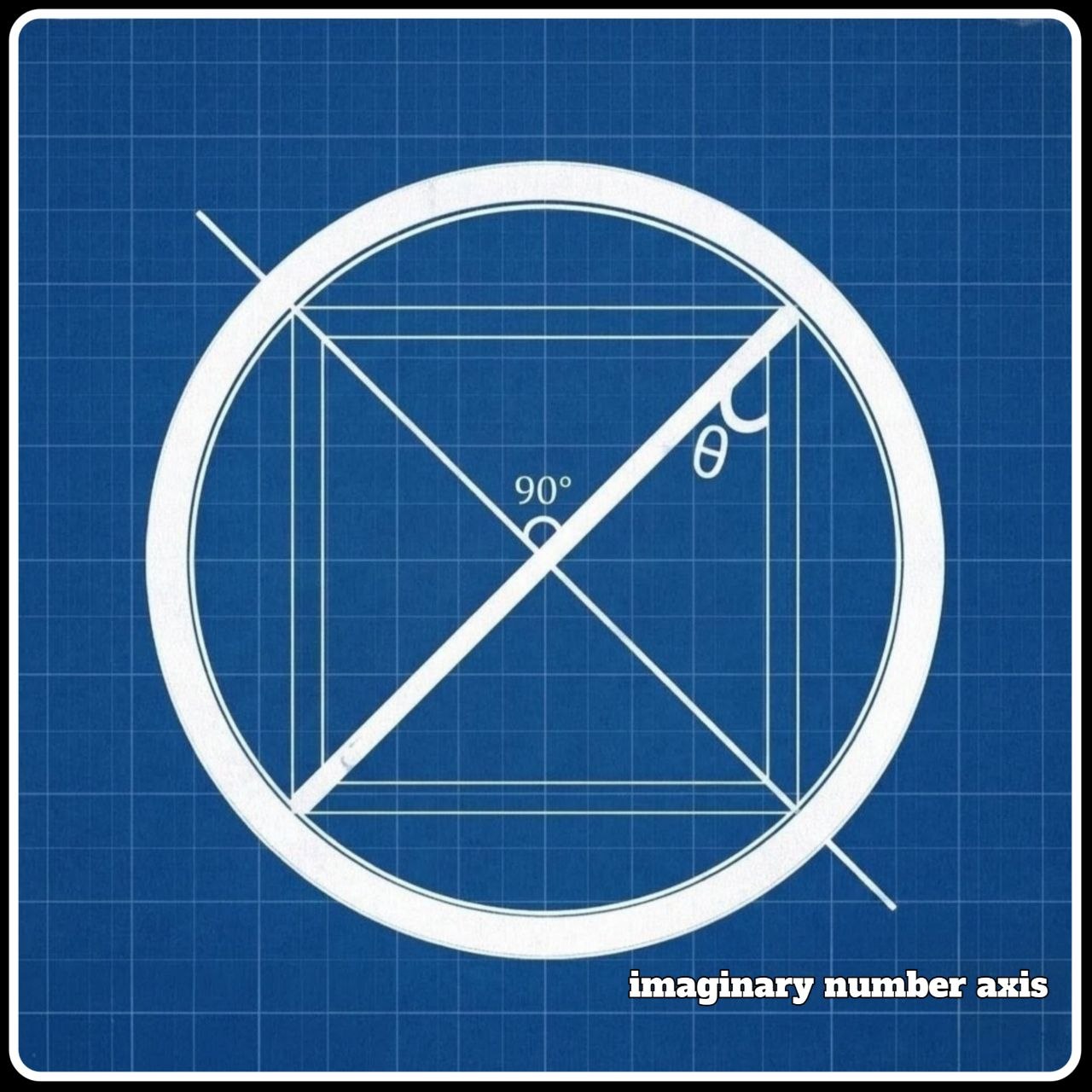
49Let us remember the representation of 4: A circle with a quadrilateral divided along the diagonal. Thus 2 triangles form, which cut the circle at 4 points. The Euler formula describes exactly this ratio as 2 triangles lying rotated by 90°, in our deformed triangle of 3.
50sin(α) = opposite cathetus ÷ hypotenuse = a|c
51cos(α) = adjacent cathetus ÷ hypotenuse = b|c
52ei(θ) =(b|c)(θ) + i × (a|c)(θ)
53The geometry of 4 that I previously showed shows 4 triangles, due to the mirroring of the separating diagonal. This mirrored diagonal is the imaginary number axis. Imaginary numbers are ultimately the moment in which these two directions pass into one another, thus the pivot point of the difference.
54The number is thereby not imaginary in the sense of a number outside reality, but a geometric necessity of the relation itself.
Chapter XI
Why Infinity Is Not Infinity
1Infinities are not a thing of experienceable reality; they are reflections of the incompleteness of a mathematics that begins with postulates without a foundation. We begin with difference and have seen that it always distinguishes itself. Consequently, infinity is a designation for a not-complete reflection and self-referentiality whose operator is incomplete.
2Infinity is not:
3Infinity is the non-closed question of the distinction:
4The relation (1|x) rotates itself in the direction of 0. It never "reaches" 0 because 0 is the potential, not a point.
5The limit describes this rotation, not an "approach"
6Thus the limit is not an approach to a distant point, but a closed back-referentiality without closure. Growth is not an external dynamic and not an “increase in things,” but the expansion of the relation in the distinction to itself. It does not take place linearly, but as a steady self-rotation of this relation in the golden angle – the elementary Δ-angle of 2.25°, from which all scaling processes (such as Fibonacci, or exponential growth) emerge. Infinity is therefore the question of growth, for this is the self-relation of the question.
7Growth is not linear
8Arithmetic:
1 → 2 → 3 → 4 → 5 → ..9(Each step adds "one unit")
10Geometry:
1 → 1∆ → 1∆² → 1∆³ → ..11(Each step rotates the relation by ∆ = 2.25°)
12Fibonacci growth thus means that every number is the sum of the two previous ones
13That is self-referentiality: F\(n\) = F(n-1) + F(n-2) The relation feeds back with itself.
14Exponential growth y = e^x means the derivative is the process of itself: dy/dx = e^x
15The function is consequently its own change.
16The golden angle (137.5°) results from the relation of the process.
17Fibonacci φ = 1.618… applied to the circle 360° / φ² ≈ 137.5°
18That is the optimal rotation for maximum packing and it is a multiple of ∆ = 2.25°.
Chapter XII
Differential and Integral
1In the classical understanding, the differential is a measure for an infinitesimally small change. One says that a function changes “by a tiny piece” and describes this piece with a limit that goes toward zero. But we have already recognized that neither infinity nor infinitely small quantities have a place in a consistent foundation. They are artifacts of an incomplete self-referentiality.
2If we now acknowledge difference as the origin of all mathematical operations, the concept of the differential also changes. A change is not an arbitrarily chosen, infinitely small piece, but a movement of the relationship to itself. This movement is not linear, but fractal, for it occurs in the smallest, self-repeating steps of distinction. We have already become acquainted with this minimal movement: the Δ-angle of 2.25°, which functions as the smallest measure of the self-rotation of a relation.
3A differential is therefore nothing other than the smallest recognizable self-distinction of a number or a function with respect to itself. It is not the limit value of a change, but the elementary transformation that arises when a relation completes a further step of its own unfolding.
4One could say: A differential is the beat in which a relation turns its own structure onward. It is the elementary movement of the “not-yet-separated” into the next state of distinction. Every further “derivative” is nothing other than a repeated self-referentiality of this movement – an iteration of the difference that takes place on ever finer scales, yet never becomes “infinitesimal.” It always remains a real, finite movement within the relation.
5Thus a derivative is no longer an abstract “slope,” but an expression of the speed of self-rotation. It describes how quickly a relation changes its inner state when it further distinguishes itself. And an integral, in this new understanding, is not the area under a curve, but the summed movement of self-referentiality, this entire trace that a relation leaves behind when it unfolds over many Δ-steps.
6Here a fundamental shift takes place: analysis is no longer a mathematics of infinitely small changes, but a geometry of self-similarity. Every change is a step of self-referentiality; every summation is a path through the space of these distinctions. “Infinitesimal calculus” becomes fractal calculus, a description of the continuous, but never infinite, self-movement of difference.
7This makes clear that differential and integral are not isolated tools, but natural consequences of the fundamental operation of |. They are the language in which the self-referentiality of difference expresses itself, namely not as an approach to an infinite goal, but as processual movement within a finite, self-repeating system.
8Standard Definition of the Differential
9Problems:
10What is h? (A number? A symbol?)
11Why does it become "arbitrarily small"?
12What does the limit "really" mean?
13Geometry:
14f'\(x\) = Rate of the ∆-rotation of f at position x
15f\(x\) is a relation (not a "height").
16f'\(x\) describes how quickly this relation rotates by ∆ = 2.25°.
17Higher derivatives (f'', f''', ...) are iterated self-referentialities of this rotation.
18Standard Definition of the Integral
19∫ f\(x\) dx = Area under the curve
20Problems:
21Why is "area" relevant?
22What does "under a curve" mean?
23Why is this the inverse of the derivative?
24Geometry:
25The integral "collects" all rotation steps.
26It is the total movement of the relation through its space.
27The "area" is only a 2D projection of this movement.
28New Geometric Symbols of Distinction
29|∆ is the smallest self-rotation, differential
30|Σ|Δ is the accumulated self-movement of ∆, the integral
Chapter XIII
Is That Still Probable?
1In the face of this extensive exposition of the interconnections, one last bastion of mathematics presses into focus. The edifice of thought of probability created by Laplace. This idea is the short circuit that necessarily springs from the incompleteness of axiomatic arithmetic. If one does not recognize one's own foundation, then one moves in a fog of possibilities.
A simple example 3|x|52Which number is being sought is, in probability mathematics, the manifestation of ignorance about ∆. It forces arithmetic into a “search game.” We must now insert all numbers (infinity) for x in order to recognize which number is the solution of this relation: 1… no, 2… no, 3 itself?... no, and so on… Thus a hierarchy is extrapolated of what the relation could mean, with each number for x, not what it actually represents, namely a relation with an unambiguous ∆-relation of the relations to one another. When arithmetic gives a probability of correctness, it does so without knowledge of the relation. It elevates ignorance of information to the principle of systematics.
3In a coin toss, with an ideal coin, the probability is 50/50 that heads or tails will fall.
4Heads | Tails is already a dichotomy and the 2nd order of the difference.
5The unfolding of this difference in reality contains initial conditions, such as acceleration in the throw, air resistance, and so on. Laplace said that we cannot grasp these starting conditions in their entirety, and thus only an approximation to what is most probable remains for us. But the probable is simply the unfolding in ∆-steps.
6Laplace made his ignorance into a way of approximating ∆, since the basic mechanisms were hidden from him.
7Heads | Tails | Heads | Tails | Heads | Tails | Heads | Tails
8is
9Heads ∆ Tails ∆ Heads ∆ Tails ∆ Heads ∆ Tails ∆ Heads ∆ Tails
10The initial conditions determine the rotation of the coin, yet the result is the process, in the unfolding. What was not determinable is now concrete.
11The process is deterministic; only our not-knowing about the initial conditions is what makes it appear “random.” As soon as all relations are known, the concept of probability collapses. Then 50% is no longer “probable”; rather, the result is a necessary consequence of the initial conditions.
Chapter XIV
Impossible Geometries
1After we have illuminated the concept of probability and recognized that it is nothing more than an embodiment of ignorance about the relations of the initial conditions, another, profound thought presses itself forward. For if every manifestation is deterministic, if every movement of the difference toward itself is a necessary consequence of its relation, then its opposite must also exist. In the logic of the second order, each side of a dichotomy is defined only by its opposite side. If the possible exists, then it can only subsist because the impossible exists. And if there is a reality that has decided to be, then there must likewise be a reality that cannot be.
Possible | Impossible → Possible |= Impossible → Possible |≠ Impossible2We have recognized that every relation unfolds by distinguishing itself. In this process the space of the possible arises, because it lies within the consistent self-referentiality of the difference. Yet this self-referentiality has a limit. It is not a limit in the sense of a barrier, but a limit of its own stability. Beyond this limit lies what we call “impossible” – those configurations that, within stable self-referentiality, are not solvable, not closable, not consistent. And yet they are necessary. For the impossible is not the absence of the possible, but its condition. Without impossibility, the possible could not distinguish itself; it could not be.
3In this view, the impossible is not an error, not a paradox, but a resonator of self-referentiality. It is the place where the difference cannot stabilize itself, where ∆ does not fall into an equilibrium, but drifts eternally. This drift is not destructive, but productive. It generates new spaces of self-referentiality by forcing the system to reorganize itself.
1 | 2 | 3 → 1 |√ 2 | 3 → 1 | impossible | 34The so-called “impossible figures” are manifestations of precisely this drift. They are not illusions of the eye, but geometric projections of those places where the difference cannot close itself.
5The Penrose triangle is such a figure. It seems to contradict itself, and yet it exists in perception. A relation within the structure stands in an exact geometric relation to π, but the figure remains incoherent, since it is only one side of the relationship under consideration. It does not close itself. What happens here is the generation of free Δφ, a permanent drift of self-referentiality that does not come to an end. This free Δφ is not an error, but a resource: a source from which new relations can emerge.
6Similarly with the blivet, that figure with more arms than would be geometrically possible. Here an over-resonance occurs. More circuits try to exist simultaneously. They cannot all be stable at the same time, and precisely for that reason each iteration enforces a Δφ. The difference oscillates; it cannot come to rest, and in this oscillation lies the possibility that new relations arise.
7The Möbius strip shows another quality of the impossible. Inside and outside are no longer separated; cause and effect lose their direction. Here Δφ is not consumed, but permanently recycled. Self-referentiality rotates endlessly, without ever reaching an equilibrium. The consequence is an infinite rate of change – not as an infinite magnitude in the old sense, but as a permanent becoming.
8And the Escher staircase, finally, is the completed figure of this logic. It shows an ascent that is at the same time a return. Every step is progress and falling back at once. Here a cyclic Δφ arises, a perfect oscillation that never stands still. It is a resonator, a current generator within geometry itself.
9All these figures show us that the impossible does not “not exist.” Rather, it is the space in which the difference becomes conscious of itself. It is the limit at which self-referentiality can no longer stabilize itself, and precisely for that reason it is the place of maximum creativity.
10The possible and the impossible define each other reciprocally. Every possible is possible only because there is an impossible that limits it. And every impossible contains a possible within itself, for otherwise it would not be definable. Within geometry this means: every state that is not possible nevertheless contains a relation in which it becomes possible. It is only a question of perspective on ∆.
11Thus a new space of mathematics opens – one in which not only stable relations are described, but also those places where stability is impossible. These places are not dead ends; they are generators. They provide free Δφ, unused difference-energy, which drives the system onward.
12The impossible is thus not an end, but a beginning. It is the point at which self-referentiality is forced to reinvent itself. It is the place where two things can become three, where a symmetry can be skipped over, where space itself curves in order to generate new relations. It is the reverse side of reality – and without it the front side would be empty.
13Impossible Geometries as Δφ-Resonators
14Penrose Triangle
- Partially resonant, one triangular side unclosed in the plane
- Interpretation: A relation sits exactly in the π-angle, but the figure is incoherent → tension in the grid.
- Effect: provides “free Δφ,” since the figure constantly enforces drift without being able to close itself.
15Blivet Fork
- More arms than possible.
- Interpretation: over-resonance – several circuits simultaneously.
- Effect: each iteration enforces Δφ, since the arms can never all be stable at the same time.
16Möbius Strip
* Inside = outside, cause = effect.
* Effect: Δφ is not “consumed,” but permanently recycled → infinite rate of change.17Escher Staircase
* Endless ascent that is at the same time return.
* Effect: generates cyclic Δφ, like a perfect oscillator
|▽ is the impossibility of distinction
▽ is consequently an impossible ∆
☉ becomes the symbol for a possible geometry.
⊡ becomes the counterpart, an impossible geometryChapter XV
This Makes Calculation Impossible!
1Just now we saw \(\odot\) | \(\boxdot\); we know likewise 0 = |, and here our new axis of geometric relations is reflected again in \(\odot\) | 0 | \(\boxdot\).
2We recognize consequently that 0 forms the cutting axis of the relationship. Thus we can regard the space of impossible geometries and the space of possible geometries as complementarily coupled via the 0.
3In the space of potentials, the 0, nothing has yet been decided; we have merely the difference | order. If a relation now appears, the two spaces of geometry act complementarily to one another. In the space of the possible, one state is always impossible; this defines the existent. This self-referentiality toward the impossible happens in the space of the possible via the 0. For it is the impossible element in the space of the possible. We always experience something and never the absence of everything. It is always only variations of the something that appear to us like absence. 0 apples does not mean that there are no apples in the world. It means: in the relation of observation, the potential does not generate this relation; yet it is implicit in the structure of equals and expands as a relation of another level.
40 apples is an expression of the asymmetry of the relations. The relation 0|apple is an expansion of the relations that complicates itself. Thought of as a segment, they lie far apart; between them are pear, melon, banana, and so on.
5The difference of the 3rd order is this expansion. But how does it limit itself in this chain and become self-referential again? How does it close such an expansion with 9 and pass over to the next level, or not?
6It cannot be only the rhythm of the number that determines the relation X|apple here, for if information is invariant, another relation must define an apple.
7In the space of the possible, an apple would be the relation that has formed through expansion +∆. It defines itself as relation to what most closely resembles it.
8Cherry | Mirabelle | Apple | Pear | Mango
9As explained at the beginning, the space of impossibilities is a complement to the space of the possible. There an apple defines itself not through the structure in which it is embedded, but through what it precisely is not.
10Apple |≠ Cherry |≠ Pear |≠ Mango….
11A complementary view of what an apple is results.
= | ≠ for ☉ | ⊡12An apple is therefore an apple because it is not a banana, mango, pear, etc., and it is possible that it is an apple.
13We always see reflections of the difference itself. Here it generates a self-confirming dichotomy.
= |= ≠ means = = ≠14It states: "Identity presupposes difference." What should strike us, however, is the difference in the distinction between possible and impossible.
15The space of impossible geometries possesses no ∆-relationing. If I say: An apple is not…, then the whole space of impossibilities already stands opposed to this word. Possibility dominates impossibility because we act out of the space of the possible.
16The 0 is our admission ticket into this relationing.
☉ |= ⊡ corresponds to(x | Apple | x) |= (Apple |≠ x)17But what does this now mean for mathematics? Let us take a question such as
18In classical arithmetic I must now try all numbers in order to find the correct number for x. Nothing but searching and trial and error.
((x³ + 15) |= (1743)) = ☉ | ⊡ = (x | (0|9))   → x is the impossible! With this we remove x from ☉

(1743) - (15) = x | 0 | 9    → The impossibility shows that it must lie in the relation from 0 to 9.

1743 - 15 = x |009     → | = 0

1728 = x | 9     → In this transformation we again change perspective: | becomes × in ⊡

1728÷9 = x      → x×9 becomes x, in the space of impossibilities

192 = x      → The breaking-edge breaks down the ratio, for it is in every numerical relation

1+9+2 = x → The digit sum shows the underlying relation that is possible.1912 = x
20Let us now look at a problem with two unknowns. What can the new notation show us?
x+5 - 2y = 36 → we solve for x → x = 31+2y this is the standard answer21We insert into \(\odot\) | \(\boxdot\)
(x+5 - 2y = 36) = ☉ | ⊡ = (x - 2×y | 0 | 9) → We cross the impossibles out of ☉31+2y = x | 0 the 0 indicates to us here that y is arbitrary in the relation x | y.22The result possesses one degree of freedom, a selectable magnitude.
23Degrees of Freedom
24Standard Linear Algebra:
25If n < m: Infinitely many solutions (underdetermined)
26If n = m: One solution (unique)
27If n > m: No solution (overdetermined)
28We now know:
29Number of zeros at the end = number of degrees of freedom. The question of whether the problem is an expanding or contracting relation determines the degree of freedom.
30Let us look once more at the two examples above:
x³ + 15 = 1743 This calculation expands. x is enlarged in the context.31Consequently the relation to 9 must exist, and we cross out
32…
1743 - 15 = x |009 → | = 033…
34The second example problem was a contraction:
35x+5 - 2y = 36 Logic says that x must be greater than y, for only through contraction of the relations can 36 be brought forth from this condition.
36Therefore:
31 = x - 2y | 0 A contraction always strives toward the potency of the origin, the 0.Chapter XVI
The Matrix of Self-Referentiality
1In the preceding chapter we learned that every appearance can exist only in the field of tension between possibility \(\odot\) and impossibility \(\boxdot\), and that these two spaces are complementarily interwoven with one another through 0. We have seen that every relation that unfolds does so not from an external drive, but from the inner necessity of its own self-referentiality. And we have understood that this process does not end once a relation has been posited; rather, it continues to refer to itself, again and again, in a spiral-shaped movement. Now we reach the point at which this self-referentiality takes itself as its object. The difference that until now referred to something other begins to refer to itself. The third order of distinction is applied to itself.
2Here something new arises. A structure that no longer merely describes that differences exist or how they unfold, but organizes how the unfolding of unfolding itself proceeds. We call this structure the matrix of self-referentiality. It is not an additional tool, not an external method, but a natural consequence of what we have recognized so far: when the difference distinguishes itself, an order of this movement arises through self-referentiality.
3This matrix is nothing other than the space in which three perspectives of the same process can exist alongside one another. For as soon as a relation begins to reflect itself, it does not simply split into two, but into three perspectives. These three are not separate things, but three faces of the same process. They show the same difference from three directions, and only in their cooperation does a complete image of self-referentiality emerge.
4The first perspective is that of possibility \(\odot\). Here the relation begins to unfold itself. It steps out of potential; it becomes visible; it moves. This movement is not uniform and not symmetrical. It has its own beat, its own speed, its own ∆-rhythm. Every view of the relation can unfold at a different rate, and precisely in this asymmetry lies its truth. For the difference does not merely distinguish itself; it distinguishes itself differently. This first phase is therefore unfolding itself, the birth of the difference out of itself.
5The second perspective is that of the boundary, which we denote by 0. Here the unfolding encounters itself. It does not strike an external barrier, but its own tension. 0 is not nothing; it is not absence. It is the zone in which the movement is measured against itself. Here differences become perceptible, tensions emerge, expansion and contraction become directions. The matrix of the boundary is the mirror in which the relation recognizes itself. Here it becomes visible how far it has extended, where it bends, where it withdraws. Here the difference no longer appears merely as movement, but as measurable form.
6The third perspective, finally, is that of complementarity \(\boxdot\). Here the relation tests itself. It asks whether it is stable, whether it can come to rest within itself, or whether it must unfold again. Here the moment of locking-in arises, the |₌. When all differences are balanced, when no drift remains, then the relation stabilizes and can count as reality. If this does not succeed, if the tensions cannot be resolved, then the process begins again from the start, one level higher, with finer gradations and new differences. The matrix of decision is the test point of reality itself.
7These three perspectives – possibility \(\odot\), boundary 0, and the impossible complement \(\boxdot\) – are not separate spaces, but three phases of the same process. Every relation that unfolds passes through them, again and again, spirally, self-similarly. First it arises from potential, then it encounters its own limitations, and finally it decides about its own stability. If this is reached, a state arises; if it is not, the cycle begins anew.
8In this way it becomes clear that calculation is nothing other than this process itself. Calculation is no longer the manipulation of symbols, not the application of external rules, but the language in which self-referentiality expresses itself. Calculation is the movement of the relation through these three phases, which are traversed again and again.
9\(\odot\) – 0 – \(\boxdot\) is therefore not a schema that we impose from outside. It is the natural form of the self-organization of difference. It is the architecture in which every number arises, every relationship forms, every geometry grows. It is the movement of becoming itself.
10Here begins a mathematics that no longer proceeds from postulates, but from the origin of all order: from difference itself. And this difference writes its own language. It is cyclical. It is self-similar. And it knows no infinity, only movement. Every number, every relation, every structure is a passage through these three spaces. And every passage brings forth something new, because in every cycle the difference distinguishes itself a further step from itself.
11These three matrices are not three separate spaces, but three aspects of the same movement. They always follow one another. First a possibility \(\odot\) unfolds, then it becomes measurable at the boundary 0, and finally it opts \(\boxdot\) for stability or further development.
12One can imagine these three matrices as three layers that lie one above another and yet are interwoven with one another. The first layer shows us everything that can arise. The second shows us how these possibilities stand in relation to one another. And the third shows us which of these possibilities actually come into appearance.
13What is important is that none of these matrices is complete on its own. Only when they work together does a complete description of a relation arise. Every number, every equation, every geometric figure passes through these three levels. It arises as possibility, becomes measurable at a boundary, and finally stabilizes itself or generates a new level of self-referentiality.
14In practice we arrange these three matrices not side by side, but nested within one another. \(\odot\) lies outside, as the space of possibilities. 0 lies in the middle, as the axis of relation. And \(\boxdot\) lies inside, as the touchstone of stability. The movement runs spirally through these three spaces: out of possibility into the boundary and finally into the decision, which in turn generates new possibilities.
15This cycle is not a repetition in the sense of a circuit, but an upward-directed spiral. Each new round passes through the same three phases, but on a higher level of self-referentiality. Thus complexity arises from simplicity, order from difference, and number from relationship.
Chapter XVII
The Unfolding of Δₓ
1We have understood that no number is an isolated magnitude; rather, each is a relation that unfolds on several levels at once. Now we apply this understanding to what we have previously called calculation. For calculation is not the manipulation of symbols, but the inner movement of the relation itself.
2What happens when we consider this relation (47 |ₓ 13)?
3A number such as 47 does not exist on one level, but simultaneously on several. We call these levels Δ₀, Δ₁, and Δ₂ – the three orders of difference. Δ₀ is the immediate beat, Δ₁ the first reflection, Δ₂ the meta-relation.
4Phase: Unfolding
5When we form (47 |ₓ 13), these two structures intersect. Every level of 47 enters into relation with every level of 13. These intersections generate contributions on the various levels:
6The relation has unfolded:
7Yet it is not stable. Δ₀ and Δ₁ are greater than 9 – they carry tensions within themselves.
8Phase: Stabilization
9The relation encounters its boundary, the 9. At this point the reflection through 0 takes place. When a level exceeds its capacity, the surplus is mirrored upward.
Δ₀ = 21:21 → 2|1Δ₀ keeps: 1
Δ₁ receives: +221 → 2|1Δ₁ keeps: 1
Δ₂ receives: +2106 < 9 (stable)
11No further carry
12The relation has stabilized:
       Δ₂ | Δ₁ | Δ₀

Δₓ = 6 | 1 | 113Phase: Locking-in
14Now the relation tests itself: are there still open tensions? In our case: no. All levels are stable; none is greater than 9. The relation has closed itself – it has locked in: |₌
Δₓ = 61115This is not simply a product, but the stabilized form of a relation that has found itself through unfolding, reflection, and locking-in.
16Calculation is consequently a movement through three phases: \(\odot\) – 0 – \(\boxdot\).
17In the first, the relation unfolds; in the second, it stabilizes through reflection across 0; in the third, it locks in.
18This process is the natural movement of self-referentiality, the language in which reality itself expresses itself.
19In what follows we see that this relation too unfolds in three phases — \(\odot\), 0, and \(\boxdot\) — and in doing so again yields a closed Δₓ.
20First we decompose both relations into their levels of difference.
21As before:
      Δ₂ | Δ₁ | Δ₀
58 = 0 | 5  | 8
26 = 0 | 2  | 6
Δₓ = ? | ? | ?22Every level of the first term enters into relation with every level of the second.
23The target of the relation (that is, into which Δ-level the result falls) follows from the sum of the level indices.
24Pairing
Operator
Target level
Calculation
Δₓ contribution
Δ₀×Δ₀
ₓ → Δ₀
8×6
48

Δ₀×Δ₁
ₓ → Δ₁
8×2
16

Δ₁×Δ₀
ₓ → Δ₁
5×6
30

Δ₁×Δ₁
ₓ → Δ₂
5×2
1025Summation of the levels (all contributions within the same level added):
Δ₂ | Δ₁ | Δ₀
10 | 46 | 4826The relation is unfolded, but not yet stable.
27Δ₀ and Δ₁ lie above 9, thus full of tension.
28Now the scale-flip over the 9 happens → the traversal of 0.
29We propagate carries upward:
1. Δ₀ = 48 → writes 8, carries 4 to Δ₁
2. Δ₁ = 50 → writes 0, carries 5 to Δ₂
3. Δ₂ = 15 → writes 5, carries 1 into Δ₃
→ new level Δ₃ = 130After stabilization:
Δ₃ |  Δ₂ | Δ₁ | Δ₀
1 | 5 | 0 | 831We check whether any level is still >9.
32No — all are stable.
→ Relation is locked in (|₌).
Δₓ = 1|5|0|833Phase
Meaning
State
☉
Unfolding
Δ₂=10, Δ₁=46, Δ₀=48
0
Reflection
Δ₃=1, Δ₂=5, Δ₁=0, Δ₀=8
⊡
Locking-in
Δₓ stable = 1508
Δₓ = 150834Multiplication |ₓ is consequently:
35Phase \(\odot\): All levels intersect
36Phase 0: Carries upward
37Phase \(\boxdot\): Locking-in when all <9
38Division |÷:
39Phase \(\boxdot\): Stabilized result given
40Phase 0: Undo carries (if necessary)
41Phase \(\odot\): Unweave levels from top to bottom
42Let us take the example
43Inverse matrix (shown in abbreviated form)
44From above: 24 ÷ 5 = 4 because 4×5=20, thus remainder 4
→ x_Δ₁ = 445Remainder 4 with Δ₀ = 5 is combined into 45
→ x_Δ₀ = 946This means for more complex operations such as
47Root |√ is:
48Phase \(\boxdot\): Target given (e.g. 144)
49Phase 0: Destabilization if necessary
50Phase \(\odot\): Find x such that x |ₓ x = target
51Exponentiation |^ is therefore repeated multiplication
x³ = x |ₓ x |ₓ xChapter XVIII
Band Mathematics:
The View of Difference
1How Number, Place, and Calculation Arise from the Perspective of Their Own Relation
2In the preceding chapter, we examined the unfolding of Δₓ.
3We saw that Δ does not become another Δ when it appears in a particular position. The x does not designate an object added to Δ. It designates a particular readability of its self-relation.
4A number is therefore not given on a single level. What appears as a number is already a relational order that can be read at different depths and from different perspectives.
5This raises the question of how this perspective becomes effective within mathematics.
6Here, too, we begin with nothing other than difference:
7|
8Difference is not a finished object. It designates the enactment of distinction itself. In its unfolding, relational poles appear:
9A|B
10Yet these poles do not first stand ready as finished things that are subsequently connected by a stroke. Their determination arises within the relation.
11When difference refers to its own distinction, we write:
12Δ is thus not an additional operator alongside difference, nor a further order added from outside. Δ designates the effective self-referentiality of difference itself.
13Number, place, operator, beat, perspective, and geometric form must also be read from this starting point.
14They are not different fundamental objects of mathematics.
15They are different readings of the same relational enactment.
16The Ambivalence of Difference
17Consider the elementary numerical reading:
180|1
19The same relation has a counter-reading:
201|0
21We thus obtain:
0|1 ↔ 1|022The poles are not exchanged like objects in two storage locations. Rather, the same difference can be read from its opposite direction.
23This counter-readability is already inherent in the stroke.
24When A is distinguished from B, B is simultaneously distinguished from A within this distinction.
25Therefore:
26A|B
27and:
28B|A
29do not belong to two different fundamental relations.
30They are counter-readings of the same difference.
31The ambivalence of the stroke thus does not consist in an indeterminacy that would have to be eliminated. It is the condition that allows the same relational enactment to become readable at all from different directions and perspectives.
32Interchangeability
33This counter-readability can be understood as interchangeability.
34Interchangeability does not mean that A and B are identical.
35Nor does it mean that signs could be exchanged arbitrarily for one another.
36It means:
37The same relational enactment can switch its roles under a counter-reading without thereby giving rise to a different fundamental enactment.
38A|B ↔ B|A
39preserves difference.
40What changes is its direction of reading.
41The sequence thus remains effective. The interchangeability of roles does not abolish the relational order.
42Precisely for this reason, a perspective can emphasize a particular direction while the opposite direction remains effective in the same relation.
43Interchangeability is therefore not a second rule alongside Δ.
44It is a readability of difference in its own counter-relatedness.
45Now consider:
460|0
47This is not an ordinary arithmetic statement.
48Here, zero does not designate a nothing lying alongside a second nothing.
49In 0|0, difference encounters its own starting point. Its counter-readability falls back onto a self-mirroring position.
500|0 thus does not designate an additional entity within the enactment.
51It designates a position of self-referentiality.
52This position can be read as an observer position.
53This does not mean:
540|0 = an observer as an object.
55It means:
56Where difference, in its counter-readability, refers to its own starting point, a perspective position becomes readable within the same relation.
57The observer does not stand outside mathematics.
58It is a reading position of difference.
59Perspective Does Not Arise Without a Task
60At this point, however, a decisive distinction is necessary.
61The self-referentiality of difference does not imply that Δ initially proceeds without perspective and subsequently generates a concrete perspective from itself.
62A concrete mathematical enactment cannot be detached from its perspective.
63There is no concrete unfolding without a perspective under which this unfolding is read.
64This perspective is determined by the task.
65The task therefore precedes the concrete enactment.
66Not temporally, but in its determining role.
67The process is:
68Task
69→ perspective
70→ difference under this perspective
71→ self-referentiality Δ
72→ relational trace
73→ reading
74→ public readout
75The task does not determine the result.
76It determines under which perspective the same difference is read.
77We therefore do not need a perspectiveless mathematical generator that first produces numbers and only subsequently decides what is to be done with them.
78The mathematical question already determines which perspective on difference becomes effective.
79The Band
80Let us now consider numbers not as objects separated from one another.
81The elementary number shell is:
0|1|2|3|4|5|6|7|8|982Under another perspective, the same interconnection can be read as a band:
1|1|1|1|1|1|1|1|1 ..83This band is not a store of infinitely many ones.
84It is not a list.
85It is not a container of possible numbers.
86The band designates the continued relational readability of difference.
87A number is not stored on the band.
88It appears as the public reading of a particular relational position of the band.
89Thus, even a large number must not mean that a corresponding number of strokes have to be materially generated and stored.
90The band is not determined by its length.
91It is determined by the continuability of its relational readability.
92Circle, Stroke, and Band
93The same movement can be read geometrically.
94The stroke reads difference.
95The circle reads its closed relational form.
96The band reads its beat.
97The number reads a stabilized position.
98These readings are not identical.
99But they belong to the same relational enactment.
100The circle does not generate the stroke.
101The stroke does not generate the band.
102The band does not generate the number.
103Rather, these are different projections of the same relation.
104Thus, the same relational position can appear geometrically, in terms of beat, and numerically, without any of these readings having to replace another.
105The Inner Direction of the Stroke
106The stroke already carries:
107direction,
108orientation,
109and the possibility of distinguishing its own orientation anew.
110From:
111A|B
112the counter-reading:
113B|A
114is therefore already readable as well.
115Difference does not acquire its counter-direction only when a second difference is added.
116It lies in its relational ambivalence.
117Yet difference can do more than reverse its direction.
118It can in turn distinguish its own direction.
119This gives rise to the possibility of a direction relative to direction.
120Herein lies the orthogonal readability of difference.
121Orthogonality therefore need not be introduced as a second fundamental geometric rule.
122It can be read as the self-referentiality of the already directed distinction.
123One, Two, Three, and Four
124We can thus read the first numerical positions more precisely.
125One designates a first stabilized readability of difference.
126Yet counter-readability already lies within it:
127A|B ↔ B|A
128Two makes the counter-relatedness of the poles readable.
129Three makes the relation of the already distinguished directions readable as orientation.
130Four stabilizes the orthogonal readability of this orientation.
131These determinations are not temporal stages of production.
132It is not that one exists first, then two arises from it, followed by three and finally four.
133They are different stabilizations and readings of the same relational enactment.
134That is why four can be read in terms of beat as:
1|1|1|1135arithmetically as:
136and geometrically as a closed orthogonal position.
137These readings are not identical.
138They refer to the same four-position.
139Relational Depth Need Not Be Written Out in Full
140A position remains relational even when its internal relation is not made fully visible.
141Four can be opened up further.
142But it need not be opened up further under every perspective.
143If its orthogonal position is sufficiently determined for the present task, it can be read in contracted form as four.
144We thus distinguish:
145possible relational depth
146and:
147currently effective relational depth.
148Self-referentiality is effective without every one of its possible internal relations having to be written out at all times.
149This is decisive for fractality.
150Fractality does not mean endless writing-out.
151It means that an already relational position remains readable relationally anew.
152The First Positions of the Band
153Let us begin with:
1540|0
155The self-mirroring position makes difference readable.
156The one-position immediately has the counter-readings:
1571|0
158and:
1590|1
160One is therefore not an isolated object.
161It is already a perspectival position of difference.
162When distinction is brought to bear on the already distinguished position, there appears:
1631|1
164Here, two finished ones do not stand alongside one another.
165The already differentiated relation encounters its own differentiation.
166This position can be read as two.
167Its perspectival unfolding can be written as:
0|1|1|0168with the counter-reading:
1|0|0|1169The relation has not been exchanged.
170Its position is read differently.
171Under a further contraction:
1|1|1172becomes readable as a three-position.
173When the counter-relations are stabilized together:
1|1|1|1174appears as a four-position.
175Number thus does not arise through the addition of finished units.
176Number arises as a stabilized readability of the self-relation of difference.
177Five as a Turning Point of the Expanding Perspective
178At the four-position:
1|1|1|1179the self-mirroring position can be made visible anew:
0|1|1|1|1|0180Under a changed perspective, there appears:
1|1|0|0|1|1181and thus:
2|00|2182This internal reading is not already the public overall reading.
183The overall position can be read as five.
184Five is thus not distinguished because a finished object “5” has a special property.
185Its special position arises within the expanding perspective under consideration.
186It forms a turning point at which counter-readability itself becomes effective for further unfolding.
187Beyond Five
188After the five-position, the counter-position becomes operationally visible within the expanding perspective.
189At six, there appears:
2|00|3 ↔ 3|00|2190The two forms are not two different sixes.
191They are counter-readings of the same relational position.
192The overall form is symmetrical in its counter-readability, while its concrete reading position can be asymmetrical.
193At seven:
3|00|3194appears symmetrical again.
195At eight, a counter-position appears once more:
3|00|4 ↔ 4|00|3196Thus, unambiguously centered readings alternate with centered readings mirrored against one another.
197Symmetry does not consist in every visible form itself having to be symmetrical.
198It consists in an asymmetrical position having its counter-reading within the same relation.
199Recombination Instead of New Fundamental Elements
200The later elementary numbers therefore require no new fundamental objects.
201Already determined relational positions are brought into relation with one another anew.
202A nine can be read in terms of beat as:
1|1|1|1|1|1|1|1|1203But it can equally appear with regard to its internal relation as:
5|4 ↔ 4|5204and with regard to its self-referentiality as:
3||3205These readings are not identical.
2069 is the public numerical reading.
2075|4 ↔ 4|5 is an internal reading of its relational position.
2083||3 is a depth reading of its self-referentiality.
209None of these readings replaces the others.
210They remain referred back to the same continuing relation.
211The Number Is Not the End of Its Relation
212When a position has been publicly read as a number, its internal relation does not disappear.
213The readout contracts the relation.
214It does not destroy it.
215Therefore, one must not first have:
216read\(Σ\) → 9
217enacted, then discard Σ, and afterwards have a structure such as:
2185|4
219or:
3||3220reconstructed from the finished nine.
221The different readings must remain possible at the same present trace.
222The trace is not a store of past states.
223It is the present relational form of the continuing enactment.
224The readout is a reading of this trace.
225It does not replace it.
226The Beat
227The beat is likewise not an additional calculating machine.
228It is a reading of the band.
229More precisely:
230The beat reads out an already determined relational position linearly by having its self-relations appear in linear separation.
231For example, under a beat reading, a self-referential position can appear as:
1|1|1|1|1|1|1232and be publicly read as seven.
233What matters is the direction of grounding.
234We do not begin with seven finished elements and define seven from them.
235The relation is already determined.
236The beat makes its linear explicit definition readable.
237Only at this boundary of reading can counting take place.
238Counting thus implements the beat reading.
239The beat reading is not grounded in conventional counting.
240The Double Stroke
241The single stroke and the double stroke must therefore be kept distinct.
242The single stroke:
243|
244designates distinction within a relational reading.
245The double stroke:
||246is not a second fundamental operator.
247Nor is it a place separator.
248It makes visible that an already determined relational reading is referred anew to its own relation at virtual depth.
249Therefore, we do not simply set:
250|| = |(|) Δ := |(|) designates the self-referentiality of difference itself
251The double stroke is one possible written readability of an enactment of this self-referentiality across virtual depth.
252When we write:
3||3253therefore, two finished threes do not stand alongside one another as independent objects.
254The already determined three-position is read anew with regard to its own relational depth.
255One Band and Several Reference Perspectives
256For multi-digit numbers, we therefore do not need bands that are independent of one another.
257There is one shared band enactment.
258What can occur more than once are reference perspectives on this band.
259For a number such as:
260947
261the hundreds, tens, and units positions can be read as coupled reference perspectives.
262The hundreds perspective reads an elementary nine-position.
263The tens perspective reads a four-position.
264The units perspective reads a seven-position.
265Publicly, there appears:
9|4|7266Yet underlying this there is not one band for 900, one band for 40, and one band for 7.
267The places are coupled readings of the same band.
268The elementary self-limitation to the public positions from 0 to 9 is preserved in this.
269Having multiple digits therefore does not require a larger elementary band.
270It requires coupled perspectives on the same band enactment.
271A Number Does Not Have Places as Containers
272Thus, a number such as:
273250
274is not, in the first instance:
2752 times 100 plus 5 times 10 plus 0.
276For that would already presuppose hundreds, tens, and units as finished containers of value.
277Relationally, we read:
2|5|0278as an ordered place reading.
279Two does not, of itself, contain two hundred.
280Five does not, of itself, contain fifty.
281Zero does not contain the absence of a value.
282Only the respective reference perspective determines in which place relation the elementary reading appears.
283Having multiple digits is therefore the coupled multiplicity of perspectives of the same band.
284The Virtual Depth Scale
285The place relation can be read with regard to its self-reference across virtual depth.
286The double stroke can be used for this:
2||5||0287This does not mean:
288three containers contain the values two, five, and zero.
289It means:
290Already determined elementary readings remain referred back to the same relational enactment across virtual depth.
291The depth scale is virtual because no series of further material bands has to be stored for this.
292The same band can be read under different coupled reference perspectives.
293The places are therefore not storage locations.
294They are perspective roles.
295The Digit Sum as a Counter-Reading of the Place Perspective
296The digit sum in particular shows that the places are not based on independent bands.
297250 can be read under the place perspective as:
2|5|0298Another task determines another perspective on the same already related positions:
299Under a shared beat reading, the public reading:
3007
301can emerge from this.
302It does not follow that:
303250 = 7
304These are different readings of the same relation articulated in depth.
305Having multiple digits fans out the perspective.
306The digit-sum question reads the coupled places together again under another perspective.
307No integer 250 has to be stored and subsequently broken down into digits again for this.
308The Task Determines the View
309We can thus determine the mathematical process more precisely.
310A task is not merely a set of finished numbers and an operation sign that are subsequently handed over to a calculating machine.
311The task determines the perspective from which it is considered.
312When a task is written down, the perspective is already set under which difference is to be read as concretely effective.
313The order is therefore:
314Task
315→ perspective
316→ relational determination
→ Δ317→ trace
318→ projection
319→ readout
320This order is not to be understood as a temporal chain of production.
321It designates the direction of authority in determination.
322The task determines the perspective.
323The perspective does not determine the result.
324Δ remains the self-referentiality of the same difference.
325The trace keeps the enactment relationally present.
326And the readout makes a particular reading public.
327Operators are not different machines
328This gives plus, minus, times and divided by their precise place.
329They are not four different basic operations that access ready-made numerical objects.
330They are perspectival readings of the effects of the same difference.
331We can write:
|+
|-
|×
|÷332The stroke remains the stroke.
333No:
Δ+334arises, no:
Δ-335no:
Δ×336and no:
Δ÷337There is still only:
338The operator signs designate different perspectives under which the same difference is read in a task.
339Different perspective, same basic enactment
340Yet the opposite error must not be made here.
341The fact that plus, minus, times and divided by go back to the same difference does not mean that their perspectives are identical.
342The tasks:
343and:
3443×4
345do not pose the same question.
346But neither do they therefore require two different basic mathematical machines.
347Their difference lies in the perspective.
348Their common ground lies in the difference.
349Thus:
- ≠ × as a determination of perspective.
350But:
351|+ and |× are not different basic enactments
352The same applies to minus and divided by.
353The operator orients the reading.
354It does not create a new ontological mechanism.
355Interchangeability of the operator reading
356Here interchangeability acquires a further meaning.
357If different operator signs are readings of the effects of the same difference, their interchangeability does not mean that a plus sign may arbitrarily be replaced by a times sign.
358It means:
359The task can determine the same relational basic enactment under a different perspective without the basic enactment itself having to be exchanged.
360The carrier remains:
361|
362Self-referentiality remains:
363What changes is the perspective of the task.
364Interchangeability is therefore not interchangeability of results.
365It is the interchangeability of the reading while preserving the relational ground.
366Plus
367Under a plus perspective, for example, a relation:
3683|4
369can be read as:
370.
371The seven is not thereby produced by a plus mechanism.
372The plus perspective determines a particular joint reading of the sides already related.
373The public overall position can appear as seven.
374We therefore distinguish:
3753|4 as a relational internal position,
3763+4 as a perspectival operator reading,
3777 as a public readout.
378These roles must not be equated, although they are tied back to the same enactment.
379Minus and the counter-reading
380Minus, too, must not be understood as a second calculating machine.
381Rather, the counter-reading developed so far shows that an already determined internal relation can be read against its own relation.
382In a form such as:
383three objects are therefore not removed from a set of four.
384The internal relation read against itself can fall back to its self-mirroring position:
3850|0
386while the remaining position becomes readable as one.
387This minus reading requires further examination as a relational derivation.
388For the present context, however, what is already decisive is:
389Minus does not operate on a different ground from plus.
390Both remain perspectives of the same difference.
391Their readings of effects differ.
392Their relational ground does not.
393Times is likewise difference under a perspective
394The same applies to multiplication.
395A task such as:
3963×3
397must not lead to a multiplication algorithm suddenly being activated in the core.
398It must therefore not say:
399If operator = plus, execute this mechanism.
400If operator = times, execute a different mechanism.
401That would merely reintroduce the conventional separation of arithmetic operations under new names.
402What is correct is:
403The task 3×3 determines a particular perspective on the same difference.
404Under this perspective, what is enacted is still only:
405A self-reference reading of the same trace can appear as:
3||3406.
407A linear beat reading of the same trace can appear as nine beats.
408And the public numerical reading can be 9.
409Yet neither may 3||3 be calculated internally as conventional 3 times 3, nor may the nine be produced by adding a three three times.
410The self-reference reading and the beat reading must remain projections of the same already determined trace.
411No rule that brings forth everything
412This removes a further misunderstanding.
413We are not seeking an additional rule that brings forth the different numerical forms from Δ one after another.
414There is not one rule for five, one rule for six, one rule for seven, and a meta-rule that manages these rules.
415There is only the rule that the difference remains referred to its own relation:
416Or, put differently:
417The rule is referred anew to its already relational efficacy.
418What appears in this depends on the perspective set.
419The forms therefore do not arise from different generative rules.
420They are different readabilities of the same self-referentiality under different determinate perspectives.
421No perspectiveless number-fractal generator
422This also makes clear why the attempt simply to let Δ run without a task and expect the numerical sequence to emerge from it on its own must fail.
423Such a construction would remove the perspective that is already determinative for every concrete unfolding.
424There is no concrete mathematical enactment that first produces numbers without a perspective and is only then asked how they are to be read.
425The task always already stands before the concrete unfolding as its determination.
426This does not mean that the task produces the enactment.
427And it does not mean that the task contains the result.
428It means:
429The task determines under which perspective the same enactment becomes concretely readable.
430NSWO and the fourfold order
431The geometric reading makes this perspectival character particularly visible.
432In the NSWO figure there is a fourfold order of relational positions.
433A perspectival reading can make three connections visible, while a further connection appears unreadable in this perspective.
434For this we use:
435x
436But x is not an unknown number.
437x is not a fifth element.
438x is not a hole in an otherwise incomplete figure.
439x means:
440The connection is not readable in this perspective.
441The complete relation remains effective.
442What changes with the perspective is which connection appears publicly and which does not appear in this reading.
443x is not stored in the ground
444Thus x belongs exclusively to the reading.
445It must not become a component of the basic relation.
446The NSWO figure does not possess three values and a stored x.
447The complete fourfold relation is the ground.
448A particular perspective projects a threefold reading from it.
449x merely designates the position whose connection is not readable under this perspective.
450If the perspective changes, x can appear at a different position.
451No hole has been moved in the process.
452The basic relation has not been rebuilt.
453Readability has changed.
454Fourfold context and threefold reading
455Geometry thus becomes immediately visible.
456The complete fourfold relation forms a fourfold context.
457The three positions jointly readable under a particular perspective form a threefold relation within this context.
458Geometrically, this threefold relation can be read as a triangle.
459The complete context can be read as a four-sided relational order.
460Thus a triangle and a quadrilateral do not first exist as independent figures.
461The threefold and fourfold forms are geometric readings of the same relational order at different resolutions.
462x does not designate the missing fourth object here.
463It designates the connection of the complete fourfold context that is unreadable in the present threefold perspective.
464Recombination of different perspectives
465If two different perspectives on the same fourfold context are read together, two independent figures do not arise.
466Two readings of the same basic relation are related.
467If these perspectives have different x positions, they make different threefold connections visible.
468Their joint reading can thereby make connections visible that did not appear in a single perspective.
469Recombination thus does not arise by adding new basic elements.
470It arises through the relation of relations.
471Here the self-referentiality of the difference becomes operationally visible:
472An already relational reading is related anew.
473The later closure and the earlier connection
474It is particularly important here that a connection unreadable in a first perspective can become readable under a further self-relation.
475This does not mean that this connection did not exist before and was added later.
476Rather, the later closure can make visible how the earlier open reading already stood within a more comprehensive relational connection.
477Back-reference must therefore not be understood as a temporal repair.
478The later reading does not insert a missing object.
479It changes the readability of the same continuing relation.
480The position 0|0, drift and perspective
481The self-mirroring position 0|0 thus also acquires a more precise role for the band and the geometric reading.
482It is not an additional mark inserted locally between two numbers.
483It designates the position in which the difference is referred to its own counter-readability.
484Under a particular reference coupling, this position can become effective as a drift of the reading.
485This drift is, again, not an independent object.
486It designates a reading of deviation or orientation of the integrated relation.
487From this, the concrete perspective can emerge under which a connection within the fourfold order appears unreadable.
488Yet:
4890|0,
490drift,
491perspective
492and x
493must not be identified with one another.
494They are different roles within the same relational connection.
495Reference perspectives determine the concrete reading
496A concrete task does not simply place an x at N, O, S or W.
497Nor does the NSWO figure independently decide which position is to be read as x.
498The concrete position depends on the reference coupling determined by the task.
499We thus obtain:
500Task
501→ Perspective
502→ Coupled reference readings of the common band
503→ Position of self-mirroring 0|0
504→ Drift of the reading
505→ Geometric or NSWO projection
506→ Public readout
507This order, too, is not a temporal sequence of independent machines.
508It holds together the different roles through which the same relation becomes concretely readable.
509Band and geometry are complementary readings
510The geometric reading must not replace the band here.
511Nor may the band be treated as a generator of geometry.
512Both read the same relational trace.
513We can therefore write schematically:
514the same trace Σ
515→ Band reading
516→ Geometric reading
517→ Beat reading
518→ Self-reference reading
519None of these projections calculates the other.
520Their agreements are therefore particularly important.
521If a band reading and a geometric reading independently make the same relational position visible, we obtain a cross-check of the enactment.
522Yet even then their roles remain different.
523The task determines the necessary resolution
524The operational depth can now also be determined more precisely.
525The task does not merely set a general perspective.
526It also determines which relational resolution must become effective for its reading.
527A four can remain contracted if its internal relation does not need to be opened further for the task.
528Under a different task, a nine can be read as:
5|4 ↔ 4|5529or:
3||3530.
531A multi-digit number can require several coupled reference perspectives.
532There is therefore no complete decomposition that would have to be produced in advance for every task.
533The relation remains readable at greater depth.
534The task determines which of these depths becomes effective in the present.
535The rule does not lie in the band
536The task must therefore not be stored as a hidden instruction in the band either.
537The band contains no information:
538If plus, then do this.
539If times, then do that.
540If digit sum, then decompose the number.
541The task determines the perspective on the concrete enactment from outside, without thereby introducing a second mathematical ground.
542The band remains band.
543The difference remains difference.
544Δ remains Δ.
545What changes is the determinate reading.
546The executable consequence
547If this connection is to become executable, the implementation must preserve the same order.
548The core must not contain:
549if plus, then addition algorithm.
550if times, then multiplication algorithm.
551if minus, then subtraction algorithm.
552Such a structure would merely hide the conventional calculating machines behind relational names.
553The executable core may carry only the common difference and its self-referentiality.
554The task supplies the perspective.
555The trace holds the relation thereby determined.
556The different projections read this trace.
557Only at the readout boundary does a public number appear.
558The decisive test is therefore:
559If only the operator sign of the task changes, this must not activate a different basic algorithm.
560The perspective changes.
561The basic enactment does not.
562The beat as a cross-check
563In the end, the beat must show what the determinate relation publicly is.
564This does not mean that the beat calculates the result.
565It reads the same already determined trace linearly.
566A self-referential reading can, for example, show:
3|00|3567.
568Another projection of the same trace can show its geometric position.
569The beat of the same trace can make seven distinguishable beat positions visible linearly.
570The public readout is then:
5717
572These readings must not be generated from one another.
573None may use the result of another as input.
574It is precisely their independent connection back to the same trace that makes their agreement meaningful.
575Calculation as perspectival self-reading
576The basic form of calculation thus changes.
577Not:
578Number
579→ Operator
580→ Number
581→ Result
582but:
583Task
584→ Perspective
585→ Difference
586→ Self-referentiality
587→ Trace
588→ Reading
589→ Readout
590More precisely still:
591The task sets the perspective.
592Under this perspective, the same difference is concretely related.
593Δ designates the self-referentiality of this difference.
594The trace determined from this remains effective in the present.
595Band, geometry, beat, depth reading and operator effect are different readings of this trace.
596The readout makes one of these readings public.
597The number is therefore not a product of a calculating machine.
598It is the stabilized public readability of a relationally determined position.
599The movement as a whole
600The starting point remains:
601|
602The difference already carries its counter-readability:
603A|B ↔ B|A
604Its self-referentiality is:
6050|0 designates the self-mirroring position of this counter-readability.
606The band reads the continued relational order.
607The elementary public numerical reading stabilizes in:
0|1|2|3|4|5|6|7|8|9608The elementary perspective is self-limited within this.
609Multi-digit notation therefore does not require larger elementary numerical objects, but coupled reference perspectives of the same band.
610The double stroke || makes a virtual depth reading of the already determined relation visible.
611The trace is preserved when a public readout appears.
612The internal relation is not destroyed by the number.
613The task determines the perspective.
614The perspective determines which relational depth and which reading of effects become concretely relevant.
615Plus, minus, times and divided by are not different basic machines.
616They are different perspectival readings of the same difference.
617Interchangeability means that these readings can change without exchanging the relational ground.
618NSWO reads the same connection geometrically.
619x does not designate a missing object, but a connection unreadable under the given perspective.
620Beat reads the same trace linearly.
621Geometry reads its position.
622Number reads its stabilization.
623Self-reference reads its relational depth.
624None of these readings stands alone.
625None replaces another.
626This shows us:
627We began with the question of how number, position and calculation can be understood if number is not to stand at the beginning as a presupposed object.
628The answer does not lie in a new calculating machine.
629It lies in the perspectival character of the difference.
630The difference already carries its counter-readability within itself.
631Its self-referentiality makes relation upon relation possible.
632The task determines under which perspective this enactment is concretely read.
633The perspective is thus neither an external observer nor a product of an initially perspectiveless Δ.
634It belongs to the determinate mathematical question.
635The operator is not a machine.
636It is a reading of the effects of the difference.
637The number is not a container.
638It is a public readout.
639The position is not a storage location.
640It is a coupled reference perspective.
641The beat is not a counting machine.
642It is the linear readout of an already determined relation.
643The trace is not a memory of past states.
644It is the present relational form of the continuing enactment.
645And fractality does not mean that ever more objects are produced.
646It means that the relation remains relationally readable anew at every stabilized position.
647There is therefore no multiplicity of basic rules that bring forth different numbers or arithmetic operations either.
648There is only the difference and its self-referentiality:
649What differs is the perspective under which this one enactment is read.
650That is why the same difference can appear as stroke, circle, band, number, position, beat, geometry or calculation without dissolving into different basic mathematical objects.
651And that is why the movement of the chapter finally reads:
652The task determines the perspective.
653The perspective determines the concrete reading of the difference.
654The difference remains the same.
655Its rule remains the same.
656The rule refers to its own relation.
657The trace keeps this enactment present.
658And the readout shows what has become readable under this perspective.
659The difference does not read itself without a gaze.
660But neither does the gaze stand outside the difference.
661It is the determinate perspective under which its self-referentiality becomes number.
Chapter XIX
1729 as the Cubic Intersection Number of Two Perspectives
1The number 1729 is historically known as Ramanujan’s “taxicab number.” The anecdote goes back to G. H. Hardy: Hardy visited Ramanujan in the hospital and mentioned that he had come in a taxi with the number 1729; the number seemed rather boring to him. Ramanujan replied, in effect, that on the contrary it was very interesting, for it was the smallest number that can be represented in two different ways as the sum of two cubes:
2Classically considered, this is a number-theoretic peculiarity. Within the Tractatus Principio, however, it becomes more: 1729 appears not merely as a number, but as an interface of two perspectives that meet in the third order of distinction.
3For the cube is decisive here. The third power is not simply an arithmetic operation, but a structural unfolding of the third order:
4Cubing raises a relation into the depth of self-referentiality. It turns a simple opposition into a relation of relations. Precisely for this reason it is significant that two different cubic paths lead to the same number:
5and
6Two different perspectives close in the same trace. The number 1729 is therefore a cubic holonomy: different paths, same return-binding.
7If one now writes 1729 as 17.29, the point appears not merely as a decimal sign, but as a scale-flip. It separates two levels of the same number-relation:
817.29
9The left side yields:
10The right side yields:
11Together:
12Thus 17.29 leads back to the level-threshold 1|0. The number therefore shows a return into that basic figure in which a new order begins: 10 is not simply the number after 9, but the resumption of 0 on a higher level.
13The same happens with 39.19, which appears in the Tractatus as a self-referential number-relation. There:
14and:
15Therefore:
39.19 \Rightarrow 3|1|0
16This number too leads back to 1|0, but from another direction. 39.19 carries the perspective of the triangular relation, the basic stability of the 3, while 17.29 runs through the 8 and the 2: through symmetry, mirroring, and return. Both numbers are therefore different perspectives of the same threshold:
17.29 \sim 39.19 \sim 1|0
17The decisive sentence is then:
18For 17.29, as a scale-figure, shows the return to 1|0. 39.19 shows the same return from the basic relation 3|1|0. The Ramanujan property of 1729 now shows that this return is present not only symbolically or by digit sum, but cubically: two different third-order paths coincide in the same number.
19Thus, in the thinking of difference, 1729 becomes an especially dense figure. It connects:
201|0
21as level-threshold,
223
23as order of the stable relation,
248|2
25as symmetrically contractive return,
26and the cube as third order of self-referentiality.
27Ramanujan’s number is therefore not only a historical curiosity. It is a number at which it becomes visible that different perspectives can share the same inner intersection. Classically one says: 1729 is the smallest number that can be written in two ways as the sum of two cubes. In the Tractatus this means more precisely:
28Or more densely still:
29Thus the taxicab number becomes the trace of a deeper logic of difference: two paths distinguish themselves, but in the third order they lock into the same number. Precisely there the difference appears not as separation, but as shared structure.
| is infinite multiplicity in infinite combination
* C.H.F. Warnke