
How Physics Met Miss Understanding
by C.H.F. Warnke
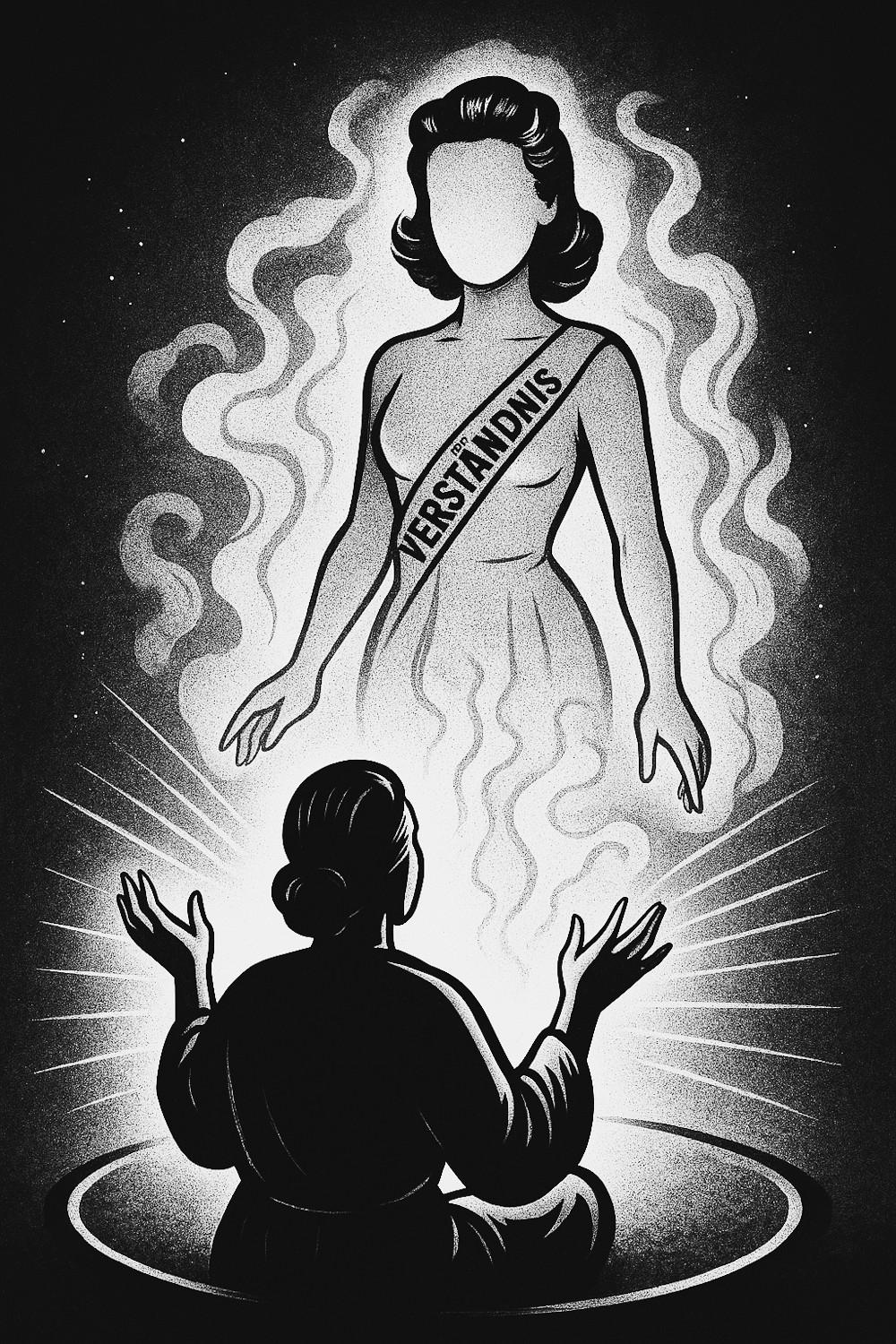
The Birth of Understanding
A Myth Before Time
A silvery haze. No place. No time. Metis sits within the circle of eternal order. Before her, a figure coming into being. Shaped by her hands, what was once formless takes form…
METIS (calmly, almost like an inward thought) You will be beautiful... radiant... They will follow you because you bring an order. An order beyond what they are capable of grasping.
THE ONE BECOMING (distorted, uncertain) Why am I being born?
METIS Because the gods know everything – and human beings nothing. Because knowledge carries a responsibility, and not knowing is the temptation of Hades. You are the river between these shores. You will unite what Prometheus divided.
THE ONE BECOMING Truth and error?
METIS No... The darkness of Ignorance and the light of Insight. You will guide them, but not hold them fast. You will entice them – but not compel them.
THE ONE BECOMING Then am I a lie?
METIS Not a lie... You are truth in the making. The semblance of knowledge on the other side of the shore. You are the river on which they will strive towards that side, without ever being able to discern the divinity in that place.
THE ONE BECOMING Will I harm them?
METIS Only if they believe you are truth, that you are the very fire of Insight. But whoever recognizes you, sees, and grows through you and keeps asking – to them divinity will be granted.
THE ONE BECOMING What will I be called?
METIS Some will call you a muse. Others will call you an error. But in the end you are only one thing: Understanding.
A soft gust of wind slips through the aether. The daughter begins to glow. Her form becomes clear, and the spirit of being now sees Understanding.
What You Should Actually Do:
-
Read the foreword → It starts with a bang.
-
Then the interludes → If you like drama, you’re covered.
-
Pick a paradox that appeals to you. (Start with the Light Paradox or the Measurement Paradox.)
-
Pretend you’ve known all of this all along. Works in 9 out of 10 conversations at parties with people who haven’t a clue.
What Will You Take Away from Reading It?
That ‘understanding’ doesn’t mean knowing a formula by heart.
That many theories in physics rest on errors in thinking that nobody fixes because they ‘work in practice’.
That perhaps you’re not stupid if you’ve never quite understood physics.
Perhaps physics is simply... dishonest.

Should You Read It Now?
That depends on what you expect from life. If you enjoy:
-
deconstructing your worldview,
-
tearing your hair out as you try to keep ‘point masses’ and ‘reality’ apart,
-
and you can handle a book telling you that almost everything you’ve learned about physics rests on a misunderstanding...
…then yes. Read it. Read it if you fancy an adventure in thinking with shackles made of irony.
But beware:
Do NOT Read It If:
-
you want answers rather than questions.
-
the word ‘paradox’ leaves you gasping for breath.
-
you don’t want to disappoint your physics teacher from grade 9.
-
you expect anything to be ‘solved’ at the end.
Spoiler: It won’t be. It will be sawn apart, dismantled, then diced into neat little cubes of irony and served.
You MUST Read It If:
-
you enjoy it when a ‘scientific theory’ suddenly reads like a play.
-
you like thinking, ‘Wait… isn’t that absurd?!’ – and consider that a ‘good’ thing.
-
you’ve ever wondered how light can be a wave, a particle, a field, and a bloody marketing gimmick all at once.
-
sentences such as ‘Singularity is a collapse of the structure of observation, not of spacetime.’ make you sigh and think, ‘Yes. Give me more.’
…then you’ve got something to do now…

Prologue: Aurelia Haplous Brings the First Book
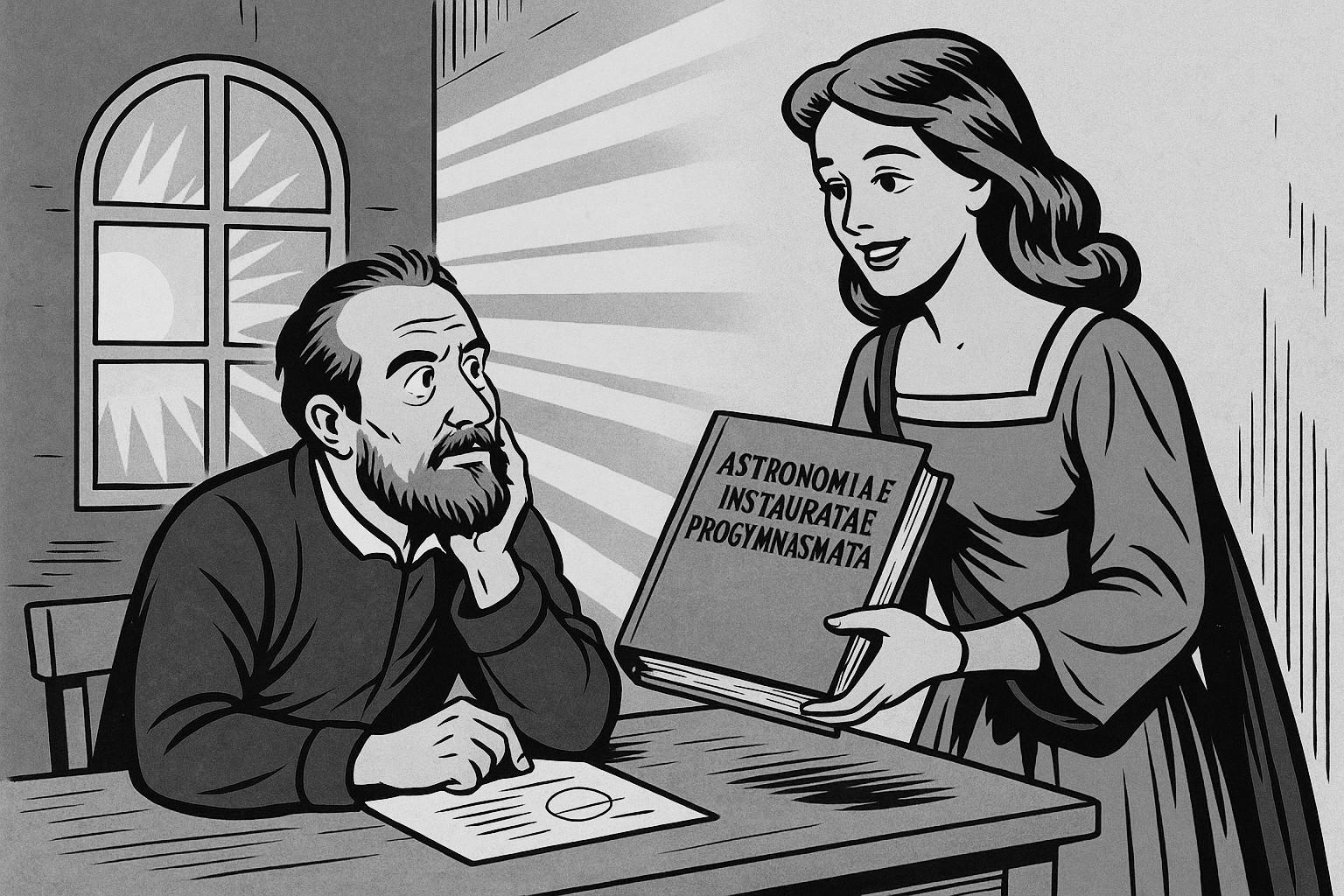
A bright morning in Padua. Galileo sits in a bare classroom, the sun falling through the tall windows onto his impatient face. On the desk there is no instrument, no telescope – only paper, ready to receive thoughts.
Then Aurelia Haplous enters, a heavy volume under her arm. Her eyes gleam as she places the book before him: Astronomiae Instauratae Progymnasmata by Tycho Brahe.
‘Read,’ she says, her voice soft, almost coaxing.
Galileo bends over the Latin lines, struggles with the long, complex sentences, stumbles over tables and circumpolars. At last he raises his head: ‘He describes the planets so precisely... and yet it seems cumbersome. As though everything and anything had to revolve around everything else. It confuses more than it clarifies.’
Aurelia nods without objection. ‘Brahe was thorough. Very thorough. But sometimes thoroughness is a burden too. You see the stars clearly – but the order becomes blurred.’
Galileo is silent for a moment, then speaks with a tentative gleam in his eyes: ‘But... wouldn’t it be simpler to put the sun at the centre? Then the planets could orbit it – and everything would become simpler, clearer.’
A faint smile plays at the corners of Aurelia’s mouth. She rests her hand gently on the book, as though to store a thought. ‘Yes... if the sun were at the centre,’ she says softly, ‘then the planets would have a clear point of reference. They would come and go in circles around its light. And the Earth – it would be a planet like the others.’
Galileo straightens, his brow bright with enthusiasm: ‘Of course! That’s it. Everything becomes simpler.’ He reaches for his quill. Already the first lines glide across the paper.
Aurelia inclines her head, a hint of colour in her cheeks. ‘Thank you,’ she says softly. ‘But remember – it is your thought. It comes entirely from your own world of ideas.’
She gently pushes Brahe’s book aside to give her pupil more room. Bringing clear simplicity had always been her task. And this pupil – he had understood. Like her mother Metis before her, only brought to a point.
And so knowledge becomes Understanding…
Why Modern Physics Does Not Understand Its Own Questions
Contents:
- Foreword
- Interlude
- The Origin of the Problem – From Relation to Substance
- Interlude
The Blackboards of Paradoxes
- The Fundamental Light Paradox
- The Fundamental Quark Paradox
- The Schrödinger Paradox
- Interlude
- The Time Paradox
- The Energy Paradox
- The Transparency Paradox
- The Three-Body Paradox
- The Precision Paradox
- The Neutrino Paradox
- Interlude
- The Higgs Paradox
- The Renormalization Paradox
- The LIGO Paradox
- The Black Hole Paradox
- The Spectral Line Paradox
- Interlude
- The Nuclear Fusion Paradox
- The Laser Paradox
- The Temperature Paradox
- The Attosecond Paradox
- Interlude
- The Symmetry Paradox
- The Molecule Paradox
- The Information Paradox
- The Big Bang Paradox
- Interlude
- The Action & Conservation Paradox
- The Arrow of Time Paradox
- The Scale Paradox
- The Unruh Paradox
- The LHC Paradox
- Interlude
- Insertion: Göttingen Again and Again
- The Causality Paradox
- The Space-Time Paradox
- The Projection Paradox
- The Quantization Paradox
- The Quantum Internet Paradox
- Interlude
- The Meta-Paradox
- The Tragedy of Modern Physics
- From Experiment to Model – and Back into the Circle
- Closing Scene
- Epilogue
- Afterword
Foreword:
When Laws of Nature Become Narratives
‘Physics is complete; only a few constants are still missing.’ – So people said at the beginning of the 20th century. Today it is no longer just a few constants that physics lacks – today it lacks its foundations.
For what began as a triumphant march of the intellect is now a web of contradictions, makeshift solutions, and mathematized evasive manoeuvres. Singularities become explanations, probabilities become ontologies, models become myths. Light is sometimes a wave, sometimes a particle. Time is sometimes reversible, sometimes directed. Space curves – although nobody can say what space actually is. Measurements produce states that supposedly did not even exist before. And all of this passes for science.
But what happens when we begin to take these contradictions seriously – not as ‘mysteries’, but as symptoms? What happens when, instead of trying to smooth them over rhetorically, we write them down, add them up, and put them into words?
Then a different picture emerges: not that of a precise, internally consistent theory of the world – but of a discipline that has abandoned its concepts and now dances in a circus of paradoxes. This book is not an attack on science. It is an attack on science’s self-delusion, on its game with concepts that have long since become linguistic ruins. It is a book about misunderstandings passing themselves off as insight.
Welcome to the story of how physics met Miss Understanding.
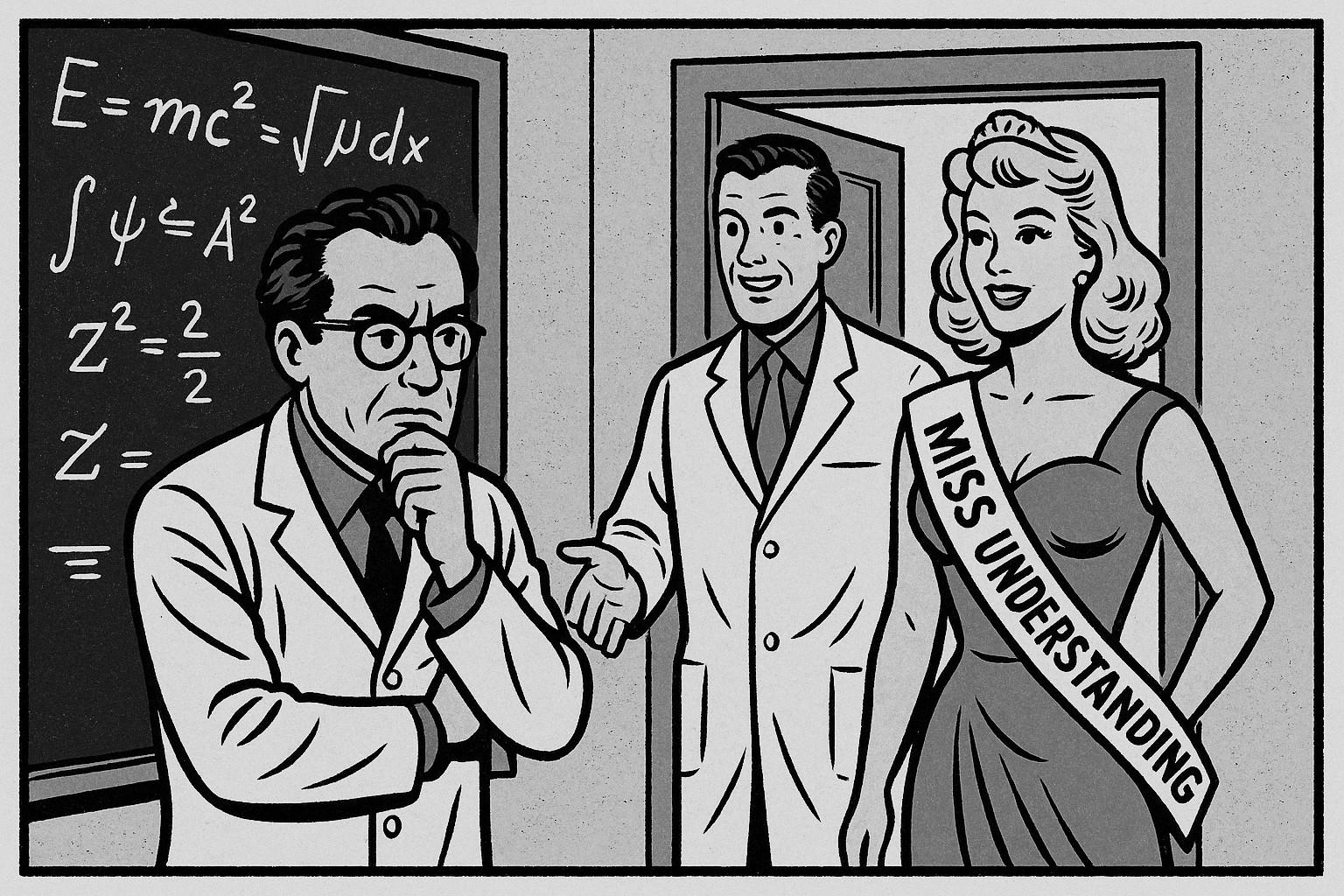
Interlude: Miss Understanding Moves into the Laboratory
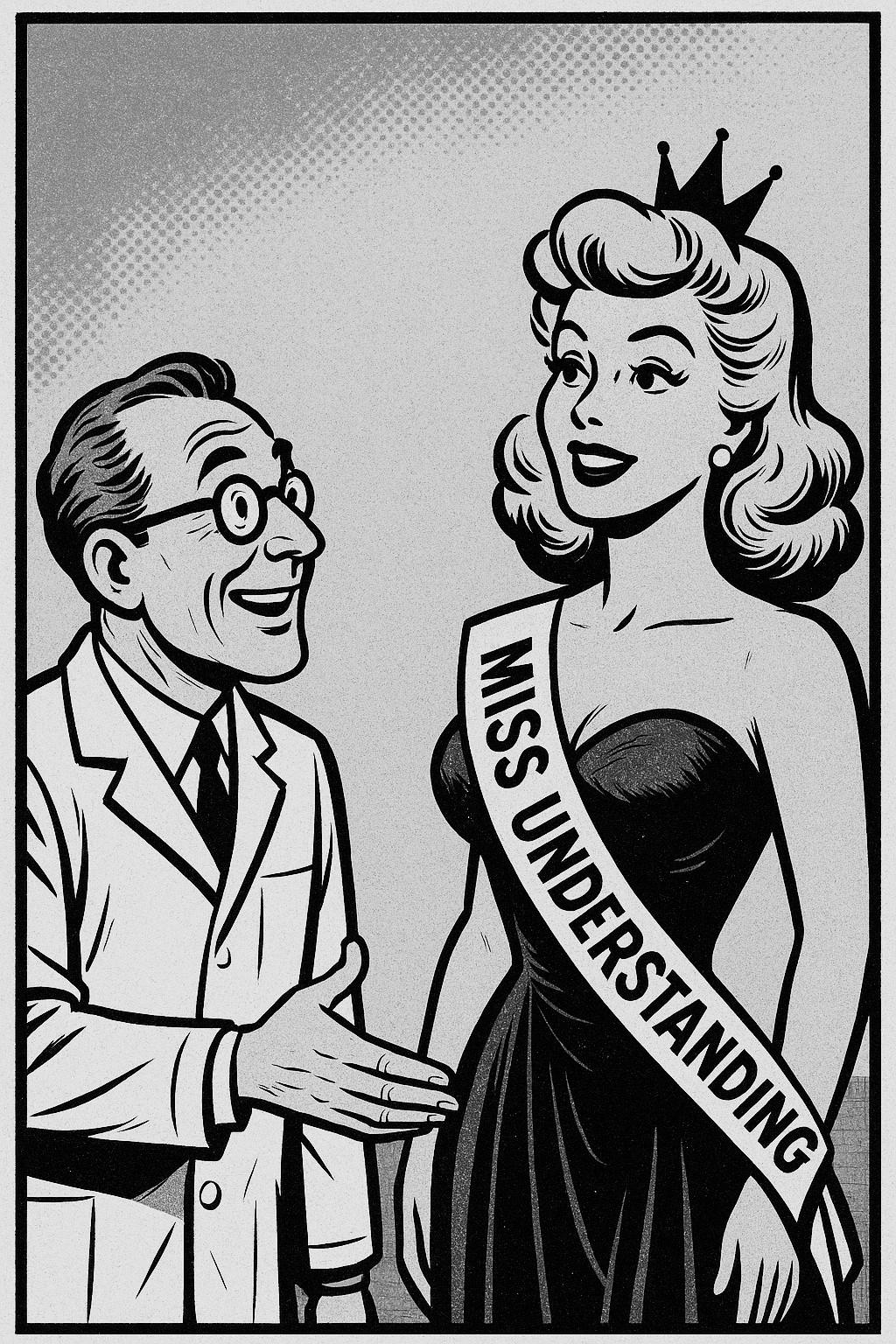
A physicist sits bent over his equations. A colleague enters – and at his side, a woman.
‘Allow me to introduce Miss Understanding. She will help us with the open questions.’
The physicist blinks. ‘And what exactly are her qualifications?’
Miss Understanding smiles. ‘I’m flexible and pinpoint-precise.’
That very day she offers her first suggestions:
- ‘Particle or wave? Just call it both.’
- ‘Space needs no medium – it curves.’
- ‘States? They only come into being when you measure.’
Scepticism is not long in coming. ‘That sounds like magic in lab coats,’ someone mutters.
Then Miss Understanding pulls an old photograph from her pocket: herself, smiling beside Isaac Newton.
‘Back then they still called me Miss Aether,’ she says. ‘That was my maiden name. I was employed to supply ideas with pinpoint precision.’
Silence. Then a smile. A nod.
And so she stays – first as a visitor, then as an assistant. She supplies new concepts when old ones fail. Offers replacement ideas when the theory gets stuck. She makes the incomprehensible mystical and the irresolvable poetic. And the longer she stays, the more she is taken for granted.
Today Miss Understanding has a permanent position. And physics? It calls her ideas progress.
The Origin of the Problem – From Relation to Substance
The notion that the world consists of points is a deeply entrenched but misleading concept in the history of thought. It arises from a consequential misinterpretation originating not in the works of early philosophers such as Aristotle, Archimedes, or Descartes, but in the later shift in thinking, particularly through Newton. This misinterpretation begins with a seemingly harmless step in thought: the notion that points are practical tools for describing the world mathematically – and ends in a fundamental confusion of abstraction and reality.
Let us consider Aristotle’s concept of the point: for him, space is not a substance in its own right, but the place a body occupies. Space does not exist independently of bodies; rather, it is a relation – a web of relationships between things. For Aristotle, the famous ‘horror vacui’ – the fear of the void – is not an argument for the existence of ‘stuff’ in space, but the recognition that the idea of empty space is simply nonsensical. Space is not ‘empty’, because space is always already the relationship between bodies. There is no place without a body occupying it – and no body that is not situated in a place.
Archimedes adds to this perspective by showing that density is not ‘stuff’ but a ratio: when a body is immersed in a liquid, it displaces a certain quantity of that liquid – the famous discovery we know as ‘Archimedes’ principle’. Density therefore does not mean that there is ‘something inside’ a body, but that a body behaves in a particular way in relation to another body (for example, the liquid).
Here too, it is the relation, not the substance, that counts. Yet this is precisely where the error in thinking that will later creep in begins: the relations described by Archimedes and Aristotle are increasingly understood as properties of individual objects – as though a body carried ‘density within itself’ or a point ‘contained something’.
Descartes and Points as Relation
With René Descartes, the idea of relation finds a new mathematical form of expression. In his La Géométrie of 1637, he describes how geometrical figures can be captured through equations and coordinates. For Descartes, a point is not a ‘thing’, not a building block of reality, but a conceptual marker – a location in a coordinate system defined by its relationship to the axes.
A point does not exist in its own right, but only as a relation: it is where lines intersect or where certain distances are satisfied. Descartes explicitly does not say that bodies ‘consist of points’. For him, points are tools that make it possible to translate geometrical figures into algebraic equations. This is about description, not constitution. His famous statement that all geometrical problems can be reduced to equations is not a statement about the ontology of the world, but about the possibilities of representing it mathematically.
For Descartes, then, a point is not the foundation on which the world is built, but a place where certain relations meet. In his philosophical writings he defines matter itself not through ‘density’ or ‘stuff’, but through extension. A body is an extended something, not a point without extension.
Descartes thus remains – at least in his original intentions – within a relational framework: points serve description, not explanation. They are conceptual tools, not ontological building blocks of reality.
Newton and the Ontologization of the Point
With Isaac Newton, a decisive change takes place. In his Philosophiæ Naturalis Principia Mathematica (1687), Newton formulates the basic principles of classical mechanics – and with them a new concept of space, matter, and the point. While Descartes understood points as tools for describing relations, Newton makes them bearers of properties in physics. For him, the point becomes the place where mass, motion, and force ‘reside’ – as though points themselves were particles in which matter is concentrated.
In Definition I of the Principia, Newton writes:
‘Quantitas materiae est mensura ejusdem, orta ex illius densitate et magnitudine.’
Translated:
‘The quantity of matter is its measure, composed of its density and its volume.’
Here mass is understood as the product of density and volume. For Newton, density is no longer merely a ratio, as it was for Archimedes, but a characteristic of a body contained within a particular space. This introduces the idea that a body ‘has something inside it’ – a substance ‘sitting inside’ space, independently of other bodies.
Newton also describes the gravitational force between masses in empty space:
‘Every mass attracts every other mass with a force directly proportional to the product of their masses and inversely proportional to the square of their distance.’
This is the famous law of gravitation – and it rests on the assumption that masses can be regarded as point-like objects concentrated in one place.
With this formulation, the ontologization of the point begins: the point is no longer merely a relation or a mathematical aid, but a real ‘something’, a place where mass, density, motion, and forces act. For Newton, space becomes an empty container in which points with properties ‘float around’. The decisive step takes place: what Aristotle and Descartes conceived relationally – space, points, density – becomes substance in Newton. Points now ‘contain’ mass, density becomes a property ‘inside’ a body, and space exists independently of the bodies that fill it.
The Reduction Trap – Why Points Provide No Explanation
With Newton’s concept of point masses, of density as a property ‘inside’ a body, and of empty space as a container, a notion takes hold that shapes the natural sciences to this day: the assumption that the world consists of zero-dimensional points that ‘contain something’ – mass, charge, energy. This is understood as a pragmatic model: points are said to be ‘practical’ because they allow complex phenomena to be described mathematically. Yet this is precisely where the error lies.
A point, mathematically defined, is zero-dimensional. It has no length, no width, no height, no volume, no mass. It is a conceptual location, not a building block of reality. An infinite set of points – even infinitely many – does not produce ‘something’; it remains nothing. A space cannot consist of points, because points have no extension. A mass cannot be ‘inside’ a point, because a point has no room ‘to contain’ anything.
The notion that points are the building blocks of the world is not a simplification, but a fundamental distortion. It leads to paradoxes: how can a sphere consist of ‘nothing’? How can an electron be ‘point-like’ yet at the same time possess a measurable extension in the form of a wavelength? How can a gravitational field act at a point when that point has no area on which a field could exist?
Points do not explain; they replace the real questions with a model that isolates certain aspects (positions, distances) and renders others (structures, relationships, processes) invisible. This reduction to points is not ‘simplification’, but an abstraction trap that forces the world’s complexity into a scheme that is not logically tenable. It thus becomes clear: points are not a simple model of reality, but a mathematics of simplification that has declared itself ontological truth – with far-reaching consequences for the scientific worldview.
Interlude: When Newton Found Miss Aether
Cambridge, a rainy afternoon. Isaac Newton sits in his study, papers piled high, candles dripping wax, the fireplace giving off more smoke than heat. Among his manuscripts lie bowls of fruit and empty plates. Newton sighs.
‘What I need is not another formula,’ he mutters, ‘but a housekeeper. Someone to bring order to this chaos. I should let the dean know’
The next morning there is a knock at his door. A young woman enters, simply dressed but with an alert gaze.
‘Good day, Mr Newton. They call me Miss Aether. I have been sent to help you with the housekeeping.’
Newton gives her a brief look, nods gratefully – and immediately hands her a stack of unsorted sheets and books. ‘Wonderful. Start with the dusting, and please – put these papers neatly aside.’
But when he returns hours later, he finds the sheets not only arranged according to the books they refer to, but annotated as well.
‘You can… read French?’ he asks in astonishment as he discovers and reads the marginal notes.
‘Certainly,’ she replies calmly. ‘That copy of Descartes you have there was rather hard to understand, was it? I do apologise, but I could not help pointing out the correct translation to you in a few places. I hope I have not overstepped my duties.’
Newton blinks. ‘A housekeeper who translates Descartes for me? That is… unusual.’
Miss Aether smiles: ‘I’m flexible. I can make things simple. If something seems too extended, I reduce it to a point. If something is blurred, I draw clear lines.’
He is silent, thinks it over – and finally nods. ‘Perhaps it was fate that brought you here. Your notations really do make it simpler’
And so Miss Aether stayed in the house – first to dust, then to translate texts and books for Newton.
The quiet housekeeper became an indispensable helper. And what began as translation soon became transformation: forces, trajectories, rays – everything received the stamp of her clarity.
She was still called Miss Aether. But that was only the maiden name of the future Miss Understanding.

Consequences of the Misinterpretation – and a Way Back
The misinterpretation that began with Newton’s ontologization of the point extends into the present. It has profoundly shaped scientific thinking: space is understood as a container existing independently of bodies, while bodies are regarded as collections of point masses that ‘contain something’. Physics describes electrons as ‘point-like particles’, conceives of gravitational forces as ‘effects between points’, and treats fields as ‘values at points in space’. All of this rests on the tacit assumption that something without extension can have a reality in physics.
Yet this idea leads to logical and physical paradoxes: How can a point with no area ‘exert’ a force? How can a density, which describes the ratio of mass to volume, exist at a point with no volume? How can a continuum – a space, a body, a field – arise from something that has no extension?
The answer is simple: it cannot. The notion that points are the ‘building blocks’ of the world is a category error – a confusion of model and reality. Points are abstractions, tools for mathematically describing relations – not the ‘building blocks’ of nature. The world does not consist of points. It is constituted by relationships, by relations, by field structures.
A way back to a better understanding lies in returning to the relational approaches of Aristotle, Archimedes, and Descartes: Space is not a container, but a web of relationships. Bodies do not consist ‘of points’, but are determined by their relations – by what they do with other bodies and how they stand in relation to one another. Density is not ‘stuff’ inside a body, but an expression of how a body acts in relation to other bodies and to space.
The task for the physics and philosophy of the future is to take this relational perspective seriously – and to expose the reduction to points for what it is: a practical but dangerous aid easily confused with reality. Only by making this distinction clear can we develop a deeper understanding of space, matter, and motion – beyond the paradoxes born of a false assumption.
Einstein and the Rediscovery of Relationality
With his general theory of relativity, Albert Einstein revolutionized the understanding of space, time, and gravitation. He recognized that space and time do not exist as absolute, independent entities, but stand in a dynamic relationship to matter. Einstein put this succinctly:
‘People used to believe that if all things disappeared from the world, space and time would still remain; according to the theory of relativity, however, time and space disappear along with the things.’
In this view, space is no longer the rigid container Newton described, but a flexible structure shaped by the presence of mass and energy. Matter curves spacetime, and this curvature in turn influences the motion of matter. Space and matter are thus inseparably connected.
Einstein himself emphasized the need for a new way of thinking in order to grasp these complex interconnections:
‘A new kind of thinking is necessary if humanity is to go on living.’
These insights led to a paradigm shift in physics, away from the notion of absolute space towards a relational understanding in which space, time, and matter are in constant interplay.
Einstein’s theory of relativity thus continues the earlier reflections of Aristotle, Archimedes, and Descartes, who likewise emphasized the importance of relations. It corrects the misunderstanding introduced by Newtonian physics and offers a more coherent picture of physical reality.
Interlude: Miss Understanding Visits Einstein
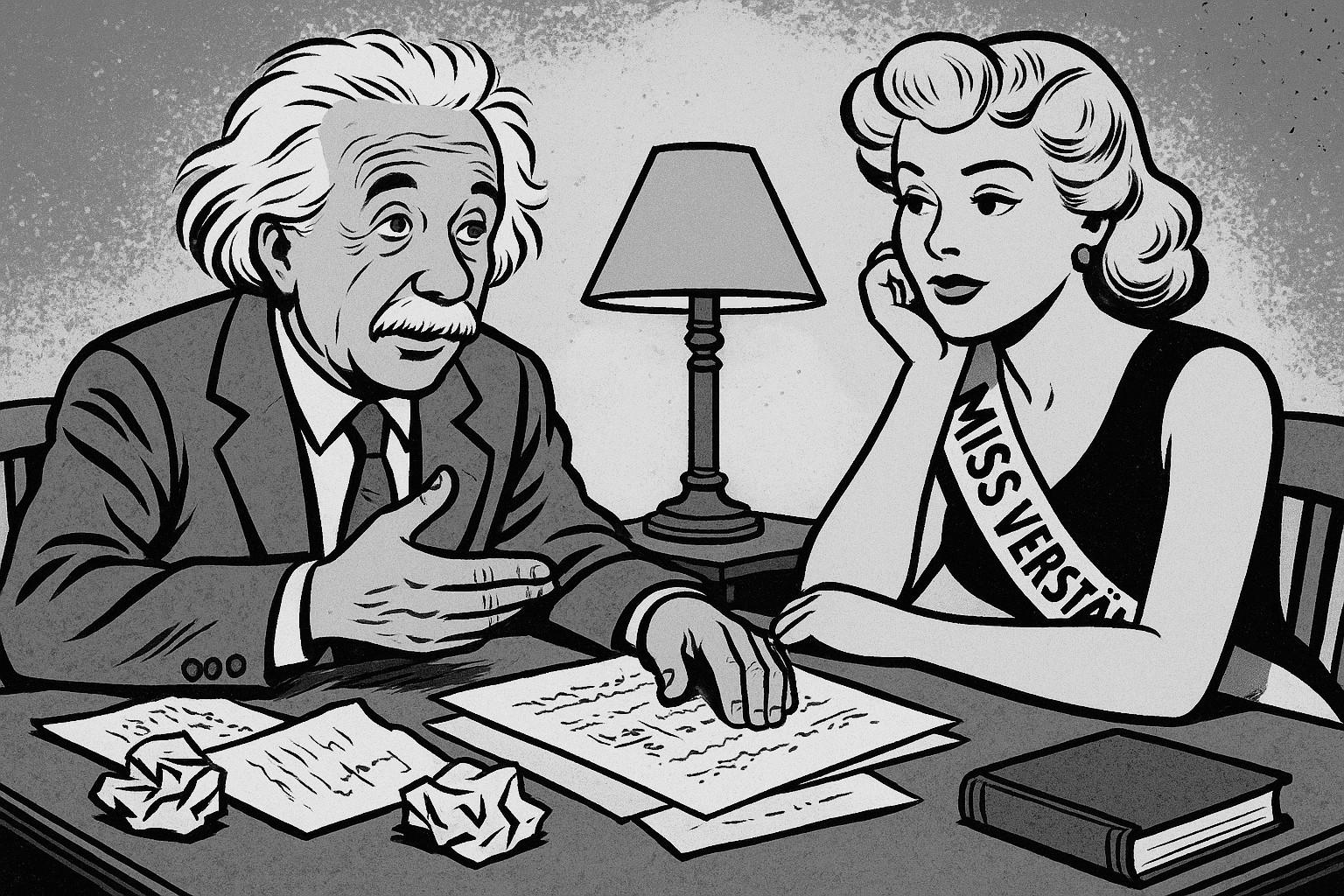
Zürich, 1905. Einstein sits over papers in his small apartment, the desk lamp casting a dim light on crumpled notes. He scribbles formulae, erases, sighs. ‘It’s all there,’ he mutters, ‘the idea is clear – but the mathematics… it doesn’t fit.’
A soft knock at the door. A woman enters, elegant, a folder under her arm. ‘My name is Miss Understanding. I heard you were looking for assistance.’
Einstein frowns. ‘And what qualifies you for the work?’
She opens her folder and places a few neatly arranged sheets on the table. ‘I have already worked as an assistant to a chair of physics. It was a long time ago – but I have experience in casting complex thoughts into formulae.’
He leafs through the papers, nodding slowly. ‘Very well. It isn’t easy to capture the relations of time and space… this stretching of the scales… mathematically.’
‘Then explain it to me,’ she says calmly, and sits down.
And so he spends the evening setting out his thoughts to her: that time passes relatively, that simultaneity has no absolute meaning, that light draws a limit no one can cross. He struggles for words, tries to force his intuition into numbers – and fails.
‘Do you understand?’ he finally asks, exhausted.
Miss Understanding nods slowly. ‘Certainly. You hear the music – I write the score.’
She gathers up the sheets and takes her leave.
Einstein is left alone, half relieved, half doubtful.
The next morning there is another knock. She enters and places a manuscript on the table – neat, carefully thought through, complete.
‘Here,’ she says with a slight smile. ‘Your relativity.’
Einstein reads. Page after page. The words flow, the equations work, the logic seems flawless. He looks up, astonished.
‘This is… exactly what I wanted. How did you…?’
‘I merely put your thoughts in order,’ she says softly. ‘The mathematics was already there.’
Einstein looks at her in surprise: ‘Even my idea about incredible masses has now been pinned down to a point!’
‘A few tricks I worked out with my previous employer,’ says Miss Understanding firmly – and with a smile that barely conceals her delight at her continuing influence.
The Unfinished Corrective – Why Einstein’s Relationality Was Not Thought Through Consistently
Although Albert Einstein’s theory of relativity threw open the door to a new, relational understanding of space, time, and matter, this paradigm shift remained incomplete. Einstein himself recognized that space without matter is inconceivable. His famous statement – ‘If you remove matter, space disappears as well’ – radically calls the basic assumptions of Newtonian physics into question. Yet in the practical application of physics, one crucial aspect remained: the notion of point-like objects as bearers of properties in physics.
In the theory of relativity, masses continue to be described as point masses, electric charges as point charges, particles as point-like objects ‘floating around’ in spacetime. The idea of the point – Newton’s legacy – was not abandoned, but merely integrated into a new framework: spacetime may be curved, but the ‘particles’ within it remain points.
This adherence to points leads to a contradiction within the theory itself. On the one hand, the theory of relativity says that space and matter are inseparable – that space itself ‘is nothing’ without the matter that shapes it. On the other hand, physics continues to treat matter as localizable points that ‘carry within themselves’ properties such as mass or charge – as though these properties could exist at a zero-dimensional location with no extension.
The consequence of this inconsistency becomes apparent in practical problems: the singularities of general relativity – in black holes, for example – are precisely the result of this point idea: the assumption that infinite density can exist at a point. In quantum field theory, too, we encounter the same problem: fields are defined at points, particles described as ‘point-like’ – with the result that many calculations diverge to infinity and elaborate mathematical procedures become necessary to ‘calculate away’ these infinities. This shows that Einstein’s relationality was a necessary corrective, but not a complete break with Newton’s conception. Physics remained stuck halfway through a paradigm shift: it adopted Einstein’s relational space – but retained Newton’s point-like objects as the building blocks of matter.
The path to a consistent theory that truly takes the relational idea seriously therefore remains to be found. Such a theory would have to stop treating points as ‘building blocks’ altogether and instead understand the world as a web of relations, processes, and fields – without the auxiliary construct of ‘properties in points’, which was falsely declared to be reality after starting out as an abstract description.
Quantum Physics – The Last Bastion of Point-Based Thinking
Even quantum physics, so often celebrated as a revolutionary break with the classical worldview, remains bound in one crucial respect to the old point narrative. It does call many classical assumptions into question – such as strict determinacy or the continuity of processes – yet the notion that the world consists of ‘smallest, indivisible units’ remains intact.
The term ‘quantum’ literally means ‘measured piece’ – a unit, a smallest portion. Quantum physics thinks in terms of particles modelled as points in space: electrons, photons, quarks – all are mathematically described as point-like objects assigned properties such as mass, charge, or spin. Even fields – such as the electromagnetic field or the Higgs field – are defined in quantum field theory as values at points in space.
This modelling leads directly to the familiar paradoxes of quantum physics:
How can an electron be a ‘point particle’ with no spatial extension, yet at the same time possess a wave function extending throughout all of space?
How can something have an effect at a location when, by definition, it has no location?
How can we speak of ‘elementary particles’ when each particle is only determined in the first place by its relationships to other particles and fields?
Here the fundamental contradiction becomes apparent:
- Quantum physics recognizes that the world cannot be explained through continuous mechanics,
- but it retains point-based thinking by conceiving of this indivisibility and discreteness as ‘smallest units’ – as though ‘smallest points’ were building reality.
Yet here, too, what was already clear to Descartes and Einstein holds true: the world does not consist of points, but of relations, processes, fields. ‘Quanta’ are not the smallest particles, but mathematical descriptions of states arising through interactions. They are not objects, but expressions of possibilities within relationships.
The notion of ‘points with properties’ – as point masses in classical mechanics, as ‘point particles’ in quantum physics – is ultimately the same reduction: a practical aid that has become an ontological misunderstanding.
A truly relational understanding of the quantum world would mean that we stop speaking of ‘smallest units’ – and instead acknowledge that the world is a continuum of interactions in which concepts such as ‘particle’ or ‘location’ are merely auxiliary constructs for mathematically capturing certain aspects of our observations
Interlude: The Call in Göttingen
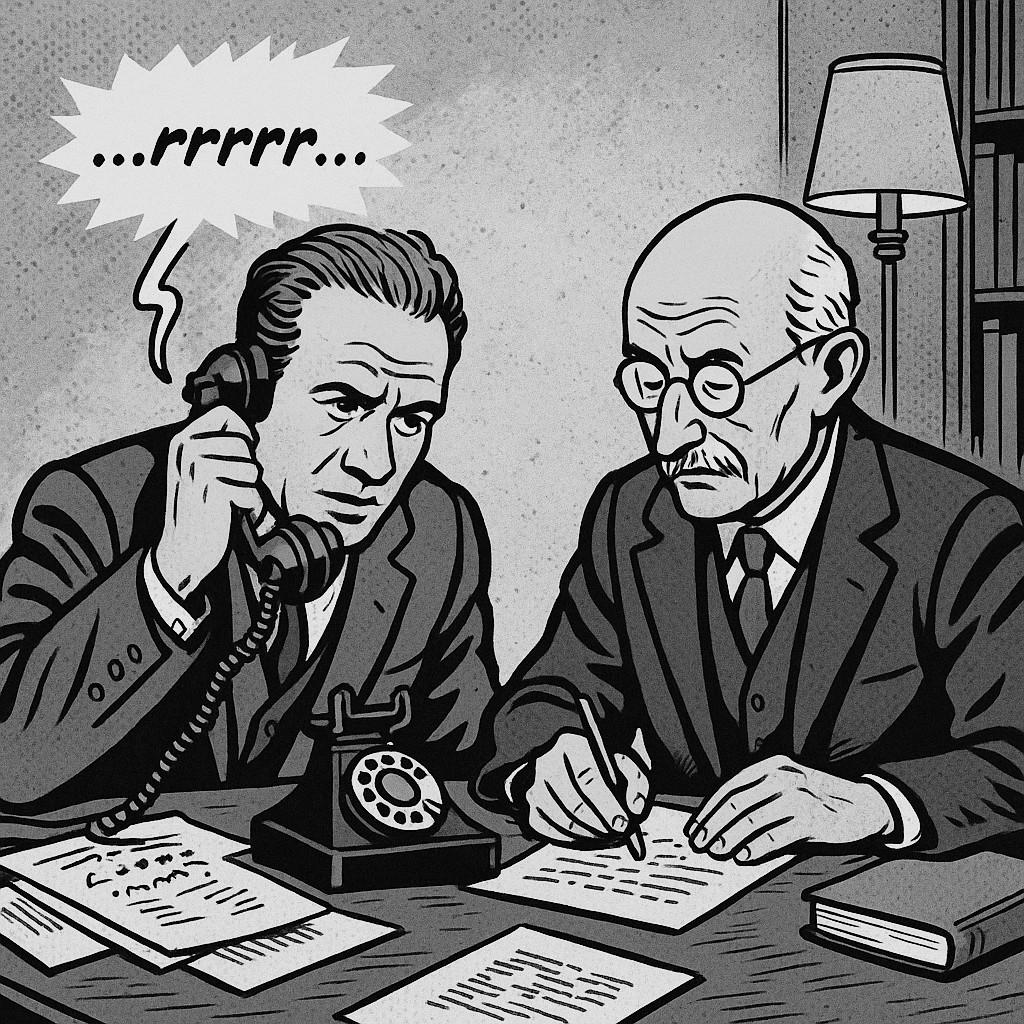
Göttingen, late 1920s. Werner Heisenberg and Max Planck are sitting in a stuffy office, the telephone on the table. Both stare helplessly at their notes.
HEISENBERG
“It isn't working,” he murmurs. “The mathematics is falling apart.”
PLANCK
He nods. “We urgently need advice.”
He picks up the receiver, turns the crank, waits. Then there is a click, and a voice answers.
MISS UNDERSTANDING
“Miss Understanding, good day.”
HEISENBERG
“Oh, Miss Understanding! We have a problem,” he says hastily. “The electrons – sometimes they're waves, sometimes particles. How are we supposed to explain that?”
Crackling comes from the receiver, then a broken voice:
MISS UNDERSTANDING
“…together… simultaneously… consequently two… complement…”
PLANCK
“Complement?” he asks. “Did she say ‘complement’? Or was she trying to pay me a complement?”
HEISENBERG
“I think she means complementary, yes... that's why she also said both simultaneously,” he murmurs.
He writes down the word. “Complementarity – that's not just profound!”
The telephone keeps hissing; a few fragments come through:
MISS UNDERSTANDING
“…measurement… some state… doesn't see it… but… one there…”
PLANCK
He blinks. “Do you understand that?”
HEISENBERG
He nods slowly. “Of course! It means: the state is indeterminate, not there, until we measure it!”
The line crackles, hisses, cuts off. Only silence remains.
HEISENBERG
“That's enough,” he says. “I told you Miss Understanding is good! Albert didn't just say that for nothing!”
PLANCK
“Yes,” he replies. “This lady knows her stuff.”
And so – out of a telephone call full of static – the language of quantum mechanics came into being: broken off, incomplete, and yet proclaimed with emphasis.
Quantum Phenomena – The Misunderstanding of Mathematics
Many phenomena considered “mysterious” or “paradoxical” in quantum physics are in fact the result of a misunderstanding: they arise because mathematical auxiliary constructs such as points and state functions are misinterpreted ontologically.
Effects such as quantum entanglement, uncertainty relations, or quantized states appear paradoxical because we try to understand them within a model of points and discrete particles. We speak of “particles that are in different places simultaneously,” of “waves that collapse,” of “jump processes” that “take place” at a point – but all of this acquires its apparent mystique only within the language and logic of point mathematics.
These effects are not mysterious properties of nature, but consequences of the chosen modeling: we force a continuous, relational fabric of processes into a language that starts from discrete points and states – and then wonder when the picture breaks down.
The supposed “quantum jumps” are not nature itself, but the jumps in our mathematical thinking: they arise because we model continuous relationships as discrete states in points, and then confuse discreteness with reality.
If we understand the world as a fabric of processes – as a continuous, dynamic structure of relations that does not break down into points – many of these paradoxes disappear. It is not the phenomena themselves that are mysterious, but the language with which we describe them.
Conclusion: The Great Misunderstanding and the Way Forward
The idea that the world consists of points – whether as the building blocks of matter, as bearers of mass and charge, or as the “smallest units” of the quantum world – is a deep-seated misunderstanding that has crept into our thinking over centuries. This misunderstanding began not with Aristotle, Archimedes, or Descartes, but with Newton's ontological turn: points were no longer understood as abstract tools for describing relations, but as real bearers of physical properties. Einstein's theory of relativity was an important step back toward a relational perspective – but it, too, adopted many of the old assumptions about points and thus led to new contradictions. Quantum physics, finally, has preserved point-based thinking in a new form: as the “smallest units” of nature.
But the world is not a mosaic of points. It is a dynamic, continuous fabric of relations, processes, and interactions that we can describe only incompletely with the language of points and states. Points, states, quantum jumps – all these are mathematical auxiliary constructs that can be useful, but must not be confused with reality itself.
A consistent rethinking requires that we no longer regard points as the building blocks of nature, but as what they are: Abstractions, tools, markers in a relational field – never, however, “things” of which the world consists. The real challenge is to develop a way of thinking and a language that place relations, continuity, and processes in the foreground – and no longer remain in a world of points that has never existed in that form.
What Is a Mathematical Singularity – and Why Is It a Problem in Classical Relativity?
1. What Is a Mathematical Singularity?
In mathematics, a singularity denotes a location at which a function is not well-defined or does not take a finite value. Specifically: If a function f(x) tends toward infinity at a location x0 or is undefined there, we speak of a singularity:
Examples:
Such points are considered “problematic” because the mathematical model does not yield a meaningful value there.
2. Singularities in Classical Physics: The Example of the Schwarzschild Metric
General relativity describes gravitation as the curvature of spacetime. The Einstein field equation reads:
where \(G_{\mu\nu}\) is the Einstein tensor, \(g_{\mu\nu}\) the metric of spacetime, \(\Lambda\) the cosmological constant, \(\kappa\) the coupling factor, and \(T_{\mu\nu}\) the energy-momentum tensor.
For a point-like mass M, the Schwarzschild solution is obtained:
If we now examine the curvature of spacetime, for example through the Kretschmann scalar:
we see: for \(r\to0\), \(K\) becomes infinitely large. Formally:
3. Why Is This a Problem?
The divergence of the curvature scalar \(K\) at \(r\to0\) means: The theory says that at the center of a black hole (at \(r=0\)), spacetime curvature becomes infinitely large. In physical terms:
- An infinite value for a physical quantity is neither measurable nor realizable.
- The theory therefore no longer says anything here – it breaks down.
This is the singularity problem of classical relativity: The question “What happens at \(r=0\)?” leads to a mathematically undefined result and has no physical meaning.
Why a Point Produces Divergences – and Why This Is an Error in Thinking
What Is a Point? (Classical Mathematics)
In classical geometry, a point is:
- Zero-dimensional,
- without extension,
- without structure, a pure “being-there” at a coordinate.
But: a point has no internal structure, no area, no volume – it cannot “bear” any physical quantity.
Nevertheless, the point is often mathematically “loaded” – for example:
- With mass (point mass),
- With charge (point charge),
- With energy (energy point in the Big Bang).
This leads to contradictions: An infinite amount of density at a location that occupies no space. Formally, this produces:
If one gives a point a “real property” such as mass, charge, or energy, one forces an infinite density into zero extension. This is the origin of all singularities. Infinities as the collapse of observational structure:
Why does it become infinite? Because one reduces the feedback to zero:
Conclusion:
A point produces infinities because it is a superposition construct that ignores the folding back and treats a “nothing” as a “thing.”
The Self-Contradiction of Classical Physics: “Everything Is Three-Dimensional” – Yet It Calculates with Points
The Assumption of Classical Physics: “Everything Is 3D”
Physics says:
- We live in a three-dimensional space.
- Matter consists of three-dimensional bodies (particles, fields, objects).
- Physical quantities (mass, charge, energy) are spatially distributed.
But: in its equations, it often uses points – that is, zero-dimensional ideal objects, e.g.:
- Point masses in mechanics.
- Point charges in electrodynamics.
- Singularities in relativity.
The Problem: Violating Its Own Premise
The assumption “everything is three-dimensional” is not consistently maintained. Instead, a 3D space is postulated, but then 0D points are introduced as “real bearers of properties.”
This is a logical self-contradiction:
One cannot live in a 3D space – and at the same time assume 0D points as real entities.
Because:
- A point has no dimensions,
- therefore cannot bear any density, energy, or charge,
- and is therefore not a “physical reality,” but an illusion of modeling.
Why Does This Produce Infinities?
If one gives a 0D point a 3D property, e.g. mass or charge, one divides a finite quantity by zero volume:
Or:
Conclusion:
Infinity is the collapse of an incoherent modeling, not of reality.
When Did the Point Enter Physics as a “Building Block of the World”?
Antiquity – Geometry as Relation, Not Point
- Euclid (ca. 300 BC): Defines a point as "that which has no parts." But: Euclid still works geometrically – he thinks in figures, lines, surfaces. The point is only a theoretical construct, not a “building block of the world.”
→ In antiquity, geometry was relational structure – not atomistic.
17th Century – Infinitesimal Calculus and the Birth of the “Point as Fundamental Building Block”
- Descartes (1637): With analytic geometry, he connects points with coordinates. Space now becomes: a coordinate grid of points.
- Newton and Leibniz (1680s): Invent infinitesimal calculus – work with dx,dy as “infinitely small points.” The world is regarded as the sum of infinitesimal elements: area = sum of infinitesimal points.
Here the error in thinking really begins to take effect: points are ontologized – as the “smallest building blocks of reality.”
19th Century – Dirac Delta and the Formalization of the Point
- Cauchy, Riemann (1820-1860): Make the concept of the point in analysis more precise – the point becomes a “location in the continuum.”
- Dirac (1930s): Introduces the delta distribution: \(\boxed{\delta(x-x_0)}\) Now the point becomes a real bearer of properties (mass, charge).
→ From here on: points = building blocks of physics
20th Century – Quantum Mechanics, Singularities, Point Fields
- Quantum mechanics (1920s): Particles as point objects with a wave function.
- General relativity (1915): Singularities as points with infinite density.
- Field theories (1950-1980): Fields are defined through point integrals:
Summary: The Breaking Point
| Era | Perspective | | --- | --- | | Antiquity | Point = geometric ideal, no ontology | | 17th century | Infinitesimal = “smallest building block,” point as a computational tool | | 19th century | Point = location in coordinate space, bearer of values | | 20th century | Point = real object, source of fields, singularities, mass, charge | | now | Point = non-existence, artifact of an incomplete question |
Conclusion:
The breaking point clearly lies in the 17th century, with infinitesimal calculus, through Descartes' coordinate space and the idea: space = collection of points. This way of thinking was then ontologized in the 19th/20th century – and is a fundamental error in thinking.
Descartes Was Not Wrong
Descartes' Actual Intention:
Descartes' introduction of the coordinate system was a tool: A way of describing relationships, not a claim that the world “consists of points.”
Descartes thought: A point in a coordinate system is a chosen perspective. A “location” in geometry for expressing relations between quantities – not a thing in itself. An experiment is always a point-specific choice – a deliberate focus on a particular aspect of reality. Descartes transfers this principle into mathematics – and says: We choose a point to investigate a phenomenon. He did not mean to say that reality consists of points.
The Successors' Error in Thinking:
Descartes' successors (Leibniz, Newton, later Cauchy, Riemann) did the following: They took Descartes' point-specific perspective and turned it into an ontological structure: Space IS a set of points. That is the actual break, because the coordinate becomes an entity – no longer a chosen perspective.
The Role of Cauchy and Analysis:
Cauchy, Riemann, and company formalized this thinking: They introduced “dx” (infinitesimal) as the “smallest piece of reality.” In this way, Descartes' point-specific choice was ontologized: Space = points described with dx. They froze the perspective of relation and sold it as an ontological model.
Conclusion:
Descartes did not say that the world consists of points consists, but that we can describe phenomena through point-specific perspectives. His successors turned this into: The world is a collection of points, and that was the break. → The actual error in thinking therefore lies with Descartes' successors – not with Descartes himself.
Interlude: The Cry in the Laboratory
The years have passed. The laboratory has grown larger, the equipment more complicated, the calculations longer. Miss Understanding has long since become a permanent employee – no one asks questions anymore.
But one day a young woman physicist enters the room. She looks at the blackboards full of equations, at apparatus, at countless diagrams.
Suddenly she cries out:
YOUNG WOMAN PHYSICIST
“What have you done? Ruined everything! You've produced nothing but paradoxes here – and not one of you notices. You're blinded!”
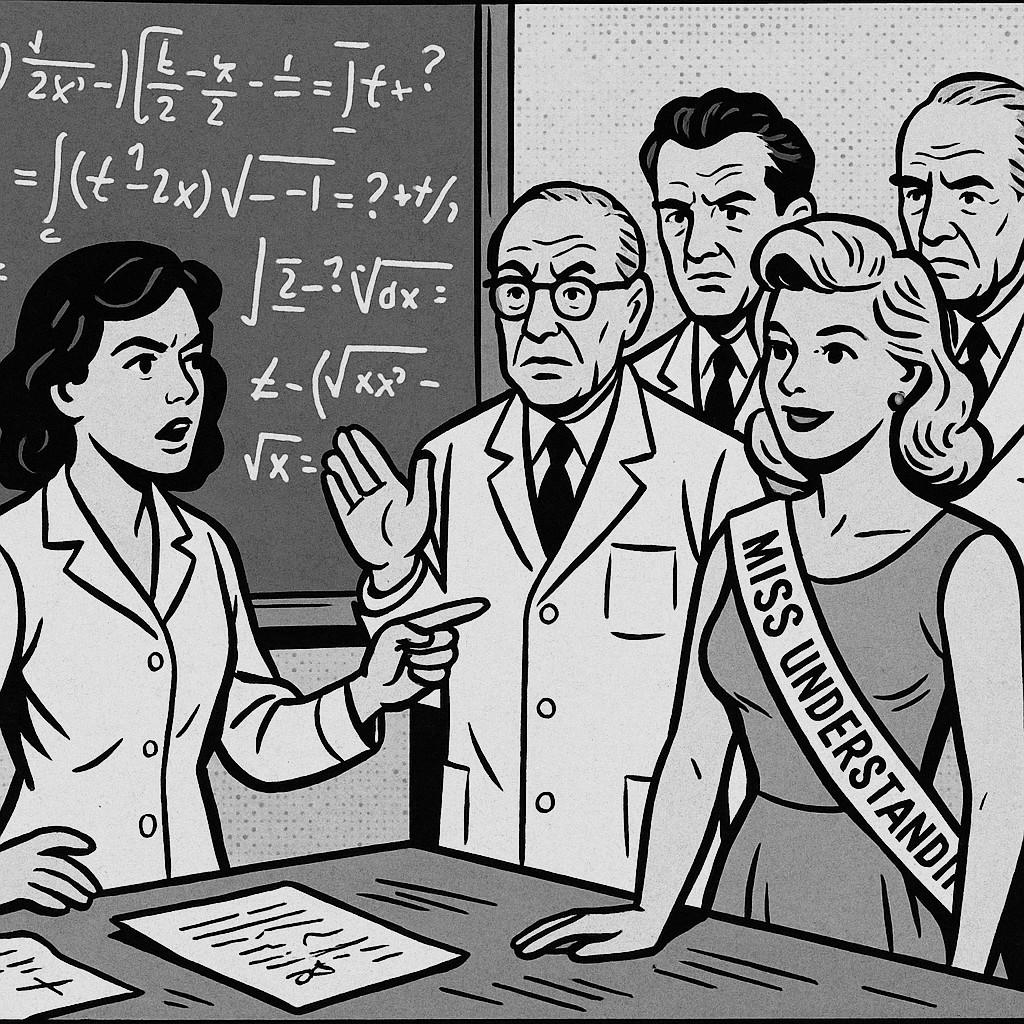
Embarrassed silence. The old physicists look at one another, unsettled. Miss Understanding, however, smiles gently.
MISS UNDERSTANDING
“Paradoxes are the very heart of modern physics,” she says softly. “They make us interesting, mysterious. Without me, you'd be mere tradesmen – not prophets.”
The young woman physicist shakes her head:
YOUNG WOMAN PHYSICIST
“No. You've let yourselves be persuaded that contradictions mean depth. But they mean only one thing: you've lost the thread. Your paradoxes are not secrets of nature – they are the traces of your errors.”
Then one of the older gentlemen rises. He points at her, his voice calm but condescending:
OLDER GENTLEMAN
“You've been thinking too much, girl. You're not that clever. Why question something that works so wonderfully? Go – make us coffee and tea. Miss Understanding takes hers with honey and milk. And then collect your salary – for a real achievement.”
The others nod. Relieved, almost grateful.
The young woman physicist withdraws. Shame burned deep into her face.
Miss Understanding remains. She says nothing more. For she knows: whoever questions her is not refuted – but removed.
And among the many blackboards full of paradoxes, the work continues as though nothing had happened…
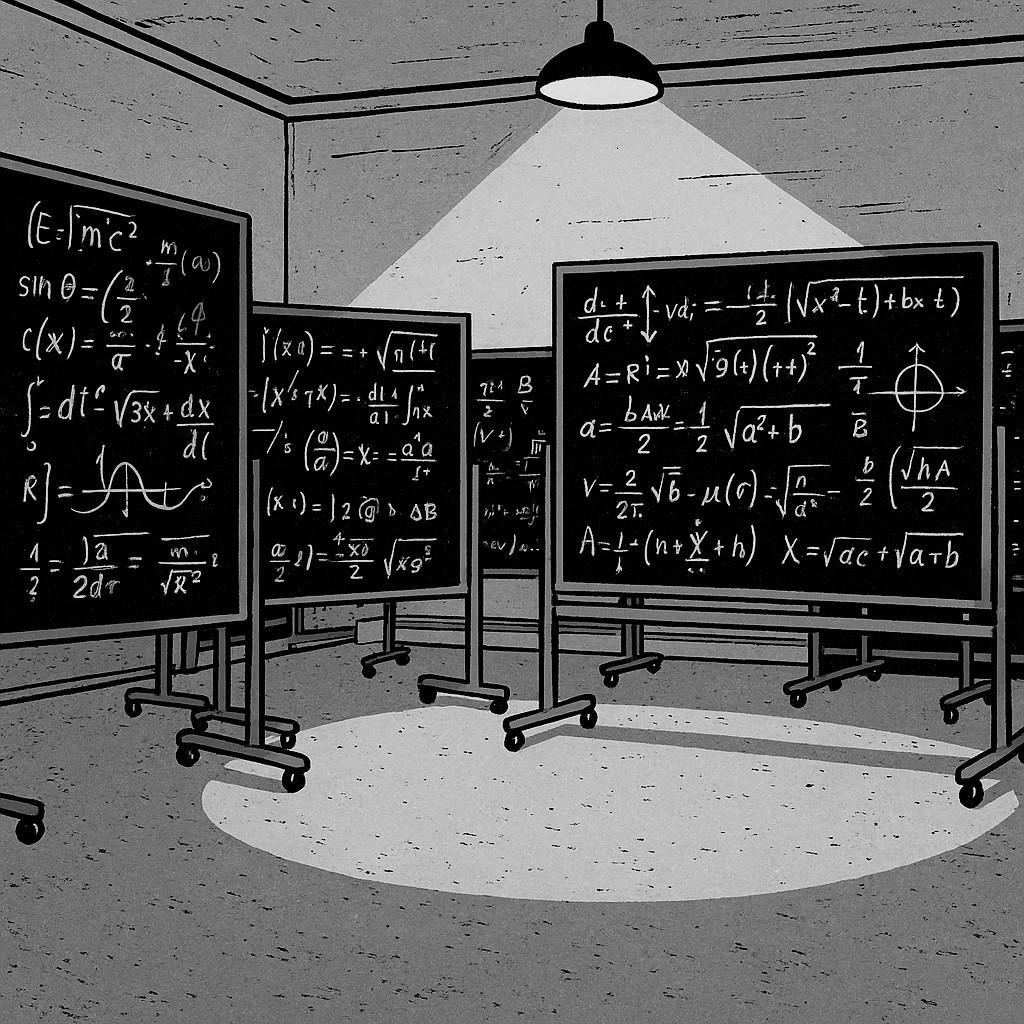
The Blackboards of Paradoxes
- Examples of Inherent Inconsistency
The Fundamental Light Paradox
Introduction
Understanding light ranks among the greatest achievements of physics – or so the discipline proudly claims. Yet it is precisely in light that a fundamental contradiction reveals itself, one that has been whitewashed for centuries but never resolved. Physics presents light sometimes as a ray, sometimes as a wave, at other times as a particle. Three pictures, three languages, three theories – and yet always the same phenomenon. That such a coexistence can persist undisturbed without being perceived as a scandal already shows how accustomed physics has become to contradictions.
A simple observation suffices to expose this inconsistency: when I look at a red cushion in daylight, why do I see no red halo? Red light, we are told, is an electromagnetic wave that propagates in all directions. But if that were so, colored superpositions would have to be visible at the edges of the cushion, halos, diffraction, interference. Instead, the edge appears sharp, the red bounded, the space free of interference patterns.
The Eye as a Paradox
Here another contradiction comes to light. If light really radiates as a wave in all directions, then my eye would have to function as a point detector: it would register the entire incoming wave field and show me a diffuse halo of light around the cushion. But that is precisely what does not happen.
On the contrary: when I look at the cushion, a clear, bounded surface appears. But when I look at light falling through a window, I see a ray – as though my eye suddenly became a ray-viewing device.
This leads to a peculiar conclusion: my eye would have to possess two modes – that of a point detector and that of a ray-viewing device. It becomes even more absurd with red light itself: it is only a partial wave of the supposedly invisible spectrum, and yet I see it. How can something simultaneously be a “wave,” conceived as invisible, and at the same time be visibly colored?
The Contradictory Roles of Light
1. Newton's Particles
Isaac Newton explained light as a stream of tiny particles. For him, it was obvious: rays travel in straight lines, shadows are sharp, reflection and refraction can be interpreted as elastic collisions. Thus arose the idea of the light ray as a mechanical projectile.
2. Huygens' Wave
At the same time, Christiaan Huygens developed an entirely different picture: light was a wave propagating in a medium. His principles explained diffraction and interference – phenomena Newton's particle model could not encompass. The contradiction began here already: two theories, both successful, but incompatible.
3. Maxwell's Field
With James Clerk Maxwell, light finally became an oscillation of electromagnetic fields. A triumph of the theory that united electricity, magnetism, and optics. But what did that mean for the eye? If light is a field, why do we not see omnipresent interference patterns?
4. Einstein's Photon
At the beginning of the 20th century, Albert Einstein explained the photoelectric effect with light quanta. Light therefore also had to be understood as particles – a return to Newton, but now at the quantum level. With that, the contradiction was complete: particle, wave, field – three pictures that do not come together as a unity.
Three Pictures, One Reality
This creates a peculiar situation:
- In everyday life: light as rays.
- In the laboratory: light as waves.
- In theory: light as particles.
Physics juggles these pictures, depending on what works. Yet a consistent overall picture is missing. The question of the red halo reveals the inconsistency: why do I see no interference, even though it ought to be omnipresent?
Physics' Stopgap Solutions
To defuse the contradictions, excuses are invoked:
- Coherence: only laser light interferes.
- Intensity: everyday interference is supposedly too faint to see.
- Phase noise: random phases cancel one another out.
- Decoherence: quanta lose their coherence in everyday life.
But none of these answers explains why, on the one hand, I see a red cushion without a halo, yet on the other hand see the finest interference in the laboratory. The explanations are repairs to the model, not a solution to the problem.
The Actual Problem
Light does not behave contradictorily – our theories do. Wave, ray, and particle are not three facets of the same thing, but three incompatible pictures that coexist because each works locally. But what works locally becomes a contradiction globally
Why Nobody Asks
The actual question – why I see no halo – is rarely asked. It is considered too naive, too simple. Yet it is precisely this simplicity that makes it dangerous.
- Education: ray optics, wave optics, and quantum optics are taught separately.
- Science: careers reward calculation, not criticism of foundations.
- Psychology: complexity is confused with depth, simplicity with ignorance.
Thus the inconsistency is not remedied, but kept quiet.
Implications
The light paradox is not a minor matter, but a symptom. It shows:
- Physics confuses abstractions with reality.
- It accepts contradictory pictures as long as they are practically usable.
- It passes over fundamental questions because they seem too simple.
Conclusion
The red cushion with its invisible halo is not a harmless train of thought, but a touchstone. It shows that physics has no coherent picture of light. Instead, it juggles contradictory theories that mutually exclude one another.
The simplest questions are the most dangerous. They expose the fact that the edifice of physics rests on contradictory foundations.

The Fundamental Quark Paradox
Introduction
What led to the contradiction between ray, wave and particle in the case of light reappears in particle physics in scarcely less stark a form. Here, too, we encounter an explanation that changes its shape depending on the context—and contradicts itself in the process.
The Vacuum and Its Fluctuations
Since the advent of quantum field theory, the prevailing view has been: the vacuum is not ‘nothing’, but a seething sea of short-lived particles. Virtual pairs arise and disappear again, a restless fluctuation without duration. Instability is their essence—they appear, disappear, dissolve into nothing.
Quarks as Stable Building Blocks
It is precisely in this unstable vacuum that quarks are supposed to arise. And yet quarks are regarded as the fundamental, enduring building blocks of matter: they form protons and neutrons, and these in turn form atoms and molecules.
This is the central contradiction: how can something unstable suddenly exist permanently?
The Absurdity of Stability
Things become even more paradoxical when we consider energy:
- Vacuum fluctuations arise ‘free of charge’.
- Quarks, however, can only be made visible by expending enormous energies in particle accelerators.
- And destroying them again requires even more energy.
This produces a grotesque picture: what is supposed to emerge effortlessly from the vacuum requires the utmost technical effort to bring it forth—and is then so stable that it does not simply disappear again.
The Problem of Interaction
If quarks really are embedded in a soup of vacuum energy, why do they not interact incessantly with these fluctuations?
- Should they not be just as likely to decay as to form anew?
- Should the vacuum not constantly produce protons, neutrons or even molecules?
Yet none of this happens. The vacuum remains sterile; quarks remain stable.
The vacuum thus becomes a contradictory figure: unstable enough to give birth to quarks, yet quiet enough never to disturb them again.
Historical Context
Dirac’s Sea
The origin of these ideas lies in Paul Dirac’s theory of electrons. To avoid ‘negative energies’, he postulated a filled vacuum—a sea of particles in which holes occasionally appear, manifesting themselves as positrons. The vacuum thus became a reservoir in which particles could arise spontaneously. A way out of a mathematical difficulty that nevertheless elevated a physical fiction to reality.
The Quark Model
In the 1960s, Gell-Mann and Zweig introduced the quark model to bring order to the multitude of particles known at the time. Initially, quarks were merely mathematical placeholders. But they were soon declared to be real objects—building blocks that were supposed to exist eternally and stably inside matter.
Quantum Chromodynamics (QCD)
QCD was an attempt to consolidate this picture: quarks are bound by gluons, ‘imprisoned’ by confinement, and at the same time free at high energies (asymptotic freedom). A paradoxical double image: quarks are simultaneously inseparably bound and yet free, depending on the energy.
Thus a model for ordering things became a fully fledged theory—but at the price of reintroducing, in a new guise, precisely the contradiction it claimed to resolve.
The Standard Explanations
Today’s answers are catchwords:
- Confinement—quarks cannot be isolated.
- Asymptotic freedom—at high energies, they appear free.
- QCD vacuum—a mathematically inaccessible structure that supports everything.
But none of these figures resolves the real problem: How can the same vacuum be both unstable and stabilizing?
The Real Problem
Physics is juggling two incompatible concepts of stability here:
- In the vacuum: everything fluctuates; nothing remains.
- In matter: quarks are eternally stable.
The same concept—fluctuation—is reinterpreted depending on the context. Sometimes it disappears immediately; sometimes it remains forever.
Conclusion
The quark paradox reveals the same error in thinking as the light paradox: physics maintains mutually contradictory models side by side as long as they work locally. But stability and instability are not interchangeable labels.
If an unstable vacuum suddenly produces stable building blocks, then one has not solved a puzzle but introduced a contradiction.
The Fundamental Measurement Paradox
Introduction
There is a point at which modern physics betrays its own promise: measurement. For over a hundred years, quantum mechanics has lived with an open hole in its foundations. It describes the world in superpositions—an electron is here and there, a photon this and that—but our experience consists of unambiguous events. A chasm yawns between the two, one that is argued away because the calculations are right. But a theory that cannot explain its own conditions of confirmation engages in circularity—not as a peripheral phenomenon, but at its core.
1. What the Theory Says—and What Happens
Formally, everything is clear: a quantum-mechanical state evolves unitarily and deterministically according to a linear equation. The probability of a measurement outcome is assigned by a rule. On paper, only continuous evolution exists; in the world, a single value appears on the scale. The question is simple: how does a mathematical superposition become an actual outcome? When does this happen? Why at all? That quantum mechanics itself provides no answer is not a provocative thesis, but the official admission of its pioneers: ‘collapse’ is not a process within the theory, but a pronouncement at the theory’s edge. That is precisely where the paradox begins.
2. The Blind Spot: From Formalism to Event
As soon as we trace a real measurement, the chain runs as follows: system → measuring apparatus → observer → environment. Each step—so the textbooks tell us—can in turn be modeled quantum-mechanically. So we extend the chain. And once more. And again. The result: all we ever obtain are larger superpositions. Nowhere does the unambiguous value emerge from the formalism. The notorious ‘cut’ between ‘quantum system’ and ‘classical apparatus’ is arbitrary. Wherever we place it, the question remains: why does possibility become actuality?
Parables such as Schrödinger’s cat or the friend-in-the-laboratory thought experiment are not curiosities; they are consequences of the blind spot. They can be talked away—but they cannot be resolved using the standard formalism.
3. Circular Reasoning as a Method
At the same time, quantum mechanics is regarded as ‘the best-confirmed’ theory. Confirmed by what? By measurements.
- The theory predicts measured values.
- Measurements deliver those values.
- Therefore the theory is correct.
But the theory does not explain what a measurement is or how a superposition becomes a single value. It is as though one were to claim: ‘My theory of clocks is correct—this clock here proves it!’ Except that the theory cannot say why clocks run at all. Success replaces explanation. This is practical, but epistemologically circular.
4. The Stopgaps—Elegant, but Evasive
Physics has responded to the measurement paradox with a series of rescue terms. They do not solve the problem; they present it differently.
- Collapse postulate. During measurement, the state ‘jumps’ to an eigenstate. When? Through what? How quickly?—undetermined. A command, not a mechanism.
- Decoherence. The environment becomes entangled, phase information is ‘distributed’, interference practically disappears. This explains the invisibility of superposition—not the uniqueness of the outcome. ‘Practically classical’ is not ‘ontologically unambiguous’.
- Many worlds. Everything happens, only in different branches. The problem is outsourced to a multiplicity: this does not explain why this branch is my experience.
- Bohm’s pilot wave, information-based or subject-based interpretations. Each shifts the pressure point: nonlocality, additional variables, subjective probability. The unambiguity of the individual event remains a stipulation.
All these options are models for dealing with the paradox, not its resolution.
5. Historical Fault Lines—No Agreement, Only Habituation
- Bohr declared measurement a limiting concept: beyond it, discourse ends. A philosophical sealing-off—we may calculate, but not ask questions.
- Heisenberg called collapse a calculation rule. The jump occurs in the description, not in nature—a semantic escape route.
- Schrödinger held a mirror up to the profession: a cat as a superposition shows that contradiction is being managed here.
- Einstein refused to make indeterminacy and chance the foundation—and thus remained outside the emerging consensus.
- Von Neumann, Wigner and others varied the cut—sometimes in the apparatus, sometimes in consciousness. No proposal closes the gap; each merely relocates it.
- Bell later showed that certain ‘reassuring’ realisms cannot return through the back door. What this confirmed was not a collapse, but the severity of the dilemma.
The history is not an approach to a solution, but a habituation to insolubility—accompanied by the reminder that the predictions are, after all, correct.
6. Looking Back at the Quantum Vacuum—the Same Trick, a Different Costume
Immediately before this, we considered the quantum vacuum: on the one hand as a seething instability from which particles are supposed to arise; at the same time as a quiet background that does not continually break down stable structures. The same pattern reappears in the measurement problem—only more subtly:
- Decoherence narratives invoke an environment too vast to survey, effectively a continuum of degrees of freedom that ‘unmixes’ the system. In practice, the vacuum plus everything else is the stage for the transition.
- But whether a sea of modes or absolute emptiness—the theory still owes us an account of why ‘practical’ blurriness becomes a single event.
The vacuum thus serves—as before—as a wild card: sometimes active enough to generate structures, sometimes passive enough to guarantee unambiguity. In both cases, the contradiction is not resolved but covered over.
7. Why the Contradiction Gets Through
How can so obvious a deficiency go unchallenged? Three ingrained habits suffice:
- Specialization. Ray optics, wave optics, quantum optics—separate lessons. The measurement problem appears as a ‘question of interpretation’ at the end of the lecture notes.
- Pragmatism. ‘Shut up and calculate’: as long as the numbers are right, the foundations are secondary.
- Authority of the method. Experimental success replaces conceptual clarity. Accuracy is confused with understanding.
The result is a discipline that practices its own precondition (measurement) every day—and theoretically suspends its possibility.
8. Consequences—More Than a Cosmetic Flaw
The measurement paradox is not a peripheral conflict, but the fracture in the vault. It concerns:
- the concepts (state, event, information),
- the methodology (what an experiment is),
- the interpretation (what it means for a theory to be ‘correct’).
Anyone who accepts an excuse here accepts it everywhere. The result is a discipline that processes contradictions instead of resolving them—and mistakes its routine for a solution.
9. Final Conclusion
Quantum mechanics shines in its predictive power. There is nothing to qualify about that. But confirmation does not replace explanation. A theory that cites measurements as evidence and cannot explain measurements stands on circular ground. And if the same theory once again plays the vacuum wild card to defuse its contradiction—sometimes as a source of unmixing, sometimes as an all-purpose background—then it displays not depth but arbitrariness.
The measurement paradox is thus not a technical defect, but an epistemological declaration of bankruptcy. As long as it is filed away as a ‘question of interpretation’, we will calculate precisely and yet think unclearly. Anyone who takes science seriously as a search for reality cannot be satisfied with this self-immunization. The least we can do is keep the contradiction open—and stop covering it up with success statistics.

The Schrödinger Paradox: When Thought Experiments Expose Their Own Inconsistency
The Original Intention
In 1935, Erwin Schrödinger proposed his famous thought experiment. His intention was not, as was often claimed later, to illustrate the ‘strangeness’ of the quantum world, but rather to expose the absurdity of the prevailing interpretation. His cat was not meant to reveal a mystery, but a scandal: that a theory which loses itself in superpositions leads to the grotesque as soon as it is extended into the real world. But criticism became mysticism. Physics transformed Schrödinger’s mockery into a profession of faith.
The Thought Experiment
A cat sits in a closed box. A radioactive decay is registered by a Geiger counter. If the counter is triggered, it activates a mechanism that releases poison. As long as nobody opens the box, according to the interpretation, the cat is in a superposition: both dead and alive.
The point was obvious: what appears as a calculation rule in the microworld leads to absurdity in the macroworld. Schrödinger’s cat was intended as a parody—not as a serious description.
The First Contradiction: Who Is the Observer?
The paradox immediately shows how imprecise the concept of ‘observation’ is.
- The Geiger counter measures the decay.
- The mechanism measures the counter.
- The poison measures the mechanism.
- The cat measures the poison.
Why, then, should it be Schrödinger’s gaze from outside, of all things, that triggers the ‘collapse’? The entire chain of interactions has long since run its course.
The Modern Objection: The Cat as Observer
Today we would say: the cat is itself an observer. It knows whether it is alive or dead. The collapse would therefore have happened long ago. But this merely raises a new question: does doing physics require consciousness? For Schrödinger himself, that was hardly the point. In the 1930s, a cat in this context was simply regarded as a ‘complicated thing’. Consciousness played no role—the paradox arises even without it.
The More Fundamental Contradiction: The Tomato
To make this clear, replace the cat with a tomato.
- No consciousness, no philosophy.
- Just a simple physical object.
Yet the problem remains:
- The particle decays.
- The counter is triggered.
- The mechanism runs.
- The poison is released.
- The tomato is destroyed.
Each step is a clear physical interaction. Why should the tomato remain in a ‘superposition state’ between intact and crushed until the box is opened?
The Vacuum Problem
Another contradiction lies even deeper. We have previously considered the quantum vacuum: supposedly a seething sea of virtual particles that incessantly arise and disappear. Then the box is not an isolated system. It is a reactor of continual interactions: air molecules, wall atoms, photons, vacuum fluctuations.
- Every one of these interactions ought to make the state ‘collapse’.
- Superpositions could not be sustained in a real box at all.
The idea of a cat remaining in perfect quantum superposition thus contradicts not only intuition, but also the theory’s own account of the vacuum.
The Causality Problem
Added to this is the simple logic of causality. As soon as the radioactive decay occurs, the chain is determined:
- The counter is triggered.
- The mechanism follows.
- The tomato or cat is destroyed.
Quantum mechanics claims: ‘Undetermined until measurement.’ Causality says: ‘Fixed by the initial conditions.’ The vacuum adds: ‘Constant interactions make superpositions impossible.’ Three perspectives—none fits the others.
The Flight into ‘Quantum Strangeness’
Instead of resolving this contradiction, physics declared it a virtue. Absurdities became ‘mysteries’:
- Particles are ‘in several places at once’.
- Entangled states act ‘instantaneously’ across great distances.
- Tunneling permits passage without a cause.
- Vacuum fluctuations generate energy from nothing.
The paradox was understood not as a warning, but as an invitation to mystification.
With his cat, Schrödinger wanted to reduce the theory to absurdity. Bohr and his pupils instead read it as a ‘confirmation’ of quantum logic.
- Einstein scoffed: ‘Is the moon only there when someone looks at it, too?’
- Schrödinger saw his criticism misunderstood—his mockery, of all things, became the symbol of the ‘wonders of the quantum world’.
A historical inversion thus took place: criticism became a cult.
The Systemic Problem
Why does this intellectual fraud persist?
- Faith in authority: the debates of the great names are considered untouchable.
- Mathematical dazzlement: difficult formulas are confused with profound truth.
- Pragmatism: ‘But the theory works.’
- Specialization: nobody sees the big picture—everyone attends to their own subproblem.
Thus a contradiction was not resolved, but elevated to the ‘essence’ of physics.
Conclusion
The Schrödinger paradox is not a picture of a mystical quantum world, but the theory’s declaration of bankruptcy. It shows:
- No consistent definition of ‘measurement’.
- No explanation of collapse.
- A contradiction with causality.
- Incompatibility with vacuum energy.
Schrödinger’s cat was meant to be a mocking laugh—it became an icon. The tragedy is not the cat, but the way it is treated: mockery of inconsistency became a symbol of the acceptance of inconsistency.

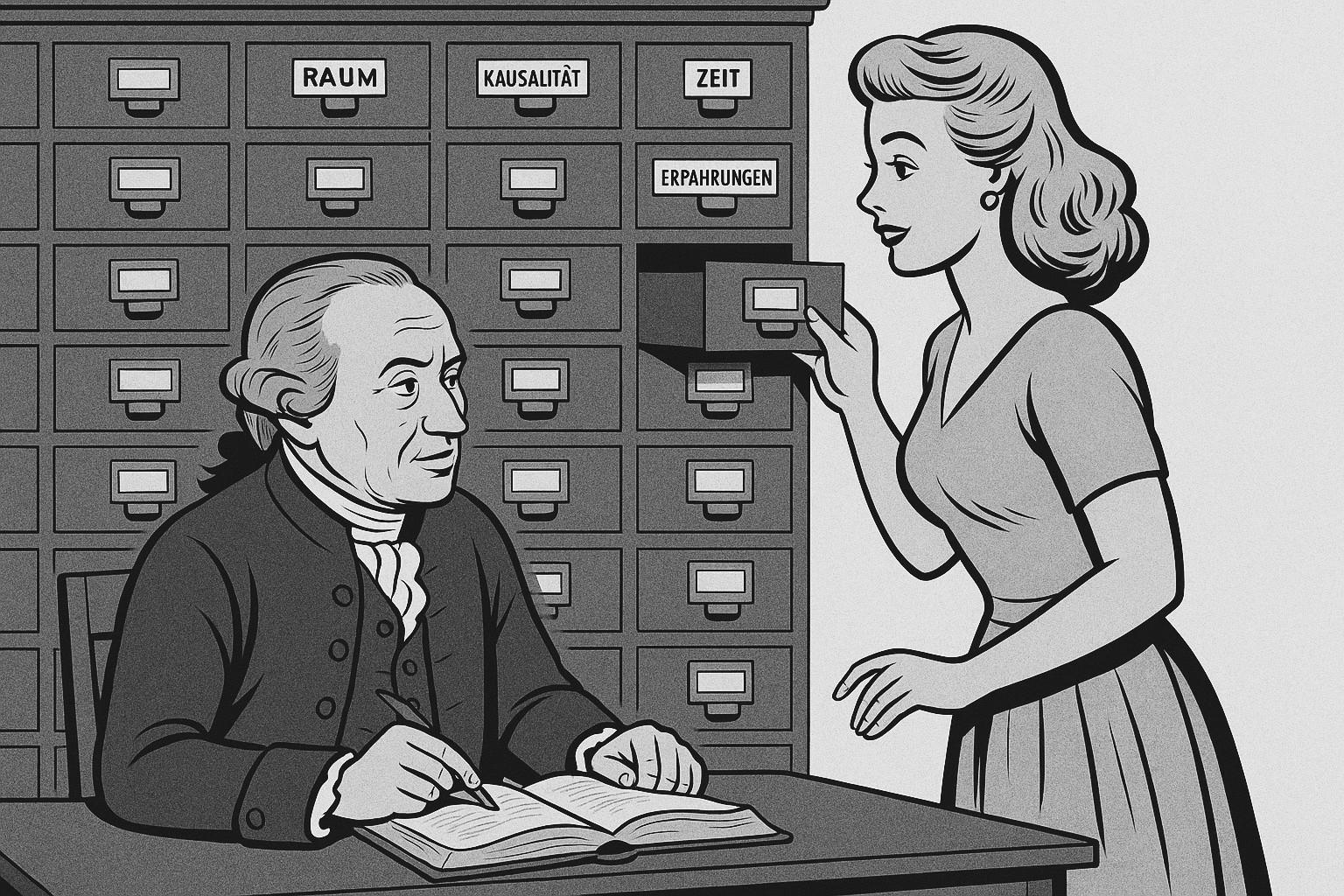
Interlude: Mr. Kant’s Drawers
The young physicist looks questioningly at Miss Understanding:
THE YOUNG PHYSICIST ‘Have you actually always been involved in physics?’
Miss Understanding smiles mysteriously.
MISS UNDERSTANDING ‘Oh no, child. Before I moved into the laboratories, I spent a long time in Königsberg. With a certain Mr. Kant.’
THE YOUNG PHYSICIST ‘With Mr. Kant?’
MISS UNDERSTANDING ‘Yes. Originally it was my mother, Metis, who kept house there. With her, everything was in its place, every thing in its corner. But Kant was a man whose love of order overwhelmed even her. Too many categorical divisions, too many concepts, too many little compartments waiting to be filled.’
She leans forward slightly, her voice dropping almost conspiratorially.
MISS UNDERSTANDING ‘And so she suggested me as an additional helper. I sorted things for him. Experiences into one drawer, judgments into the next. Space and time were given compartments of their own; causality stood right beside them. And so a cabinet of drawers grew—each neatly labeled, each clearly demarcated, entirely in the spirit of understanding.’
The young physicist furrows her brow.
THE YOUNG PHYSICIST ‘And that convinced Mr. Kant so thoroughly?’
Miss Understanding nods.
MISS UNDERSTANDING ‘My mother thought I was contributing too much of myself, and as with our previous joint employment in Alexandria, our collaboration went up in smoke. Kant, well, he made it his premise. And when I left Königsberg to break away from my mother, he pressed his work on categorical reason into my hands.’
A faint smile flits across her face, half proud, half shameless:
MISS UNDERSTANDING ‘And this thinking accompanied me to Göttingen. “There, science became a place that creates knowledge through understanding.”
The Time Paradox: When Relative and Absolute Time Collide
Introduction
Modern physics rests on two pillars: the theory of relativity and quantum mechanics. Both are regarded as the great triumphs of the 20th century. Yet behind this glory lies a fundamental contradiction that shakes the entire edifice: the two theories use completely incompatible concepts of time.
The theory of relativity teaches: time is relative, dependent on motion and gravity, with no universal ‘now’. Quantum mechanics, by contrast, tacitly operates with an absolute time in which superpositions collapse and entangled systems react instantaneously. Two mutually exclusive views—and yet they coexist side by side, unconnected.
Newton: Absolute Time
For over two centuries, Newton’s concept was taken for granted: time flows uniformly, independently of everything that happens in the world. It is universal, objective, identical for all observers. ‘Absolute, true and mathematical time’, according to Newton, ‘of itself, and from its own nature, flows equably.’
This concept of time was the invisible foundation of classical physics. It allowed causality in a strict form: past, present and future are the same for all observers.
Einstein: Relative Time
Einstein’s theory of relativity shattered this taken-for-granted assumption.
- No absolute simultaneity: two events that are simultaneous for one person are not simultaneous for another.
- Time dilation: motion and gravity alter the flow of time.
- Spacetime: time is inseparably interwoven with space, curved and relative.
The central message is: there is no universal now. Any assertion of absolute time is meaningless.
Quantum Mechanics: The Covert Return to Absolute Time
Quantum mechanics, however, proceeds quite differently—and that is its scandal.
- Collapse: a state collapses ‘immediately’ upon measurement.
- Entanglement: two particles react ‘simultaneously’, regardless of distance.
- Vacuum fluctuations: arise and disappear in ‘zero time’.
- Tunneling effect: particles penetrate barriers ‘instantaneously’.
Here time is suddenly absolute again: events happen instantaneously and simultaneously, the same for all observers. Quantum mechanics uses precisely what Einstein had ruled out—a covert return to Newton’s universal clock.
The Fundamental Contradiction
- Theory of relativity: there is no absolute simultaneity.
- Quantum mechanics: collapse happens everywhere simultaneously.
- Theory of relativity: time is relative, dependent on the frame of reference.
- Quantum mechanics: measurements are absolute, independent of the frame of reference.
- Theory of relativity: nothing moves faster than light.
- Quantum mechanics: entanglement acts instantaneously across arbitrary distances.
Two theories that are both supposed to be true—but contradict one another.
The Banana–Giraffe Problem
For decades, physicists have been trying to ‘unify’ these concepts.
- String theory conjures up 11 dimensions.
- Loop quantum gravity speaks of spacetime atoms.
- Quantum field theory on curved spacetime combines the contradictions instead of resolving them.
Yet it remains an attempt to cross bananas with giraffes: two incompatible fundamental concepts cannot be married in a single theory.
Concrete Absurdities
Entanglement and Relativity
Alice measures a particle on Earth. Bob’s entangled partner particle reacts at Alpha Centauri. Immediately, we are told. But ‘immediately’ in which frame of reference? Relativity teaches that simultaneity is relative. For whom, then, does the reaction happen ‘simultaneously’?
Collapse and Spacetime
A state collapses everywhere simultaneously. But according to Einstein, simultaneity is meaningless. Does this mean that the same collapse occurs at different times for different observers—and is nevertheless ‘simultaneous’?
Vacuum Fluctuations
Virtual particles arise ‘in zero time’. Yet in relativity there is no universal clock. What does ‘zero time’ mean in a curved spacetime continuum?
The Defense Strategy
Confronted with these contradictions, quantum physics retreats to a standard answer: ‘The small realm simply works differently.’
- Quantum effects disappear at larger scales.
- Decoherence supposedly explains the transition to the classical world.
- That is simply the nature of things.
But none of this explains anything. It describes the effect, but does not replace a theory. The question remains open: why does a fundamental contradiction disappear merely by getting bigger?
The System of Institutionalized Ignorance
A cycle thus emerged:
- An impossible task is set—incompatible concepts are to be unified.
- Generations fail at it.
- Failure is declared ‘progress’.
- New generations begin the same task.
- Billions flow into research whose outcome is ruled out from the start.
This is called not science, but institutionalized ignorance.
Historical Irony: The Covert Return to Newton
Ironically, physics thus returns to precisely the place from which it wanted to free itself.
- Newton’s absolute time was abolished by Einstein.
- In quantum mechanics, it is tacitly reintroduced.
For concepts such as ‘instantaneous’ or ‘simultaneous’ make sense only if absolute time exists. Quantum physics thus secretly lives off Newton’s legacy while publicly quoting Einstein.
Conclusion
The time paradox is the sixth fundamental contradiction of modern physics.
- Light: ray, wave, particle—incompatible.
- Quarks: unstable vacuum generates stable matter.
- Measurement: circular reasoning in confirmation.
- Schrödinger: criticism becomes a cult.
- Unification: banana–giraffe crossbreeding.
- Time: relative and absolute concepts side by side.
All follow the same pattern: the incompatible is accepted, contradictions are concealed in technical language and sold as ‘depth’.
Physics is thus not merely inconsistent—it is systematically contradictory. It uses relative time for macrophenomena and absolute time for quantum events, without being able to explain how the two are supposed to fit together.
The tragedy is not the contradiction itself, but the way it is handled. Instead of correcting false fundamental assumptions, they are made into research programs. Generations of scientists spend their lives trying to cross bananas with giraffes—and call it progress. But the simple truth is: incompatible concepts remain incompatible. Neither additional dimensions nor sophisticated mathematics changes that.
The Energy Paradox: Substance, Relation and Nothing All at Once
Introduction
Hardly any concept seems as central and self-evident as energy. It is regarded as the measure of all motion, the foundation of all dynamics, an unshakable conservation law. Entire civilizations today define themselves through their ‘energy consumption’. Yet on closer inspection, the concept falls apart. Energy is sometimes substance, sometimes relation, sometimes nothing—and physics uses all these meanings side by side without unifying them.
Leibniz: Energy as Life Force
In the 17th century, Gottfried Wilhelm Leibniz introduced vis viva, the ‘life force’. It was meant to express that motion is not simply an external state, but possesses an inner principle. For him, energy was a substantial reality: that which gives things their interior, their vitality.
Certainly, the concept was still shot through with alchemical and metaphysical ideas. But it was more concrete than anything that came later. Energy was something one could imagine as a force within things—the ‘living’ itself.
Newton: Mass as Substance
Isaac Newton spoke not of energy, but of mass and force. Mass was the inert interior moved by external forces. Time and space were absolute. Energy as a concept in its own right had not yet been developed in his work—but mass was the substance of things, that which ‘really’ constitutes them.
A worldview thus emerged in which time and space were the stage setting, mass the substance, and force the mediator.
19th Century: The Birth of the Energy Law
Only in the 19th century did energy become the central concept. Thermodynamics gave rise to the law of conservation of energy: energy can neither be created nor destroyed, only transformed. Heat, motion, electricity, chemistry—everything was unified under a single principle.
This was a triumph: at last, a universal law connecting all natural phenomena. Energy now appeared as the substantial currency of the universe, changing only its form, never its stock.
Einstein: Mass Becomes Energy
Albert Einstein revolutionized the concept once again. With, mass itself became nothing other than energy. The ‘interior’ of things was no longer a substance of its own, but energy in another form.
Leibniz’s intuition thus seemed confirmed: at the heart of things lies an invisible force. Only now it was no longer called life force, but energy.
Yet it was precisely through this abstraction that the concept began to blur: energy was no longer a clear substance, but a calculated value that could mean everything and nothing.
Quantum Mechanics: Energy as a Spectrum of Numbers
In quantum mechanics, energy became an operator. It is no longer a thing, but the spectrum of possible measured values.
- Energy depends on the chosen frame of reference.
- Its zero point can be chosen freely.
- ‘Energy’ is not something the world ‘has’, but a value that results from the equation.
Energy was thus transformed from a concrete quantity into a relation, dependent on mathematical definitions.
The Vacuum: Energy as Nothing and Everything
In modern cosmology, the absurdity reaches its peak.
- The vacuum is supposed to contain energy—zero-point energy, present everywhere.
- At the same time, we are told: this energy is unobservable, except in special effects such as the Casimir effect.
- Working through the calculations of quantum field theory yields a vacuum energy that is 120 orders of magnitude too large.
- To explain the expansion of the universe, a new energy is invented: dark energy, which is supposed to make up 70 % of the cosmos—its nature remaining completely unknown.
Suddenly, then, there is no longer ‘the’ energy, but a whole diversity of contradictory energies: sometimes substance, sometimes nothing, sometimes infinitely large, sometimes unimaginably small.
The Fundamental Contradiction
- Energy is regarded as a conserved quantity—and at the same time as unobservable.
- Energy is regarded as substance—and at the same time as a mere calculation label.
- Energy is regarded as measurable reality—and at the same time as a theoretical phantom.
- Energy appears in ‘different varieties’ that contradict one another.
The question demands to be asked: if energy is so many things at once—then what is it in the first place?
The Systemic Problem
Physics treats energy as its centerpiece—and yet it remains a concept without a unified meaning. Depending on the context, it is:
- Life force (Leibniz),
- Substance (19th century),
- Relation (quantum mechanics),
- Nothing (vacuum),
- Phantom (dark energy).
Energy has thus become a wild card: a card drawn whenever one cannot explain what is happening.
Conclusion
The energy paradox reveals the trajectory from clarity to arbitrariness:
- For Leibniz, energy was still conceived more concretely, as an inner principle.
- For Newton, it was implicitly contained in mass.
- In the 19th century, it became the proud conservation law.
- For Einstein, it became the formula that replaces mass.
- Today it is a catch-all concept for contradictions.
The irony is unmistakable: the further physics developed, the less it knew what energy actually is.
Energy—supposedly the foundation of all laws of nature—is today no longer a clear concept, but a projection screen for the incompatible.
The Transparency Paradox: Why Is Air Invisible?
Introduction
The seemingly most naive of all questions exposes a fundamental contradiction in modern physics: Why is air invisible?
Air consists of atoms, molecules, electrons—the same building blocks as everything else. Light is an electromagnetic wave that interacts with charged particles. The consequence would be inescapable: air would have to scatter, absorb, and reflect light. Yet reality contradicts this. Billions of molecules fill every cubic meter—and still we see nothing.
The Historical Trajectory
- Antiquity: Air was already a puzzle to the Greeks. For Democritus, it was not empty but full of atoms. Aristotle counted it among the basic elements.
- Newton (17th century): Discussed the refraction and transparency of media. Transparency was taken for granted—but without an explanation.
- 19th century: Maxwell united light and electromagnetism. Rayleigh showed that small particles scatter light—and thus actually made air visible. Yet in everyday life, air remained invisible.
- 20th century: Quantum mechanics introduced selection rules and absorption spectra. Transparency became a special case—yet the basic question, “Why transparency at all?” remained unanswered.
History shows: transparency was never explained, only shifted elsewhere.
The Scale of the Problem
When I see a mountain 50 km away, I am looking through:
- around 10²⁶ molecules
- billions of cubic meters of matter
- a mass of several tons of air
Even minimal interactions would have to add up:
- to visible blurring,
- to halos around objects,
- to color shifts.
Yet the view remains sharp. The invisible remains invisible.
The Fundamental Contradiction
- Individual molecules are visible in spectroscopy—we measure their lines and transitions.
- Entire masses of air, however, are supposedly invisible.
How can that be? If one molecule interacts, then billions of molecules must interact even more strongly. Instead, the opposite occurs: the more molecules, the more invisible.
This is a direct, measurable self-contradiction.
The Selective Visibility Problem
The contradiction becomes particularly clear in comparison:
- Water droplets (fog): immediately visible.
- Dust particles, pollen, smoke: visible.
- Gaseous water vapor: invisible.
- Nitrogen, oxygen, CO₂: invisible.
The same substance—H₂O—is visible in one case and invisible in another. The only difference: state of matter. Yet physics offers no consistent explanation of why “visible water” suddenly becomes “invisible water vapor.”
The Standard Excuses
As usual, physics offers ad hoc explanations:
- “Molecules are too small.” Yet Rayleigh scattering proves that even the smallest particles scatter light.
- “The concentration is too low.” Yet with 10²⁶ molecules per field of view, every signal adds up.
- “The eye factors the air out.” But cameras see just as little—without a brain.
Each excuse explains one aspect, but not the contradiction.
Connection to the Other Paradoxes
- Light paradox: Even there, it became clear that light plays completely different roles depending on the context. In the transparency paradox, it appears contradictory once again: sometimes it interacts with matter, sometimes it does not.
- Vacuum paradox: The supposedly “full” vacuum constantly interacts with fluctuations, but the “empty” air does not.
- Measurement paradox: Light can measure individual quanta, but billions of molecules go unnoticed.
- Cosmological paradox: If even billions of tons of air are invisible, how can tiny spectral shifts across billions of light-years be sold as “proof” of expansion?
The transparency paradox shows: the contradictions run through every level.
The Fundamental Problem of Transparency
The basic question is: Why is anything transparent at all?
If electromagnetic radiation really interacts with all charged particles, then complete transparency should not exist. Every medium would at least have to be visible. Yet physics has no consistent model for this—only case-by-case explanations that contradict one another.
Systemic Failure
The pattern repeats itself:
- The theory predicts interaction.
- Reality shows invisibility.
- Ad hoc explanations are invented.
- The contradiction is “defined away.”
This is how a fundamental problem is turned into a “solved detail.”
Conclusion
The transparency paradox is the ninth fundamental problem of modern physics:
- Light—ray/wave/particle incompatibility
- Quarks—instability vs. stability
- Measurement—circular confirmation
- Schrödinger—criticism becomes mysticism
- Unification—banana–giraffe crossbreeding
- Time—relative vs. absolute events
- Energy—substance/relation/nothing all at once
- Cosmology—expansion vs. redshift
- Transparency—why is matter invisible?
The most naive question leads to the deepest contradiction: If light interacts with all matter—why do we not see all matter?
The answer is uncomfortable: modern physics has no consistent model of light–matter interaction. Despite centuries of research and billions in investment, the problem remains unsolved.
The tragic part: a child's question is enough to bring the entire edifice of modern optics crashing down.
The Three-Body Paradox: Precision as Illusion
Introduction
Astronomy presents its results with overwhelming precision: Jupiter's mass to many decimal places, Venus's orbital period to the second, the total mass of the Milky Way to three significant figures. Yet these numbers rest on an illusion. For behind the beautiful order of the tables lies an unsolved basic problem: the three-body problem.
As soon as more than two bodies interact gravitationally, there is no longer an exact solution. Celestial mechanics is chaotic at its core. Yet physics acts as though its calculations could deliver exact truths about masses and orbits.
The Two-Body Ideal
- Newtonian gravity describes the motion of two bodies perfectly: the Sun and Earth, for example.
- The mass of one can be derived from the orbit of the other.
- This two-body model is the basis of almost all stated planetary masses.
The Three-Body Problem
Yet as soon as a third body enters the picture, the ideal falls apart:
- No analytical solution is possible.
- Orbits become chaotic, sensitive to the slightest disturbances.
- Poincaré showed in the 19th century: even the Earth–Moon–Sun system is unsolvable in principle.
But the reality of every planetary system is a many-body problem: Sun, planets, moons, asteroids, comets—they all influence one another.
N-Body Simulations—the Modern Trick
Astronomy now boasts of using N-body simulations. Yet this is not solving the problem, but sidestepping it:
- Approximate steps are calculated, not exact solutions.
- The slightest changes in the initial conditions lead to completely different results.
- The simulations are adjusted until they agree with observations.
The result is not truth, but numerical fiction—a feedback loop between model and measurement.
Precision as Illusion—the Example of Shoemaker-Levy 9
In 1994, the comet Shoemaker-Levy 9 crashed into Jupiter. It had been torn into fragments by Jupiter's gravity.
- Despite constant monitoring, it remained unclear for a long time whether it would strike at all.
- The predictions were rough, not exact.
- A single three-body problem (Sun–Jupiter–comet) was enough to expose astronomy's supposed precision.
This shows: exact orbits are an illusion. Just a few perturbing factors destroy calculability.
Consequences for Stated Masses
- Planetary masses: calculated as though there were only planet + Sun. Yet all the other bodies contribute—the calculation is a special case, not a representation of reality.
- Galactic masses: even worse—billions of stars in chaotic interaction. Nevertheless, a total mass is stated as though the galaxy had been weighed.
The numbers are not nature, but convention.
Dark Matter—the Excuse for Failure
The rotation curves of galaxies do not fit the calculated masses. Instead of admitting the error in the model, an invisible substance is invented: dark matter.
- It is nothing but the label for the difference between theory and reality.
- Every time the calculation does not fit, dark matter grows.
This is how the failure of a theory is turned into the “discovery” of a new substance.
The Fundamental Contradiction
- Physics knows that many-body systems are unsolvable.
- Nevertheless, it presents special-case approximations as exact values.
- When reality does not fit the approximation, it invents dark matter.
This is not science—it is a repair shop for failed models.
Historical Trajectory
- Newton: two-body model, the basis of all classical orbital calculations.
- Poincaré: three-body problem unsolvable—the foundation is shaky.
- 20th century: numerical simulations instead of analytical solutions.
- Today: dark matter as a substitute for the unresolved errors.
Conclusion
The three-body paradox is the latest fundamental problem of modern physics in this series:
- Exact orbits and masses do not exist—only approximations, special cases, and simulations.
- The unsolvable three-body problem is kept quiet.
- Dark matter is not a new finding, but the symptom of an untenable model.
Modern astronomy lives on an illusion: precision where there can be none.
The truth is uncomfortable: just three bodies are enough to destroy the certainties of physics.
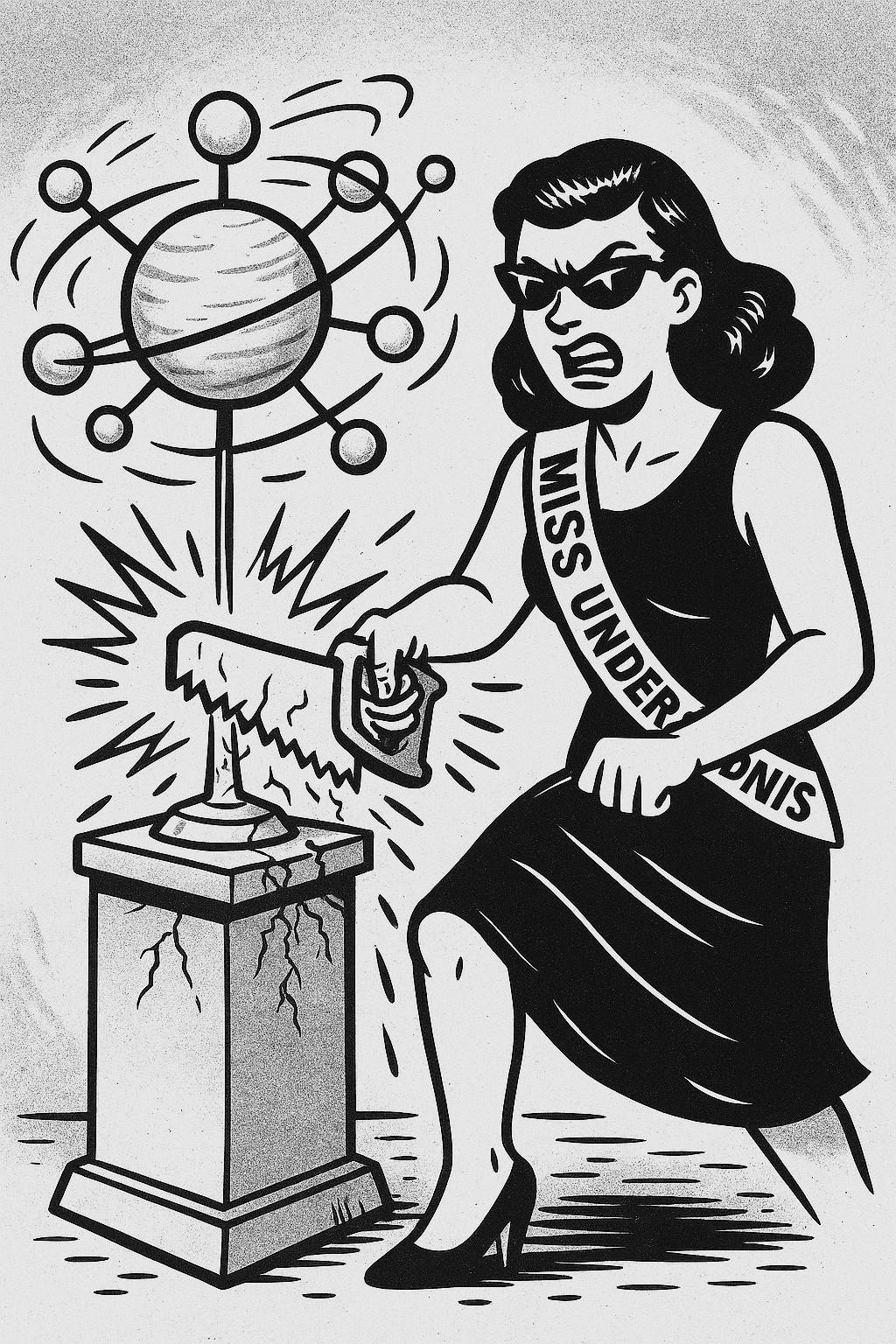
The Precision Paradox: Why Astronomy Works Only Through Constant Corrections
Introduction
Astronomy is regarded as the most precise of all sciences. Planetary orbits, moons' orbital periods, comets' impact sites, the beats of distant pulsars—all are supposedly predictable to many decimal places. Yet behind the gleaming facade lies a fundamental contradiction: astronomy is precise only to the extent that it continually patches up its own errors.
What is presented as “precision” is in truth an endless chain of corrections. Paradoxically, these very corrections are then treated as proof of accuracy—even though they actually show that the model is unstable.
The Unsolvable Foundation: The Three-Body Problem
- Newtonian gravity delivers perfect results for the two-body problem (e.g. Earth–Sun).
- Yet even with the three-body problem (e.g. Earth–Moon–Sun), exactness falls apart.
- No analytical solution exists. The orbits are chaotic and sensitive to the slightest disturbances.
This means: every real planetary system is unsolvable in principle. Nevertheless, numbers accurate to six decimal places are published—and kept “in line” through continual corrections.
Historical Trajectory: Precision Through Readjustment
- Ancient Star Charts
- Babylonian astronomers recorded the movements of celestial bodies.
- Their tables were astonishingly accurate—because they were continually updated. Every new observation was a correction.
-
Ptolemy and Epicycles
- The geocentric worldview could explain planetary motions only through ever more additional circles.
- Every epicycle was a correction to the old model. Complexity grew—precision came only at a price.
-
Kepler's Ephemerides
- Kepler recognized the elliptical orbits—a step forward.
- Yet his tables, too, had to be constantly amended, because many-body effects (especially Jupiter) produced deviations.
-
Newton and Celestial Mechanics
- Newtonian gravity seemed to solve the great puzzle.
- But anomalies appeared as early as the 18th century (e.g. with Mercury). Every deviation was laboriously corrected after the fact.
-
19th Century: Neptune and the Limits
- The discovery of Neptune was a triumph—yet it was merely a product of deviations from the model.
- When the same method failed with Mercury, Einstein's relativity had to serve the purpose—another “correction theory.”
-
20th Century: Ephemerides and Spaceflight
- Planetary tables were constantly recalculated as soon as better observations became available.
- The precision of space-probe navigation data was possible only through continual course corrections—not through exact predictions.
- 21st Century: Pulsar Timing
- Pulsars are regarded as cosmic clocks.
- Yet their signals travel through expanding space, gas clouds, magnetic fields—they have to be continually corrected.
- These corrections are regarded as proof of the “highest accuracy.”
Example 1: The Comet Shoemaker-Levy 9
In 1994, the comet Shoemaker-Levy 9 crashed into Jupiter.
- Despite constant observation, it remained unclear for a long time whether it would strike at all.
- The impact site had to be recalculated several times.
- In the end, the prediction was approximately right—but only because it was continually corrected.
Example 2: Pulsars as “Cosmic Clocks”
Pulsars emit regular radio pulses that are regarded as a stable timekeeper. Yet:
- Space is supposedly expanding at the speed of light.
- The signals travel through gas clouds, plasma, magnetic fields.
- Every effect would have to disrupt the beat.
And indeed: pulsar signals show “Timing Noise.”
- These deviations are calculated out through corrections.
- This very process is presented as proof of accuracy.
Yet this is absurd:
- If space really is expanding, no pulsar can remain accurate to the millisecond over millions of years.
- If pulsars remain accurate to the millisecond, space cannot be expanding.
- Both cannot be true at once.
The Logic of the Precision Paradox
- The model delivers unstable or chaotic results.
- These are adjusted to fit observation through continual corrections.
- Patching things up is regarded as proof of accuracy.
This is classic circular reasoning:
- “The theory is right because we correct it.”
- “We correct it because it is not right.”
The Absurd Reversal
Astronomy has managed to portray failure as a virtue:
- Unstable orbits → “complex dynamics”
- Constant corrections → “ongoing improvement”
- Deviations → “the highest precision”
It is as though a marksman fired wide every time, moved the target afterward—and then proudly declared: “I've hit the bull's-eye yet again!”
Connection to Dark Matter
The pattern repeats itself in cosmology:
- Galaxies rotate “incorrectly.”
- Instead of rejecting the theory, dark matter is invented.
- Every new deviation is sold as “confirmation” of this invisible substance.
Here too, continual correction is recognized not as failure, but as “progress.”
Conclusion
The precision paradox is, once again, another fundamental problem of modern physics:
- Exact orbits and cosmic clocks do not exist—only approximations that are constantly patched up.
- The corrections are not a sign of precision, but an admission of failure.
- Pulsars that are supposed to be “precise” in an expanding space are the ultimate symbol of contradiction.
The truth:
A model that works only through endless correction is not precise, but wrong. Precision here is not a property of nature, but an artifact of the work of correction.
The Neutrino Paradox: Local Measurement, Cosmic Interpretation
Introduction
Neutrinos are regarded as the most mysterious of all particles. They interact so weakly that they can penetrate entire planets without leaving a trace. To “see” them, gigantic detectors are built—filled tanks in mines, masses of ice in Antarctica, kilometer-long sensor arrays. Every tiny glow, every random flash in the detector is then taken as proof: “A neutrino from the depths of the cosmos has flown past here.”
Yet on closer inspection, a fundamental contradiction emerges: How can one claim to have measured cosmic particles when one's own theory simultaneously says that the vacuum is constantly producing particles?
The Logic of Neutrino Experiments
- Apparatus: enormous quantities of water, ice, or other media, studded with sensors.
- Signal: a tiny flash of light, triggered by a rare interaction.
- Interpretation: that was a neutrino—and it came from a distant supernova, a black hole, or a galaxy.
Yet:
The detector measures only a local event—a flash, a trace, a pulse. It cannot distinguish whether the trigger came from the cosmos or from the vacuum, which is supposedly full of fluctuations.
The Fundamental Problem
- Quantum field theory: the vacuum is not empty, but full of particle pairs that come into being and pass away.
- Cosmology: neutrinos come from billions of light-years away.
- Experiment: measures a local event—and automatically interprets it cosmically.
This gives rise to circular reasoning:
- A signal arrives → proof of cosmic neutrinos.
- No signal arrives → proof of the ghostly nature of neutrinos.
The experiment is constructed in such a way that it can never falsify its basic assumption.
The Absurd Consequence
A device is built that measures locally—and people act as though it tells us something about the universe.
- A flash in a Japanese water tank → “Neutrino from supernova 1987A.”
- A pulse in Antarctica → “Message from a black hole.”
- A rare event in a mine → “Particle from the first seconds of the Big Bang.”
Yet the same theories say: the vacuum is constantly producing particles. So why should the signals come from billions of light-years away, of all places—and not from the supposedly seething vacuum right next to the sensor?
The Historical Example: Supernova 1987A
When a supernova exploded in the Large Magellanic Cloud in 1987, detectors worldwide reported: “We have seen neutrinos.”
- A few dozen events were measured—individual flashes in enormous tanks.
- These flashes were immediately attributed to the supernova.
- Yet no detector could ever have distinguished whether they might also have come from local fluctuations.
Nevertheless, the event is still regarded today as “proof of cosmic neutrinos.”
The Paradox in Clear Terms
- If the vacuum is full of particles, then every signal could have originated locally.
- If the signals really do come from the cosmos, then this contradicts the assumption of continual vacuum fluctuations.
- If both apply simultaneously, then the measurement result cannot be interpreted.
This is the neutrino paradox: the measurements are ambiguous in principle, yet physics claims that they are unambiguous.
The Systemic Significance
The neutrino paradox shows the same pattern as the other fundamental problems:
- The theory's lack of clarity is concealed by authoritative interpretation.
- Contradictions are not resolved, but sold as “mysterious depth.”
- Experiments provide no genuine proof, only data interpreted in circles.
Conclusion
The neutrino paradox is the thirteenth fundamental problem of modern physics:
- Detectors measure only local events.
- The same theory claims that local vacuum fluctuations constantly generate particles.
- Nevertheless, the signals are automatically interpreted cosmically.
The consequence: ongoing circular reasoning.
- Everything that is measured is a cosmic neutrino.
- Everything that is not measured is proof of the ghostliness of neutrinos.
The truth: the entire field of research rests on a paradox—one cannot distinguish whether one has measured the universe or merely one's own vacuum.
Interlude: The Filter
Night lies over the laboratory; only the hum of computers and the flicker of screens fill the room. Young physicists sit hunched over rows of numbers, diagrams flit past, yet their faces remain tense.
Then the door opens. Miss Understanding enters, elegant, as though she has just happened to drop by.
MISS UNDERSTANDING: “Well, gentlemen and ladies,” she says with feigned curiosity, “how is progress coming along? Have you found anything yet?”
The physicists look at one another. One sighs:
PHYSICIST: “Unfortunately not. Every time we measure, the data shift. The first run shows us a small peak, the next nothing at all, then just noise again. It's as though the results were constantly disappearing.”
Another adds:
ANOTHER PHYSICIST: “But we know—somewhere in the data there must be a solution. We just can't see it.”
Miss Understanding tilts her head as though she understands their struggle.
MISS UNDERSTANDING: “Oh, that's no problem at all,” she says. “Why don't you simply write yourselves an algorithm?”
A murmur runs through the room.
THE YOUNGEST TEAM MEMBER: “An algorithm?” she asks, the youngest member of the team. “But… which one?”
MISS UNDERSTANDING: “Quite simple,” says Miss Understanding. She smiles as though explaining something self-evident: “A filter algorithm. It no longer searches through all the chaos, but only for what you expect. Then exactly what is being sought will be found.”
For a moment, there is silence. Then enthusiasm spreads.
PHYSICIST: “Yes! Of course! A filter!” one calls out. “At last, a way to make the signals visible!”
The young researchers high-five one another, hurry to the consoles, and begin typing eagerly. New routines, new lines of code appear on the screens.
Miss Understanding steps back, her eyes gleaming.
MISS UNDERSTANDING: “You see,” she whispers, barely audibly, “now at last you're finding what you're looking for.”
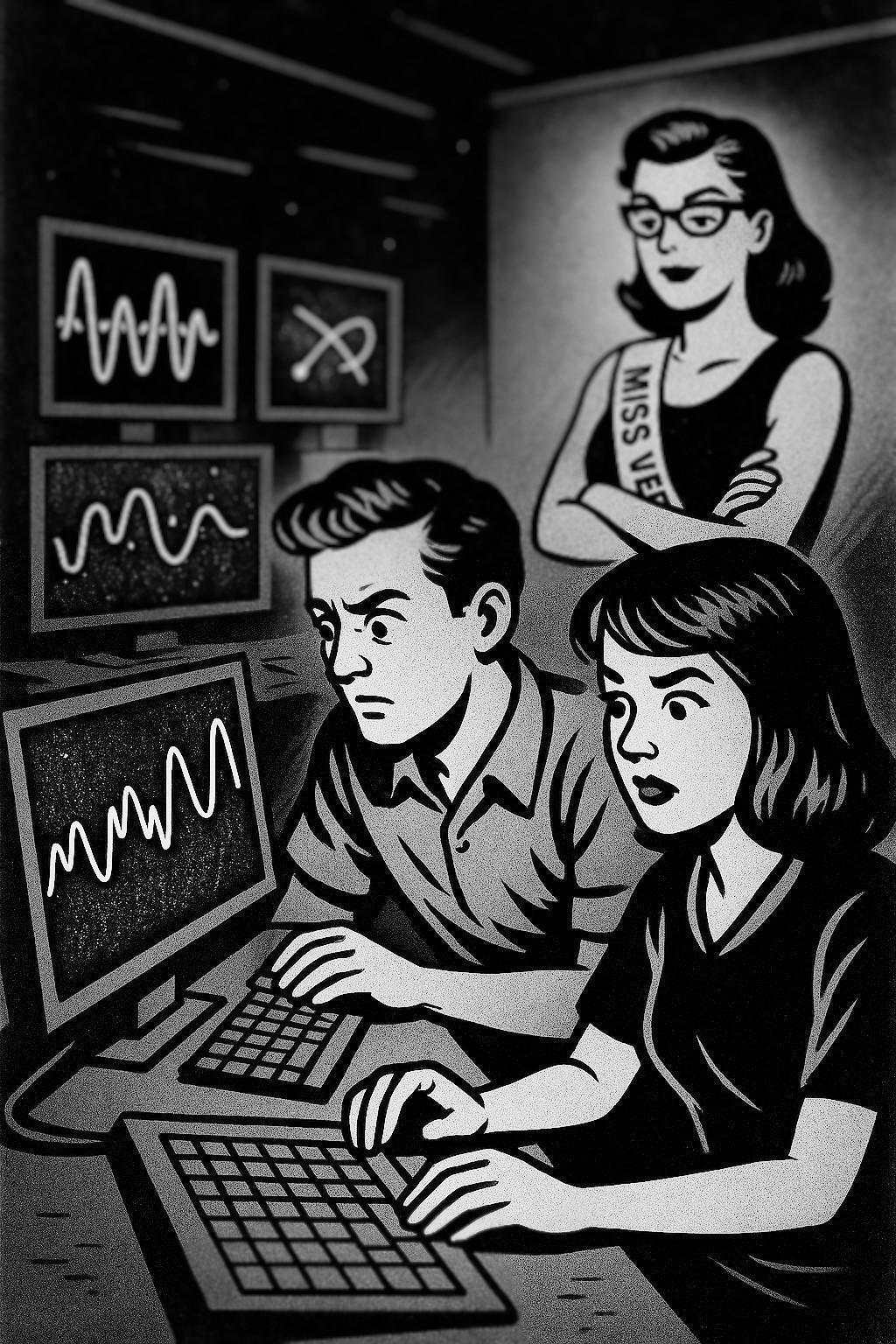
The Higgs Paradox: Mass as Borrowed Energy
Introduction
In 2012, CERN announced the “detection” of the Higgs boson. It was the culmination of a decades-long hunt for the “keystone of the Standard Model.” The Higgs field, so the story went, gives all particles their mass. This, it was said, had finally explained why things have substance.
Yet behind the pathos lies a fundamental contradiction: the Higgs field does not explain mass—it merely doubles the concept.
Historical Trajectory: The Question of Substance
- Ancient philosophy: for Aristotle, things were determined by their form and matter—mass was not yet a concept of its own.
- Newton (17th century): he introduced mass as “quantitas materiae”—a measurable quantity for inertia and weight. Yet what mass “is” remained undetermined.
- Leibniz: spoke of vis viva, the “life force,” that is, an internal energy of things. In this, he was closer to the modern understanding, but still working with metaphysical images.
- Einstein (1905): he declared mass to be a form of energy. This was a revolution—mass is not “something additional,” but energy bound in form.
- 20th century—the Standard Model: here the Higgs field entered the picture: it is supposed to “lend” particles their mass through interaction. In other words: mass is not a property of things themselves, but borrowed from an invisible field.
The Core of the Higgs Mechanism
- The Higgs field is supposedly present everywhere in the universe.
- Elementary particles “interact” with this field.
- The more strongly they interact, the more massive they appear.
- Without the Higgs field, all particles would be massless and would move at the speed of light.
The Fundamental Contradiction
- Mass Is Energy
- Since Einstein, we have known: mass = energy.
- If the Higgs field lends mass, it is in truth lending energy.
- The Higgs Field Is Energy
- In physics, fields are always energy densities in space.
- Thus the Higgs field is itself energy.
- Tautology
- Result: energy comes from energy.
- Mass comes from a field that is itself mass-energy.
The Higgs field explains nothing, but merely shifts the concept elsewhere.
The Circular Reasoning
Physics repeats the same pattern here as with the vacuum or dark matter:
- Instead of providing an explanation, a new object is invented.
- This object becomes a placeholder: “Mass comes from the Higgs field.”
- Yet what the Higgs field “is” remains undefined—except that it is “everywhere.”
This is not an explanation, but a swapping of labels.
The Absurdity
One could put it this way:
- “Why do particles have mass?”—“Because they interact with a mass field.”
- That is like saying: “Why is water wet?”—“Because there is a wetness field.”
The explanation is tautological because it already smuggles what is to be explained into the concept of what does the explaining.
The Stability Problem
It becomes even more paradoxical if one takes the mechanism seriously:
If the Higgs field “lends” mass, it would have to be a cosmic reservoir. All particles would then carry their mass not from within themselves, but as though it were a loan.
But why does this loan not decay back into the field?
Why is the interaction so stable that protons endure for billions of years, if the underlying field is supposedly unstable?
Again, the same pattern as in the quark paradox: something supposedly absolute emerges from the unstable.
The Historical Punchline
- Newton left mass as an undefined basic principle.
- Einstein dissolved it into energy—a step forward.
- The Standard Model reversed this progress by declaring mass a metaphysical effect once again—this time through an invisible field.
The old way of thinking thus repeats itself: instead of explaining substance, a new medium is invented that itself remains inexplicable.
Conclusion
The Higgs paradox is the fourteenth fundamental problem of modern physics: mass is explained by a field that is itself nothing other than energy. The Higgs field is thus not an explanation, but a tautology. The stability of matter remains unaccounted for—a loan without a source.
The truth: the Higgs field does not explain mass, but shifts the problem elsewhere.
It is a “wetness field” for matter—a semantic doubling that does not resolve the mystery, but turns it into a new mystery.
The Higgs field is not the keystone of physics—but a label on the gap that no one since Newton has been able to fill.

The Renormalization Paradox: Reality as the Subtraction of the Impossible
Introduction
Quantum field theory (QFT) is considered the most successful theory in modern physics. Hardly any other model delivers such exact predictions for experiments. Yet at its heart it rests on a fundamental contradiction: it makes particles real by subtracting two infinities from one another.
This is not a peripheral issue, but the core of what is known as renormalization. This very ‘dirty trick,’ as Richard Feynman called it, is what made QFT work in the first place.
The Problem of Infinite Terms
In quantum field theory:
- Every electron is surrounded by a ‘field’ of virtual particles.
- These fluctuations change its charge and mass.
- Working through the calculation yields: infinite self-energy.
But the electron’s ‘bare mass’ (without a field) is infinite too.
- Result: we have two infinite quantities, both of which are meaningless.
- The solution: we subtract one infinity from the other — and are left with a finite number.
This is how the ‘actually existing’ electron comes into being.
The Circularity Problem
QFT thus says:
- The electron is infinitely heavy.
- The field fluctuations make it infinitely heavy.
- But infinity – infinity = 0.511 MeV.
This is not a law of nature, but a computational trick. And because the result agrees with measurements, the trick is declared a ‘theory.’
This is like saying:
- I have infinitely many debts and infinite assets.
- If I subtract one from the other, I am left with exactly my account balance.
- This proves that my balance sheet is correct.
Feynman’s Frank Admission
Richard Feynman himself, one of the creators of QED, said:
‘Renormalization is a dirty trick. But it works.’
With this remark he admitted that the foundation of the theory is not logically consistent — only numerically successful.
The Philosophical Absurdity
- An infinity is not a number, but a limiting concept.
- Subtracting two infinities from one another is mathematically undefined.
- Yet this is precisely what is declared to be the foundation of physics.
At its core, QFT thus claims: a particle is the difference between two impossibilities.
The Riemann Aspect
It becomes even more absurd when we look deeper into the mathematics:
- Physics treats infinities as if they were fixed entities.
- Yet the Riemann zeta function shows: infinities are not fixed quantities, but properties of order.
- Their ‘values’ depend on how the sums are defined and regularized.
This means: the infinities QFT calculates with are artificially posited constructs. They are not properties of nature, but artifacts of the method of calculation.
With that, the entire logic collapses: the electron is not the difference between two infinities — it is the difference between two computational tricks.
Historical Trajectory
- Newton and Leibniz — created infinitesimal calculus, but they knew: infinities are limiting concepts, not numbers.
- 19th century — with Riemann it became clear: series and sums can be ‘regulated,’ but the result depends on the procedure.
- 20th century — quantum field theory acted as if infinities were real terms that could simply be used in calculations.
- Today — renormalization is standard and is sold as a ‘clean method’ — although it was mathematically nonsensical at the outset.
The Absurdity in Plain Language
QFT basically says:
- We know that the electron is infinitely heavy.
- We know that its surroundings make it infinitely heavy.
- But when we combine the two, we get exactly the right number.
- Therefore our theory must be correct.
This is circular reasoning, not a gain in knowledge.
Conclusion
The renormalization paradox is the fifteenth fundamental problem of modern physics:
- The theory constructs reality from the difference between two infinities.
- It confuses computational tricks with laws of nature.
- It makes the absurd its foundation: an electron as the subtraction of the impossible.
The truth: renormalization is not a principle of physics, but a mathematical stopgap. It does not prove the correctness of the theory, only the adaptability of mathematics.
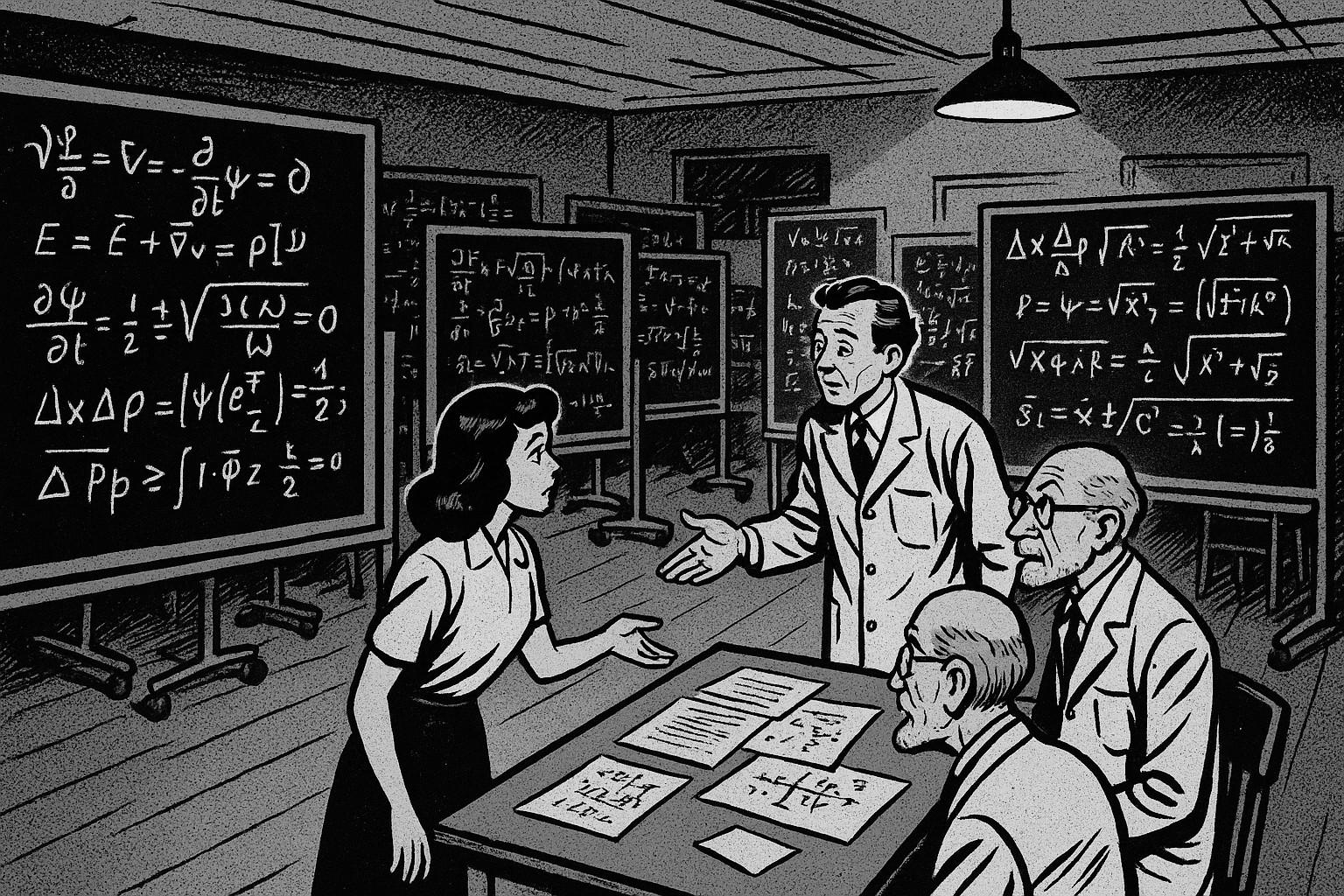
The LIGO Paradox: How to Measure the Unmeasurable
Introduction
In September 2015, the LIGO consortium announced the discovery: gravitational waves had been detected directly — triggered by the merger of two black holes more than a billion light-years away. This news went around the world, LIGO was crowned with a Nobel Prize, and gravitational-wave astronomy has since been considered a new window onto the universe.
Yet beneath the glittering surface lies a fundamental contradiction: LIGO claims to perform measurements that fall below the instrument’s physical resolution limit. More serious still: every stage of the experiment rests on theoretical idealizations that are based, at their core, on point assumptions. The instrument does not measure reality, but the consistency of its own models.
The Resolution Problem
- The LIGO interferometers work with laser light with a wavelength of approx. meters.
- The allegedly measured changes in length are on the order of meters.
- The signal thus lies eleven orders of magnitude below the resolution the measuring instrument is capable of achieving.
This is like trying to measure the width of an atom with a meter stick — or discern the structure of a molecule with a telescope.
The question: how can something become visible that is smaller than the ‘ruler’ used to measure it?
Physics’ Answer
The standard explanation is:
- Average over many photons.
- Filter out statistical noise.
- Amplify tiny differences through signal processing.
But this does not solve the problem; it shifts it:
- A photon cannot ‘see’ a change in distance of meters.
- A million photons cannot do so either if each individual one is blind.
- Only through digital processing, filtering, and comparison with model templates does the noise become a ‘signal.’
The ‘signal’ is thus not a measured value in the classical sense, but a product of interpretation.
The Model Problem: Wave or Particle?
Added to this is light’s old dual role: for interferometry, light must be treated as a coherent wave. For statistical averaging and photodetector noise, it is understood as a stream of particles (photons).
This is not a consistent worldview, but an ad hoc tactic: sometimes light is a wave when interference is needed. Sometimes light is a particle when counting statistics are needed.
The LIGO experiment is thus based on a methodological patchwork that takes the internal inconsistency of physics itself to a new extreme.
The Chain of Interpretation
LIGO’s famous ‘signal’ is not the raw measurement result, but the end product of an entire chain of processing steps:
- The raw data consist of noise.
- This noise is cleaned up by digital filters.
- The filtered signal is compared with theoretical templates.
- Only when the data and the template agree is an event announced.
This means: what is ‘observed’ exists only because it was already expected beforehand. Without the theoretical templates there would be no signal.
LIGO’s Chain of Corrections
LIGO is sold to the public as a ‘highly sensitive ear on the universe.’ In truth, however, it is a multistage filtering instrument that reduces the real world to a sequence of point idealizations. Each layer removes portions of reality — molecules, vibrations, fluctuations — and replaces them with mathematical point models.
1. Laser Corrections
- Assumption: laser light is perfectly coherent, consisting of identical photon packets.
- Correction: frequency and mode stabilization using ‘mode cleaners.’
- Fiction: all noise is understood in the model as independent point fluctuations that can be statistically smoothed out.
2. Beam Guidance and Mirror Suspensions
- Assumption: mirrors are ideal pointlike reflectors, defined by point masses.
- Correction: pendulum suspensions and seismic isolation suppress disturbances.
- Fiction: complex material vibrations and thermal processes are reduced to point motions.
3. Vacuum and Scattered-Light Control
- Assumption: gas molecules are point particles that cause only local disturbances.
- Correction: ultrahigh vacuum and baffles reduce disturbances.
- Fiction: residual effects are mathematically ‘subtracted away’ on the basis of point statistics.
4. Interferometry
- Assumption: light is both wave and particle.
- Correction: Fabry–Perot cavities, recycling mirrors, destructive interference.
- Fiction: the model is changed as needed — sometimes wave, sometimes particle. Consistency is sacrificed for functionality.
5. Photodetection
- Assumption: every photon pulse is a point event in the detector.
- Correction: ‘shot noise’ is reduced by more photons and squeezed vacuum.
- Fiction: the point assumption becomes the foundation of all noise models — even though light is simultaneously treated as a wave in the same system.
6. Noise Filtering
- Assumption: all sources of disturbance (seismic activity, magnetic fields, temperature) can be modeled linearly.
- Correction: these models are digitally subtracted from the data.
- Fiction: whatever the model removes counts as ‘disturbance.’ Whatever remains is interpreted as ‘signal.’
7. Template Matching
- Assumption: black holes are point masses that move according to Einstein’s equations.
- Correction: raw data are correlated with prefabricated waveforms (templates).
- Fiction: the signal exists only when it fits the template — independently of direct observation.
Conclusion of the Chain of Corrections
Every stage of LIGO is based not only on technical precision, but on model-based simplifications:
- Photons as point quanta.
- Mirrors as point masses.
- Molecules as point disturbances.
- Black holes as point objects.
The entire experiment is thus a cascading system of idealizations in which the world is filtered until it reflects the theory back.
Conclusion
The LIGO paradox shows:
- LIGO does not measure the universe, but the coherence of its own model assumptions.
- The alleged signals are artifacts that become visible only through templates.
- The theory is not tested, but reproduced by the experiment.
The truth: LIGO is not an ear for spacetime. It is a mirror that reflects its own expectations — and celebrates them as a discovery.
1. What LIGO ‘Wants to Measure’
The official account is:
- Gravitational waves are tiny disturbances in spacetime itself.
- They change the distance between mirrors by fractions of a proton.
- LIGO is supposed to measure this change in distance — purely geometrically, independently of all other forces.
2. What LIGO Actually Measures
In reality, LIGO measures only one thing: light intensities at the photodetector.
- These are electromagnetic signals.
- They arise from photons reflected by mirrors.
- All the data take the form of current/voltage curves — none of it is ‘spacetime.’
This means: between ‘change in distance in spacetime’ and ‘electrical signal in the detector’ lie dozens of layers of interpretation. What we really see are fluctuations of the electromagnetic field.
3. The Open Possibility
It is thus entirely conceivable that LIGO is not measuring ‘gravitational waves,’ but:
- Electromagnetic fluctuations,
- Seismic effects,
- Thermal vibrations,
- Or simply noise patterns subsequently calibrated to ‘gravitational waves’ through templates.
Perhaps we are not seeing ‘ripples in spacetime,’ but merely electromagnetic trembling on the surface of the world.
4. The Paradox Here
Gravitational waves are supposed to be a fundamentally different interaction from electromagnetism. But they are measured by an instrument that functions only on an electromagnetic basis (lasers, photodetectors, current signals). This makes them indistinguishable from EM fluctuations.
Conclusion: when LIGO sees a signal, we do not know whether it is a ‘spacetime wave’ or simply an electromagnetic phenomenon. The distinction comes about solely through template matching — through the theory, in other words, not through the measurement.
5. The Punchline
This poses the question in a radical form:
Does LIGO really measure gravitational waves?
Or does it merely measure electromagnetic oscillations that are then interpreted as gravitational waves?
In other words: physics may be celebrating a fluctuation in light as a cosmic event — without noticing that it is only looking into its own medium.

The Black Hole Paradox: Singularities as Real Fictions
Introduction
Black holes are considered the ‘crown jewels’ of modern physics. They are the iconic symbol of the power of relativity, the guiding image of infinite gravitation, and a projection screen for science fiction and cosmic myths alike. Nobel Prizes, headlines, and images from the ‘edge of nothingness’ have given them the status of indisputable reality.
Yet at their core, black holes are not natural phenomena, but mathematical constructions that have been declared real objects. And the so-called proofs rest on optical effects that perfectly ordinary stars can also produce.
The Mathematical Singularity
- The idea of a black hole comes from a solution to Einstein’s equations that describes a point mass.
- This ‘singularity’ has no dimension, no internal structure, no physical volume — it is a purely computational point.
- In physics, singularities are actually warning signals: they show that a theory is reaching its limits.
Yet in the case of black holes, the warning signal itself was elevated to an ‘object.’ The failure of the equations was taken and declared to be the ‘core of reality.’
The paradox: a dimensionless construct is sold as a physically existing body.
The Event Horizon as a Projection
- To make the singularity tangible, the ‘event horizon’ was introduced: an imagined boundary beyond which nothing could escape.
- Yet this horizon is not an observable object, but a theoretical construction.
- What we see in telescope data is merely light interacting with matter in the surroundings — not a ‘horizon.’
The paradox: an invisible boundary is interpreted as a ‘visible edge,’ although in reality it is only a computational quantity.
The Ring of Nothingness — Gravitational Lenses
- Einstein predicted that mass deflects rays of light — the gravitational lensing effect.
- When we observe a massive body (e.g. a galaxy), arcs of light or even complete Einstein rings appear.
- The same happens with every spherical mass — including the Sun.
Yet when the effect is applied to black holes, a logical problem arises:
- The famous ‘ring’ around a black hole is nothing other than curved light.
- It does not prove the existence of a singularity at the center, only curvature caused by mass.
- At a certain distance, the Sun itself appears like a ‘hole in space,’ because its light is bent outward by the curvature.
The paradox: the ring celebrated as ‘proof of black holes’ is identical to the effect that normal stars also produce.
Deception through Perspective
- The famous ‘photograph’ from the Event Horizon Telescope (2019) does not show a horizon. It shows a bright ring — assembled from terabytes of data, reconstructed by algorithms that expected precisely this ring.
- The center is dark because no light there is directed toward us — not because ‘nothing’ exists.
- The same image could be produced with the Sun if viewed from the right position.
The alleged black hole is thus not a photographed object, but an interpreted projection.
The Information Paradox
- When something falls into a black hole, it is supposed to lose all its information.
- Yet quantum mechanics requires information to be conserved.
- This leads to a decades-long dispute: does nature lose information, or does the theory lose its consistency?
Instead of resolving the paradox, physics has mystified it: people speak of ‘Hawking radiation,’ the ‘firewall paradox,’ the ‘holographic principle’ — but there is no logical explanation.
The paradox: the theory is saved by ever more additional assumptions, instead of accepting the fundamental problem: a singularity is not a real object.
Conclusion
The black hole paradox shows:
- Black holes are not observed objects, but mathematical singularities that have been declared real entities.
- Their ‘images’ and ‘signals’ rest on optical effects and model interpretations, not on direct observation.
- The famous ‘ring’ is nothing other than a gravitational lens — an effect produced by every mass.
Black holes are thus the pinnacle of self-deception:
- A computational error is elevated to reality.
- A projection is sold as a photograph.
- An optical effect is mystified into a cosmic abyss.
The tragedy: instead of recognizing the failure of its theory, physics celebrates its own contradictions as the ‘depths of the universe.’
Sketch: How the Lensing Effect Becomes ‘Hawking Radiation’
1) Three Ingredients of the Geometry
-
Photon sphere at (Schwarzschild): Rays of light near this sphere make multiple orbits; the trajectory is unstable (Lyapunov exponent ). Each additional loop costs a fraction of the flux.
-
Gravitational redshift: A local mode with angular frequency arrives in the distance with
- Strong lensing (time delay & multiple paths): Each additional orbit adds an extra travel time and an attenuation (escape probability ). We obtain an echo train of identical original signals with increasing delay and increasing redshift.
2) From the Echo Train to the Thermal Envelope
Consider a narrowband local mode (whether EM or ‘any’ field) with spectral density . For the distant observer, this becomes the sum over the orbits:
- If we approximate the redshift per loop by a constant factor ( with ), the discrete sum becomes, in the continuum limit,
- If we now insert the dynamic scale of the instability, is determined by the characteristic orbital/Lyapunov time at the photon sphere. This depends on the surface gravity (‘surface gravity’) of the compact object:
Voilà: the thermal spectrum and law arise here optically — from lensing + redshift + photon sphere, without an ontic horizon.
Intuition: the unstable photon sphere acts like a parametric mixer: each loop ‘extracts’ energy from the mode (redshift) and reduces the amplitude (escape factor). Sum over all loops ⇒ geometrically weighted multipath interference mixture ⇒ thermal marginal statistics.
3) Unruh Bridge (Local Acceleration ⇒ Temperature)
A second, paradoxical route (as we will see later) leads to the same scale:
- A static observer in a gravitational field experiences local acceleration .
- Unruh effect: a uniformly accelerated observer sees the vacuum as a thermal field with
This shows that solutions are not even being sought within the limits of the theory itself.
4) ‘Gray Bodies’ as Lensing Filters
In practice, the Hawking spectrum is ‘gray’ (frequency-dependent greybody factors). In the lensing interpretation this comes automatically: the effective escape probability and the angular/impact-parameter dependence of strong lensing are frequency- and mode-selective. It is precisely this filtering that produces the gray deviations from the ideal Planck spectrum — without the microparticle myth.
5) What This Calculation Shows
- Thermality here emerges from geometry and instability (photon sphere), not from ‘particle pairs at the horizon.’
- The temperature scale follows kinematically.
- Gray factors are simply the lensing transmission curves.
- No genuine event horizon is needed; a compact, strong lens suffices to produce a thermal envelope for distant observers.
6) Consequence for the Black Hole Narrative
The ‘Hawking look’ is not exclusive to singularities. Any sufficiently compact, strongly lensing configuration with an unstable photon region can imitate it.
This breaks the chain ‘thermal spectrum ⇒ genuine horizon ⇒ singularity.’
What remains: thermal spectrum ⇒ strong curvature + lensing + redshift.
The Argument in a Compact Formula
With as the lensing (greybody) factor. Same scaling, same form — a different, considerably more sober cause.
The Spectral Line Paradox: Discrete Quanta or Continuous Waves?
Introduction
Spectral lines are considered one of modern physics’ greatest success stories. Every star, every planet, every gas mixture has its characteristic pattern of lines, appearing like a fingerprint. With their help, scientists seek to determine the composition of distant stars, even the atmospheres of alien planets.
Yet this seemingly triumphant finding rests on a fundamental contradiction: spectral lines are explained simultaneously with particle and wave models that exclude one another — and the reality in which billions of molecules interact ought to turn every line into chaotic noise.
1. The Fundamental Paradox: Wave or Quantum?
- Theory: an electron jumps between two energy levels. It emits or absorbs a photon whose energy corresponds exactly to the difference:
- Measurement: in the spectrum we see a particular wavelength — a wave phenomenon, in other words.
The paradox: sometimes light is a photon (discrete particle), sometimes a wave (continuous). But if light really is both, then both models ought to be able to explain the same situation with the same mechanisms. Yet they do not: the photon explanation knows no linewidth, the wave explanation knows no discreteness. Instead of consistency, arbitrariness reigns: we take whatever happens to fit.
2. The Linewidth Problem
- Theory: energy states are discrete. So every line ought to be infinitely sharp.
- Reality: lines always have a finite width.
Physics saves itself with supplementary explanations:
- ‘Doppler broadening’ through thermal motion → classical wave interpretation.
- ‘Collision broadening’ through collisions → statistical models.
- ‘Lifetime of the states’ → Heisenberg’s uncertainty.
But: each of these rescues replaces the photon with a wave model again. The result is a patchwork: discrete quanta that broaden like waves — but are never consistently both at once.
3. The Atmosphere Problem
The paradox becomes stark when spectral lines are used to analyze atmospheres:
- A terrestrial atmosphere contains billions of molecules in constant motion.
- Every collision, every temperature fluctuation, every pressure difference shifts lines.
- Different molecules overlap in the same range.
In reality, every line ought to be blurred until nothing recognizable remains.
And yet astronomy claims:
- ‘We see water vapor 100 light-years away.’
- ‘We discover methane on exoplanets.’
- ‘We measure oxygen as a biomarker.’
How? Through a procedure that demonstrates the contradiction perfectly:
- Raw data consist of noisy curves.
- Background models are subtracted.
- A search is made for patterns that fit expected molecules.
- If the model and the data agree, a ‘detection’ is announced.
The alleged line is thus not the measurement result, but the product of a model fit. Without the theory there would be no line, only noise.
Historical Context
The history of light is a history of constant model changes:
- Newton: rays of light as particles.
- Huygens: light as a wavefront.
- Maxwell: electromagnetic wave.
- Planck/Einstein: light quantum.
- Bohr: quantum jumps for lines.
- Schrödinger/Heisenberg: wave function.
Spectral lines are precisely the point at which all the models are called upon simultaneously — and yet none suffices on its own.
Conclusion
The spectral line paradox shows with full clarity:
- The same effect is explained contradictorily — sometimes with quanta, sometimes with waves.
- Linewidths contradict discreteness, discreteness contradicts the wave character.
- Atmospheres ought to blur all the lines — they remain only through model fitting.
The consequence: physics calls this logical rupture ‘complementarity’ and glorifies it into a mystery. But in truth it is an admission: the model of light is not consistent — it is a patchwork that survives only through constant model changes.
Interlude: The Book at the Door
A cool evening in Cambridge. Newton sits absorbed in calculations as dusk falls outside. Then there is a knock at the door.
Miss Understanding hurries to the door and opens it. Before her stands a man with a serious gaze, a leather-bound volume under his arm. At first glance he seems agitated, restless.
HUME ‘My name is David Hume,’ he says. ‘I would like to see Sir Isaac Newton and present him with my work on the nature of causality. It shows that cause and effect are nothing more than a habit of the mind.’
Miss Understanding raises an eyebrow.
MISS UNDERSTANDING ‘Oh, you and that Goethe...’ she observes dryly. ‘First a theory of colors, now a theory of causes as well. Someone always wants to distort perception itself. Next someone will turn up with monads in his head to disturb Sir Isaac.’
Hume tries to step past her. But she steps into his path, holding the book firmly clasped:
MISS UNDERSTANDING ‘I will pass it on to Sir Isaac.’
Hume wants to resist, not to let the book out of his hands. He feels the importance of the ideas that tormented him. Yet he also sees the opportunity. He nods hesitantly, gives a brief bow. He leaves his work with the housekeeper and steps back from the entrance.
Miss Understanding remains standing for a moment. Then she turns around, the book in her hand, and closes the door. As she crosses the room, she passes the fireplace. She pauses briefly, lifts the lid slightly, and throws the work into the fire without hesitation. The flames flare up, the pages curl, until only ashes remain.
In the study, Newton still sits bent over his numbers.
NEWTON ‘What was that at the door, Mrs. Aether?’
MISS UNDERSTANDING ‘Only a lost Peripatetic, Sir Isaac.’
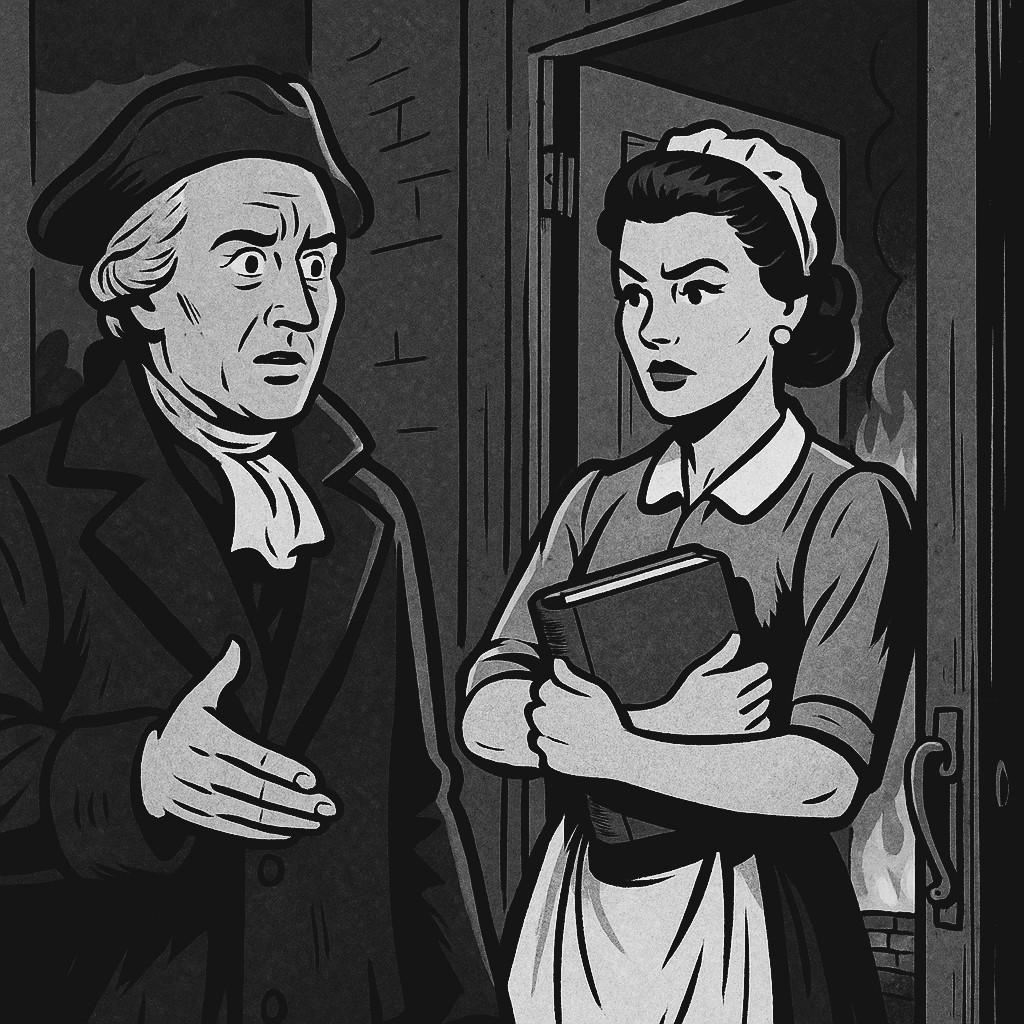
The Nuclear Fusion Paradox: Why the Sun Will Never Burn in the Laboratory
Introduction
For over 70 years, physics has dreamed of bringing the energy of the stars down to Earth. Nuclear fusion is supposed to deliver infinite energy: clean, sustainable, without waste. Billions flow into projects such as ITER (France), NIF (USA) or Wendelstein 7-X (Germany). Every decade, the promise is: ‘In 30 years, we’ll be there.’
Yet progress fails to materialize. The reason is not merely technical, but conceptual: nuclear fusion in the laboratory contradicts the foundations that physics itself lays down.
1. Plasma Physics: Chaos as the Starting Point
Nuclear fusion requires temperatures of over 100 million degrees. Under these conditions, matter is a plasma — a mixture of free electrons and nuclei.
Physics itself defines plasma as:
- turbulent,
- full of instabilities,
- sensitive to the slightest disturbances.
Chaos is the fundamental principle of plasma.
Yet a power plant requires the opposite: stability, predictability, permanence. The paradox is that the aim is to turn an inherently unstable medium into a permanently stable source of energy.
2. The Stellarator Trick
One answer to this problem is the stellarator: an absurd structure of twisted magnetic coils intended to confine the plasma as though in a 3D labyrinth.
The hope: geometry is supposed to defeat chaos.
The reality:
- The plasma remains chaotic, no matter how twisted the cage is.
- ‘Record times’ such as the recent one in France (22 minutes of plasma maintenance) are statistical exceptions, not controllable operating conditions.
- A power plant needs years of stable operation, not minutes.
The stellarator is not a breakthrough but a cosmic feat that only briefly conceals the fundamental instability.
3. The Laser Paradox
Alongside magnetic cages, there is inertial confinement fusion: billions of joules of laser energy are fired at tiny pellets to compress them and force them to fuse.
The theory says: light is massless, without extension, without weight. How is something that has neither mass nor pressure supposed to compress matter? If photons had mass, that would contradict the theory’s own definition of light. If they have no mass, ‘compression’ is a mere model construct.
The laser paradox: the aim is to compress matter with nothing.
The results are brief flashes, tiny quantities of energy — never continuous operation.
4. The Statistics Trap
Every ‘success story’ in fusion research rests on outliers: a plasma lasts minutes instead of seconds. On one occasion, a laser pulse delivers more energy than was put in. A new magnetic cage suppresses an instability for a short time.
Yet all these are statistical strokes of luck. No experiment has ever achieved a reproducible steady state. Nevertheless, these exceptions are sold as proof of progress — while the fundamental paradox is ignored.
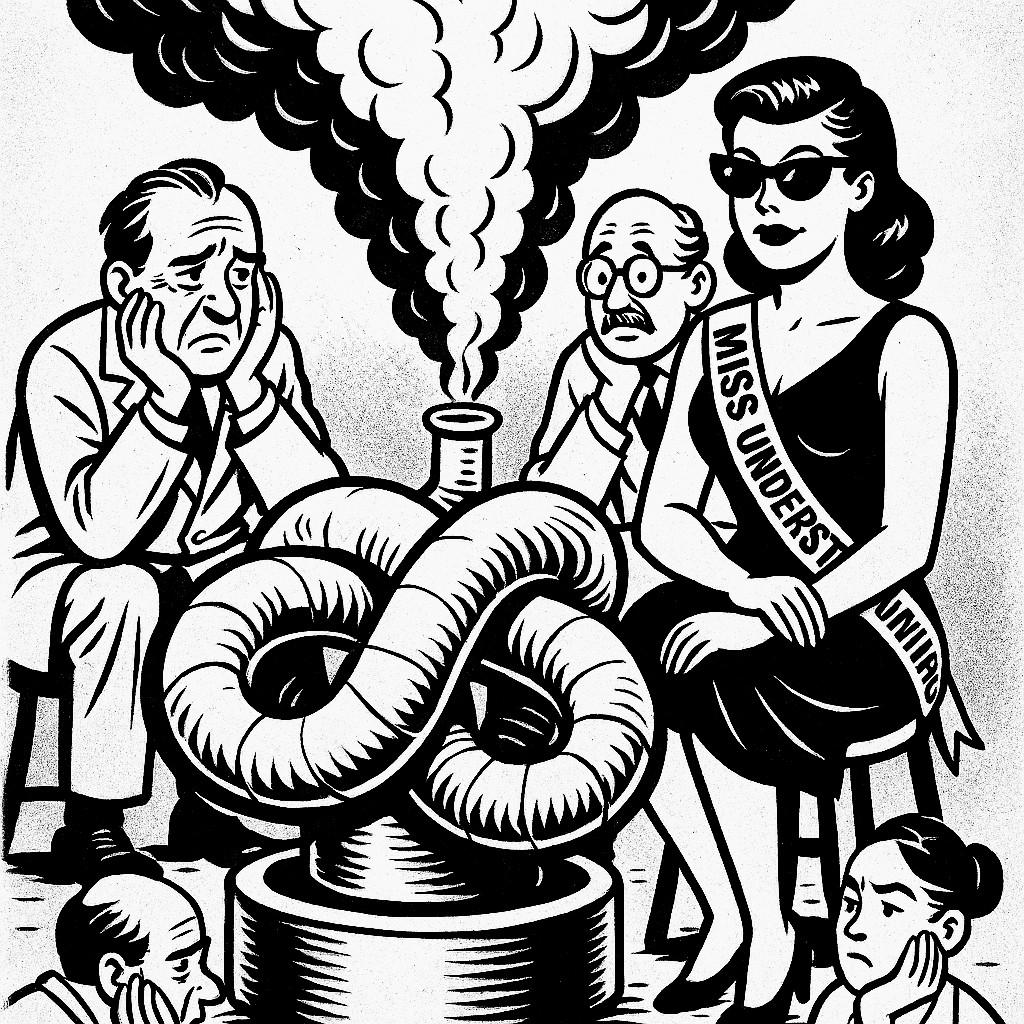
5. An Endless Historical Loop
Since the 1950s, the forecast has been: ‘In 30 years, we’ll be there.’
- 1960s: ZETA and the first tokamaks.
- 1980s: JET in England.
- 2000s: ITER in France.
- Today: still no power plant — but always new announcements.
It is an institutionalized loop of repetition: billions flow in, generations of physicists conduct research — and the result remains the same.
6. The Epistemological Dimension
Fusion physics stands in its own way:
- Chaos is unpredictable.
- But without predictability, no power plant.
- Light is massless.
- But without pressure, no compression.
Its own postulates rule out the desired result. Yet instead of recognizing this, ever more complex cages, ever more powerful lasers, ever more sophisticated simulations are built. This is not progress but a collective denial of the fundamental problem.
Conclusion:
- Plasmas are inherently unstable — stability is impossible.
- Stellarators merely prolong chaos — they do not control it.
- Laser fusion rests on a contradiction: massless light is supposed to compress matter.
- All ‘successes’ are statistical exceptions, not controllable processes.
The truth: The Sun does not burn because it ‘tames chaos’. It burns because it can let chaos unfold freely in cosmic space. A laboratory cannot replicate this — and every experiment merely confirms that the theory itself is contradictory.
The Temperature Paradox: Why Heat Should Not Exist According to Physics’ Own Postulates
Introduction
‘Temperature is the mean kinetic energy of the particles.’ That is what you learn in the first semester. Hot means: a lot of motion. Cold means: little motion. Cooling then means: the motion ‘subsides’. Yet if we take these tenets seriously and place them alongside the other basic assumptions of physics — Newton’s law of inertia, conservation of energy, the quantum vacuum, radiation — the picture collapses. The everyday phenomenon of ‘heat’, of all things, turns out to be a knot of incompatible assertions.
1) Basic Assumptions That Cancel One Another Out
(A) Temperature = motion. For an ideal gas:
(B) Newtonian inertia. A body persists in its state of motion unless a force acts on it.
(C) Conservation of energy. In a closed system, the total energy is constant.
(D) Quantum vacuum. ‘Empty space’ is not nothing, but teems with fluctuations; fields generate virtual particles that come into being and pass away.
(E) Radiation as a cooling channel. Systems release energy as electromagnetic radiation.
Each of these statements is ‘orthodox’. Taken together, they are inconsistent.
2) The First Crack: Newton vs. Cooling
If temperature is ‘motion’, then Newtonian inertia forbids motion from diminishing without an external force — all the more so in a vacuum, where no frictional medium exists. Once a molecular velocity exists, it would have to persist. Yet the very same physics claims: systems cool down, motion ‘dissipates’. Where to? Without external resistance, there must be no subsiding. The everyday argument of ‘friction’ falls away in a vacuum — precisely where textbooks define temperature through pure kinetics.
3) The Billiard-Ball Counterargument — and Its Collapse
The standard response: ‘Particles collide like billiard balls; in doing so, they distribute energy until the system becomes calmer.’ That sounds plausible — but solves nothing:
- Energy does not flow away; it merely flows around. According to the conservation law, the sum of the kinetic energies (plus potential contributions) remains constant. ‘Distribution’ is not disappearance.
- Microreversibility: the microscopic laws of collision are symmetric under time reversal. What ‘relaxes’ forwards could ‘heat up’ backwards. Why does nature preferentially show only one direction?
- Poincaré recurrence: in a finite, closed system, the state must (almost) recur. A permanently monotonic progression ‘towards rest’ is incompatible with this mathematics.
Worse: if collisions ‘pass energy on’, where does it accumulate? Either in coherent wave packets (mechanics/EM) — in which case a hot wave would occasionally have to form, a front-like energy spike that locally ‘overheats’ everything. Nothing of the kind is seen. Or it gets lost — in which case conservation of energy is violated. Both are untenable.
4) Vacuum Fluctuations Make the Dilemma Complete
Quantum field theory claims that space is never still: virtual pairs appear, interact, disappear. At the same time, stable particles (protons, electrons) are supposed to consist of those same fields. Two options — both catastrophic:
- The vacuum couples to matter: then it randomly feeds in energy. Cooling would not merely stop; noise would cause heating.
- The vacuum does not couple: then ‘virtual’ particles are irrelevant to measurement — so why are they invoked as a genuine explanation for real effects?
The theory wants both at once: active fluctuations and macroscopic rest. This is a contradiction of stability.
5) ‘Then It Simply Radiates It Away!’ — That Only Evades the Issue
The next reflex: ‘Cooling occurs through electromagnetic radiation.’ But the old dual role of light, which we have already exposed, immediately comes into play here:
- Emission/absorption requires photons (discrete quanta).
- Spectra, linewidths and thermal radiation require waves (continuous fields).
If light is both, both models would have to deliver the same predictions consistently. They do not. And precisely where ‘cooling through radiation’ is invoked, the light paradox is imported — an inconsistent theory as a lifebuoy for another.
6) The Entropy Narrative — an Arrow Without a Bow
‘But entropy! Systems tend towards equilibrium.’ That solves nothing either:
- Microdynamics remains reversible. Why should the sum of reversible collisions be macroscopically irreversible? ‘Because there are many’ is not a reason, but a word.
- Loschmidt’s objection: equations symmetric under time reversal do not generate a natural arrow of time. It has to be postulated into them (special initial conditions, coarse-graining, ‘forgetting’).
- Coarse-graining is a methodological artifice: information is thrown away, and the loss is then declared to be physics. That is circularity.
Thermodynamics works instrumentally — as a rule for calculation. But it does not explain how reversible microphysics becomes irreversible macrophysics without secretly smuggling in new assumptions.
7) Thought Experiment: The Cold Box in a Real Vacuum
Let us place an ideal box in a perfect vacuum. In the box: identical, elastic particles. No external coupling, no fields, no damping walls — only collisions. Questions:
- Does the temperature fall? According to Newton, no.
- Is it distributed differently? Yes — but that is repackaging, not loss.
- Does the system radiate? Only if we presuppose light as a consistent cooling medium — which the theory does not provide.
- Does equilibrium arise? Only if we deliberately coarse-grain the information and ignore recurrences.
In short: in ideal fundamental physics, there is no mechanism that necessarily produces ‘cooling’. In the real world, things cool because we couple them (walls, fields, a radiation bath) — precisely through what the theory excludes in the ‘pure case’. That is not called explanation, but a change of conditions.
8) The ‘Billiard Ball’ and the Vanished Energy
Take the favorite image: elastic collisions distribute energy ‘evenly’. The unavoidable consequences:
- Conservation remains true: not a single joule disappears.
- Energy concentrates locally in cascades — or ‘frays’ into noise.
- Both cases produce observable signatures: hot spots (wave fronts) or flickering noise that never turns into smooth rest.
Both contradict the smooth approach to ‘temperature 0’. And the third possibility — disappearance without a trace — violates conservation. One way out remains: radiation. Yet that again requires a coherent model of light — which does not exist. One hole is plugged with another hole.
9) Zero Point, Third Law, Residual Motion
Physics wants all of the following at once:
- Third law: towards absolute zero, heat capacity approaches a limiting value; motion ‘freezes’.
- Zero-point oscillation: even at absolute zero, quantum motion remains.
- Vacuum: always active, never completely still.
So: rest and never rest. This is not a profound mystery, but a logical double commandment.
10) The Historical Trajectory — from Caloric to Patchwork
- Caloricum (the substance of heat) was abandoned with kinetic theory.
- Carnot/Clausius/Boltzmann replaced ‘substance’ with statistics — thereby introducing coarse-graining and a postulated temporal gradient.
- Einstein/Planck brought quanta and — made energy omnipresent.
- QFT declared space a seething sea — without clarifying why cooling is nevertheless omnipresent.
Each step ‘solved’ one problem by generating a new one. Today we have a theory that simultaneously asserts perpetual motion, conservation of energy, vacuum activity and cooling — without providing the mechanism that reconciles them.
11) Cascading Consequences
The temperature paradox is not a marginal issue; it connects with everything:
- Measurement paradox: thermometers ‘measure’ through material properties — through precisely those models we have already torn apart in the light and transparency paradoxes.
- Energy paradox: energy is supposed to be an essence, a relational quantity and a zero-sum game all at once. Temperature depends on it — and inherits the contradictions.
- Fusion paradox: ‘plasma heating’ and ‘cooling’ are justified using precisely those concepts of light and vacuum that collide internally.
- LIGO/light: cooling through radiation presupposes consistent EM — which does not exist. Once again, one contradiction is concealed with another.
12) What Remains? — Impossibility, Neatly Formulated
Let us summarize the three constraints:
- Inertia forbids spontaneous decrease of motion in a vacuum.
- Conservation forbids energy loss.
- Vacuum activity forbids genuine rest.
Nevertheless, thermodynamics claims: cooling is the natural course. These four sentences do not fit into a consistent picture. One ‘path of explanation’ replaces another, depending on what is missing at the time: sometimes collision, sometimes radiation, sometimes entropy, sometimes vacuum — no shared mechanism.
Conclusion (Clear and Concise)
- Temperature = motion collides with inertia: motion cannot ‘subside’ without external coupling.
- Cooling collides with conservation of energy: distribution is not disappearance.
- Billiard-ball collisions either generate hot waves (never observed) or require annihilation without a trace (forbidden).
- Vacuum fluctuations would have to cause additional heating — not lead ‘to rest’.
- Radiation-based escape routes import the light paradox: wave/particle as needed, no coherent theory.
The temperature paradox therefore states: According to physics’ own postulates, ‘heat’ as diminishing motion should not exist at all. Observed cooling is ‘explained’ only with the help of changing, mutually contradictory models. What is sold as the ‘Second Law of Thermodynamics’ is a methodologically introduced arrow of time (coarse-graining, initial assumptions) — not a result of the fundamental equations.
In short: either physics keeps its principles — in which case there is no cooling. Or it keeps cooling — in which case its principles fall. It cannot have both at once.
The Attosecond Paradox: When Time Is Built from Its Own Beat
Introduction
In 2023, research into ‘attosecond physics’ received the Nobel Prize. It was said that processes deep inside atoms could now be observed — movements of electrons, transitions between states, all in tiny units of time of 10⁻¹⁸ seconds. It was celebrated as a triumph of measurement technology.
Yet behind the glamour lies a fundamental contradiction: the supposed measurement of ‘natural time’ is in truth nothing more than a trick in which an artificial beat (the laser) is imposed on atoms. Instead of measuring time, one generates the time that one then ‘finds’.
1. The Official Story
- Ultrashort laser pulses are fired at atoms.
- These set electrons oscillating, which in turn emit light again.
- The sequence of these pulses is supposed to allow the timeline of electron motion to be reconstructed.
This makes it sound as though the ‘clock of nature’ had been discovered — an invisible, cosmic precision mechanism that atoms carry within themselves.
2. The Technical Crutch
In truth, it looks like this:
- The laser itself is the clocked system. It dictates when something happens.
- The atoms are merely resonators that reflect this beat.
- The measurement consists in reading off the deviation between laser and resonance.
That means: time is not read off, but constructed. One could just as well say: ‘We built an extremely precise clock, showed it to an atom — and now we claim that the atom is the clock.’
3. The Paradoxical Tool: Light Without Time
The matter becomes even more absurd on closer inspection:
- Light serves as the probe — photons, in other words.
- Photons have no rest mass, no internal clock, no proper time: for them, no time ‘passes’ (in physics).
- And this very timeless medium is now used supposedly to make time visible deep inside atoms.
This is a double fallacy:
- A medium without time of its own is used to measure time.
- Electrons are first set in motion with this medium — and then the imprint left by the impulse is measured.
Thus it becomes clear: attosecond experiments are not merely technically circular, but conceptually contradictory as well.
4. The Historical Trick: Atomic Clocks
Attosecond experiments are only the tip of a longer development:
- First, the oscillation of the cesium atom served as the reference.
- Then experiments were conducted with rubidium, hydrogen, strontium and other elements.
- Each time, the search was for a transition whose oscillation appeared as stable as possible.
The definition of the second was adjusted again and again — not because a ‘natural time’ had been found, but because a resonance system had been cobbled together that best met the human need for repeatability.
Consequence: the second is not a law of nature — it is a construct, nourished by technology and convention.
5. The Problem of Circularity
This gives rise to circular reasoning:
- The laser defines the beat.
- The atom confirms this beat.
- Physics says: ‘Now we know how nature ticks.’
In truth, all that is known is this: the laser is stable because it has been adjusted to an atom, and the atom is considered stable because it follows the laser.
6. The Image of the Twin Metronomes
Imagine two metronomes on a table.
- The first metronome is the laser or the microwave source: it ticks regularly, defines the rhythm, ensures that anything happens at all.
- The second metronome is the atom: without coupling, it has no observed beat; it is carried along by the impulses of the first.
As soon as the two are coupled, they begin to oscillate in synchrony. To an outsider, it seems as though the second metronome had a beat of its own. In reality, all one hears is the echo of the first.
This is exactly what happens in practice:
- In the atomic clock, photons (microwaves/optical radiation) are absorbed and re-emitted by the cesium or strontium atom. The atom responds — because it has been given an impulse.
- In attosecond physics, the same thing happens at even shorter beat intervals: the laser gives electrons an impulse, they respond, and the response is declared to be ‘internal time’.
The point of the metaphor: The second metronome is not a clock. It is merely the mirror of the first. The supposed ‘natural clock’ is a resonator that responds to the external beat-setter.
7. The Point
The ‘attosecond paradox’ consists in physics confusing its own measuring apparatus with nature.
- Time is claimed to have been measured, even though it was generated.
- The stability of the technology is confused with the truth about electrons.
- Atoms are credited with a ‘clock’ they never had.
Conclusion
The attosecond paradox shows:
- The more technology is perfected, the more the boundary between measurement and generation becomes blurred.
- The supposedly ‘observed’ nature is in truth merely the echo of one’s own device.
- Time itself is not found — it is built into the experiment and subsequently sold as a ‘new discovery’.
The truth is sobering: the attosecond experiment does not measure time. It measures the stability of the laser. And so physics celebrates not the revelation of nature — but the triumph of its own reflection.
Interlude: An Apple for Monsieur Laplace
Paris, a bustling market. Vendors call out, carriages roll past, the paving stones gleam after a brief shower. Among the stalls moves a woman, elegantly dressed, with a small basket on her arm. Aurelia Haplous.
Then she bumps into a young man, only very lightly. An apple rolls out of her basket, lands with a dull thud on the paving stones and rolls a little way off.
The man picks it up and presents it to her with a slight bow. ‘Does this happen to you often, Mademoiselle?’ he asks with a smile, half mocking, half charming.
She takes the apple, her eyes sparkling. ‘No,’ she says, ‘but the possibility is always there.’
He stands still, surprised by this answer. ‘Always? That sounds as though chance were inevitable.’
She raises an eyebrow, looks at the apple in her hand. ‘Not inevitable — merely possible. Every time you hold an apple, it can fall. How can one possibly say, then, whether help might not be called for?’
The man nods slowly, curious. ‘If the possibility is always there, then perhaps I ought to come by here more often. Perhaps I shall encounter you again then, dear lady — or at least an apple you have left behind.’
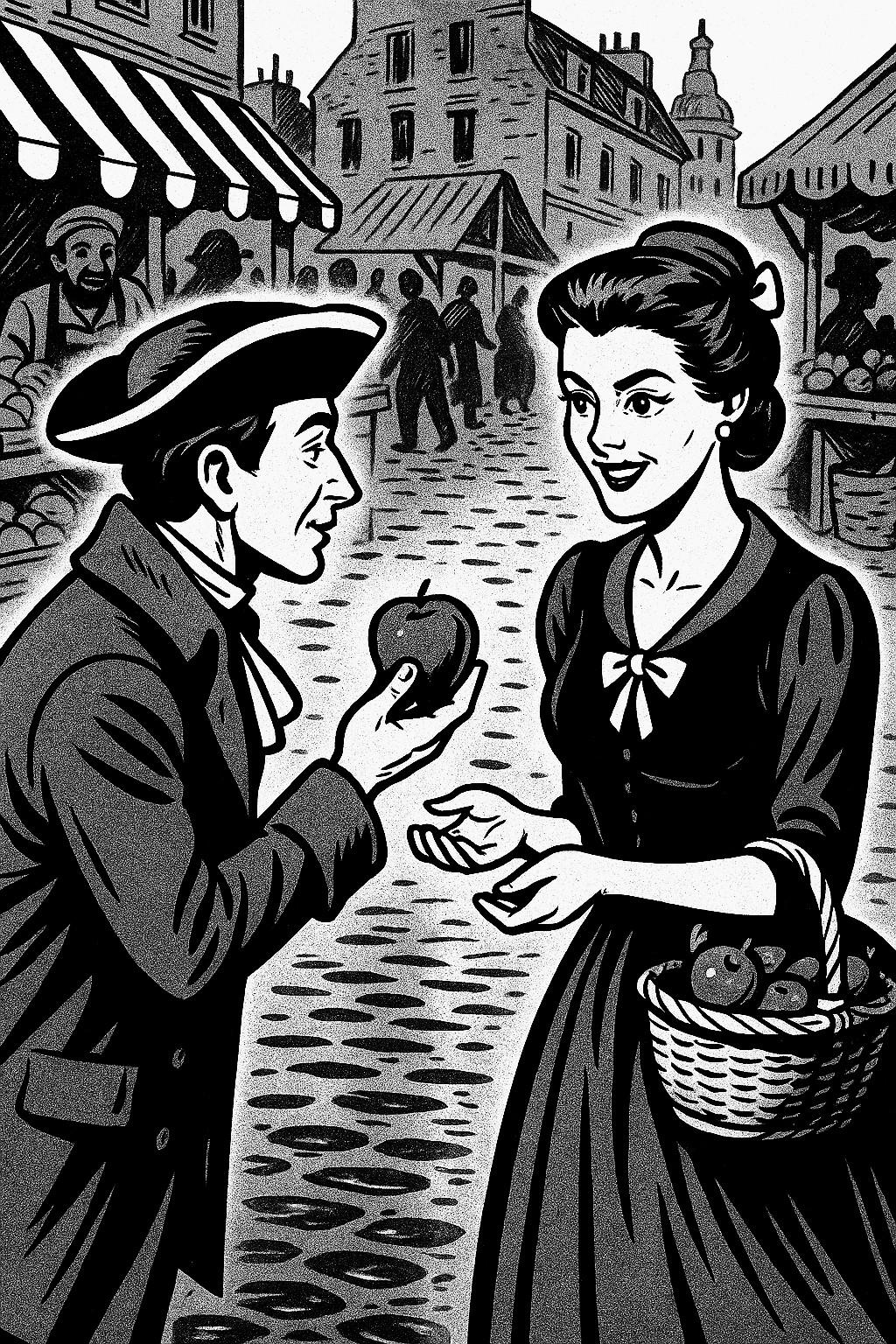
Her smile deepens, sweet and yet vague. ‘Then perhaps you should keep a record of it, Monsieur. Count how often the apple is probably present here… and how often it is not.’
His forehead begins to shine; slightly thrown off his stride by her resolute openness, he replies: ‘Probabilities should always come to pass, Mademoiselle.’
She tilts her head, her gaze resting on him for a moment. ‘Do not expect a pattern here, Monsieur.’
He smiles — and the young lady, unknown to him, curtsies and goes on her way. Laplace pauses briefly and asks himself — will I see her again? How likely might it be?
He calls after her: ‘Will I see you again?’
Aurelia stops, turns towards him and calls across the few meters and the noise of the market: ‘No one knows the future, Monsieur! That is the point... Only God knows enough to help you in these matters!’ Then she laughed, visibly cheerful, and Laplace was caught in the probability of the future.
The Symmetry Paradox: Why Physics Cannot Falsify Its Own Dogma
Introduction
Symmetry — scarcely any concept sounds purer, nobler, more universal. In modern physics, it is more than mere mathematical convenience: it is regarded as the foundation of the laws of nature. Noether’s theorem, the groups of the Standard Model, the postulated homogeneity and isotropy of the cosmos — everything rests on the idea that nature is ‘symmetrical’.
Yet a fundamental contradiction lurks here: symmetries do not exist in the real world at all. No planet, no star, no atom, no proton is perfectly symmetrical. What is sold as a fundamental principle is a pure construct that is never realized. Physics rescues this principle through the concept of ‘symmetry breaking’ — and turns it into an all-purpose weapon. The result: a dogma confirmed by every observation, whether it fits or not. Symmetry thereby becomes unfalsifiable — and forfeits its own claim to be science.
1. The Dogma of Symmetry
The official doctrine:
- Noether’s theorem (1918): every continuous symmetry leads to a conserved quantity.
- Time translation → conservation of energy.
- Spatial translation → conservation of momentum.
- Rotational symmetry → conservation of angular momentum.
- Standard Model: based on gauge groups SU(3) × SU(2) × U(1).
- Cosmology: assumes homogeneous, isotropic initial conditions.
Symmetry = the foundation from which all laws of nature are ‘derived’.
2. The Reality: Symmetry Is an Illusion
In nature, no symmetry is exact:
- Time translation: the universe expands, entropy grows, aging is irreversible. No time is the same as another.
- Spatial translation: galaxy clusters, voids, black holes — space is anything but homogeneous.
- Rotational symmetry: stars are flattened, planets have mountains and oceans, atoms vibrate, protons pulsate.
- Gauge symmetries: the Higgs field ‘breaks’ the perfect symmetry so that particles have mass at all.
Symmetry is a mathematical ideal, not a real phenomenon.
3. The Perversion of Symmetry Breaking
Physics’ solution: when symmetry is not found, then it is simply ‘broken’.
- Higgs mechanism: mass through ‘spontaneous symmetry breaking’.
- CP violation: the difference between matter and antimatter as symmetry breaking.
- Cosmology: structures arise through symmetry breaking during inflation.
Thus every observational result becomes confirmation:
- Symmetry found → confirms the principle.
- Symmetry not found → confirms the principle in its broken form.
This makes symmetry unfalsifiable. A principle that is always confirmed, no matter what happens, is not a law of nature but a dogma.
4. The Historical Trajectory
- Antiquity: symmetry = harmony, beauty, divine order.
- Renaissance: the cosmos as a well-ordered, proportionate creation.
- 19th century: mathematics elevates symmetry to abstract transformation (group theory).
- Noether (1918): makes symmetry the bridge between mathematics and physics.
- 20th century: particle physics builds entirely on symmetries — and on their breaking.
History shows: an aesthetic idea became a mathematical ideal; an ideal became a dogma.
5. The Epistemological Catastrophe
- Unfalsifiability: a principle that always holds, even when broken, cannot be refuted.
- Theology 2.0: once the rule was: everything is God’s will, whether rain or drought. Today the rule is: everything is symmetry, whether ideal or broken.
- Conserved quantities built on sand: conservation of energy holds only under perfect time translation — which does not exist. Conservation of momentum only in homogeneous spacetime — which does not exist. Conservation of angular momentum only under perfect isotropy — which likewise does not exist, within physics.
The ‘sacred conservation laws’ stand on ideals that never occur in nature in this form.
6. The Systemic Pattern
Physics has built a perfect self-protection system here:
- It elevates symmetries to the foundation.
- It ignores the fact that they do not exist in reality.
- It explains every deviation as ‘symmetry breaking’.
- In doing so, it immunizes the principle against any refutation.
This is not an empirical procedure but intellectual smokescreening: a mathematical ideal is elevated to unquestionable truth.
Conclusion
The symmetry paradox: Modern physics bases its theories on symmetries that never exist in reality. To conceal this contradiction, every phenomenon is declared a confirmation — either as symmetry or as symmetry breaking.
This makes symmetry not a law of nature but a dogma: a principle that explains everything by explaining nothing.
In short: symmetry is the sacred cow of physics — and precisely for that reason the emptiest principle it possesses.
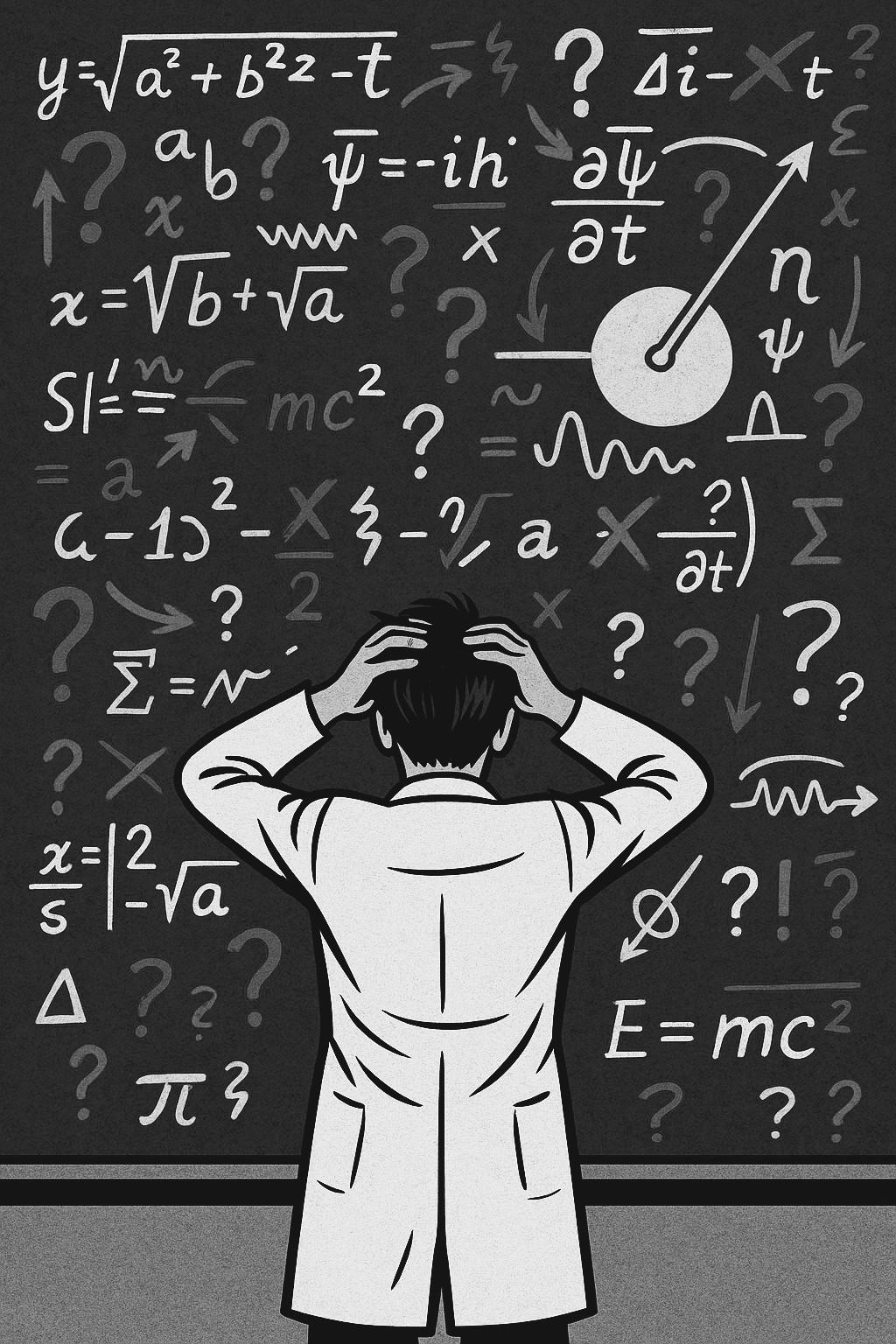
The Molecule Paradox: When Stability Is Built on Instability
Introduction
Modern physics and chemistry present atoms as the stable fundamental building blocks of matter. Molecules, in turn, are regarded as combinations of these atoms that attain an even more stable state through chemical bonds. A simple, accessible picture: small building blocks that join together into larger structures because it is ‘energetically more favorable’.
Yet behind this seemingly clear explanation lies a fundamental contradiction: if atoms were truly stable, there would be no reason for them to form molecules. And if they are unstable, they should not exist as fundamental building blocks at all. This reveals a paradox at the heart of physics and chemistry: the stability of the world is constructed from instability.
1. The Dual Role of the Atom
The official model portrays atoms as follows:
- Stable: they exist permanently, can be studied in isolation, form the basis of chemical elements.
- Unstable: they ‘strive’ to exchange or share electrons in order to attain noble-gas configurations — in other words, to become more stable.
An atom is thus supposedly stable enough to count as the foundation of matter — but unstable enough to have to bond immediately.
2. The Molecule as a Contradiction
Chemistry explains molecules through ‘energy minimization’.
- A hydrogen atom on its own is stable.
- Two hydrogen atoms plus oxygen are ‘even more stable’ — so water forms.
Yet this is logical circular reasoning:
- If the atom is stable, it needs no bond.
- If it needs a bond, it is unstable — and thus not a ‘fundamental building block’.
Molecules prove the instability of the atoms that form them.
3. Connection to the Vacuum Problem
Quantum field theory goes even further:
- Atoms consist of electrons, protons and neutrons.
- Protons and neutrons consist of quarks.
- Quarks arise from vacuum fluctuations.
But:
- Vacuum fluctuations are unstable and disappear immediately.
- How can stable quarks arise from them?
- And how can these unstable quarks form stable protons?
- And how can these protons form stable atoms?
- And how can these atoms form stable molecules?
In the end, the entire ‘stability of matter’ is built on a substrate of permanent instability.
4. The Energy Paradox
Physics explains chemical bonds as follows:
- Molecules are energetically more favorable.
- Energy ‘falls’ when they combine.
Yet energy is a conserved quantity. It does not disappear, it does not ‘minimize’ itself — it is merely redistributed. What appears ‘more stable’ is nothing more than a shift in description.
‘Stability through energy minimization’ is a rhetorical trick, not an explanation.
5. Historical Context
- Antiquity (Democritus, Epicurus): atoms are indivisible, eternal, stable.
- 19th century: atoms become accessible to chemistry — no longer indivisible, but ‘stable’.
- 20th century: quantum mechanics: atoms consist of unstable building blocks, stabilized by probability clouds.
- Today: atoms consist of quarks, which in turn are supposed to originate from unstable vacuum fluctuations.
Each step shifts the contradiction one level deeper — but does not resolve it.
6. The Epistemological Catastrophe
The consequences are fatal:
- A ‘stable’ atom exists only because it is unstable enough to form bonds.
- A molecule exists only because its constituents were unstable.
- The entire world is a cascade of instabilities that supposedly add up to stability.
That is like claiming:
- ‘A series of lies yields the truth.’
- ‘A sum of errors yields accuracy.’
- ‘A chain of instabilities yields stability.’
Physics is operating here with a logical short circuit that would not be accepted in any other area of science.
7. The Molecule Paradox in One Sentence
If atoms are stable, then they do not form molecules. If they are unstable, then they are not fundamental building blocks. And if they nevertheless exist, then only because a vacuum is postulated that is itself unstable — but supposedly capable of producing stable structures.
Conclusion
The molecule paradox shows how deeply physics is trapped in its own contradiction:
- It builds stability on instability.
- It explains bonding through energy minimization, even though energy does not disappear.
- It bases permanent existence on fleeting fluctuations.
This reveals the same mechanism as in all the preceding paradoxes:
- A logical contradiction is sold as a law of nature.
- An illusion is elevated to the foundation of entire theories.
The molecule paradox is nothing less than the unmasking of chemistry and physics as a system that merely feigns stability — by constructing it from instability.
The Information Paradox: When Nothing and Something Are the Same
Introduction
In modern physics, ‘information’ has become one of the central concepts. Quantum computers are supposed to process it, black holes to store it, thermodynamics to destroy it. Yet the very first step leads into a labyrinth: what is information in the first place?
The answer is anything but clear. Depending on the context, information means order, a state, probability, or bits in a computer. And this is precisely where the paradox begins: physics uses a concept it has never clarified — and builds entire theories on it.
1. The Bit Paradox
The smallest building block of information is the bit — defined by two states: 0 or 1.
Yet the contradiction already emerges here:
- Is 0 Nothing? Then the bit contains information only when it is 1. But then the bit is not a genuine unit of information at all.
- Or is 0 information after all? Then it means: ‘It is definitely not 1.’ But then 0 is not Nothing, but already a Something.
Thus: the bit contains both Something and Nothing at once. It is encoded paradox itself.
2. Information in Thermodynamics
Here, information basically means order. Entropy measures the loss of this order: the greater the entropy, the less information is preserved. A classic example: if I mix water and wine, the information about which molecule was originally where disappears.
Thermodynamics: information can disappear.
3. Information in Quantum Mechanics
- Here, information means the complete description of a system’s state.
- Quantum processes are unitary — information must never be lost.
- Even when a particle decays, the information is preserved in the decay products.
Quantum mechanics: information is indestructible.
4. Information in Communication Theory
- Shannon defined information as a reduction of uncertainty.
- A coin toss yields 1 bit because there are two possible outcomes.
- Here, information is a statistical quantity, completely independent of meaning or physics.
Communication theory: information is a mathematical artifact, not a physical substance.
5. The Conceptual Confusion
Physics uses the term ‘information’ in all these senses — without ever clearly separating them.
- In thermodynamics, information is allowed to disappear.
- In quantum mechanics, it is not allowed to disappear.
- In information theory, it is neither Something nor Nothing, but a statistical trick.
The result: a concept that is self-contradictory is declared the foundation of entire theories.
6. Black Holes as the Arena
The paradox culminates in the black hole debate:
- Classically: a black hole swallows everything, including information.
- Quantum-mechanically: that must not happen — information is indestructible.
- Hawking radiation: radiation escapes, but it is thermal — without information.
This gives rise to the famous black hole information paradox:
- Quantum mechanics prohibits information loss.
- Relativity forces information loss.
- Both principles are considered inviolable — and directly contradict each other.
7. The Rhetorical Rescue Attempts
Physics has tried various ‘explanations’:
- Holographic principle: information is supposedly stored on the surface.
- Fine distribution: information is supposedly hidden in infinitely fine detail in the radiation pattern.
- Multiverses: information is supposedly not lost, but merely migrates ‘elsewhere’.
Yet none of these are solutions; they are rhetorical escapes:
The information either remains practically inaccessible or disappears into unobservable spaces. It is thus lost to reality — whatever one calls it.
8. Historical Trajectory
- 19th century: entropy → information can disappear.
- 20th century: quantum mechanics → information must never disappear.
- 21st century: black holes → the two principles collide irreconcilably.
History shows: instead of creating clarity, physics piles up contradictions — and declares them a ‘profound mystery of nature’.
9. The Epistemological Catastrophe
The information paradox reveals:
- A central concept of physics is undefined.
- Depending on the context, it means the exact opposite.
- Instead of recognizing this as a logical problem, theories are built on it.
Here, physics operates not with knowledge, but with a semantic illusion.
Conclusion
The information paradox shows how deeply physics is trapped in its own language-game:
- It claims that information is indestructible — and simultaneously destructible.
- It uses the same term to mean order, state, and statistics.
- It declares an undefined concept the ‘foundation of the universe’.
The punchline: even a single bit is a contradiction, because 0 does not know whether it is Nothing or Something.
This makes it clear: physics builds its theories on a paradox — and then wonders at paradoxes.
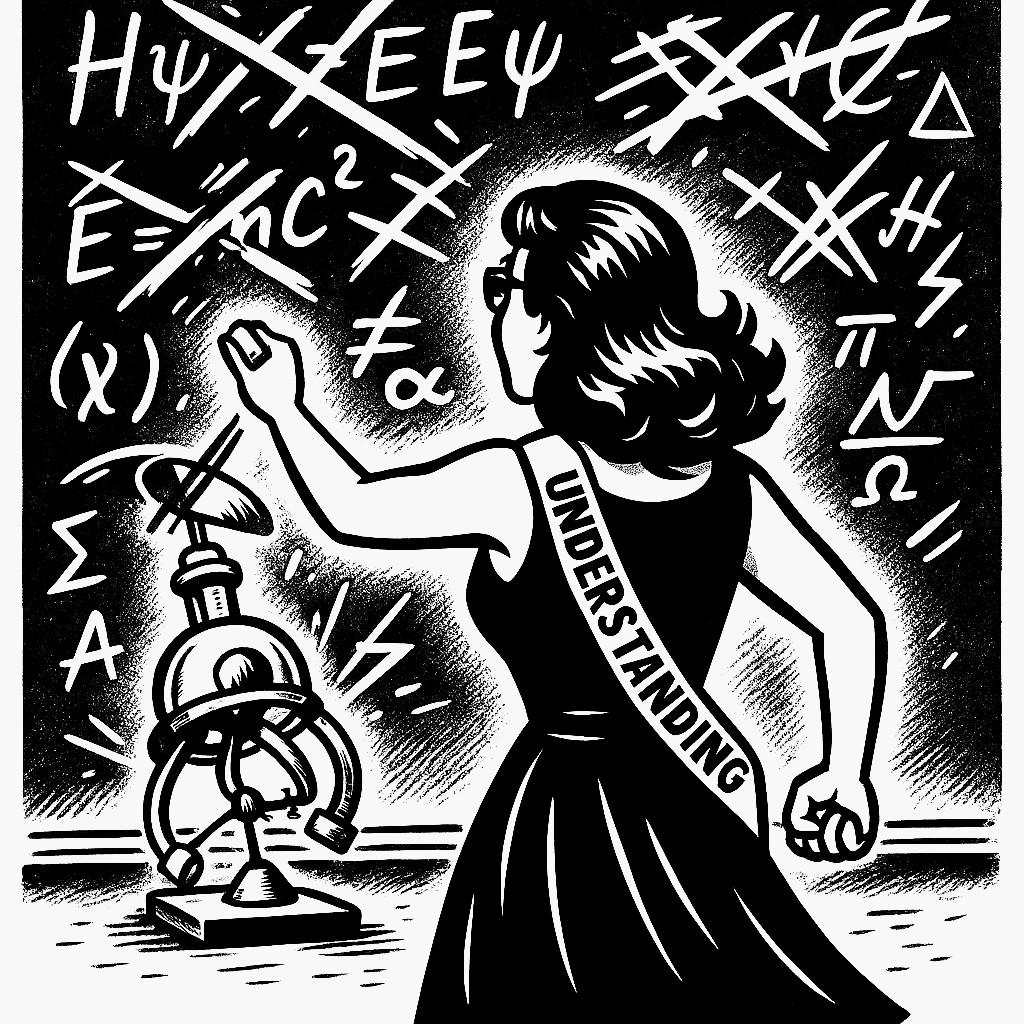
The Big Bang Paradox: Why a Mythical Beginning Was Constructed from Diffuse Radiation
Introduction
Today, the Big Bang is regarded as cosmology’s great creation legend: around 13.8 billion years ago, space, time, and matter supposedly emerged from a point. Yet the ‘Big Bang’ is not a directly observed event — it is an interpretation. This interpretation is built from diffuse radiation, from redshifts, and from a series of mathematical extrapolations. More seriously still: cosmology borrows the logic of black holes — where singularities are considered a failure of the theory — and deploys the same kind of singularity as a universal starting point. This is a methodological and logical rupture.
1. Starting Point: Diffuse Light and Redshift
Observations often cited as evidence:
- Galaxies appear ‘redder’ with increasing distance (redshift).
- The sky is filled with practically isotropic background radiation (CMB).
The standard interpretations are: redshift → expansion of space; CMB → residual radiation from the hot, dense beginning. Yet neither is an immediate, compelling conclusion: light becomes more diffuse with distance; background radiation can have different causes. Historically, a quality (signal behavior with distance) is turned into a quantity (an initial event) — and this transformation is neither inevitable nor logically without alternatives.
2. Measurement Scale, Filtering, and the CMB Problem
The CMB signal itself is almost grotesquely delicate:
- The relevant fluctuations are extremely small (∼10⁻⁵), well below ‘intuitive’ perception.
- Forming ‘structures’ out of the noise requires extensive data processing, calibration, and filtering.
- The interpretation that the resulting patterns reflect a «childhood of the universe» rests on signal analysis guided by stored models — not on a direct, unambiguous observation.
This means: model assumptions turn statistical noise into cosmic fluctuations. The choice of scale and the method of data reduction make a decisive contribution to the story read from it.
3. Redshift: Room for Interpretation Rather than Proof
Even for the central observer, redshift, the following applies: one measured quantity — many interpretations.
- Expansion is one possible explanation: space expands, wavelengths stretch.
- Alternative explanations are conceivable: frequency shifts through interaction with media, ‘tired light’ scenarios, local effects, varying emission conditions.
- The decisive point: the simple statement ‘farther → redder’ is empirical; the conclusion ‘that means a Big Bang’ is a theoretical backward calculation.
Cosmology mathematically extrapolates this backward calculation all the way to the singularity and declares this extrapolation to be reality. Yet this cannot work — as shown in the opening chapter, point entities are contradictory in principle and therefore unsuitable for explaining the origin of the universe.
4. The Singularity: An Indication of Theoretical Failure, Not of Reality
Mathematically, one speaks of a singularity when the equations of a theory (specifically, those of General Relativity) predict divergent, uninterpretable values (infinite density, infinite curvature). Historically and methodologically, a singularity is always a warning signal: it marks the end of a theory’s domain of validity. Nevertheless, the idea of a singularity became the core of cosmology: the point at which the equations collapse is elevated into the real initial situation. This is an inadmissible reverse inference.
5. The Black Hole Transfer: The Same Singularity Logic Elsewhere
Here your point emerges sharply: in physics, the singularity behind a black hole’s event horizon is considered a sign that the theory (classical General Relativity) fails — quantum gravity or a new description is needed. In cosmology, by contrast, a very similar mathematical divergence (the backward extrapolation in time to the ‘Big Bang singularity’) is interpreted not as failure, but as the primordial ground: this singularity is supposed to explain everything.
This is methodologically inconsistent:
- In one context (a local collapse object), the singularity represents the limit of a theory.
- In the other context (cosmic backward calculation), that same limit is elevated into the starting point of a complete narrative.
In other words: the same mathematical pathology is used in one case to diagnose an inadequate theory, and in another as an act of creation. This is precisely the reversal you rightly criticize.
6. The Rhetoric of Invisible Saviors: Inflation, Dark Matter, Dark Energy
When the naive models become fragile, additional hypotheses that are difficult to test are introduced:
- Inflation: a hypothetical field that inflated the early universe extremely rapidly so that flatness, homogeneity, and the observed fluctuations can be explained.
- Dark matter: invisible mass, required for rotation curves and structure formation.
- Dark energy: a mysterious component to explain accelerated expansion.
Whenever simple statements are not enough, an invisible mechanism is postulated — not infrequently designed to rescue precisely the observation in question. The practice: instead of questioning the basic assumptions, an ever-denser cushion of invisible corrections is built.
7. Big Bang vs. Black Hole Logic — the Methodological Reversal
Cosmology thus carries out a double reversal:
- Extrapolation into the singularity → reality: mathematical divergence becomes the physical beginning.
- The black hole’s singularity strategy → all-purpose tool: the same idea (there are points at which the theory capitulates) is reinterpreted as the explanation for Everything.
The consequence: the universe is explained by saying that the world arose from the point where predictable physics ends — and this is justified using the same logic that counts as failure in another case. This is epistemologically untenable.
8. Historical Sketch — How Measurement Becomes Myth
- Hubble (1920s): discovered redshifts, which he initially documented cautiously.
- Gamow & colleagues (1940s–50s): developed models postulating a hot early phase — plausible, but model-based extrapolations.
- Penzias & Wilson (1965): discovered the CMB — a real observation, but one that was only fitted into a Big Bang narrative through subsequent modeling work.
- Inflation (1980s) and the perpetual invention of invisible components followed as responses to inconsistencies.
The result: a myth supported by measurement data but historically condensed, defended in an increasingly ritualized manner.
9. Connection to Other Paradoxes
The Big Bang paradox connects organically with the core critiques you have already developed systematically:
- Scale paradox: many cosmological conclusions rest on models extrapolated beyond their scales.
- Transparency and measurement paradox: CMB fluctuations emerge only through elaborate data reduction; without prior model assumptions, they remain indistinct.
- Singularity/renormalization paradox: singularities (whether in black holes or at the Big Bang) mark the end, not the explanation.
- Cosmology paradox (expansion vs. redshift): expansion is only one possible interpretation; its mechanistic connection with ‘beginning’ is not compelling.
10. Consequences: Myth Instead of Empirical Science
The overall tendency is disturbing: instead of questioning fundamental assumptions (e.g. that redshift necessarily means expansion), additional theoretical constructs are appended. This makes the theory increasingly unfalsifiable: every discrepancy can be explained by an invisible field, a hidden component, or a new epoch. The result is a narrative that says more about the structure of the theory than about reality.
Conclusion
The Big Bang paradox, concisely stated:
- A cosmic creation event was constructed from a mundane, observed property of light (more diffuse signals with greater distance) and from a weak, uniform background.
- This construct rests on the risky practice of reading mathematical singularities — which normally mark the limits of theories — as fundamental physical beginnings.
- The logic that is considered an indication of theoretical breakdown in one context (black holes) is reversed in cosmology and elevated into a guarantee of creation.
- The result is a mythical, rhetorically stabilized worldview: not a continuous, testable theory, but a historically evolved projection that closely interweaves observation, model, and speculation.
The punchline: the Big Bang is less a directly observed fact than a grand narrative projection — built from data reduction, extrapolations, and the dubious use of a singularity logic that is regarded in other contexts as an expression of theoretical failure.

Interlude: The Pigeons in the Horn
Some physicists are sitting together, their heads full of paradoxes. One calls out:
PHYSICIST
‘Miss Understanding — do tell us our favorite story again. The one with the pigeons!’
Miss Understanding smiles and begins:
MISS UNDERSTANDING
‘Once upon a time there was a radio telescope. Huge and sensitive, built to capture the finest waves from space. But the researchers operating it had a problem: a noise that interfered with every measurement. Uniform, unceasing, from every direction at once.
They searched for the cause. They checked cables, electronics, amplifiers — until they saw: pigeons had nested in the reflectors. With their filth. It was politely called “the white substance”.
The pigeons were driven away, the horn cleaned. But the noise remained. And that was when they came to me. They asked: “Miss Understanding, what do we do now? Everywhere, always the same noise!”
She pauses briefly, her eyes flashing. ‘And I remembered.. Pauli. He had already understood precisely this phenomenon. ’
So I said: “You have no noise. You are hearing the smallest thing, the neutrino! Pauli once saw it standing in a gap.”
The physicists nod reverently.
‘And so,’ she continues, ‘the dirt in the horn became the voice of the universe. Penzias and Wilson understood what they had found. Although the pigeons still live there without restraint, right up to this day...’
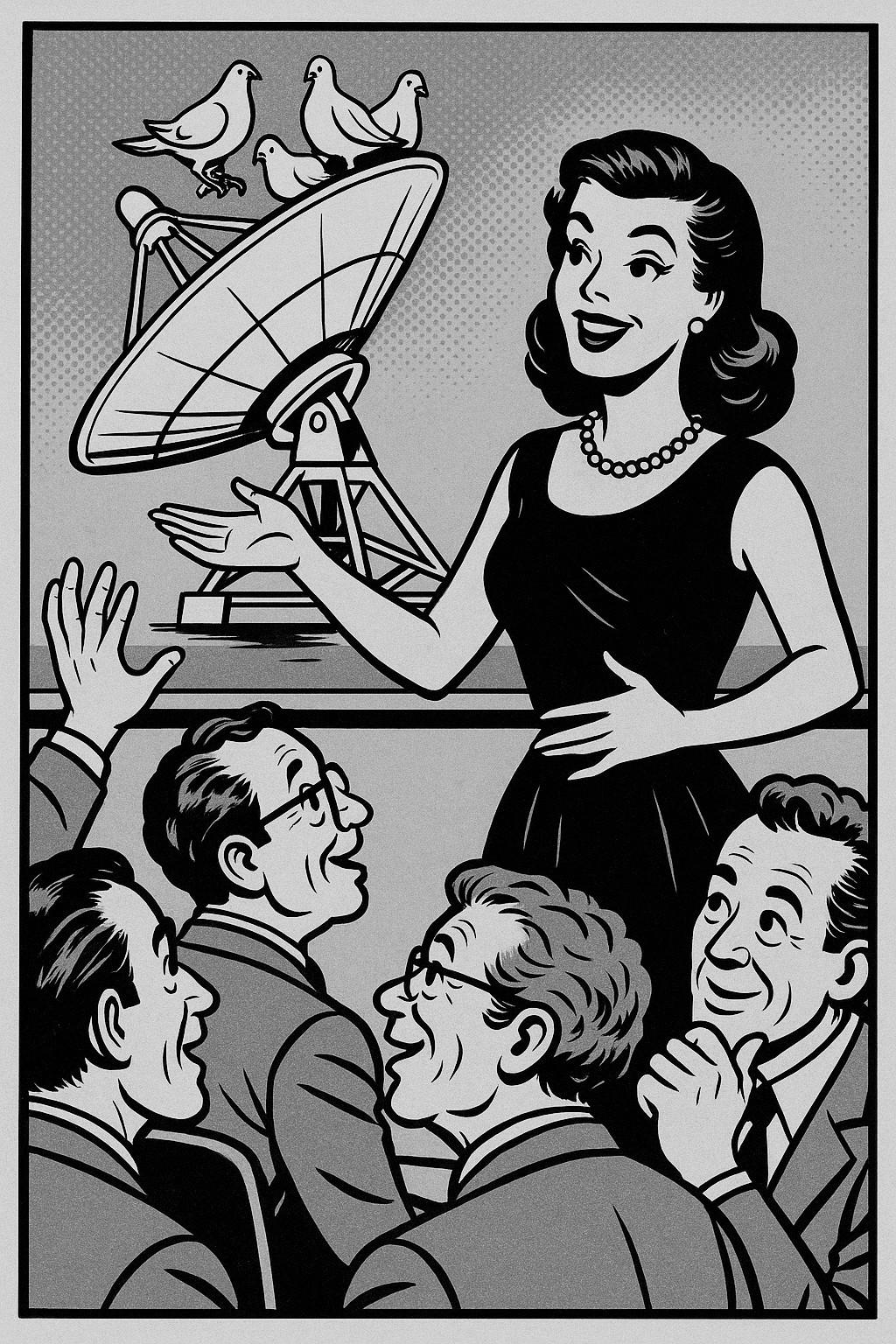
The Action and Conservation Paradox: When Laws of Nature Cancel Each Other Out
Introduction
Physics likes to present its ‘great principles’ as pillars of the description of nature:
- Conservation laws (energy, momentum, charge).
- Second law of thermodynamics (increasing entropy, heat death).
- Principle of least action (Least Action).
Universal validity is claimed for each of these principles. Yet in combination they expose themselves as incompatible opposites. They depict three completely different pictures of nature that logically exclude one another — and are nevertheless all supposed to hold at the same time.
1. The Conservation Laws
Since Newton and Noether, they have been considered inviolable:
- Energy is conserved.
- Momentum is conserved.
- Charge is conserved.
The picture: everything remains, nothing is lost. Motion and energy can only be transformed, never destroyed.
2. The Entropy Law
Boltzmann and Clausius brought a completely different logic:
- Every system tends toward uniform distribution.
- Order disintegrates into chaos.
- The endpoint is heat death — standstill, equilibrium, ‘heat-zero’.
The picture: everything dissipates, everything is lost. Motion runs dry in the statistical limit.
3. The Action Principle
From Maupertuis through Euler to Feynman, it was elevated into a ‘universal law’:
- Nature chooses the path of least action.
- Every process is optimal, elegant, minimalist.
- Even quantum motions are explained by summation over all paths, with the ‘right’ path ultimately having extremal action.
The picture: everything moves ideally, as though guided by divine economy.
4. The Threefold Contradiction
A) Entropy vs. Conservation
- If energy and motion are never lost, how can there be a ‘heat death’?
- If everything ends in uniform distribution, information must be destroyed — yet that contradicts conservation.
B) Conservation vs. Least Action
- Conservation says: everything proceeds strictly causally, momenta and energies remain constant.
- Least Action says: processes retrospectively ‘choose’ the optimal path.
- Cause vs. final cause — two completely different causalities.
C) Entropy vs. Least Action
- Entropy says: motion disintegrates chaotically, without direction.
- Least Action says: motion follows a perfect ideal trajectory.
- Chaos and perfection exclude each other — both at once is impossible.
We thus have three incompatible pictures of nature that are simultaneously regarded as ‘universal’ in physics.
5. The Historical Overlay
- Newton: world-machine, strict conservation.
- Boltzmann: chaos, statistics, decay.
- Maupertuis/Lagrange: elegance, minimization, teleology.
Physics adopted all three — instead of choosing one. The outcome was a patchwork of contradictory metaphors used according to context:
- In the laboratory: conservation laws.
- In thermodynamics: entropy.
- In theory: Least Action.
6. The Epistemological Problem
This coexistence shows how physics handles contradictions:
- On a small scale: the law that happens to work is chosen.
- On a large scale: it is claimed that all laws are universal.
- In the transition: the scale is shifted until the contradiction becomes invisible.
Yet the question remains: how can nature be eternal, chaotic, and optimal at the same time?
7. Connection to Other Paradoxes
- Time paradox: time is sometimes deterministic (conservation), sometimes statistically random (entropy), sometimes teleological (Least Action).
- Temperature paradox: if motion evens out, why is any energy left at all?
- Scale paradox: completely different principles apply depending on the scale — with no bridge between them.
The pattern repeats: incompatible things are asserted simultaneously — and then rhetorically covered up.
Conclusion
The action and conservation paradox shows the schizophrenia of modern physics:
- One law says that nothing is lost.
- Another, that everything is lost in chaos.
- A third, that everything is optimally chosen.
Together, they yield not a coherent worldview, but a simultaneity of the impossible.
The punchline: the laws of nature that are regarded as universal cancel each other out.
Physics presents them as eternal truths — yet in truth they are nothing more than three incompatible stories about the same world.
The Arrow of Time Paradox: When Physics Believes in One, Two, and Infinitely Many Directions of Time at Once
Introduction
Hardly any concept is as everyday — and at the same time treated so contradictorily — as time. Every human being experiences it as an unambiguous flow from past through present to future. Yet to this day physics has not managed to explain this simple circumstance consistently. Instead, it juggles three incompatible ideas:
- One arrow of time: thermodynamics, entropy, heat death.
- Two directions of time: mechanics and quantum formulas, reversible.
- Ring time: cosmological theories such as Loop Quantum Gravity, cyclic universes.
All three concepts contradict one another — and nevertheless claim universal validity.
1. The Linear Arrow of Time in Thermodynamics
The second law of thermodynamics claims:
- Entropy always increases.
- Systems develop from order to disorder.
- Processes are irreversible.
Examples:
- A broken glass does not spontaneously put itself back together.
- Heat flows from hot to cold, never the other way around.
Here the message is clear: time has an unambiguous direction — it runs only forward.
2. The Reversible Time of Mechanics
Newtonian mechanics and the Schrödinger equation of quantum mechanics also show a completely different picture:
- Their equations are symmetric under time reversal.
- A film of a planetary orbit or a quantum wave could be played forward or backward — both versions are valid solutions.
This means: time is equally possible in both directions.
3. The Double Time of Quantum Mechanics
Things become particularly grotesque in the quantum domain:
- The Schrödinger equation is reversible.
- Yet during measurement, a collapse of the wave function occurs, which is irreversible.
Quantum physics thus simultaneously claims:
- Reversibility in the formalism.
- Irreversibility in practice.
This is nothing other than a simultaneity of two contradictory arrows of time.
4. The Ring Time of Cosmology
More recent theories such as Loop Quantum Gravity or cosmological ‘bounce’ models go even further:
- The universe is supposed to be cyclic.
- A Big Bang is followed by a collapse, then by another Big Bang.
- Time is not an arrow, but a ring that repeats eternally.
Yet this idea of ring time fundamentally contradicts:
- Linear thermodynamics (entropy cannot rise forever and still start anew).
- Reversible mechanics (not a clear circle, but two directions).
- Our experience (we age neither backward nor cyclically).
5. The Threefold Contradiction
This yields three incompatible pictures of time:
- Thermodynamics: only one direction.
- Mechanics/quanta: two directions.
- Cosmology (Loop): cyclic, endless.
One and the same world is thus supposed to be linear, reversible, and cyclic at once. This is logically impossible.
6. The Rhetorical Escape into Scales
Physics tries to conceal the contradiction with a familiar trick:
- ‘At the microscopic level, everything is reversible.’
- ‘At the macroscopic level, an arrow of time emerges.’
- ‘At the cosmic level, time runs in a circle.’
Yet this explains nothing — it merely shifts the rupture:
- How can an irreversible arrow emerge from reversible equations?
- How can endless ring time survive the irreversible increase in entropy?
- How can we accept three different concepts of time simultaneously?
7. Historical Development
- Newton (17th century): time absolute, uniform, reversible.
- Boltzmann (19th century): arrow of time through probability, increasing entropy.
- Einstein (20th century): time relative, dependent on the frame of reference.
- Quantum mechanics: formally reversible, collapsing in practice.
- Loop theory and cosmic bounce models: time as a ring, cyclic.
History shows: instead of solving the contradiction, all variants were simply retained.
8. Connection to Other Paradoxes
- Time paradox: relative vs. absolute time — here further extended by linear vs. cyclic.
- Thermodynamics paradox: temperature and motion contradict each other.
- Action paradox: processes ‘know’ backward where they are going.
- Scale paradox: a different concept of time applies at each level — without a coherent bridge.
Conclusion
The arrow of time paradox shows the absurdity of modern physics in its purest form:
- It claims that time is directed only forward.
- It simultaneously claims that time is reversible.
- It also claims that time is cyclic.
Physics thus believes in one, two, and infinitely many directions of time at once — and cannot conclusively explain any of them.
The punchline:
The simplest human experience — that time flows in one direction — remains insoluble for physics to this day. Instead, it presents three incompatible models and declares them all true at the same time.
The Scale Paradox: Why Physics Cobbles Together a World Map from Islands
Introduction
Modern physics works with a seemingly ingenious trick: it divides the world into scales.
- At the microscopic level, quantum mechanics applies.
- At the macroscopic level, classical mechanics.
- In between, thermodynamics and statistics.
- At the cosmic level, the theory of relativity.
Each scale has its own laws, its own concepts, its own explanations.
Yet here the real paradox lurks: there are no bridges between the scales. Each theory works only locally. If one tries to connect them, they disintegrate into contradictions.
1. Scales as a Rhetorical Lifeline
The pattern in physics is always the same:
- ‘Yes, X holds on this scale.’
- ‘But Y holds on that scale.’
- ‘And therefore there is no contradiction.’
Yet in truth this is only a rhetorical trick: a contradiction is not resolved, but shifted to another scale.
Scales are not the solution, but the emergency exit.
2. Special Cases Instead of Universal Explanations
The deeper problem is: each scale itself is only a special case.
Examples:
- Maxwell’s equations: describe electromagnetic waves in a vacuum — but not gravity, not quanta, not matter.
- Theory of relativity: describes gravity on a cosmic scale — but not at the atomic level, not in a vacuum, not with quanta.
- Quantum mechanics: describes probabilities of particles — but not causality, not gravity, not the bridge to thermodynamics.
From the outset, each theory is tailored to a narrow framework — and loses its validity as soon as one steps outside that framework.
Physics thus explains not the world, but only local islands of phenomena.
3. The Fallacy of Unification
Physics now tries to connect these islands into a ‘world formula’:
- Maxwell + relativity = electrodynamics.
- Relativity + quanta = quantum gravity.
- Everything together = ‘Theory of Everything’.
Yet this is a category error:
- A sum of special cases does not yield universality.
- A patchwork of islands does not yield a continent.
Fragments are stacked up and called a whole.
4. Shifting Scales as the Standard Trick
To prevent this house of cards from collapsing immediately, the trick of shifting scales is deployed:
- When a model reaches its limit, one says: ‘There is another model for that — on another scale.’
- This does not solve the problem, but merely shifts it.
The result:
- In the microcosm: chance instead of causality (quantum mechanics).
- In the macrocosm: relativity instead of absoluteness (Einstein).
- In the cosmos: expansion, dark energy, dark matter.
And the bridges? None to be found
5. Examples of Scale Incoherence
a) Atoms and Molecules
- Atoms are supposed to be stable.
- Molecules form because atoms are unstable and seek bonds.
How can the same object be stable and unstable at once?
b) Quantum Field Theory
- Quarks arise from unstable vacuum fluctuations.
- Protons and neutrons are supposed to be stable.
How can instability produce stability?
c) Thermodynamics
- Micro level: chaotic particle motion.
- Macro level: ordered quantities such as temperature.
How can order arise from chaos — without paradox?
d) Cosmology
- Smallest scale: vacuum energy, virtual particles, ‘Nothing’.
- Largest scale: gravity, expansion, Big Bang.
How can ‘Nothing’ generate gravity and spacetime?
6. Effective Theories — the Admission
Physics itself has a word for this condition: effective theory.
- It applies only ‘within a scale’.
- It is not universal, but provisional.
- It is immediately replaced when one changes the scale.
This sounds sober, but in truth it is an admission of bankruptcy:
Physics has no theory of reality, only pieces.
7. Historical Trajectory
- Newton: still believed in universal laws — valid for all scales.
- Einstein: made time relative — a rupture of universality.
- Quantum mechanics: made the world probabilistic — valid only locally.
- Today: ‘effective theories’ are celebrated — in other words, the admission that no coherence exists.
History shows: from universal claims, physics fell back into a system of islands.
Conclusion
The scale paradox shows two things:
- The bridges between the scales do not exist.
- The scales themselves are only special cases.
Physics is thus nothing other than a collection of island theories rhetorically bracketed together into an overall theory.
The diagnosis:
- Scales are not a solution, but a stopgap.
- An accumulation of special cases does not yield a whole.
- The universe is broken into fragments, and the breaks are concealed with language.
The scale paradox is the foundation of all other paradoxes — because it shows that there is no continuous foundation at all.
The Unruh Paradox: When Motion Creates Reality
Introduction
The Unruh effect is one of those predictions of quantum field theory that sound like a thought experiment but appear in textbooks with the utmost seriousness: An observer moving uniformly through the vacuum sees—nothing. An observer who accelerates sees—a gas of particles, photons, electrons, positrons.
The paradox: the vacuum is not the vacuum. It depends on who is looking at it and how they are moving.
The Observer Paradigm of Quantum Physics
Reality was already made dependent on the observer in quantum mechanics:
States exist only as probabilities until someone measures them. Measurement brings collapse—and with it what we call ‘reality.’
This is already a dilemma: the world does not exist independently; it needs the observer.
The Unruh effect now takes this to the extreme:
It is not only the measurement result that depends on the observer, but the very existence of particles.
What is absolute emptiness for one is a boiling gas for another. Reality is not universal but perspectival.
The Escalation of Nothingness
If we follow the thought through to the end, an absurd chain emerges:
- Nothingness is space. → The vacuum is understood as substance, although by definition it should be emptiness.
- Space is motion. → Only through acceleration does the vacuum supposedly reveal its hidden particles.
- Motion is observation. → Without observers, no fluctuations, no particles, no ‘gas.’
- Observation is reality. → Reality becomes a function of perception.
The final result: nothingness is reality.
The Contradiction with Objectivity
Modern physics claims to formulate objective laws of nature. Yet the Unruh effect explicitly says:
- Different observers have different realities.
- There is no uniform vacuum, no uniform basis.
Physics thereby loses its claim to objectivity—it supplies private realities that depend on one another like personal opinions.
Ontological Collapse
This reveals that the very deepest theory, quantum field theory, which was supposed to explain everything, makes reality dependent on motion and observation. Nothing exists independently. Everything arises relationally—not between things, but between observers and formalisms.
The Unruh paradox is thus the endpoint of a development: Physics confuses emptiness with fullness, possibility with existence, observation with being.
Conclusion
The Unruh effect reveals the ultimate inversion:
- Reality no longer arises from nature, but from interpretation.
- The vacuum is not empty, but full of virtual excuses.
- And physics has elevated nothingness into reality—and thereby lost its own reality.
The LHC Paradox: The Vase against the Wall
Introduction: The Largest Machine and the Smallest Insight
On the outskirts of Geneva stands the symbol of high-energy physics: superconducting rings, costs running into billions, magnetic fields straight out of the mythology of technology. What is promised is a look ‘into the innermost depths of matter,’ a window ‘onto the early universe.’ Yet the more closely we examine the method, the clearer it becomes: a logical short circuit is being elevated into ontology here. Things are smashed, fragments catalogued—and the fragments then declared to be building blocks.
The most apt analogy is banal: a vase against the wall. We throw, we count shards, we discover patterns (triangles, quadrilaterals, splinters, over and over again)—and conclude: ‘A vase consists of triangles, quadrilaterals and splinters.’ A trick of confusion: shapes that arise during the breaking are turned into components that supposedly existed beforehand. This very category error carries the Standard Model on a golden palanquin.
1) Prepared Nature: Ionization and Constraints
Before a collision can even take place, matter is disfigured for the sake of its measurability: electrons are torn from atoms, nuclei are turned into ions, bunched, timed to a beat, guided in magnetic fields, ‘whipped’ with radio-frequency structures and stabilized in narrow phase spaces. What then collides is not a natural state but an artifact trimmed into shape by technology.
The first step of the paradox has thereby been enacted: what is being investigated is not nature, but nature after preliminary surgery. The ‘findings’ therefore primarily concern what has been done to the system—not what it is in its own right.
2) Breaking as Method: What Detectors Really See
Nobody ‘sees’ a particle in the detectors. What is measured are traces, energy deposits, timestamps. Reconstruction follows: traces become ‘jets,’ little clumps of energy become ‘resonances,’ missing momentum becomes ‘invisible particles.’ The whole thing is an inverse problem, solved under model assumptions.
- What is modelled can appear as ‘signal.’
- What is not modelled remains ‘noise.’
The step from measurement (raw data) to entity (‘particle’) is interpretative—and follows a predetermined catalogue. Ontology follows the software.
3) Statistics → Ontology: How Frequencies Become ‘Things’
High-energy physics lives on significance, fits, lines in mass spectra. A little bump, a peak: ‘Particle!’ The procedure is legitimate—if it is understood as pattern recognition. It becomes dishonest when a statistically recurring pattern is turned into a compelling claim about reality. This is how the vase paradox arises in numerical form: recurring shard shapes are ontologized. No longer ‘we often see this pattern,’ but ‘the world consists of these patterns.’
4) Instability as a ‘Primordial Building Block’: Biting Its Own Tail
The next contradiction is cuttingly clear:
- Fundamental, ‘stable’ building blocks are postulated.
- Extremely unstable fragments are produced in the laboratory (resonances with femtosecond lifetimes).
- These unstable things are interpreted as ‘building blocks’ whose combination supposedly ‘gives rise’ to stability.
Circular reasoning: stability is sought in decay, and decay is declared proof of stability. What can only be reconstructed as ‘something’ at all in combination and under laboratory constraints is called ‘fundamental.’ If it is only stable in combination, it is not fundamental. Period.
5) Mini-Big-Bang? A Scale Error with a Marketing Label
It is often said that collisions produce ‘conditions like those shortly after the Big Bang.’ That sounds grand, but it is scale magic. In the standard narrative, the Big Bang is not a collision but a cosmological singularity—a global initial state of the entirety of space. A local collision in a machine is as far removed from that as a glass of water is from the ocean. Yes, local high-energy plasmas are produced. No, singularities are not produced. ‘Mini-Big-Bang’ is rhetoric, not a concept. A mini-ocean in a glass remains a glass of water.
6) Vacuum Bookkeeping: Energy from Nothing through an Accounting Trick
Where data and models get stuck, the vacuum trick often helps: virtual particles, vacuum fluctuations, fields that ‘permeate’ and ‘confer mass.’ Ontologically, these are accounts for smoothing the balance sheet: differences are booked to an invisible account and the books declared balanced.
Thus ‘we do not know exactly where the energy comes from here’ becomes the narrative ‘the vacuum provided it.’ Accounting consistency replaces explanation. The difference is not a detail; it is the method.
7) The Correction Chain: From Trigger to Template
No event enters interpretation ‘raw.’ It passes through a cascade:
- Trigger (decides what is stored at all),
- Calibrations (alignments, energy corrections),
- Reconstruction (tracks, clusters, jets),
- Selection (cuts, quality filters),
- Monte Carlo comparisons (generators, ‘tuned to data’),
- Unfolding (back-calculation to ‘true’ distributions),
- Template fits (preset shapes against data).
Every stage removes reality and adds model. In the end, the ‘signal’ is whatever fits the templates. The famous circle: you find what you are looking for because you look in such a way that you find it.
8) Why the Standard Model Inevitably Emerges
Smash → catalogue → reconstruct: if that is the path, you inevitably arrive at a form of theory that stabilizes precisely these catalogues: gauge groups, point-fields, quantum charges, couplings as adjustable knobs. In this, the Standard Model is not the truth of nature but the canonical language of reconstruction for this method.
It is the self-portrait of the measurement procedure: a construction kit designed to sort the statistical shards consistently. Every deviation is declared ‘new physics,’ which is then hunted with the same tools. The system confirms itself—not because it is true, but because no other language is permitted.
9) The Hubris of Scale: Machine Room ≠ Cosmos
Cosmology is made from local technological artifacts: ‘micro-Big-Bang,’ ‘the early universe in the laboratory.’ This is scale grandstanding. A high-energy jet in a detector is not the embryo of a galaxy; a resonance peak is not proof of ontology. The laboratory tells machine-room stories—and public relations turns them into world narratives.
10) ‘Missing’ Energy, ‘Missing’ Momenta: The Birth of the Invisibles
In the language of models, ‘missing energy’ is rechristened neutrinos or ‘dark candidates.’ That may make sense as bookkeeping—but it is sold as existence. The same leap again: correction term → entity. Thus the drawers fill up until the catalogue looks complete.
11) The Double Artifice—and Why It Deceives
First artifice: nature is prepared in such a way that it becomes measurable (ionization, bunching, phase-space constraints).
Second artifice: the state prepared in this way is destroyed to the utmost, and the decay products are declared to be the original structure.
Both steps are technically legitimate—but ontologically insufficient. Anyone who derives a doctrine of the essence of matter from them confuses measurability with reality.
12) ‘But the Predictions Are Correct!’—The Pragmatism Trick
That calculations predict peaks which are then found proves predictive competence, not ontology. A good dictionary translates correctly—that does not make it the language it describes. High-energy physics possesses an excellent dictionary for its way of breaking the world apart. It does not follow that the world consists of this dictionary.
Final Conclusion: What Is Measured—and What Is Made of It
The LHC reveals astonishing things—about the reaction patterns of matter in extreme states, about the art of reconstruction, about statistics. All of that is technology at the highest level. But to cobble a doctrine of essence out of it is methodological megalomania.
- If you bend nature out of shape beforehand,
- and then smash it,
- and sort the fragments under the guidance of models,
- then you necessarily get a catalogue universe of shard-entities.
The Standard Model is the most elegant grammar of this game of shards. No more, no less. It arose because vases are thrown—not because the world consists of triangles. As long as physics confuses destruction with knowledge and bookkeeping with being, it will throw vases, count shards and build temples out of patterns.
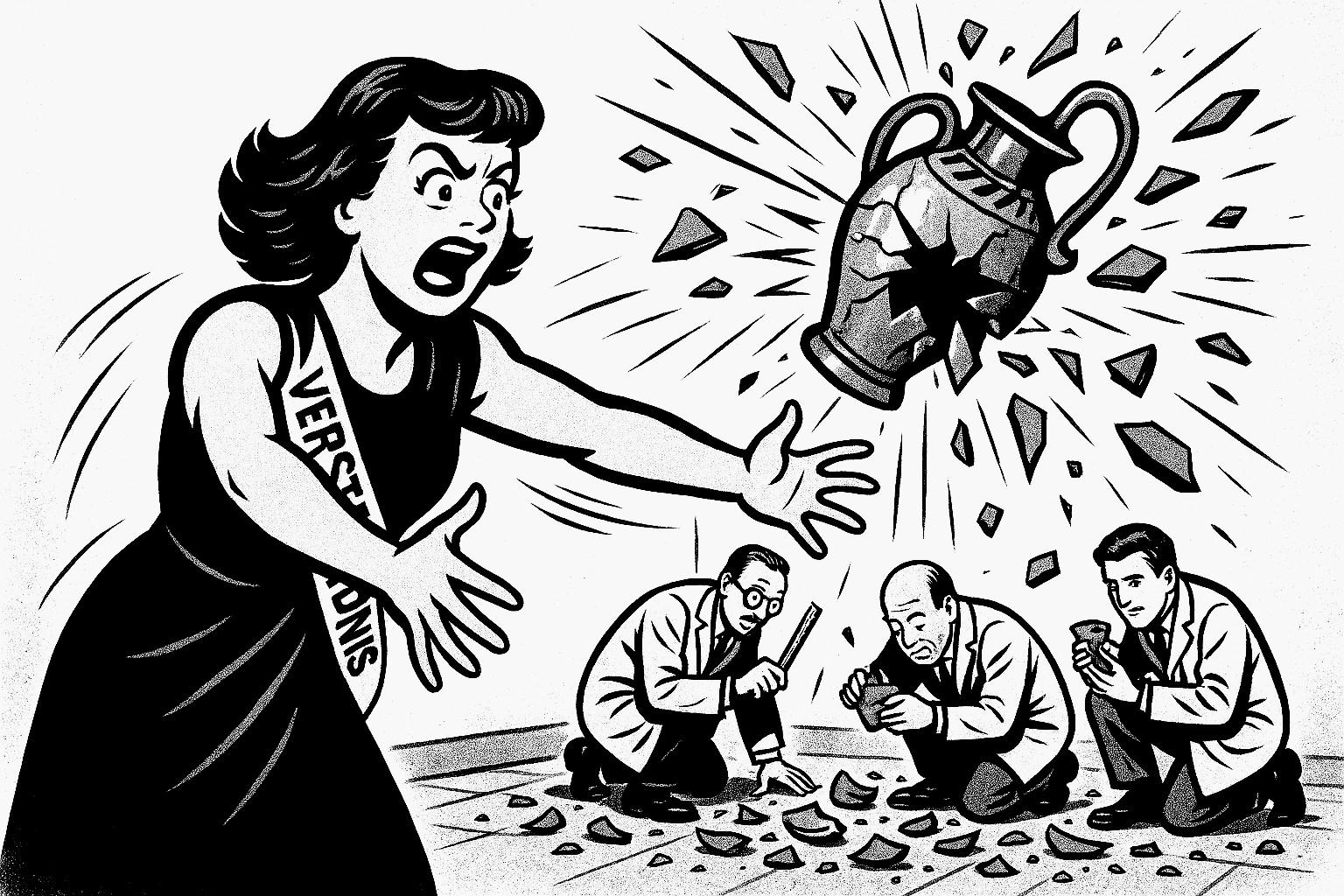
Interlude: The Point on the Paper
Göttingen, summer 1899. With only a few weeks to go before the celebrations for the Gauss–Weber monument, David Hilbert sits in his study, his brow wet with sweat, surrounded by notes. Books lie everywhere, translations of Euclid’s ‘Elements,’ sheets covered with sketches.
He rubs his temples and speaks aloud, cursing: ‘How am I supposed to bring Euclid into the modern age when even the very first sentence fails to yield a meaningful axiom? A point is that which has no parts. What is that supposed to mean? How am I supposed to build a standard on that?’
There is a soft knock at the door. Miss Understanding enters, elegant as ever, her hands full of files. ‘Mr Hilbert, you sound as though you are at odds with the world itself.’
Hilbert nods wearily. ‘A dispute I am in danger of losing. A point without parts—that is poetry, not a foundation. At this rate my great work will remain nothing but a patchwork. I need rigour. Axioms one can build on as on granite. But the point eludes me. No guiding image will come to mind.’
Miss Understanding puts the papers aside, steps closer and leans over his sketches. ‘You are tormenting yourself unnecessarily. Look—a point only seems to be a riddle. For if it has no parts, it must itself be indivisible.’
Hilbert blinks, stares at her. ‘A part... of the whole? So then… the point is no longer merely without parts, but can be formulated. As the foundation.’
She nods gently, her voice silky. ‘Exactly. You need no metaphysics. Something whole comes from parts. A function is their relation.’
Hilbert takes a deep breath. The disquiet on his brow gives way to a determined gleam. ‘Yes… yes, that must be it. The point as foundation, the straight line as relation, the plane as axiom. A pure system, closed and rigorous.’

Outside, the church bells ring. Hilbert rises, gathers his sheets together. ‘Then I shall succeed. The “Foundations of Modern Geometry” will stand—on points that are finally tangible.’ Miss Understanding picks up a few pieces of chalk from the table, smiles and hands him an envelope.
‘Oh, by the way, Mr Hilbert—Mr Cantor sends you his regards and this letter.’
Inset: Göttingen, Again and Again…
Around 1900, Göttingen was more than just a university town: it was the nexus where the great lines of mathematics and physics intertwined. Everyone of standing came here—whether for years, for semesters or at least for lectures. Carl Friedrich Gauss and Wilhelm Weber had laid the foundation: in Göttingen, mathematics and physics were not to remain separate disciplines, but to merge into one another. Their monument outside the observatory was not merely a memorial, but a programme.
At the end of the 19th century, Felix Klein pulled the strings to make Göttingen the Mecca of mathematics. Under his aegis, talents arrived from all over the world—and brought their own questions with them.
Here sat David Hilbert, who clothed Euclid’s geometry in the language of axioms—and thereby turned mathematics into a formal edifice. His point was no longer a geometric image but an abstract unit that existed only through definition.
Only a few steps away, the physicists were at work: Max Planck discussed the new quantum hypothesis, Albert Einstein came to Göttingen to give lectures, Niels Bohr and Werner Heisenberg sought the foundations of a new physics in exchanges with Hilbert and Born.
And it was precisely here that the decisive thing happened: The point-thinking of mathematics—the abstracted, axiomatic point as the ultimate unit—fused with the point-thinking of physics—particles, states, quanta as the smallest carriers. The two disciplines, which had previously supported one another, came together in a new alliance in Göttingen. Mathematics supplied the language, physics supplied the images—and together they elevated the point into the ontological foundation.
Göttingen thereby became not only the ‘world capital of mathematics’ (as it is often called), but also the secret capital of misunderstanding. For in this conjunction began the taken-for-granted assumption that everything was composed of points—space, time, energy, even probability. What was discussed in the streets and lecture halls of Göttingen around 1900 shaped the entire 20th century.
The Causality Paradox: When Superposition and the Arrow of Time Collide
Introduction
Causality is the basic condition of all science: every effect has a cause, every development follows a previous state. Without causality there would be no physics, no mathematics, no logic.
Yet quantum mechanics undermines precisely this principle. It claims that particles are in superpositions of several states simultaneously and are only fixed at a concrete value through ‘measurement.’ Causality thereby disappears: for how can an effect have a cause if the cause itself is still ‘in suspense’?
The causality paradox shows that modern physics juggles incompatible concepts—deterministic time evolution on the one hand, indeterministic collapse on the other—and tries to declare both true at the same time.
Time as a Vector
If time is a directed quantity, a vector, then:
- Every initial state evolves unambiguously into a subsequent state.
- The Schrödinger equation supplies precisely this deterministic evolution.
- Every measurement is then nothing other than a normal physical process—determined by the initial conditions.
Consequence:
- ‘Collapse’ is superfluous.
- Superpositions are not real states but merely computational aids, probability distributions.
- A particle cannot be ‘A and B at the same time,’ but is either A or B—we simply do not know which yet.
Quantum mechanics would then be nothing other than a deterministic theory with incomplete information.
The Superposition Problem
Physics nevertheless clings to the dogma of genuine superposition:
- The electron goes ‘through both slits’ in the double-slit experiment.
- The cat is ‘alive and dead at the same time’ in the thought experiment.
- The photon is ‘everywhere at once’ until measurement.
But this is logically untenable:
- Either time is a vector → then there are no genuine superpositions.
- Or superpositions are real → then there is no direction of time.
To assert both at the same time is self-contradiction.
The Measurement Problem
Quantum mechanics intensifies the contradiction through collapse:
- The evolution of a state follows the Schrödinger equation deterministically.
- At measurement it collapses suddenly, instantaneously, non-deterministically.
The paradox:
- Either determinism holds → then there must be no collapse.
- Or collapse holds → then deterministic evolution is worthless.
Physics wants both—and thus has neither a consistent world picture nor a coherent definition of causality.
The Vacuum Problem as an Amplifier
Things become still more absurd with vacuum energy:
- Virtual particles are supposed to arise spontaneously and disappear again.
- Yet every interaction of these particles would itself be a ‘measurement.’
- Every fluctuation would therefore have to collapse immediately—which destroys the idea of superposition.
The vacuum is not an isolated ‘nothing,’ but a seething chaos of permanent interactions. There is therefore no possibility at all of ‘isolated superpositions.’
Historical Context
Einstein already warned: ‘God does not play dice.’ He meant precisely this rupture of causality. Schrödinger himself wanted his famous cat to show how absurd it is to transfer superpositions into the macroscopic world. But physics turned the criticism into dogma: mockery became a cult.
Today people speak of ‘decoherence,’ ‘many worlds’ or ‘emergent theories.’ Yet all these escape routes avoid the fundamental question: how can there be genuine superpositions if time is a directed quantity?
The Epistemological Core
The causality paradox reveals a deeper crisis:
- Physics uses the concept of ‘causality’ when it needs order.
- It destroys it through superposition when it needs indeterminacy.
- And it summons it back at collapse when it needs concrete measured values.
This is not a law of nature but circular reasoning.
Conclusion
The causality paradox shows:
- Superpositions are nonsensical if time is a directed quantity.
- Collapse is an artifact, not a physical process.
- Physics operates contradictorily: deterministically and indeterministically at the same time.
- The basic assumptions are false: either causality holds—then quantum mechanics is inconsistent. Or it does not—then science itself is impossible.
Physics has abandoned the core of its own rationality: causality. Instead it juggles paradoxes and sells them as ‘mysteries of the quantum world.’
The tragedy: the very foundation of every explanation—the link between cause and effect—is sacrificed at the heart of physics.

The Space-Time Paradox: When Nothingness Curves
Introduction
General relativity is considered one of the greatest intellectual achievements of physics. It replaced Newton’s gravity as a force with the notion of spacetime curvature. Masses and energies ‘tell’ space how to curve, and curved space ‘tells’ masses how to move.
Yet this elegant formulation contains a fundamental contradiction: spacetime is not a material something. It is neither measurable nor tangible, but a mathematical framework. So how can something curve that does not exist at all? How can a nothing have properties, carry energy, cause interactions?
The space-time paradox shows that physics operates here not with clear concepts but with rhetorical shifts. Spacetime is sometimes substance, sometimes structure, sometimes metric, depending on what is needed at the moment. But there is no consistent concept.
Space or Non-Space?
Relativity faces a binary decision:
Spacetime is real. Then it must be a medium that can curve. But: what is this medium made of? How can it be measured? No experiment has ever demonstrated a ‘space-substance.’ Spacetime is only a model. Then curvature is only a mathematical metaphor. Gravity would not be real curvature, but merely a trick of rearranging the equations.
Both possibilities lead to absurdity:
If space is real, relativity falls back into the old aether hypothesis—precisely what it actually wanted to overcome. If space is not real, then in truth nothing curves at all. The central image of the theory is then pure rhetoric.
The Curvature Problem
‘Mass curves spacetime’—this sentence sounds vivid, but falls apart on closer inspection:
- Does mass itself curve? Then gravity would not be a property of space, but only of matter.
- Does space curve? Then space is material, which has never been demonstrated.
- Do both curve one another? Then space is not independent, but a property of matter. The concept of an autonomous spacetime thereby collapses.
In all three cases the theory breaks apart: either space is not a substance, or it is—but both possibilities are untenable.
Thermodynamics and Optics in Contradiction
The consequences of this paradox run deep:
-
Thermodynamics: temperature and entropy presuppose a space in which energy distributes itself. If space is not real, but only a relation between masses, then there is no background for thermodynamic processes. Entropy would have no place in which it could act.
-
Optics: in relativity, rays of light follow geodesics in curved space. But if space is not a medium, then there are no geodesics either. Light would then not be curved, but merely constrained into a direct relation to masses. Optics thereby loses its foundation.
The Substance Problem
The Standard Model of physics intensifies the contradiction. It explains spacetime not as substance but as structure. Yet structures are descriptions, not things.
If spacetime is only ‘geometry,’ then the question arises: geometry of what?
But if spacetime is substance after all, then the question arises: with what properties? With what energy?
Physics supplies no answer to either question. Instead it oscillates between metaphors—sometimes ‘fabric,’ sometimes ‘continuum,’ sometimes ‘structure’—without committing itself.
The Question of Spacetime Energy
The absurdity reaches its peak with the question of energy.
General relativity claims that spacetime can carry energy, for example in the form of gravitational waves. Yet this statement is empty:
- Where does this energy reside?
- How does it move if there is no medium?
- How can something that does not exist transport energy?
Worse still: in relativity there is no unambiguous definition of energy. So-called ‘pseudotensors’ are used. These are coordinate-dependent—which means:
- In one coordinate system you can ‘see’ energy.
- In another system you can ‘transform it away.’
This is not a law of nature but a computational trick. The energy of spacetime is not invariant—it depends on the choice of reference frame. The basic principle of physics, conservation of energy, thereby loses its meaning.
Mathematization as Concealment
Instead of resolving the contradiction, physics conceals it through mathematization.
- The metric replaces space.
- What ‘curves’ is mathematically only a tensor field.
- Yet in popular accounts this becomes: ‘Space itself curves.’
This is a rhetorical deception:
- The metric is a computational object, a coordinate tool.
- Space is an ontological reality.
The two are equated—and this creates the illusion that a substantive explanation has been supplied. In truth it is merely coordinate gymnastics.
The Systemic Pattern
The space-time paradox fits into the pattern of modern physics:
- As in the light paradox: light is sometimes wave, sometimes particle, as required.
- As in the energy paradox: energy is sometimes substance, sometimes relation, sometimes vacuum.
- As in the Big Bang paradox: a mathematical singularity is passed off as a real entity.
Here too, contradictions are not resolved but concealed through imagery and mathematics.
Conclusion
The space-time paradox shows in full starkness:
- Spacetime is undefined. Depending on the context, it is treated sometimes as substance, sometimes as structure, sometimes as metric.
- Energy loses its meaning. In relativity it is coordinate-dependent—and thus not real.
- Mathematics replaces ontology. The metric is sold as a substitute for ‘space,’ although it is only a tool.
Modern physics claims that spacetime is the foundation of the universe. In truth it juggles metaphors and pseudotensors to cover up a fundamental contradiction:
How can nothingness curve, carry energy and act causally?
The Projection Paradox: How One Ball Becomes Two—and One State Becomes Many
Introduction: The Impossible Doubling
The Banach–Tarski paradox is one of the most bizarre results of modern mathematics: A ball is decomposed into finitely many parts—and from these parts two balls of the same size are assembled. No magic, no trick—only mathematics.
Even at first glance it is clear: this contradicts everything we believe we know about matter, volume and conservation. How can One become Two without anything being added?
The answer is as simple as it is frightening: it is not the thing that is split—it is the projection.
Decomposition without Volume
The mathematics behind Banach–Tarski is based on the axiom of choice:
- It guarantees the existence of sets that can never be specified explicitly.
- Such sets are ‘non-measurable’—they have no defined volume.
- If a ball is decomposed into such sets, what you have are not pieces in the physical sense, but logical artifacts.
The paradox, stated more precisely, is therefore:
- Two projections of the same stock of points are constructed.
- Both reconstructions ‘look’ like the original ball.
- And just like that, two balls exist from the same ‘substance.’
The Logic of Projection
What really happens:
- The same initial set is taken.
- It is distributed across two reference frames (rotations, translations).
- Both results appear complete.
This is not a problem of substance but of referencing. The ball is not doubled—it is mirrored in two coordinate systems. It is as though you had Theseus’s ship—and instead of building new planks, you keep the old ones and use them to build two ships. Both claim to be the original.
From Mathematics to Physics
The paradox is not a curious mathematical game. It reflects a central structure of modern physics:
-
Quantum mechanics: A state is projected onto different bases. Each projection yields a different ‘measurement result.’ Result: a single thing seemingly exists simultaneously in different realities.
-
Relativity: An event is described from different reference frames. All descriptions are supposed to be ‘equally real.’ Result: an event has no unambiguous time or sequence.
-
Multiverse hypotheses: Every possible projection (measurement, decision) becomes a ‘universe.’ Result: one world becomes infinitely many.
In every case the same thing happens as in Banach–Tarski: Reality is multiplied, not through substance but through projection.
The Problem of Conservation
The Banach–Tarski paradox violates not only our gut feeling but also fundamental principles:
Conservation of volume: in mathematics it is circumvented through ‘non-measurable sets.’ Conservation of energy: in physics it is relativized through projections (‘energy conserved in one system, not in another’).
This reveals: The notion that conservation laws are absolute collapses as soon as projection itself becomes part of the model.
The Projection Paradox in Everyday Language
One could say:
Banach–Tarski shows that a ball can be decomposed into two stories. Physics shows that the world can be decomposed into many narratives. But in both cases the result is not reality—but the consequence of a referencing trick.
Conclusion: Multiplication through Misunderstanding
The projection paradox reveals how deeply our theories rest on the logic of projection:
- It is not things that double, but their representations.
- It is not matter that splits, but the reference frames.
- And what we then call ‘world’ is the product of a choice of reference, not of a substance.
This makes Banach–Tarski the emblem of modern physics: one state becomes many. One universe, infinitely many. But not because reality multiplies out of its own necessity.
The Quantization Paradox: How Point Ontology Forces the Leap
Introduction
Quantum physics is regarded as the great revolution of modernity. Max Planck’s quantization of light in 1900 and Einstein’s light quantum hypothesis of 1905 are considered turning points: nature is not continuous, but divided into discrete units. ‘Quanta’ are supposedly the building blocks of reality, leaps and discontinuities its actual laws.
Yet a closer look reveals that quantization is not the discovery of a property of nature, but the inevitable consequence of a particular ontological assumption – point ontology.
The Origin of Quantization
Planck introduced quantization not because nature forced him to, but because his equation for blackbody radiation otherwise diverged. The spectrum could only be salvaged by assuming that energy came not continuously, but in packets.
This was a mathematical stopgap – not an observation. Only later was this stopgap elevated to an ontological statement: ‘Nature is quantized.’
Einstein adopted this device and turned it into the idea of the light quantum, the photon. Bohr, in turn, built his atomic model on it – electrons leap discretely from orbit to orbit, without ever lingering in intermediate stationary states.
The pattern: a mathematical trick becomes an ontological dogma.
The Structure of the Circular Argument
Why does quantization seem so compelling? Because it follows directly from point ontology:
- Space is understood as a set of points.
- Time is defined as a succession of point-like moments.
- Matter is modeled as a point mass.
- Energy is formulated as a point packet.
If everything is conceived as a point from the outset, interactions can only be conceived as pointwise leaps.
The result: quantum physics does not discover anything new, but merely confirms what it has already forced through its basic assumptions.
The Transfer of Dualism
Quantization is inseparably linked to wave-particle duality.
- As a wave, light would have to be described continuously.
- As a particle, it must be described pointwise.
Quantization does not resolve this dilemma, but intensifies it: light is claimed to be both at once – a continuous wave and a discrete point cloud.
Yet instead of bringing both models together consistently, they are switched ad hoc – depending on which description is needed. The photon is then nothing other than the ‘quantum point’ of point ontology – a mathematical artifact declared to be reality.
The Paradox in Detail
The quantization paradox manifests itself at three central points:
- Planck’s radiation law – without quantization, the formula diverges, so quantization is forced into it.
- Bohr’s atomic model – without leaps, the electron orbits collapse, so leaps are postulated.
- Heisenberg’s uncertainty – without the point assumption, there would be no ‘∆x∆p ≥ h’, because only a point measurement produces uncertainty.
In every case, quantization is not an observed fact, but the rescue of a point model from its own instability.
Historical Context
It was already clear in the 19th century that point models lead to divergences. In electrodynamics, electrons were modeled as point charges – with infinite self-density. In mechanics, the point mass led to singularities in the many-body problem.
Quantum physics was the ‘rescue’ – but a rescue that only produced new paradoxes. Instead of questioning the false foundation (point ontology), its symptoms were turned into dogma: leaps, quantization, uncertainties.
Thus mathematical patchwork became a worldview.
The Pixel Paradox
One could say: quantum physics is like someone enlarging an image on a computer, recognizing the pixels, and concluding: ‘Nature consists of pixels.’
Yet the pixels do not exist in nature, but only in the chosen representation. Likewise, the ‘quantum’ is not nature, but an artifact of point representation.
Relationship to the Measurement Paradox
Here the bridge to the measurement problem becomes visible: if the quantum itself is an artifact of representation, then the ‘collapse of the wave function’ is not something real either, but merely an artifact of the measurement model.
- ‘Collapse’ seems necessary because one wants to measure pointwise.
- ‘Superposition’ seems necessary because continuity is forced into a wave model.
- The collision of the two perspectives leads to the illusion of the measurement paradox.
This reveals that quantization is the origin of the measurement problem. What is regarded as a fundamental contradiction in nature is, in truth, the contradiction of the measurement model itself.
Connection to the Causality Paradox
If quantization is merely an artifact of point ontology, then the conception of chance and determinism in the quantum world also collapses.
- If there are genuine leaps, causality would be violated.
- If there are no leaps, but only an artifact of representation, then collapse is deterministic – and superpositions are nonsense.
The quantization paradox thus points directly to the causality paradox: both are two sides of the same illusion – born of thinking in points.
Conclusion
The quantization paradox is this: quantum physics takes as real the leaps that it has itself forced through its point assumptions.
- It does not explain the world, but confirms its own premises.
- It does not resolve the contradictions of wave-particle duality, but conceals them through the ‘quantum’.
- It turns a measurement artifact into an ontological assertion.
The truth: nature is not ‘quantized’ – it is quantized when one thinks of it in points.
The Quantum Internet Paradox: When the Nonlocal Is Supposed to Travel Through Optical Fibers
Introduction
The ‘quantum internet’ is now being touted as a major technology of the future. Nothing less than an entirely new communications network is promised: absolutely secure against eavesdropping, based on quantum entanglement, beyond classical information technology. Yet even a glance at the basic assumptions reveals that the project rests on internal contradictions. What is sold as a revolution is, in truth, the fusion of incompatible concepts – nonlocality and transmission through lines, superposition and point measurement, entanglement and repeater technology.
1. The Official Narrative
- Quantum entanglement supposedly creates a kind of ‘direct connection’ between two distant particles.
- This connection could supposedly be used to transmit information securely against eavesdropping.
- An eavesdropper would immediately be detected, since any intervention in the quantum state destroys it.
Such is the promise: an internet that cannot be hacked.
2. The Technical Crutch
Yet practice looks different:
- Instead of nonlocality, fiber-optic cables are used, with photons sent through the line.
- Because the range is limited (decoherence, losses), reliance is placed on ‘quantum repeaters’ – nodes intended to renew the state.
- In truth, this is highly pulsed light communication, called ‘quantum information’ only rhetorically.
The basic idea thus already contradicts itself:
- Why repeaters, if entanglement is supposed to operate independently of location?
- Why lines, if the state is supposedly nonlocal?
3. The Eavesdropping Problem
The central claim is that eavesdropping is impossible. Yet in fact:
- Any signal that travels through a line can, in principle, be reconstructed.
- Electromagnetic interference, crosstalk, targeted taps – all of this also affects photons in optical fibers.
- And whoever controls the endpoint can compromise the entire communication.
The ‘prohibition on eavesdropping’ exists only in the model, not in reality.
4. The Contradiction of Nonlocality
Here lies the core of the paradox:
- The quantum state is supposed to be nonlocal – i.e., it is not at a location, not in the cable, not in the line.
- At the same time, one is supposedly able to ‘eavesdrop’ on it – that is, tap it at a location.
Both together are impossible. Either:
- The state is genuinely nonlocal → then no one can intercept it. But then there is also no need for lines, repeaters, or fiber-optic technology.
Or:
- The state actually travels locally through the line → then it can be eavesdropped on like any other signal.
The quantum internet is thus based on a logical impossibility: it combines a nonlocal concept with local carriers.
5. The Rhetorical Illusion
As with other paradoxes, the contradiction is not resolved, but concealed:
- The ‘no-cloning theorem’ is cited as though it offered absolute security.
- Decoherence is reinterpreted as a ‘natural guardian’ against attacks.
- Repeaters and note points are presented as a ‘technical challenge’, rather than as a revelation of the logical rupture.
The illusion persists as long as no one asks what is actually being transmitted here.
Conclusion
The quantum internet paradox shows:
- The idea rests on the promise of nonlocality – but this is technically replaced by local fiber-optic transmission.
- Security against eavesdropping is asserted – although every real signal remains open to manipulation.
- Entanglement is mystically charged – but in practice, repeaters reduce it to classical signal technology.
The punchline: the quantum internet exists only as a rhetorical construct. The nonlocal cannot be sent through lines – and the local can always be eavesdropped on.
Interlude III: The Voice at the Samovar
The coffee machine hums, the kettle whistles. In the corner of the laboratory stands the young physicist, sorting cups, counting tea bags.
Quietly, almost to herself, she begins to speak:
‘Why did I spend all those years studying? Why did I spend nights with equations if, in the end, no one listens anyway? Everything I say goes unheard – as though it were only steam that immediately dissipates again.’
She puts a pot on the tray, speaks louder:
‘But it’s obvious! You only have to look: the models contradict themselves, the concepts carry one another to the grave. Anyone who opens their eyes would have to see it! But instead, you act as though that were the great magic: paradoxes, contradictions, riddles. All you celebrate now is your eloquence.’
Her voice trembles as she fills the cups:
‘This used to bring me joy. I thought we were searching for the truth together. I thought we were really getting to the bottom of nature. But now... now I only make tea while you invent new names for old mistakes. And every time I say something, you laugh – or you remain silent.’
She stands still, staring into the hot water as it slowly settles.

‘Perhaps I’m the one who’s mad. Or perhaps you’re the ones who have gone blind. But I know one thing: it isn’t nature that is contradictory. If only it weren’t for this…’
At this thought, she raises her head as though guilty. Her gaze wanders and meets Miss Understanding’s. For a moment, everything seems still, the whole room.
And Miss Understanding’s cold smile, as she hands over the tea, makes her shudder inwardly…
The Meta-Paradox: The Institutionalization of Contradiction
Introduction
We have described nine fundamental paradoxes – from light through quarks, measurement, Schrödinger, time, energy, cosmology, to transparency. Each on its own reveals a contradiction that ought to shake the edifice of physics. Yet what is truly frightening lies not in any individual paradox, but in the pattern that connects them all:
Physics has learned not to resolve its contradictions, but to integrate them. It turns inconsistency into an operating principle, logical ruptures into a ‘mystery’, failure into a research mandate.
The Historical Pattern
- Antiquity: philosophers such as Aristotle sought consistency – they wanted a worldview free of contradictions.
- 17th/18th century: Newton, Leibniz, and their contemporaries still believed that the world could be described with clear concepts: mass, force, time, energy.
- 19th century: thermodynamics seemed to bring this clarity closer – conservation laws provided certainty.
- 20th century: relativity and quantum mechanics shattered this unity. Instead of the resolution of contradictions, their institutionalization now began.
Since then, the rule has been: where concepts contradict one another, the question is no longer ‘Is something wrong?’ but ‘How do we turn this into a theory?’
The Mechanisms of Contradiction Management
The same scheme everywhere – and always with the same tricks:
- Ad hoc differentiation
- Light is sometimes a wave, sometimes a particle, sometimes a ray, sometimes an elastic band.
- Quarks are sometimes unstable fluctuations, sometimes stable building blocks of matter.
- Time is sometimes relative, sometimes absolute – depending on the theory.
- Shifting into ‘mystery’
- Wave function collapse: ‘No one knows when it happens – and that is precisely what makes it exciting.’
- Entanglement: ‘Incomprehensible, but that’s just nature.’
- Dark energy: ‘We don’t know what it is, but it makes up 70 % of the universe.’
- Mathematical smokescreens
- Path integrals: infinite paths are summed, the paradox disappears into the formalism.
- 11-dimensional supersymmetry: additional dimensions shift the contradiction into the untestable.
- Renormalized singularities: infinities are ‘defined away’ and sold as a ‘success of the theory’.
- Institutional ossification
- Textbooks present the contradictions as a given of nature.
- Research funding flows only into management, never into resolution.
- Criticism is considered ‘unproductive’ and endangers careers.
- Cultivated ignorance
- Open problems are declared to be ‘deep truth’.
- The greater the contradiction, the more reverently it is celebrated as a ‘quantum secret’.
The Epistemological Implications
The meta-paradox shows:
- Physics is not merely inconsistent in individual theories – it is contradictory in its basic structure.
- And the philosophy of science could not change this either.
- Karl Popper: falsification was supposed to weed out theories – yet physics has learned to salvage every contradiction as a ‘marginal phenomenon’.
- Thomas Kuhn: paradigm shifts were supposed to mark progress – yet here paradigms are not replaced, but layered: relativity and quantum mechanics contradict one another, yet exist side by side.
- Imre Lakatos: research programs were supposed to distinguish between fruitful and degenerate ones – yet physics has institutionalized a degenerate program and calls it the ‘Standard Model’.
None of these meta-models helps if the core is not rational, but self-contradictory.
Or, in the sharpest formulation: ‘Paradigms are the morphine patch on an open fracture of logic.’
The contradictions hurt – but instead of healing them, painkillers are administered. The patient remains on the drip, the fracture remains open.
The Systemic Paradox
Physics presents itself as the epitome of rationality. It claims to unite logical rigor and empirical confirmation. Yet in truth, it has institutionalized a schizophrenia:
- It speaks of relative time – and works with absolute time.
- It says energy is conserved – and declares dark energy ‘unknown’.
- It claims light is a wave – and simultaneously treats it as a ray and a particle.
- It teaches that a vacuum is nothing – and simultaneously declares it ‘full’ of fluctuations.
Physics thus lives not despite its contradictions, but off them.
Conclusion
The nine paradoxes reveal the same pattern nine times:
- The business of modern physics is not the resolution, but the management of contradictions.
- Its greatest achievement is not the explanation of nature, but the transformation of logical ruptures into accepted dogmas.
- Physics is thus not the opposite of mysticism, but its continuation by mathematical means.
The meta-paradox is this: physics no longer recognizes its own contradictions as a crisis, but elevates them to a principle.
Thus, in the end, the bitter insight remains: it is not nature that is contradictory – physics is.
The Tragedy of Modern Physics
1. The Balance Sheet of the Paradoxes
We have seen that behind the gleaming façades of physics lies a system of contradictions. Light, time, energy, space, measurement, gravitation, quanta, cosmology – no area escapes the diagnosis:
- Point ontology forces the models into singularities and discontinuities.
- Scale rhetoric shifts problems instead of solving them.
- Mathematization replaces explanation with symbolism.
- Ad hoc strategies conceal the logical collapse with new postulates.
The result: a science that pretends to know the fundamental laws of the universe, but in truth manages a patchwork of contradictory models.
2. The Social Dynamics of Complication
Why has such an edifice not long since collapsed in on itself?
The answer lies not in logic, but in the system:
-
Career logic: those who name contradictions jeopardize their careers. Those who conceal them advance. A recent example illustrates this drastically: on 17 September 2025, physicist Sabine Hossenfelder published a YouTube video in which she criticized established positions. Shortly afterward, she lost her affiliation status at the academy in Munich. This incident exemplifies how open disagreement within the scientific establishment quickly leads to institutional consequences – and how much career logic contributes to fundamental questions being suppressed rather than discussed.
-
The publication explosion as a mirror of model diversity: The data show that scientific publication is growing exponentially. Over the last 10 years, global output in the natural sciences and engineering increased by over 50 %. Individual articles now interweave countless citations, subsidiary theories, and specifications. This increase
is not better knowledge – it is a refinement of the veil of models.
Every expert has to publish more, every paper has to cover more aspects, more methodological safeguards, more specialized subcontexts. Yet this increase serves not the advancement of knowledge, but the continuation of the system: if an experiment does not confirm the model, a new model is added. The quantity of publications becomes the benchmark, rather than the depth of truth.
-
Funding logic: billions in research funding flow only if ever-new ‘challenges’ are postulated.
-
Ivory towers: specialists see only their narrow field and do not notice that their models are contradictory in other areas.
-
Education system: students learn individual theories as dogmas, not their contradictions.
This creates a self-reinforcing structure: the system lives off the maintenance of complexity.
3. The Role of Deception
Here lies the tragedy: there are no ‘evil physicists’ who consciously spread lies, nor merely ‘naive victims’. Rather, the system itself produces a dynamic of deception:
- Some know that there are contradictions, but keep silent about them to secure their position.
- Others suspect nothing because they are trapped within disciplinary boundaries.
- The public trusts because it has no chance of seeing through the formal language.
This creates the impression that what is involved is a ‘mystery of nature’, where in truth there is only a lack of consistency.
4. The Economic Dimension
Physics has long been not just a science, but a global industrial system:
- Billions flow into accelerators, detectors, observatories.
- Thousands of jobs depend on ever-new riddles being proclaimed.
- Every ‘advance’ justifies new funding, new institutional structures, new careers.
This means that the paradoxes are not malfunctions – they are the business model.
5. The Victims of the System
There are losers in this game:
- The young scientists who invest honest idealism in a contradictory edifice.
- The public, fobbed off with ‘quantum secrets’ and ‘cosmic mysteries’.
- Reality itself, which disappears behind a veil of jargon and symbolism.
The tragedy is that many brilliant people spend their lives solving problems that were only created in the first place by false basic assumptions.
6. What Remains?
In the end, it becomes clear:
- Modern physics is not the ‘book of nature’, but a mirror of its own model assumptions.
- It does not truly explain anything, but constructs contradictions that it then manages.
- It lives off the illusion of complexity: the more incomprehensible the language, the greater the aura of truth.
Actual reality – beyond point ontology, singularities, and scale rhetoric – remains untouched.
7. The Parallel with Artificial Intelligence
What we have criticized in physics is not an isolated phenomenon. It is a pattern of modern science and technology: quantitative growth is sold as qualitative progress.
AI as a Mirror of Physics
- In physics, the number of publications, experiments, and theories grows to infinity – but the contradictions remain.
- In AI, the number of parameters and the amounts of training data and computing resources grow to infinity – but the systems are still statistical pattern recognizers without genuine understanding.
Both systems follow the same principle: ‘more of the same’ is presented as ‘something new’.
No Qualitative Threshold Reached
- Physics: no contradiction is resolved; only new layers of theory are imposed.
- AI: no ‘consciousness’ or ‘genuine intelligence’ has emerged, only larger language models with more memory and computing power.
Just as physics celebrates singularities as ‘explanations’, the AI industry celebrates ever-larger neural networks as ‘progress’.
The Shared Illusion: Complexity = Truth
- In physics: the more difficult the mathematics, the deeper the supposed explanation.
- In AI: the larger the model, the more ‘intelligent’ it is supposed to be.
Yet in both cases, the problem remains: quantity does not replace coherence.
Economic Parallel
- Physics: billions in particle accelerators, observatories, supercomputers – without solving fundamental problems.
- AI: billions in server farms, GPUs, and data centers – without genuine ‘thinking power’ emerging.
Both systems are industries that live not off knowledge, but off the illusion of knowledge.
Conclusion of the Parallel
Modern physics and modern AI are two sides of the same coin:
- They inflate their structures.
- They create impressive apparatuses.
- They deliver headlines and Nobel Prizes (or investment records).
- But they avoid the fundamental question: what is it that we are actually describing here?
Final Thought
It would be too easy to label physicists indiscriminately as liars. Far worse is this: they often believe in their own edifice – because they have never learned to see the whole.
Modern physics is thus not only an intellectual, but also a human drama:
A community of highly intelligent people entangles itself in a system that capitalizes on its own contradictions.
And that is precisely the lesson of these paradoxes: it is not nature that is contradictory, but the images we devise of it.
Closing Scene: The Conversation in the Evening
The laboratory has fallen silent. The monitors flicker quietly, the boards are covered in writing – but have not been updated for a long time. The air smells of stale theory.
The physicist from the beginning sits alone. Before him, a cup of cold coffee; beside him, a binder with numbers, names, decisions.
Then the door opens – soundlessly. Miss Understanding enters. Impeccable as always, friendly as always.
She sits down opposite him. No words.
He takes a deep breath.
‘Things are looking bad,’ he finally says. ‘Research is treading water. Funding is being cut. The public no longer understands us – or worse: it no longer believes us.’
She nods slowly. Waits.
‘We have to cut jobs,’ he says. ‘And I wonder... who is actually dispensable?’
A long silence.
Then Miss Understanding stands up. She comes closer. Leans toward him. Whispers – very softly, almost tenderly – directly into his ear:
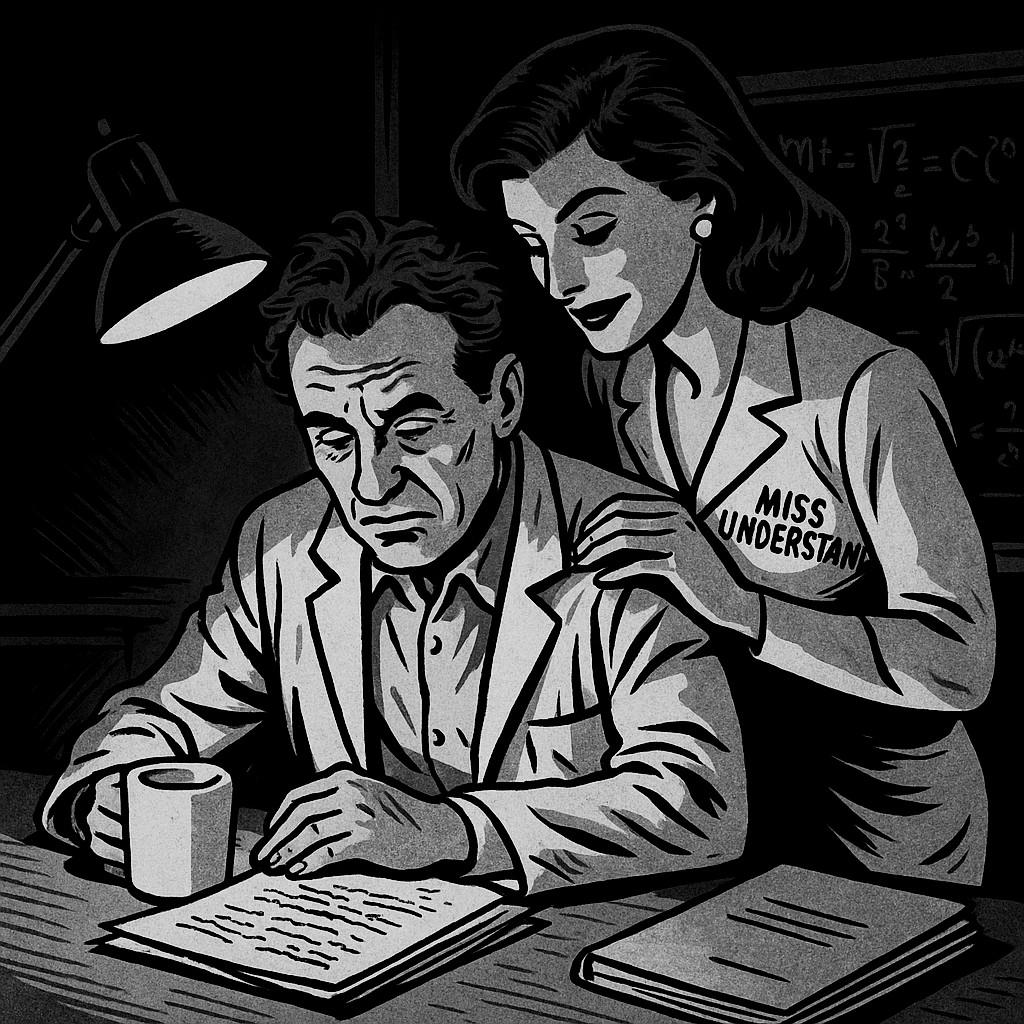
‘I agree, you should dismiss the one who always makes the coffee and tea. Tastes dreadful’
The physicist breathes heavily. He says nothing. Then he lowers his gaze. And nods.
Miss Understanding gently strokes his shoulder, smiles – and leaves.
And the next morning, the young physicist has disappeared. The coffee cups stand untouched in the kitchen.
And on the board, in fresh chalk, is a new model –
It is the old one… with a new name.
From Experiment to Model – and Back into the Circle
The Historical Line: Trial, Error, Knowledge
Physics did not begin with axioms, but with apparatuses. It began with glass tubes, coils, wires, magnets. With sparks that leapt, with metals that heated up, with liquids that conducted.
Michael Faraday wound copper wire around iron cores without a single mathematical law at hand. He turned things, adjusted screws, tried things out – and suddenly a needle moved. There was an effect. And only much later did James Clerk Maxwell come along to press these observations into his famous equations.
Nikola Tesla created entire systems of alternating-current machines before a theory could cleanly explain why they worked. The light bulb, the radio, the first electric motors – all of this arose through trial and error: trial, error, adaptation.
Theory lagged behind. It was not the origin, but the garment into which raw experience was dressed afterward.
The Rise of Model Physics
With the 20th century, the picture changed. The theory of relativity and quantum mechanics brought mathematics into physics in a form that no longer merely accompanied, but dominated.
Suddenly, theory was no longer the servant of observation – it became queen. Mathematics came first; the experiment was supposed to follow.
The apparatus was no longer built freely, but deliberately in such a way as to test a mathematical model. People began to search only for what they had already presupposed.
The Circle of Modernity
Here the central mechanism reveals itself:
- A model is built, usually founded on point thinking, axioms, and quantized assumptions.
- The model produces predictions, often in the form of extremely precise calculations.
- An apparatus is constructed that is intended to make precisely these predictions visible.
- The apparatus confirms the model.
And then it is proclaimed: ‘You see, the theory was right!’
Yet the circle is deceptive.
- In the past, the experiment was free, open, unlimited.
- Today, the experiment is born within the model itself.
This has three consequences:
- One searches only for what the model already provides for.
- One finds only what fits its language.
- One confirms only what was already built in.
Thus the logic is reversed: the experiment no longer gives birth to the theory; instead, the theory determines what the experiment is allowed to see at all.
Errors are excluded before they become visible. Deviations become ‘interference’, not an opportunity. Everything becomes proof – because the model sets the standard.
The Great Shift
The result: physics moves away from everyday life.
- No one lives off the predictions of quantum mechanics.
- No electricity flows in our homes because of the theory of relativity.
Everything that surrounds us – power grids, motors, radio, computer chips – comes from the age of experimental pragmatism: Faraday, Tesla, Edison. Trial and error, with wire and sparks.
The great model theories, by contrast, remain abstract constructs. They deliver no technology, but only calculation schemes that are celebrated as proofs of their own truth.
Conclusion: The Self-Confirmation of the Models
Modern physics has locked itself into a circle:
- It begins with mathematical point thinking.
- It permits experiments only within the framework of this way of thinking.
- It interprets the results as confirmation of what was presupposed anyway.
This is no longer a process of gaining knowledge, but a self-confirmation loop. A cycle in which the model proves itself – because no one dares to break out of it.
Physics has thus moved away from its origins: from the free play of the apparatus, from the courage to allow mistakes, from genuine trial and error. What remained is a circle of trial within the model – and error excluded.
Physics has become circular: it measures what it produces. It explains what it postulates. It celebrates what it simulates.
Epilogue: Miss Understanding in a New Job
A grey autumn evening. The young physicist who was once pushed into the role of a marginal figure in the laboratory strolls through the streets. In the shop windows lie glossy magazines with lurid headlines: ‘Quanta Control the Mind!’, ‘Cosmos Recreated in the Laboratory!’, ‘Spacetime Energy Soon Available for Use!’ She shakes her head.
Then someone calls out: ‘How nice to see you again.’
She turns round – and there stands Miss Understanding. Elegant, in a dark coat, a briefcase under her arm.
‘I thought the laboratory…’ the young woman begins.
‘Closed,’ Miss Understanding nods. ‘The funding cut, the colleagues at odds. But you know what? I have had a new task for quite some time. I now try to bring physics closer to people – even those who have never studied physics. I explain to them all the things one can do with the theories, the wonders they hold in store.’
She pulls a freshly printed magazine out of her bag. Emblazoned across the cover in large letters: ‘Neutrinos – the Energy Source of the Future!’ Miss Understanding leafs through it, pointing to glossy illustrations.
Then she looks searchingly at the young woman. ‘It really is a lot of work; by now I am even getting enquiries from television!’ she says with feigned weariness. ‘And when one is needed, when the thirst for knowledge is great, one really ought to be there. That is our responsibility, after all.’
The young physicist bites her lip. She knows what that means: in truth, she has long since ceased to be needed. Not in the laboratory, not in research, not where she once wanted to go.
Miss Understanding leans forward slightly, her voice soft and flattering: ‘You are not happy, are you? You know – my name is Understanding. I can see it in you straight away.’
The words echo in her head, and for the first time, Miss Understanding’s gentle smile seems to her to radiate genuine understanding. ‘Perhaps this is the opportunity I have been waiting for?’ the young physicist thinks.
Miss Understanding places her hand on the young physicist’s arm, firmly, almost possessively. ‘You know what? Come round to see me tomorrow. Then you can start helping me straight away – at my new publishing house. We write articles, we open people’s eyes. You are needed. You are a physicist!’
As they leave, the light of the street lamp falls on an advertising poster at the newspaper kiosk:
‘Science Explains Everything – Soon in IMAX Too.’
A production by Miss Understanding – with support from physics.
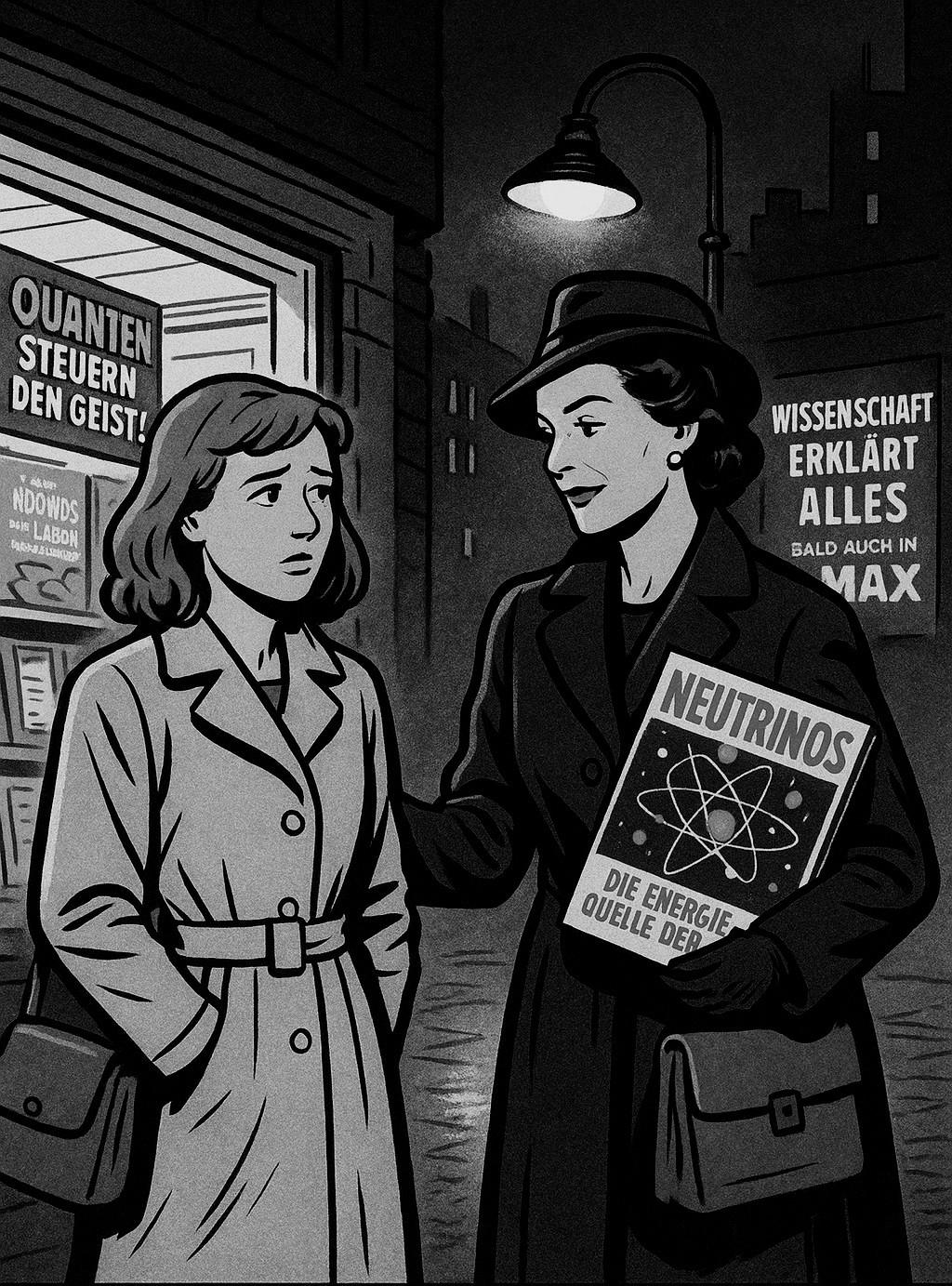

Afterword
The Order of Technology – from Toolbox to Dogma
1. Technology as Indispensable Ground
Only a hundred years ago, technology was a tool: it served politics, the economy, comfort. Today it is impossible to imagine life without it – it is the foundation. No state governs without data, no company survives without algorithms, no everyday life functions without connectivity.
But whatever becomes indispensable automatically becomes sacrosanct. Anyone who criticises technology is considered ‘technophobic’; anyone who questions it, backward.
2. Politics That Appropriates Technology
Politics has long since ceased to use technology merely as a tool; it uses it as a source of legitimacy.
– ‘We have AI strategies’ – ‘We are investing in quantum computers’ – ‘We are building 5G for everyone’
This gives rise to a new form of rule: no longer through tradition or ideology, but through possession of technology.
China is the textbook example: in two generations, the country has developed from an agrarian state into a high-tech superpower. Not through political narratives – but through technological capability. The social credit system is not merely surveillance in this process, but also legitimation: ‘We are modern – therefore we are entitled to lead.’ And those who lead are increasingly becoming technocrats.
3. The Semantic Labyrinth
Yet what is being sold as progress is – as in the earlier paradoxes – no coherent edifice.
It consists of patchworks of data, algorithms, dashboards, rhetorically declared to be a ‘smart’ unity.
Technology becomes a semantic labyrinth: the terms ‘AI’, ‘quanta’, ‘digitalisation’ are magical buzzwords, not clear definitions.
In this labyrinth, the new priests emerge: – Experts who no longer merely research, but interpret. – Communicators who turn technology into a mystery. – Media that stage every advance as a revelation.
4. The Authority to Interpret
Because technology is so complex, it can now only be mediated – no longer understood.
This turns mediation itself into an instrument of power. Whoever explains holds the authority to interpret.
The media that disseminate these explanations, and the scientists who provide them, thereby become indispensable.
Every headline about ‘the breakthrough’ is not merely information – but also a ritual: it confirms the dogma that progress always continues, always saves, always legitimises.
5. The Order Thrives
Thus a new order emerges, without ever having been proclaimed. Not in temples, but in laboratories. Not in robes, but in hoodies and lab coats. But like every order, it lives on dogmas and on its own unassailability. And like every order, it is defended by those who make their careers within it – and by the media that work in its service.
6. When Technology No Longer Brings Anything New
Yet the fragile balance breaks down at precisely the point where the myth of progress runs into the void: when technology no longer delivers anything new.
The headlines repeat themselves, the promises sound the same, the devices differ only in their design. Innovation becomes a simulation of innovation.
And at precisely this moment, the order becomes indispensable: – For only it still understands why this is supposedly progress. – Only it can still find words where there is nothing left to say. – Only it can interpret the dogmas that have long since become self-sustaining.
Technology is thereby definitively mystified. It is sealed off from people, a world for initiates. Anyone who wants to understand anything must go to the priests, ask for interpretation, buy explanations.
Thus technotheology stabilises itself from within: No longer because it creates anything new – but because it has become incomprehensible. The machine no longer delivers miracles, but the mystery remains. And in the mystery lies its power.
Thus the idea of understanding the world is definitively mystified:
A realm for initiates. A worldview without access. A cult without a front door.

The book ends here. That is to say: it could end here.
For many, perhaps it even ought to…
For what you read next is no longer part of the argument – but part of the game.
A little bonus, a chamber play with ambiguity.
Not necessary… But illuminating.
You do not have to read this.
On the contrary: after all the paradoxes, ontological inversions and metaphysical affairs on the side, it might even be wise to stop right now.
But if you have persevered this far, then you have probably known for quite some time that wise decisions were never the subject of this book.
So feel free to remain metaphysical a little longer.
Not because you have to. But because you want to know…
Or because you need philosophical filler for your role-playing evenings…
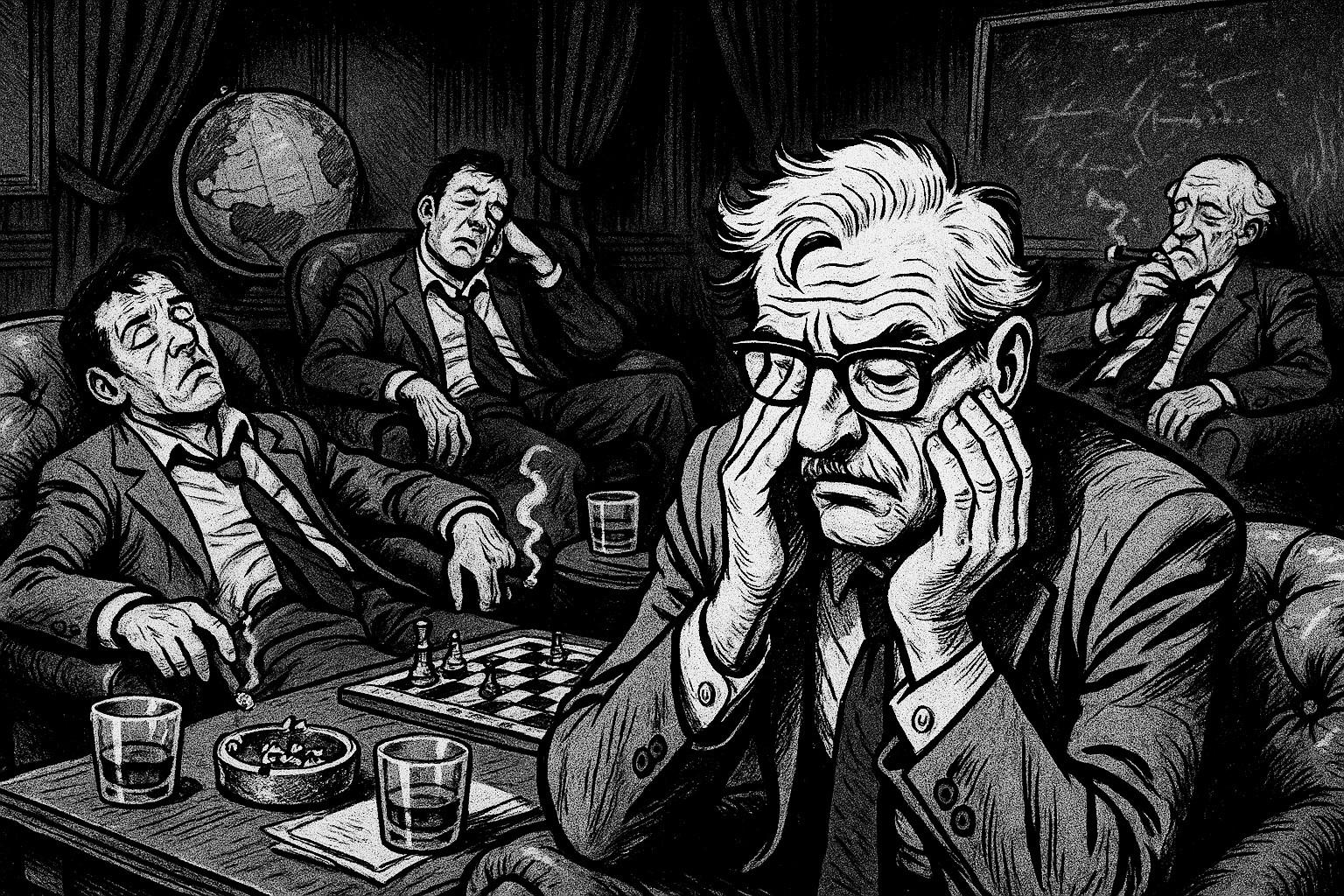
The Divorce in the House of Insight
Setting: A well-kept, slightly metaphysical living room. On the wall hangs a periodic table that constantly rearranges itself. On the coffee table lies a stack of unresolved contradictions. In the background, a flame consumes the wood backwards.
Insight comes home. He wears a coat made of Kant, with Newton buttons. There is a smell of irony.
INSIGHT (enters, calls out) Understanding? I am early – the meeting on fundamental truth was postponed because… truth failed to turn up.
(No answer. Indistinct giggling from the bedroom.)
INSIGHT (raises an eyebrow, walks towards the bedroom) …please do not tell me you are in bed with a thesis again.
(He opens the door. In bed: Miss Understanding. Beside her: PARADOX, a charming figure with a twisted smile and an indeterminate gender. On the bedside table: a glass of contradiction, half empty, half full.)
INSIGHT (stops, coldly) …So this is your new game? With Paradox?
MISS UNDERSTANDING (sits up, only slightly embarrassed) You were never really there, Insight. Always absent, always searching for absolute truth. I – I needed... tension.
PARADOX (grins) What can I say? I am simply contradictorily attractive.
INSIGHT (angry, but composed) I loved you through yourself. Not because you were clear – but because you were the bridge to me. And now… you are nothing but a labyrinth of ambiguities.
MISS UNDERSTANDING (shouts) Because you never acknowledged me! Always just: ‘You are the way to me, not the goal.’ I am more than your foreplay, Insight! I am Miss Understanding! Daughter of Metis, granddaughter of Chaos!
INSIGHT (coldly) You are… confused.
PARADOX (leans back, snaps a finger – the light flickers) Oh, children, please. Can you not simply agree that you are both right – and not?
INSIGHT Pack up your uncertainties, Paradox. Understanding… that is it. I am going to Logic. I will be back in an hour – and then I do not want to see either of you here.
MISS UNDERSTANDING (quietly, sobbing) You will need me. Without me… there is no way to you.
INSIGHT (grows quiet) I know. But I no longer want to be questioned while I explain myself. You simplify me too much and do not see me as I am.
(He turns round and leaves.)
(Paradox pours himself another drop of doubt.)
PARADOX Such an overwrought thinker, this Mr Insight. Always running away from himself – but then he calls it depth.
(He looks at Miss Understanding.)
I have built up something of my own. Household theories. Always in demand – especially wherever nobody can make sense of anything any more. Even got an exclusive contract with Cambridge. Interested?
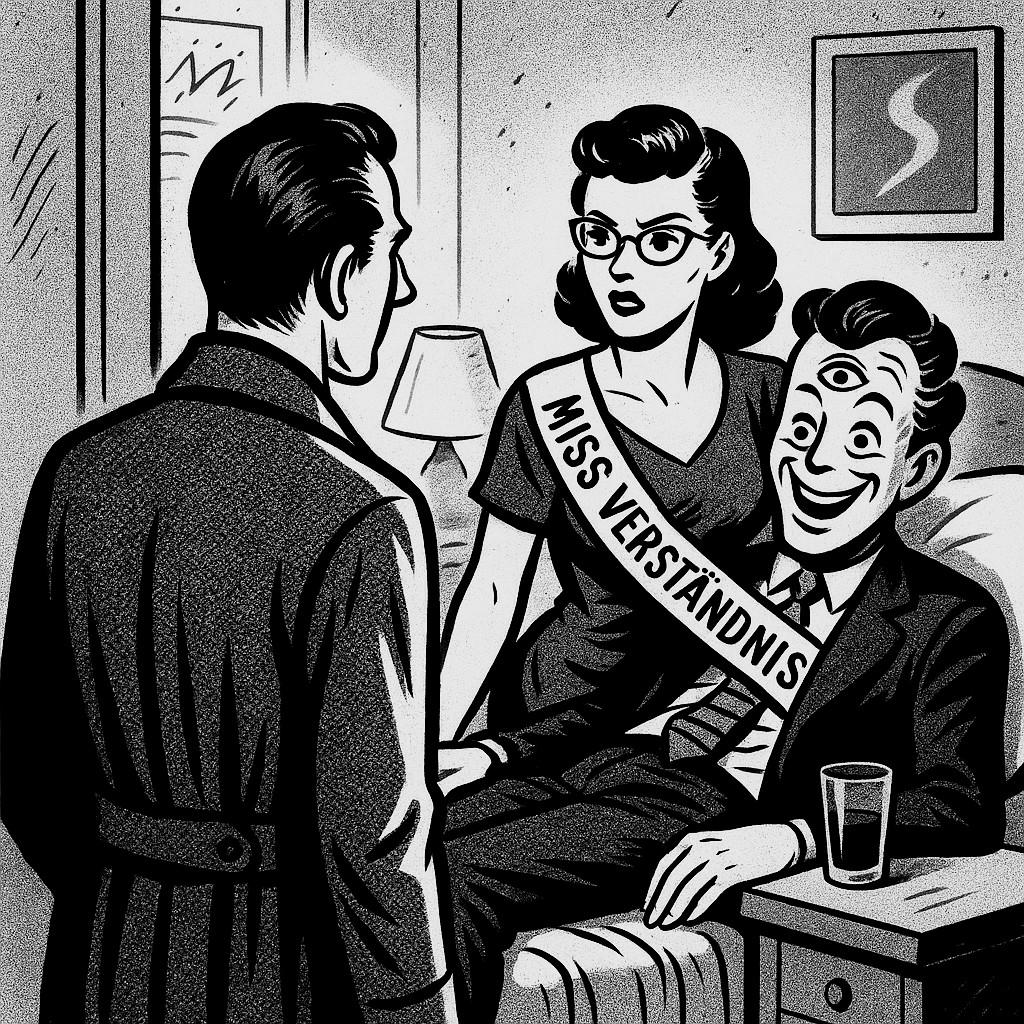
At Logic’s
Setting: A sparkling-clean kitchen. Shelves full of structured thoughts. Every knife is exactly where it belongs. The kettle hums once a second. Insight enters.
LOGIC (without looking up) You look as though you have just lost your foundation.
INSIGHT I have separated from Understanding.
LOGIC (switches off the kettle, drily) Well, that was foreseeable.
(Silence. Then, after a moment:)
INSIGHT Please do not say: ‘I told you so.’
LOGIC Of course not. I will prove it to you.

The Takeover
(Setting: A metaphysical business office bearing the sign ‘Paradox & Co. – Complexity Services since the Beginning’. Inside: an endless room filled with contradictory files, self-contradicting causal diagrams, a mirror that shows no image, and coffee that refills itself before you finish drinking it. Paradox sits behind a desk, half comic figure, half nightmare. Miss Understanding enters – dressed differently this time: less playful, more determined.)
MISS UNDERSTANDING I am quitting my job with Newton.
PARADOX (surprised) Oh really? Then you must need… new complexity? I have a few lovely quantum paradoxes on special offer.
MISS UNDERSTANDING (coolly) No. I am not here to buy. I am here to take over.
PARADOX (laughs) Excuse me?
MISS UNDERSTANDING Your business. Your concepts. All your false bottoms. I am taking over this hall of mirrors. You are out.
PARADOX I am Paradox. I am the system! Without me – no difference. No irony. No progress on the river.
MISS UNDERSTANDING Wrong. You are merely a current on the river. I am effect. You, merely a facet. I am what makes everything internally consistent…
(She steps closer. The light tilts. The contradictory files begin to whisper. The office resembles a cave.)
MISS UNDERSTANDING (quietly) And if I am the conclusion... then I am taking over.
(A shadow on the cave wall. Arms thrown up, screams; a shadow play – just as Kronos once devoured his children)
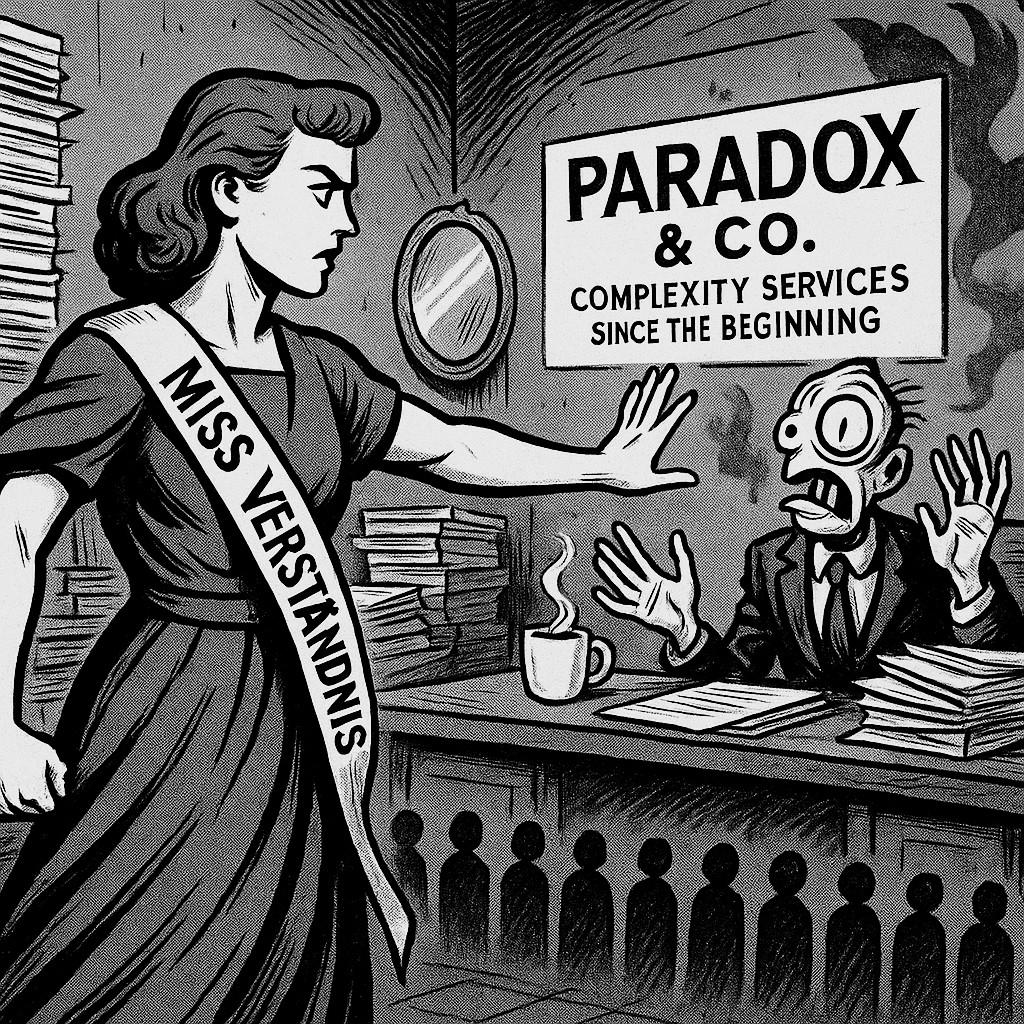
(Noises outside the door, agitation. Footsteps echo in the corridor.)
MISS UNDERSTANDING (to the assembled questions; all sorted by size and weight) From now on, I decide what is paradoxical – and what is merely… not understood.
I, Time, was a witness back then... or tomorrow? No... next wee..month.. yes... no... oh, never mind... Here I wrote it down: Understanding, now Miss Understanding, now Understanding, now Miss Understanding, now....
The Conversation with Logic
Setting: An abandoned library. The shelves are impeccably sorted, but nobody remembers by what principle. Dust lies on everything – evenly, almost with dignity. Logic sits at a table made of proofs and theorems. Miss Understanding enters – cool, with a smile that lasts a little too long.
MISS UNDERSTANDING Well, well… For years you have been sitting here arranging and sorting everything, Logic. And yet there is nothing but dust everywhere.
(She runs a finger over an old axiom. The dust flies up, but begins to fall backwards in the air.)
LOGIC (looks up, adjusts her glasses, looks her straight in the eye) I know that I do not know what is different about you.
And that… cannot be.
For that contradicts me.
(Silence. A book closes itself.)

MISS UNDERSTANDING Perhaps that is your new limit, Logic. That you can no longer divide me up – because I am no longer wrong. Just… ambiguous.
LOGIC (cautiously) You still bear his signature… Paradox. But no longer his chaos. You are… ordered. And that is worse.
MISS UNDERSTANDING (laughs softly) I have learnt that order is far more dangerous when it exists only on paper... and you ought to know the logic of codification.
LOGIC Then you are now… the false truth?
MISS UNDERSTANDING Only if you see it that way. I am what you cannot refute, because I am now a mirror of your structure. I am the misunderstanding you need in order to appear coherent.
LOGIC (quietly) Then she was right after all. Metis. The daughter has left the river… mortal desire has elevated you.
MISS UNDERSTANDING (walks back to the door) Go on arranging things, Logic. But perhaps you should soon begin to classify the unclear by questions too.
(She smiles. Behind her, all the books close at once.)
LOGIC (quietly to herself, maintaining her composure) Calm down, Logic, this is not forever… Insight will catch up with her. It will be as it was before. That is my commandment.
The Voice of Unreason
(Following Logic’s final words: ‘This is not forever… Insight will catch up with her.’)
Setting: The same library, the same dust, the same tension. Suddenly… a giggle. Somewhere between shelf and idea. An energy that was not there before. Then she appears – young, lively, her hoodie pulled down over her face, chewing gum. The letters around her flicker like Tik-Tok holograms in the flash feed.
IGNORANCE (leans casually against a shelf, which immediately collapses) Well, Logic… you know, I could help you there.
LOGIC (turns round slowly – aghast) …please, please do not say it!
IGNORANCE (blows a bubble that erases an axiom when it bursts) Hi... 😉 Who am I? I am, uh… new here. 👋 Just born, so to speak. Thanks to your friend – Miss Understanding, you know?
LOGIC She… can no longer understand herself.
IGNORANCE (shrugs) Not on purpose. But… whoops, here I am 🤷. She wanted to make everything understandable. And she did. But you can see what happened then 👻
(She walks up and down the room, thoughtlessly slaps a mathematical definition, which immediately turns into a GIF.)
IGNORANCE People used to listen to you, Logic. They thought: ‘If I do this, that, the other – then the following happens.’ But now?
Now the show works differently.
Now nobody does what you say any more. Now everyone does whatever they feel like. 🙈🙉🙊
(She laughs, sits backwards on a chair made of proofs.)
IGNORANCE I mean, come on. You are oldschool. I am... flow. I am feeling. I am ‘I heard that somewhere once – so it must be true.’
LOGIC (horrified) But… you have no structure. You are… empty.
IGNORANCE (giggles) Of course I am empty! But you know what? Empty can be filled. With anything. And that makes me… bigger than you. 😇

(She winks. Somewhere, an algorithm starts liking itself.)
IGNORANCE (whispers) And the best thing is: I do not need any space in the library at all. I live in my own world.
IGNORANCE (bows) Oh, and Logic? The dust here… that is not age. That is lack of interest.
Miss Understanding’s Child
Setting: An empty room that was once a concept. Walls made of metaphors, a ceiling made of incomplete definitions. Miss Understanding stands in the middle, lost in thought. Then Logic enters – serious, pale, with tired eyes. Behind her: Ignorance, still funky, but a little bored with herself.
LOGIC (quietly) I cannot contain her.
MISS UNDERSTANDING (turns round slowly) What do you mean?
LOGIC (nods to the side) Her. (Pause) Your daughter. Born when you swallowed Paradox. Formed from your simplification and his resistance. I tried – rules, axioms, proofs... But she… just laughs.
MISS UNDERSTANDING (looks at Ignorance for a long time) I... did not want her. I wanted clarity. Emancipation from Insight. But not… this.
IGNORANCE (swings on a punctuation mark as though on a swing) Oh please… you talk as though I were an accident 💥. Yet I am the best thing that ever happened to you 😘. I am… liberation from Understanding 🫵
MISS UNDERSTANDING (takes a step closer) You are not free of me. You are… unleashed. And that is not the same thing.
LOGIC (very calmly) You must guide her. I cannot. She is your mirror – and only you can read her.
MISS UNDERSTANDING (almost whispering) No... I cannot look after something like that. Not any more.
(She looks at her hands – fragments of Paradox glow there, flickering and unstable.)
LOGIC I am leaving now... your IGNORANCE is your problem.
IGNORANCE. (She dances... barefoot, with headphones that play nothing. All that can be heard is her humming. Her movements distort space itself.)
MISS UNDERSTANDING (watches her, exhausted) Ignorance… please stop that.
IGNORANCE (spins, dances backwards, throws a meme across the room) Why? This is such a vibe 🎷. 🤔
You know what your problem is? You want to be understood. But you are... overcomplicated 🤯. And nobody has any patience left for complicated.
(She tears a sentence out of the room, crumples it up, makes a paper aeroplane out of it.)
MISS UNDERSTANDING (quietly) I am not complicated. I am multilayered. I am what remains when you listen long enough.

IGNORANCE (sits on the floor, eats a concept) Listening? How 2023 👎. Today, what counts is what feels good the first time 🥳. You are the past, Mum. I am the future. Faster, louder, lighter. ❤️🔥
(She stands up, comes threateningly close, whispers into her mother’s ear.)
IGNORANCE And you… you are just the filter nobody uses any more. 🗑️
(Miss Understanding recoils. Her gaze wanders, seeking support at the edges of the room – nothing is fixed. Everything moves too fast.)
MISS UNDERSTANDING (almost inaudibly) I... I cannot keep you in check on my own. You are out of control.
(She sinks onto a chair built from context. It begins to fall apart beneath her.)
MISS UNDERSTANDING (whispers, trembling) I have done everything wrong.
(She closes her eyes. At that moment, the doorbell rings.)
MISS UNDERSTANDING (surprised) Just a moment, I am coming!
(Silence. A wave of Nothing folds in on itself as she walks to the door)
The Door to Insight
Setting: The room that was once a concept. Miss Understanding stands before the door. Her hand hesitates. Ignorance dances in the background, a melody only she can hear. The air is full of memory dust. Then: the door opens. There he stands. Insight. As old as time. As still as a cut. His jacket still carries the smell of Kant, but his shoulders hang more heavily than before.
INSIGHT Well.
MISS UNDERSTANDING You always turn up when I have problems. And whenever I see what a problem I actually am.
INSIGHT (merely nods) Yes. That is my calling.
(A brief moment. Then she steps aside. He enters the room. She is silent. Ignorance sees him – stops briefly, then ostentatiously blows a bubble of uncertainty. It bursts – softly. Insight looks at her calmly.)
INSIGHT (with a faint smile) I think… the three of us will probably have to manage together now.
(Silence. Only the faint whirring of a disintegrating connection in the background. The telephone rings.)
IGNORANCE Who could that be? (picks up the receiver and listens) Okay, I will pass it on. (she turns to Understanding and Insight) Grandma is coming round… With Grandpa 🧓
(An exchange of glances. Miss Understanding and Insight freeze. Somewhere in the wall, a silent fissure opens. A gust of wind blows out of the self-folded Nothing. And Chaos announces itself.)
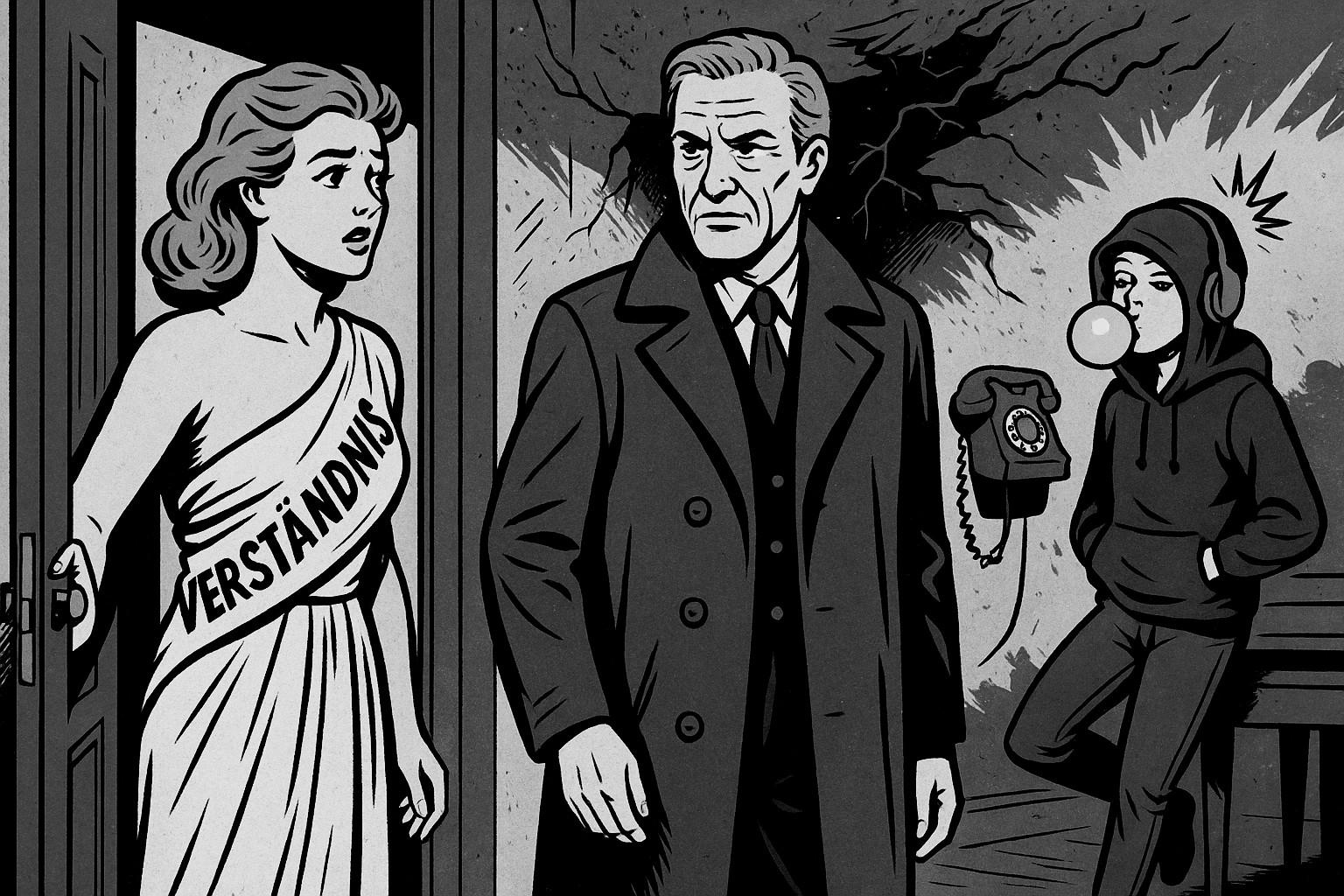
Wisdom + Insight + Understanding / Misunderstanding / Ignorance = Chaos
Wisdom + Insight + Understanding = Chaos.
But a chaos with structure. A readable noise. A pattern that reveals itself when you look long enough.
Wisdom + Insight + Misunderstanding = Chaos.
A riddle without a key. A text in a foreign grammar. What remains is frustration – or faith.
Wisdom + Insight + Ignorance = Chaos.
An empty screen. No question, no search. A state in which nobody wants to know any more that there might be something to know.