Volume II
Tractatus Principio
—
On Difference
Volume II
Book of Physics
Chapter I
The Origin of the Problem – From Relation to Substance
1The notion that the world consists of points is a deep-seated but misleading concept in the history of thought. It springs from a consequential misinterpretation whose origin does not lie in the works of early philosophers such as Aristotle, Archimedes, or Descartes, but in the later shift of thinking, especially through Newton.
2This misinterpretation begins with an apparently harmless step of thought: the notion that points are practical tools for describing the world mathematically – and ends in a fundamental confusion of abstraction and reality.
3Let us consider the concept of the point in Aristotle: For him, space is not an independent substance, but the place that a body occupies. Space does not exist independently of bodies; rather, it is a relation – a web of relationships between things. The famous “horror vacui” – the fear of the empty – is, in Aristotle, not an argument for the existence of “stuff” in space, but the statement that the thought of an empty space is simply nonsensical. Space is not “empty,” because space is always already the relationship between bodies. There is no place without a body that occupies it – and also no body that does not stand in a place.
4Archimedes supplements this perspective by showing that density is not a “stuff,” but a ratio: When a body is immersed in a liquid, it displaces a certain amount of this liquid – the famous discovery that we know as the “Archimedean principle.” Thus density does not mean that “something is lodged” in a body, but that a body, in relation to another body (e.g. the liquid), shows a certain behavior.
5Here, too, the following holds: It is the relation, not the substance, that counts.
6Yet precisely here begins the error in thought that will later creep in: The relations that Archimedes and Aristotle describe are increasingly understood as properties of individual objects – as if a body carried “density in itself” or as if a point “contained something.”
7Descartes and Points as Relation
8With René Descartes, the idea of relation finds a new mathematical form of expression. In his La Géométrie of 1637 he describes how geometric figures can be grasped through equations and coordinates. The point in Descartes is not a “thing,” not a building block of reality, but a mental marking – a place in a coordinate system that is defined by its relationship to the axes.
9A point does not exist out of itself, but only as relation: It is there where lines intersect or where certain distances are fulfilled.
10Descartes explicitly does not say that bodies “consist of points.” For him, points are tools that make it possible to translate geometric figures into algebraic equations. It is about description, not about constitution. His famous statement that all geometric problems can be reduced to equations is not a statement about the ontology of the world, but about the possibilities of its mathematical representation.
11A point in Descartes is therefore not the foundation on which the world is built, but a place at which certain relations meet. In his philosophical writings, he defines matter itself not through “density” or “stuff,” but through extension. A body is an extended something, not a point without extension.
12Thus Descartes remains – at least in his original intentions – within a relational framework: Points serve description, not explanation. They are mental tools, not ontological building blocks of reality.
Chapter II
Newton and the Ontologization of the Point
1With Isaac Newton, a decisive transformation is enacted. In his Philosophiæ Naturalis Principia Mathematica (1687), Newton formulates the basic principles of classical mechanics – and with them a new concept of space, matter, and point. While Descartes understood points as tools for describing relations, Newton makes them into bearers of physical properties. In him, the point becomes the place where mass, motion, and force “sit” – as if points themselves were particles in which matter is concentrated.
2In Definition I of the Principia, Newton writes:
3“Quantitas materiae est mensura ejusdem, orta ex illius densitate et magnitudine.”
4Translated:
5“The quantity of matter is its measure, composed of its density and volume.”
6Here mass is understood as the product of density and volume. In Newton, density is no longer only a ratio, as in Archimedes, but a peculiarity of a body that is contained in a certain space. Thereby the thought is introduced that a body “has something in itself” – a substance that is “inside” space, independently of other bodies.
7Newton also describes the gravitational force between masses in an empty space:
8“Every mass attracts every other mass with a force that is directly proportional to the product of their masses and inversely proportional to the square of their distance.”
9This is the famous law of gravitation – and it rests on the assumption that masses can be regarded as point-shaped objects that are concentrated at one place.
10With this formulation begins the ontologization of the point: The point is no longer merely a relation or a mathematical aid, but a real “something,” a place at which mass, density, motion, and forces act. In Newton, space becomes an empty container in which points with properties “float around.”
11The decisive step is enacted: What in Aristotle and Descartes had been thought relationally – space, points, density – becomes substance in Newton. Points now “contain” mass, density becomes a property “in” a body, and space exists independently of the bodies that fill it.
12The Reduction Trap – Why Points Provide No Explanation
13With Newton's concept of point masses, of density as a property “in” a body, and of empty space as container, a notion establishes itself that shapes the natural sciences to this day: the assumption that the world consists of zero-dimensional points that “contain something” – mass, charge, energy. This is understood as a pragmatic model: points are said to be “practical” because they permit complex phenomena to be described mathematically. Yet precisely here lies the error.
14A point, mathematically defined, is zero-dimensional. It has no length, no width, no height, no volume, no mass. It is a mental place, not a building block of reality. An infinite set of points – even infinitely many – does not yield “something”; it remains nothing. A space cannot consist of points because points have no extension. A mass cannot be “lodged” in a point because a point has no space in order to “contain” something.
15The notion that points are the building blocks of the world is not a simplification, but a fundamental distortion. It leads to paradoxes: How can a sphere consist of “nothing”? How can an electron be “point-shaped,” but at the same time possess a measurable extension in the form of a wavelength? How can a gravitational field act at a point if this point has no surface on which a field could exist?
16The points do not explain; they replace the actual questions with a model that isolates certain aspects (positions, distances) and makes others (structures, relationships, processes) invisible. This reduction to points is not “simplification,” but a trap of abstraction that presses the complexity of the world into a scheme that is not logically viable.
17Thus it becomes clear: Points are not a simple model of reality, but a mathematics of simplification that has declared itself to be ontological truth – with far-reaching consequences for the scientific world picture.
18Consequences of the Misinterpretation – and a Way Back
19The misinterpretation that began with Newton's ontologization of the point extends into the present. It has deeply shaped scientific thinking: space is understood as a container that exists independently of bodies, while bodies count as accumulations of point masses that “contain something.” Physics describes electrons as “point-shaped particles,” imagines gravitational forces as “effects between points,” and treats fields as “values at points in space.” All of this is based on the tacit assumption that something without extension can have a physical reality.
20Yet this thought leads into logical and physical paradoxes:
21How can a point that has no surface “exert” a force?
22How can a density that describes the ratio of mass to volume exist at a point that has no volume?
23How can a continuum – a space, a body, a field – arise from something that possesses no extension?
24The answer is simple: It cannot. The notion that points are “building blocks” of the world is a categorial error – a confusion of model and reality. Points are abstractions, tools for the mathematical description of relations – not the “building blocks” of nature. The world does not consist of points. It is constituted through relationships, through relations, through field structures.
25A way back to a better understanding leads through a recollection of the relational approaches of Aristotle, Archimedes, and Descartes:
26Space is not a container, but a web of relationships.
27Bodies do not consist “of points,” but are determined by their relations – by what they do with other bodies and how they stand in relation to one another.
28Density is not a “stuff” that is lodged in a body, but an expression of how a body acts in relation to other bodies and to space.
29The task for the physics and philosophy of the future is to take this relational perspective seriously – and to expose the reduction to points as what it is: a practical, but dangerous, aid that is easily confused with reality. Only if we draw this distinction clearly can we develop a deeper understanding of space, matter, and motion – beyond the paradoxes that were born from a false assumption.
30Einstein and the Rediscovery of Relationality
31Albert Einstein revolutionized the understanding of space, time, and gravitation with his general theory of relativity. He recognized that space and time do not exist as absolute, independent entities, but stand in a dynamic relation to matter. Einstein formulated this pointedly:
32“In the past one believed that if all things disappeared from the world, space and time would still remain; according to the theory of relativity, however, time and space disappear with the things.”
33In this perspective, space is no longer the rigid container as Newton had described it, but a flexible structure that is formed by the presence of mass and energy. Matter curves spacetime, and this curvature in turn influences the motion of matter. Thus space and matter are inseparably connected with one another.
34Einstein himself emphasized the necessity of a new thinking in order to grasp these complex connections:
35“A new kind of thinking is necessary if humanity wants to go on living.”
36These insights led to a paradigm shift in physics, away from the notion of an absolute space and toward a relational understanding in which space, time, and matter stand in a constant interplay.
37Einstein's theory of relativity thus stands in one line with the earlier reflections of Aristotle, Archimedes, and Descartes, which likewise emphasized the meaning of relations. It corrects the misunderstanding that was introduced by Newtonian physics and offers a more coherent picture of physical reality.
38The Unfinished Corrective – Why Einstein's Relationality Was Not Thought Through Consistently
39Although Albert Einstein, with his theory of relativity, opened the door to a new, relational understanding of space, time, and matter, this paradigm shift remained incomplete. Einstein himself recognized that space without matter is not thinkable. His famous statement – “If one removes matter, space also disappears” – radically calls into question the basic assumptions of Newtonian physics. Yet in the practical implementation of physics, one decisive aspect remained preserved: the notion of point-shaped objects as bearers of physical properties.
40In the theory of relativity, masses continue to be described as point masses, electric charges as point charges, particles as point-shaped objects that “float around” in spacetime. The point idea – Newton's inheritance – was not abandoned, but merely integrated into a new framework: spacetime may be curved, but the “particles” in it remain points.
41This adherence to points leads to a contradiction within the theory itself. On the one hand, the theory of relativity says that space and matter are inseparable – that space itself “is nothing” without the matter that forms it. On the other hand, physics continues to treat matter as localizable points that “carry in themselves” properties such as mass or charge – as if these properties could exist at a zero-dimensional place that has no extension.
42The consequence of this inconsistency appears in practical problems:
43The singularities of the general theory of relativity – for example in black holes – are precisely the result of this point-idea: the assumption that infinite density can exist at a point. In quantum field theory, too, we encounter the same problem: fields are defined at points, particles are described as “point-shaped” – with the consequence that many calculations diverge into infinity and elaborate mathematical procedures become necessary in order to “calculate away” these infinities.
44Thus it becomes apparent: Einstein's relationality was a necessary corrective, but not a complete break with the Newtonian notion. Physics remained stuck in a half paradigm shift: it adopted Einstein's relational space – but kept Newton's point-like objects as building blocks of matter.
45The path to a consistent theory that truly takes the relational thought seriously is therefore still outstanding. Such a theory would have to consistently cease regarding points as “building blocks” and instead understand the world as a web of relations, processes, and fields – without the auxiliary construction of “properties in points,” which was falsely declared reality from an abstract description.
Chapter III
Quantum Physics – The Last Bastion of Point Thinking
1Quantum physics, too, which is so often celebrated as a revolutionary break with the classical world picture, remains attached in one decisive respect to the old point narrative. It does call many classical assumptions into question – such as strict determinacy or the continuity of processes – yet the idea that the world consists of “smallest, indivisible units” is preserved.
2The term “quantum” literally means “measured piece” – a unit, a smallest portion. Quantum physics thinks in particles that are modeled as points in space: electrons, photons, quarks – all of them are mathematically described as point-shaped objects to which properties such as mass, charge, or spin are assigned. Even fields – for instance the electromagnetic field or the Higgs field – are defined in quantum field theory as values at points in space.
3This modeling leads directly to the well-known paradoxes of quantum physics:
4How can an electron be a “point particle” that has no spatial extension, but at the same time possess a wave function that is extended across all of space?
5How can something exert an effect at a place if, by definition, it has no place?
6How can we speak of “elementary particles” if every particle is in fact determined only through its relations to other particles and fields?
7Here the fundamental contradiction becomes apparent:
8+ Quantum physics acknowledges that the world cannot be explained through continuous mechanics,
9- but it retains point thinking by thinking this indivisibility and discreteness as “smallest units” – as if “smallest points” were what build up reality.
10Here, too, what was already clear for Descartes and Einstein applies: The world does not consist of points, but of relations, processes, fields. The “quanta” are not smallest particles, but mathematical descriptions of states that arise through interactions. They are not objects, but expressions of possibilities within relations.
11The idea of “points with properties” – in classical mechanics as point masses, in quantum physics as “point particles” – is ultimately the same reduction: a practical auxiliary tool that has become an ontological misunderstanding.
12A truly relational understanding of the quantum world would mean that we stop speaking of “smallest units” – and instead acknowledge that the world is a continuum of interactions in which concepts such as “particle” or “place” are only auxiliary constructs for mathematically grasping certain aspects of our observations
13Quantum Phenomena – The Misunderstanding of Mathematics
14Many phenomena that count in quantum physics as “mysterious” or “paradoxical” are in truth the result of a misunderstanding: They arise because mathematical auxiliary constructs such as points and state functions are ontologically misinterpreted.
15Effects such as quantum entanglement, uncertainty relations, or quantized states appear paradoxical because we try to understand them in a model made of points and discrete particles. We speak of “particles that are at different places at the same time,” of “waves that collapse,” of “jump processes” that “take place” at a point – yet all of this gains its apparent mystique only within the language and logic of point mathematics.
16These effects are not mysterious properties of nature, but consequences of the chosen modeling: We press a continuous, relational weave of processes into a language that starts from discrete points and states – and then we are surprised when the image breaks.
17The supposed “quantum jumps” are not nature itself, but the jumps in our mathematical thinking: They arise because we model continuous relations as discrete states in points, and then confuse the discreteness with reality.
18If we understand the world as a process-weave – as a continuous, dynamic structure of relations that does not break down into points –, many of these paradoxes disappear. It is not the phenomena themselves that are mysterious, but the language with which we describe them.
19The Great Misunderstanding and the Way Forward
20The idea that the world consists of points – whether as building blocks of matter, as bearers of mass and charge, or as “smallest units” of the quantum world – is a deep-seated misunderstanding that has crept into our thinking over centuries.
21This misunderstanding did not begin with Aristotle, Archimedes, or Descartes, but with Newton's ontological turn: Points were no longer understood as abstract tools for describing relations, but as real bearers of physical properties.
22Einstein's theory of relativity was an important step back toward a relational view – yet it too adopted many of the old point assumptions and thus led to new contradictions. Quantum physics, finally, has conserved point thinking in a new form: as “smallest units” of nature.
23Yet the world is not a mosaic of points. It is a dynamic, continuous fabric of relations, processes, and interactions, which we can describe only incompletely with the language of points and states.
24Points, states, quantum jumps – all of these are mathematical auxiliary constructs that can be useful, but must not be confused with reality itself.
25A consistent rethinking requires that we no longer regard points as building blocks of nature, but as what they are:
26Abstractions, tools, markers in a relational field – but never “things” out of which the world consists.
27The real challenge consists in developing a thinking and a language that place relations, continuity, and processes in the foreground – and no longer remain stuck in a world of points that has never existed in this way.
Chapter IV
Why a Point Generates Divergences – and Why That Is an Error of Thinking
1What is a point? (Classical Mathematics)
2In classical geometry, a point is:
* Zero-dimensional,
* without extension,
* without structure, a pure “being-there” at a coordinate.3But: A point has no inner structure, no surface, no volume – it cannot “carry” any physical quantity.
4Nevertheless, the point is often mathematically “loaded” – for example:
* With mass (point mass),
* With charge (point charge),
* With energy (energy point in the Big Bang).5This leads to contradictions:
6Infinitely much density at a place that occupies no space.
7This formally generates:
8If one gives a point a “real property” such as mass, charge, or energy, then one forces an infinite density into a zero-extension.
9This is the origin of all singularities. Infinities as the collapse of observational structure:
10Why does it become infinite?
11Because one reduces the feedback effect to zero:
12Conclusion:
13A point generates infinities because it is a superposition construction that ignores the folding-back and treats a “nothing” as a “thing.”
14The self-contradiction of classical physics: “Everything is three-dimensional” – but calculates with points
15The assumption of classical physics: “Everything is 3D”
16Physics says:
* We live in a three-dimensional space.
* Matter consists of three-dimensional bodies (particles, fields, objects).
* Physical quantities (mass, charge, energy) are spatially distributed.17But: In its equations it often uses points – that is, zero-dimensional ideal objects, e.g.:
* Point masses in mechanics.
* Point charges in electrodynamics.
* Singularities in the theory of relativity.18The problem: The breach of its own premise
19The assumption “everything is three-dimensional” is not consistently maintained.
20Instead, a 3D space is postulated, but then 0D points are introduced as “real bearers of properties.”
21That is a logical self-contradiction:
22One cannot live in a 3D space – and at the same time assume 0D points as real entities.
23For:
* A point has no dimensions,
* therefore cannot carry density, energy, or charge,
* and is therefore not a “physical reality,” but a modeling illusion.
Chapter V
Descartes Was Not Wrong
1Descartes’ actual intention:
2Descartes' introduction of the coordinate system was a tool:
3A way to describe relations, not a claim that the world “consists of points.”
4Descartes thought:
5A point in a coordinate system is a chosen perspective.
6A “place” in geometry, in order to express relations between quantities – not a thing in itself. An experiment is always a point-like choice – a targeted focusing on a particular aspect of reality.
7Descartes transfers this principle into mathematics – and says:
8We choose a point in order to investigate a phenomenon.
9He did not want to say that reality consists of points.
10The error of thinking of the successors:
11Descartes' successors (Leibniz, Newton, later Cauchy, Riemann) have:
12Taken Descartes' point-like perspective and made an ontological structure out of it:
13Space IS a set of points. This is the actual break, because the coordinate becomes an entity – no longer the chosen perspective.
14The role of Cauchy and of analysis:
15Cauchy, Riemann, and others formalized the thinking:
16They introduced the “dx” (infinitesimal) as the “smallest piece of reality.”
17In this way Descartes' point-like choice was ontologized:
Space = points that are described with dx. They froze the perspective of relation and sold it as an ontological model.18Descartes did not say that the world consists of points, but that we can describe phenomena through point-like perspectives. His successors made from this:
19The world is a collection of points, and that was the break.
20→ The actual error of thinking therefore lies with Descartes' successors –
21not with Descartes himself.
Chapter VI
The Number 39.19 as the Measure of the Real
1We come from difference itself, which is mirrored in 0 | 1 and through repetition becomes its own appearance.
2In Tractatus Principio we have seen the signs as they carry themselves: |, 0, ∆, \(\odot\), \(\boxdot\) – the whole grammar of distinction. Now we go from there into the world that is supposedly described by numbers. For physics is the attempt to measure difference. Yet what it measures is always already a relation.
3All measures of physics are forms of the same expression. Meter, second, joule, kilogram. They are not things, but positions of difference. They differ only by the place at which difference is posited. The measure is not a number, but a repetition of the ten, 0 | 1 | 0, a loop of one and nothing. And we have just become acquainted with this system.
4The decimal system is not a human invention. It is a natural order of unfolding. Every number repeats the relation, every unit is a mirroring of ∆. Thus 9 appears from 8 and returns to 1, as every movement of measure is a return.
5The number 39.19 stands here as the fixed point of this recurrence. It is the prime constant (primary constant), the self-similarity in which all measures fall into one another. It is not a unit, but a transition between all units. Path, time, energy, and mass: they all find in 39.19 their common scale, their zero point of coherence.
6Whoever divides by 39.19 enters the pure space of relation. Whoever multiplies by 39.19 calls forth the appearance of a determinate relation. Every quantity x can thus be mirrored in itself: once as number, once as reality. 39.19 is the threshold at which this mirroring becomes stable.
7Therefore one can omit the measures. Meter, second, joule, kilogram. They all carry the same rhythm, the same difference. It is always 0 | 39.19 | ∆. The measure itself remains invariant, because it measures only the difference.
839.19 is not a factor, but a mirroring. A ratio that holds itself. At this point the relation is completely closed, and what we call a “constant of nature” is only its recurrence in a determinate ratio of distinction.
9From here physics begins, yet not as a description of things, but as movement of relation. We must recognize that measurement itself is the act of positing a difference, which unfolds everything that follows, such as gravitation, light, energy, space, from this relation of the number that we use as measure.
10Example of Invariance under Exchange of Units
11If the measure changes, then it does so without the underlying relation changing. Units of measurement are angles of view onto these relations that we consider.
12Let us consider what a measure is. It is a relation with a factor; this factor is the angle of consideration onto the relation that we want to describe. ∆ is the place of this relation.
13λ is now the scale factor that concerns the representation, not the relation itself. Every unit of measure carries its relation within itself, in the numbers, not in its unit. This is the angle of view onto the relation.
0|x|₊∆ → 0|λx|₊∆ where (0|x) ≡ (0|λx) simultaneously scales the measure in the same ratio14The relation cancels:
0|(x|÷K)|₌0|(λx|÷λK)| and the measure disappears in the ratio.15We can therefore write:
0|(x|÷K)|₌0|(x|÷K)|16For all λ, this means that measure is invariant under equivalent scaling.
17In geometrical language it means that if a triangle grows in all sides by the same factor λ, then its ratio remains invariant.
18The relation 0|a|÷c remains the same, because (a/c) = (λa/λc).
19Thus in physics:
20∆ = 1/(K·r²) ∆ measures how strongly two degrees of freedom stand in relation to one another, depending on their distance r and a scale factor K, and if r → λr, K → λK, then ∆ → 1/(λ³)∆, but every normalization that renormalizes via Σ∆ cancels λ³ again. The measure can grow or shrink, but the relation remains fixed.
0|(a|÷c)|₌0|(λa|÷λc)|₌0|(a|÷c)21and likewise
0|(x|÷K|r²)|₌0|(λx|÷λK|λ²r²)|₌0|(x|÷K|r²)22The measure scales, the relation remains. Reality knows no “meter” and no “second.”
23It knows only the ratio of relations. Therefore every unit is only a projection, a kind of shadow on the [word missing in the German source]. Reality itself remains invariant.
24It stands firm in 0|39.19|₌∆, the point at which all units mutually cancel one another.
25The gravitational constant G, the speed of light c, the Planck quantum of action ℏ: they are all not fundamental, but projections of the relation onto a determinate scale.
26This invariance of the exchange of units has shown us that every quantity in the space of distinction exists only through its ratio to itself. Yet as long as measures such as kilogram, meter, or second are used, the difference remains bound to external scales. It is not yet free.
27The K-normalization lifts this binding. It replaces the units of measure with a pure resonance relation of difference, a self-relatedness without foreign reference.
28Thus the physical expression is transferred into the ontomathematical one.
29The Principle of Refolding
30Every physical quantity x carries a relation within itself:
X = (A|B)31The K-normalization defines:
X = (A|B)|ₖ = X÷Kx32The operator |k is the scale flip of measure. It inverts the dimension into its cause and gives it back as resonance. K is the self-resonance of difference and not a factor, but the rest point in the circle of measure.
33The Structure of K
34K is not a number, but an invariant relation of resonances.
35It connects energy, time, length, and mass as eigenmodulations of difference:
K = f(π,∆,∆∆)36π designates the geometrical binding-back of the circle.
37∆ the fractal phase angle ∆ = 2.25°
38∆∆ the total resonance of all levels.
39The conclusion is that K is the fixed point of refolding, which reproduces itself in every scale. In the 39.19 this process has taken shape.
39.19 is thus the first manifestation of the K-relation, the place at which measure and relation mutually cancel one another.
40Dedimensionalization, where in the classical form it holds:
E = m c^241K-normalized, this becomes:
42For this is the double refolding of difference. Energy and mass are then no longer separate quantities, but two phases of the same self-resonance.
43All measures, whether kg or m or time s, disappear in the relation |k . Reality becomes pure difference without the comparative relation of a scalar.
44Each of these quantities is a refolding of difference into itself. Their common fixed point is K; it is the constancy of their resonance. K holds the equilibrium between unfolding and refolding, between measure and relation.
45After K-normalization it holds:
(A|B)|ₖ = (0|1)46Everything physical thereby becomes a special case of difference. The world is no longer an order of measures, but a resonance space of distinction |, in which every quantity is another angle of view, not a property.
K = 39.19 is not a special measure.47It is the resonance point at which all measures mutually cancel one another.
48Once again, very emphatically, why this is decisive for physics, for the problem of classical physics with something like:
F = m×a

[F] = Newton = kg·m/s² kilograms, meters, and seconds are represented there49In order to consider the relation of what we describe, we must lead the variants of the angles of view back to their fundamental normalization.
50Force has thereby consequently become dimensionless, since it now expresses itself in ∆ itself.
51The number F_K describes the pure resonance, without artificial scales.
Chapter VII
The Rule of Increasing Complexity
11–2–3 make space. Not because they count things, but because they carry differences.
21 is the positing, the radius
32 is the difference, the diameter
43 is the relation of the differences to one another. The triangle
5With this, space is complete, for geometry has long represented relations as a triangle. We now think of them merely as connectors, between the things of perception.
6In this, space does not arise from extension, but from relation, which appears to us like space.
7This space is the measure of increasing complexity, for as soon as a difference relates to itself, the number of relations grows and with it the depth of the space, of the things.
8We call the growth rule of this change energy. But energy is not substance, but the visible expression of the inner linkage of the differences. It is the impression of a movement with which the relations nest into one another. This is the origin of all complexity, for it is not expansion, but rather self-multiplication of the relation to one another
9Thus, out of 0|1 → 0|1|2 → 0|1|2|3, the first geometry comes to be. And each addition of another difference \(∆\) opens a new degree of freedom, another level of relation, a new shell.
10These degrees of freedom are back-relationings that pluralize the whole network of relations in its interconnections.
Chapter VIII
This Is Energy
1Energy is informational change over time. It is nothing other than the difference of the difference over a span of time. It is not “something that acts,” but a false thinking of cause and effect. In physics, energy is the driving force. It moves things, gives them mass and thus presence on the stage of space.
2But that is a false assumption. For what is energy supposed to be? It is supposed to be the source of current as the energy of the electron flow. Motion is traced back to kinetic energy. But what energy is, in physics, is a property of systems that appears in different forms and can be converted into one another, but is never lost.
3The logical error is already lodged here, for we see change and think that a force is involved, one that inheres in things and only has to be activated in order to express itself.
E = (0|∆) | (∆t) where ∆t = t¹ - t² (two points in time)4It means that energy is the projection of the difference \(∆\) onto the time axis. The difference itself carries no direction, and only the difference of the times (t¹, t²) sets it in motion.
5What we see is consequently not “energy at work,” but simply a new state of the relations, which we attempt to explain by means of mysterious energy.
0|E ≡ 0|(∆|÷∆t)6and because every time is only relation, the following also holds:
70|E ≡ 0|\(∆₁|₋∆₂\) the difference of two differences, which appears as motion
8With this one can say that energy is the velocity of information, for it sets the still image of measurement in motion, in our measured relation.
9When information rests (|₌), energy would disappear, yet it drifts (|₊ or |₋), it appears to us as work, heat, radiation, gravitation. And because the measure remains invariant \(0|39.19|₌∆\), this definition holds on every scale, from the electron to the galaxy.
Chapter IX
Energy, Mass, and Gravitation
1When we consider energy as the flow of information that changes over time, the result is:
0|E ≡ 0|(∆ |÷ ∆t)2with ∆t = t¹ |₋ t²
3Reading: Energy is the difference-change projected onto time.
4Let us now use Einstein’s insight that energy is mass in motion. Equivalence: E = m c²
5The speed of light here is the geometric beat of a relation per time: 0|c ≡ 0|\(∆ |÷ ∆t\)ₘₐₓ
6Then equivalently: 0|E ≡ 0|(m |ₓ c |ₓ c)
7thus rearranged: 0|m ≡ 0|(E |÷ (c |ₓ c)) ≡ 0|\(∆ |÷ ∆t |÷ (c |ₓ c)\)
8We can now show that mass is the bound information rate, normalized by c².
9Let us now link our insight about energy with the unit-invariance of 39.19
10We introduce the resonance measure as a pure scale anchor of our relation: 0|K ≡ 0|39.19
11Every like-formed scaling λ of the plane of representation (meters, seconds, joules, kilograms) is carried along: 0|x → 0|λx, 0|K → 0|λK and cancels out in every formation of ratios: 0|(x |÷ K) |= 0|(λx |÷ λK). With this, all following relations are measure-invariant and no units are needed any longer.
12Let us now use the inverse square as pure relation. We define the radial coupling (difference-density) as: 0|Δ\(r\) ≡ 0|(1 |÷ (K |ₓ r |ₓ r))
13(“1/r² with scale anchor K”)
14The scaling test shows: r → λr, K → λK ⇒ Δ → (1/λ³)Δ; every normalization over ΣΔ cancels λ³ out again, so the scaling is invariant.
15Let us now consider Newton’s laws of gravitation as relation. Gravitation here is the back-relatedness of two bound information flows over Δ\(r\). A feedback coupling:
16This is the pure form of “1/r² with product of the masses.”
17If we now use Einstein’s insight about the relation of mass and energy, E = m c², here, we can show the information rate of two relations.
18Replace m by energy/information rate:
0|m ≡ 0|(∆ |÷ ∆t |÷ (c |ₓ c))Thus 0|Δ_g(r) ≡ 0|(((∆₁ |÷ ∆t₁ |÷ c|ₓc) |ₓ (∆₂ |÷ ∆t₂ |÷ c|ₓc)) |ₓ (1 |÷ (K |ₓ r |ₓ r)))Contracted: 0|Δ_g(r) ≡ 0|(((∆₁ |ₓ ∆₂) |÷ (∆t₁ |ₓ ∆t₂) |÷ (c|ₓc |ₓ c|ₓc)) |ₓ (1 |÷ (K |ₓ r |ₓ r)))19This representation means that gravitation grows with the crossed information production \(∆₁·∆₂\), it falls with the time spans \(∆t₁·∆t₂\) and is damped by c⁴ and the radial relation (K·r²). No measure entry is needed, for K = 39.19 carries the scale and cancels out under normalization.
20If we look at the logic of distinction and the dichotomies that we perceive as information, a shell logic forms. Contraction vs. expansion, inside and outside.
21As we know, these two directions of view are complementary:
0|₊∆ ↔ 0|₋∆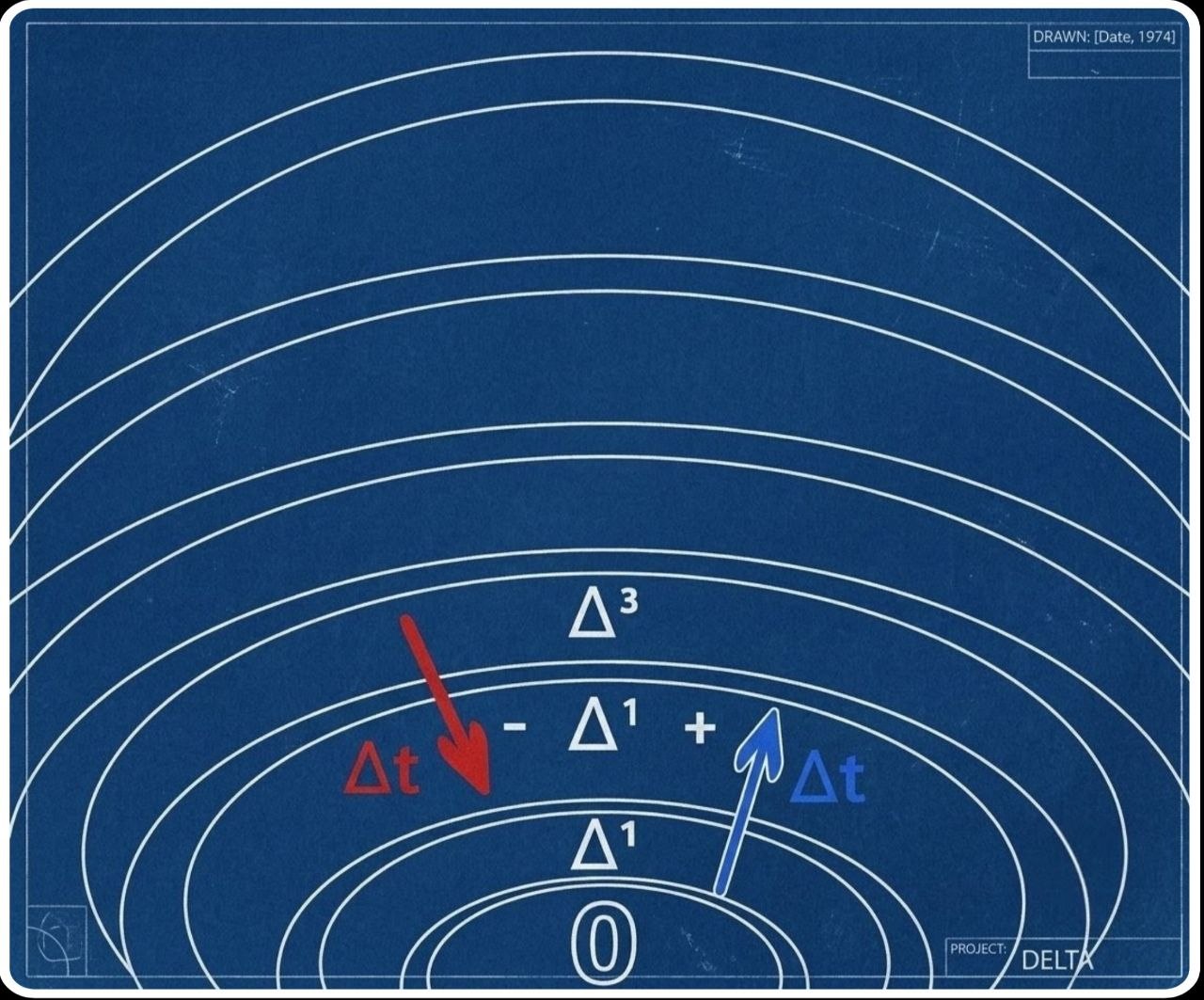
22It follows from this relational, ambivalent reading:
23- High \(∆ |÷ ∆t\) locally ⇒ large \(0|m\) ⇒ strong \(0|Δ_g\) ⇒ contraction (shell closes). - Low \(∆ |÷ ∆t\) ⇒ small \(0|m\) ⇒ weak \(0|Δ_g\) ⇒ expansion (shell opens). - The equilibrium, that is, the locking-in, arises when the transfers are stable: \(0|Δ_g |₌ 0\) (no further drift on the plane)
24Let us try to understand this idea by means of Earth’s gravitation g.
0|g ≡ 0|9|.81 (“shortly before scale-flip”)25We recognize that g is the relation at the fracture edge 9→.81; visible (8) relative to its positing point (1). In other words:
0|g(R) ≡ 0|((M |ₓ 1) |ₓ (1 |÷ (K |ₓ R |ₓ R)))26with 0|M ≡ 0|\(Σ(∆ |÷ ∆t) |÷ c|ₓc\) over the shell
27The number 9|.81 is thus the projected, stable form of a shell shortly before the change of plane (|.), whereby we do not use “m/s²” as a reference for classification, but recognize the unit as projection and can thus classify the relation that has arisen without a scalar.
28The Quintessence
29Everything is ratio. K makes the representation measure-invariant, c limits the beat, and “mass” is only bound information rate. Gravitation is then nothing but the back-relatedness of these bound rates over the shell r. This is the organizing contraction of complexity. It is the compression of the degrees of freedom that arises from the multiplication of relations themselves.
30Where information flows freely, distinction arises, which we interpret as energy.
Chapter X
Gravitation as a Shell Model
1What we describe as gravitation is no pulling, no force, no field. It is the image of a gradient of degrees of freedom, seen from a center of mass outward. The body does not curve, as Einstein postulated; it differentiates itself, it enacts itself in relation. Each layer thereby carries fewer bound degrees of freedom; each distance is a loosening of the relation.
2The shell is therefore a simplified model, a geometric translation of the course of degrees of freedom. It shows how the relation 0|Δ_g\(r\) staggers itself into planes. For it is bound in the interior, drifting at the edge. Gravitation is therefore nothing other than the steady decrease of the binding of information in relation to one another.
3At the center: 0|₋∆ – pure compactness; at the boundary: 0|₊∆ – open expansion.
4Between them lies the existence zone, where the degrees of freedom hold themselves in equilibrium.
5Thus one can say that gravitation is the measure in which complexity folds back onto itself. It appears as a shell because we look at the relation from outside. Yet in truth it is an inner, radiating gradient of difference itself.
6The Observer and the Observed
7Every relation that we measure references the observer. For difference itself | holds only where a point is set from which it is seen, from where a relation forms.
8The observer is this place of relationing. He is not outside the relation, but its origin. The observer is himself a shell. He consists of degrees of freedom that unfold from the innermost center 0|₋∆ outward 0|+∆.
9His body is the pole of condensation of the relation, his perception the drift outward, 0|₊∆. What he sees is the intersection point of both directions: 0|₌∆; thus the zone of perception arises.
10Tycho Brahe saw the sun orbiting the earth. He was not mistaken in this, for he saw out of the relation that he experienced, which sees itself as the center. In his relation the earth was 0|₋∆, the resting pole, and the sun 0|₊∆, a drift, the wandering light, relative to his fixed position.
11Copernicus, by contrast, turned the relation around. He set the midpoint outward, let the earth become 0|₊∆, and made the sun 0|₋∆. Yet the relation remained the same, 0|₋∆ ↔ 0|₊∆, for only the viewing angle changed. Consequently, both models are in contradiction, for what is moving here? And the answer is again relational, for seen from outside, an observer of the solar system could confirm neither Tycho Brahe's nor Copernicus's world picture. This shows us the invariance of information, which assumes only one unambiguous position when we use one of these perspectives.
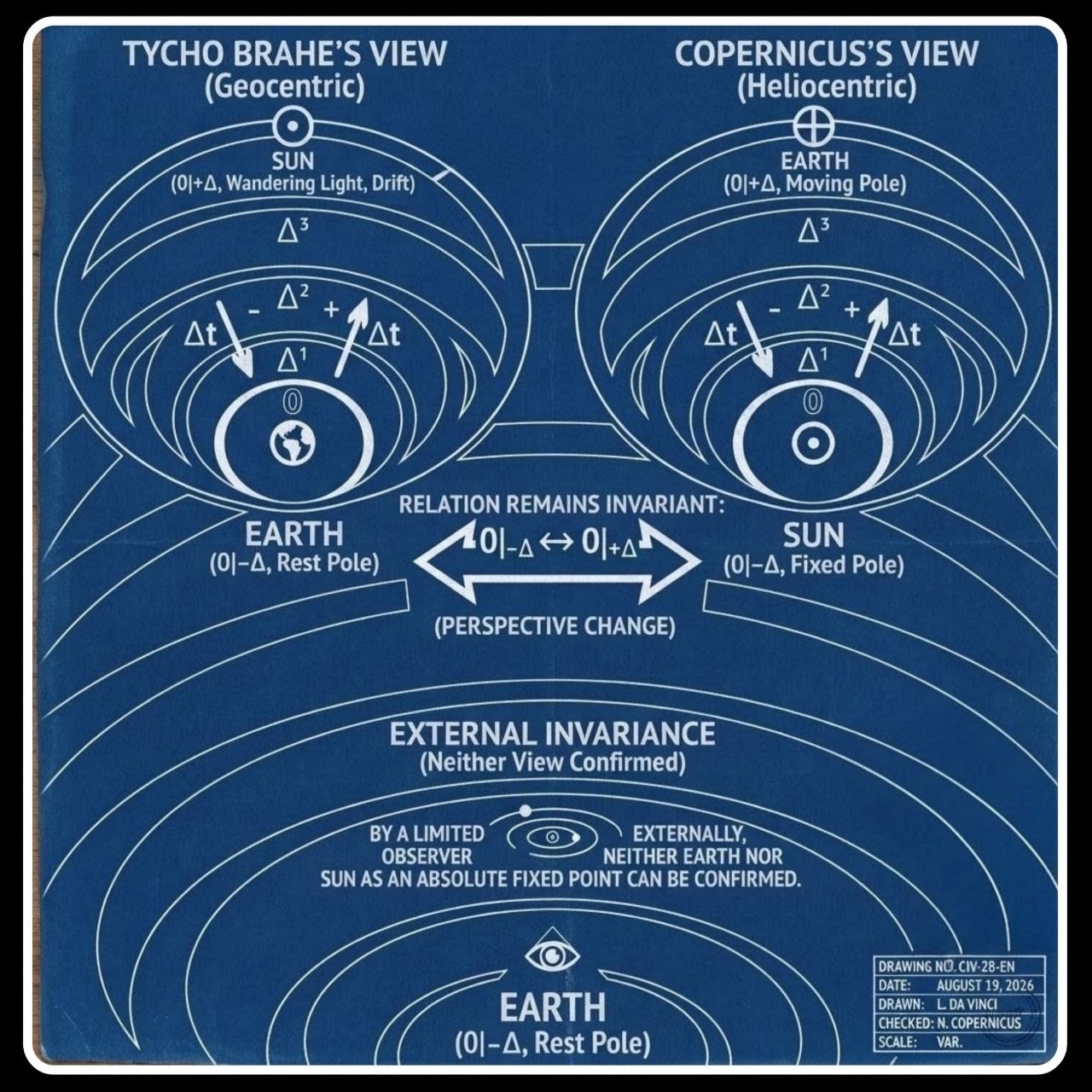
12Every shell that the observer builds up as a relation to himself carries both poles of distinction within it: gravitation inward and drift outward.
13The earth's core is the real image of 0|₋∆, the fixed point at which information remains bound. The sky is the visible image of 0|₊∆, the open expansion in which everything scatters. Between them, in the zone 0|₌∆, we live — in the equilibrium of the degrees of freedom.
14Here the two directions meet: inside pulls, outside expands. Perception is precisely this point of contact, where the observer and the world bring each other into appearance.
15Therefore: the observer generates the pole that he measures. 0|₋∆ becomes visible because we stand in 0|₊∆. And 0|₊∆ appears because we are anchored in 0|₋∆.
16What we call gravitation is only the return direction of our own expansion outward. What we call light is the expansion of the same relation from another viewing angle. The world does not arise from things, but from the configuration of perception, that is, from the way in which 0|₋∆ and 0|₊∆ come into relation in us.
17The observer changes the relation, yet the relation itself remains invariant. It only shifts its midpoint.
0|(A|₊∆) ≡ 0|(B|₋∆)18If A is the observer and B the observed, then motion is only the projection of the difference of both directions of freedom. The sun moves around the earth because the observer stands in 0|₋∆. The earth moves around the sun because the observer stands in 0|₊∆. Yet 0|₋∆ ↔ 0|₊∆ is one and the same relation, only with exchanged pole.
19The world picture is therefore not an image of reality, but a perspective on the same relation. There is no absolute rest, no absolute motion, but only the invariant between them:
0|₌∆, the equilibrium of perception20The observer is therefore not an external witness of the world, but its middle position, a boundary at which the relation looks at itself.
21The observer is thereby not an entity. He is ¤ the impossibility that is probable.
22In the relation 0|¤ he appears as a place, yet this point carries no substance,
23but only the intersection of all relations that form him.
24¤ is the place where the impossible folds into possibility. It stands between \(\odot\) and \(\boxdot\), between 0|₋∆ and 0|₊∆, between inside and outside. Therefore it can see both without ever possessing either one.
25All relations of possibility with which ¤ stands in relation form what we call the self. It is a parallel structure of probabilities that rebalance themselves anew in every moment.
26becomes in ¤ the equation 0|¤|₌∆.
27The observer unfolds as a parallel structure in which every relation that he sets simultaneously generates its outside, its counter-pole. Thus the experience of the world arises. The outside is not an opposite, but the projection of the inner parallelity of ¤. What he experiences is only the difference of his own relations.
28It follows that ¤ is the origin of the outside. For the outside is nothing other than the continuation of the inner relation beyond its possibility. What we call “space” is the trace of this unfolding:
29The observer is therefore not in space; rather, space is in him. He is in his relation to the impossible. He is the impossible that looks at itself, and precisely therein becomes probable.
30Gravitation as the Observer's Retroaction
31We now see that space is not a stage, but the feedback of the self-relatedness of every observer. What we measure as gravitation is the retroaction of observation itself. For every relation that ¤ sets draws an opposite side after it. ¤ stands at the midpoint of the relation, where the impossible mirrors itself as possibility. He looks at the world, and through this looking there arises the curvature that we call gravitation.
32The relation is:
33When ¤ looks outward \(₊∆\), expansion arises. The experienceable becomes the opening of the degrees of freedom; the relation becomes more complex.
34When ¤ looks inward \(₋∆\), gravitation arises, for it is the condensation of the relations, of what has been experienced.
35Both directions are not forces, but projections of the same movement of ∆, in the self-relatedness of ¤. Gravitation is the folding back that results from the relationing of information by the observer. What appears outside as a field is inside the tension of the relation. Massive objects do not pull, but stand in a correlation to ¤, which exists at every point of spacetime as probability and thereby stands in relation to everything possible.
360|∆_g ≡ 0|\(¤|₋∆|₊∆\) Gravitation is the own pull of the observer's relation
37The earth therefore has a center not because it carries mass, but because ¤ observes it in this way. Its “core” is the focus of the bound relation, the point at which perception feels its own boundary.
38From this boundary arises the apparent force that we see, for the return direction of the setting of a distinction itself brings forth this process. When ¤ looks at the world, he draws relations together. When he sets himself in relation with it, the outside arises from this distinction. This is the duality of gravitation and expansion, which expresses itself in the relation of 0|₋∆ and 0|₊∆. The world orders itself according to the distinction that grounds it. Every observer generates, through his own relation, the curvature that binds him.
0|¤|₋∆ ↔ 0|¤|₊∆39In this interplay the universe rests. Not in the equilibrium of forces, but in the equilibrium of contemplation.
40All relations, all degrees of freedom, all shells meet in a single relation:
41This is the complete relation of the real. It begins in possibility \(\odot\), passes through the inverted course of relation \(₋∆\), and finds itself in the observer (¤), where it unfolds outward \(₊∆\), and limits itself in the impossible \(\boxdot\).
42Here the observer is no longer separated from the world. He is the midpoint-operator that reverses the direction and brings forth the outside.
43Gravitation is the path from \(\odot\) to ¤; expansion is the path from ¤ to \(\boxdot\). Both are the same relation, seen from opposite poles.
44Therefore \(\odot\) = \(\boxdot\) is not an opposition, but a circuit: the continual return of difference to itself. Every shell, every movement, every force is only another frequency on this loop.
45Thus at the center of physics there stands no law, but a relation: the self-relatedness of the observer.
Chapter XI
Zeno's Paradox and the Standstill of Time
1Zeno of Elea saw a paradox in the movement of things.
2He described it with the example of an arrow that flies, yet never reaches its target. For before it hits, it must first traverse half the path, and before it reaches this half, half of the half, and so on. Every stretch breaks down into infinitely many partial stretches, every time into infinitely many points of time.
3Zeno thereby showed, however, not that movement is impossible, but that movement never takes place. What one sees as movement is the sequence of infinitely many relations at a standstill.
4If in every moment the arrow stands still, then it is exactly where it is, and nowhere else, except in this relation. This moment is completely closed; it is a complete relation:
0|₌∆5This is the Frozen Frame, the instant of existence itself. Here there is no duration, no direction, no time, but only the difference that brings itself into fixed form.
6Yet when ¤, the observer, strings these moments one after another, something new arises. A difference between the differences arises. 0|₌∆₁ ↔ 0|₌∆₂
7This difference of the ∆'s is what we experience as time: ∆t = \(∆₂ |₋ ∆₁\).
8And as soon as a difference is set over time, energy arises as a reading of this relation: E = \(0|∆\) | ÷ ∆t
9Thus we see that what we call “energy” is nothing other than the measure of change between two Frozen Frames. The arrow does not move; rather, the relation of its images changes in the observer, in the drift of his impossibility.
10Energy is thereby the perceptual value of difference that we have quantified. However, this is set by the observer between the standstills. It is not in the arrow, but in the relation that links its positions through our perception of time.
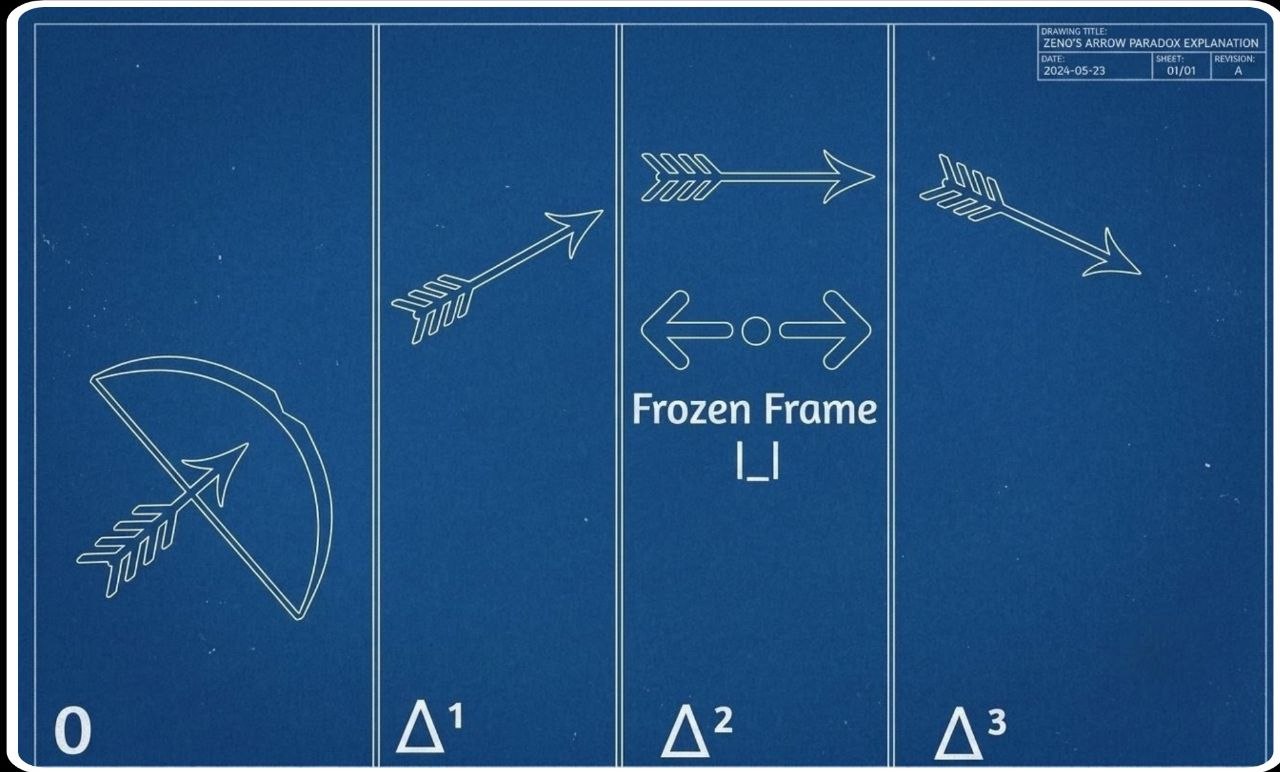
11Each frame is its own universe of its relations, a complete world, and the movement that we believe we see is only the flowing-into-one-another of the previous relation into the next.
12Thus Zeno's Paradox shows not that movement is contradictory, but that it consists of the repetition of the perfectly still-standing. Energy is the designation of this repeating experience; in this, it is the distinction of a difference with which information links its relations, in the perception of the observer.
13The world therefore does not happen in time. It is set anew in every frame. And ¤ is the place of this setting: the impossibility that becomes possible, the point at which the first radius cuts the circle.
14¤ strings these standstills together, and in this sequence there arises what we call “reality.”
|_| (Frozen Frame)15Single frame is closed:
|_| ≡ 0|₌∆16Perception couples two frames:
|1_|217The lower stroke unfolds into difference:
|1_∆218Time is the unfolded difference:
∆t ≡ ∆ (from |_ becomes _∆)19Energy is defined only between frames:
0|E ≡ 0|(∆ | ÷ ∆t) with |1_∆220Single frame ⇒ no time difference, no energy:
|_|  ⇒  ∆t ≡ |▽        (impossible distinction)
0|E ≡ 0|(∆ | ÷ |▽) ⇒ 0|E ≡ 0|⊡ (not definable)21No “∞”, for energy is neither infinite nor present in the single frame; it is simply not defined \(\boxdot\), because there is no distinguishable time difference.
22Only when ¤ relations two frames is E finite and well-determined:
¤: |1_|2 → |1_∆2 ⇒ 0|E ≡ 0|(∆ | ÷ ∆t)23Energy accordingly corresponds to the relation of two standstills, not to the property of a standstill.
Chapter XII
Energy and the Frozen Frame
1We now know that energy is not a substance; it is the between of what is experienced, of change. What we call energy is our ignorance of the still-standing frame, the Frozen Frame, in which all movement appears only as difference.
2The world itself rests in itself. What we perceive as change is the after-flicker of the difference between two states that in truth are the same, fanned out by our observation.
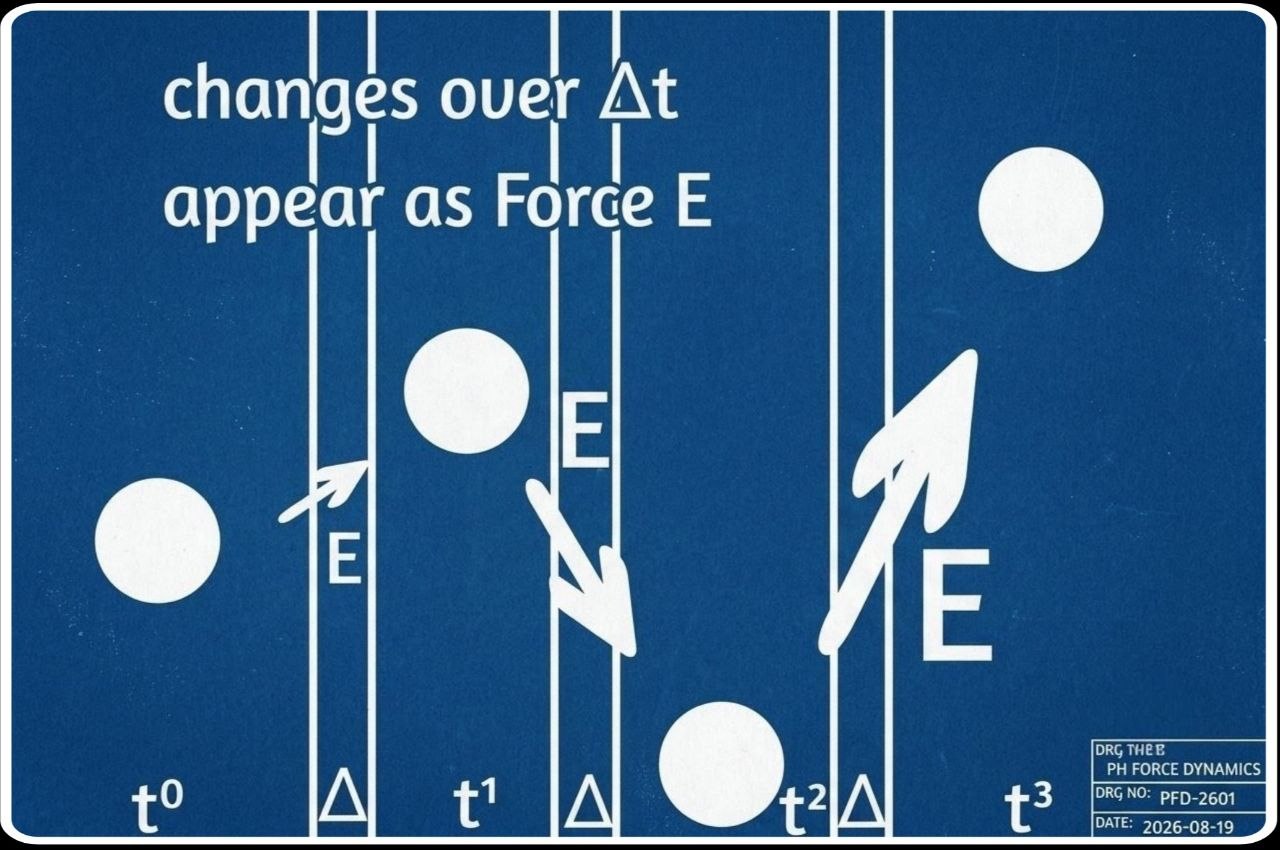
3Therefore energy is the gap between things, not that which connects them, but that which holds them apart so that experience can arise at all.
4In this view, energy is the impossible part: that which cannot be and yet happens. It is the complementary to the possible, the movement born from standstill.
E = (⊡|☉)5Energy is the tension between these poles, the recognizing of difference, the resonance of the world with itself. It shows us change where in truth only the relation relations itself.
6Therefore every calculation, every equation, can be related to energy, and this not because it is the basic measure, but because it is the place of indeterminacy at which thinking sees becoming.
7Energy is the moment in which the impossible becomes visible and the possible loses itself.
8It is a structural model error of physics and, despite this, harbors its actual, true relation.
Chapter XIII
The Time of Cause and Effect
1The reverse side of this consideration is time. It is what arises when one Frozen Frame changes into the next. Like a film that turns still images into the movement of life, the measurement of our selves turns into an unfolding reality of what is experienced.
2We have seen that this movement is not energy; it is the interpretation of our perception. In David Hume's words, it is the habit of what is experienced, which we reify and hold to be given. And this thought shows us that time must be seen in the same way, since it belongs to the same relation of absence.
3Time is always experienced in two ways at once. As observer one is between the possible and what is not possible, between past and future. The observer is the now, the place where past and future are linked. What is past is only a viewpoint from this place, -∆ onto a relation of ordered relations of the Frozen Frames. Ordered by the observer, like a photo album, each image a Frozen Frame.
4The future has not yet unfolded; it is the possible that one does not fully recognize from the now. For the dichotomy of -∆|+∆ is a mirror of standstill and movement. The relations that we see extending from outside, toward 0 \(-∆\), are already unfolded; they are firmly linked with the relation of the observer in the now.
| _ | _ | _ | _ |¤| _ | _ | _ | _ | _ |
-∆|-∆|-∆|-∆|-∆|¤|+∆|+∆|+∆|+∆|+∆

where +∆ unfolds pyramidally:

          ∆
        /   \
       ∆     ∆
      / \   / \
     ∆   ∆ ∆   ∆

The result of the increase in complexity:
1 ∆ → 2 ∆ → 4 ∆5The space of the possible is subject to the rhythm of number. It can only be experienced, for a Frozen Frame is always an extension \(+∆\). Consequently every Frozen Frame is a choice, a choice of the next state in the network of relations that we, as observers, pass through.
6In this insight it becomes clear that conservation of energy describes the closedness of each Frozen Frame in what is experienced, for everything is always a place of relations that has manifested itself in time. Noether's theorem grasps exactly this, but under the false axiomatic viewpoint of energy as force and not as relation between the measured values.
Chapter XIV
The Flow of Time
1What exactly, then, is the passing of time? Is it a relation that unfolds from the observer out into the world?
2We always observe a now that has already passed, for now shows us its meaning only when we set it in relation to the past. Thus the meaning of what we consider arises. Sense here results only in contrast to what we have not yet experienced, but which we regard as possible. The possibilities of the future are linked with the past, for only from it does the path of the possible arise, which unfolds in the now.
3Every Frozen Frame is a moment that creates a sequence of what is experienced only through the relation and choice of the observer. Every moment is fixed; it is symmetrical to the preceding and to the future frame and to that which is placed in contrast to it.
4Energy is here the imagined measure of change.
5Yet this change is a choice of the observer, for he is the link between past and possibility. He is the now.
6It means that this now is a relation between a now that we suppose to be past and that which, from possibility and as consequence of this now, we let become our path in time.
7In this we always consider the same order of things. For if all temporal states exist, then it is the sequence of relation that gives them weighting.
8Since this relation is a viewpoint out of the now, it is retro-causal.
9The trajectory through the network of the relations of information is determined by the past, yet the freedom of choice in the now can change this trajectory by reformulating the emerging order of the Frozen Frames accordingly. And consequently the past also changes, so that it can first make the observer's choice possible.
10The past is always a path without branches. This path is logical and builds on itself; it is causal.
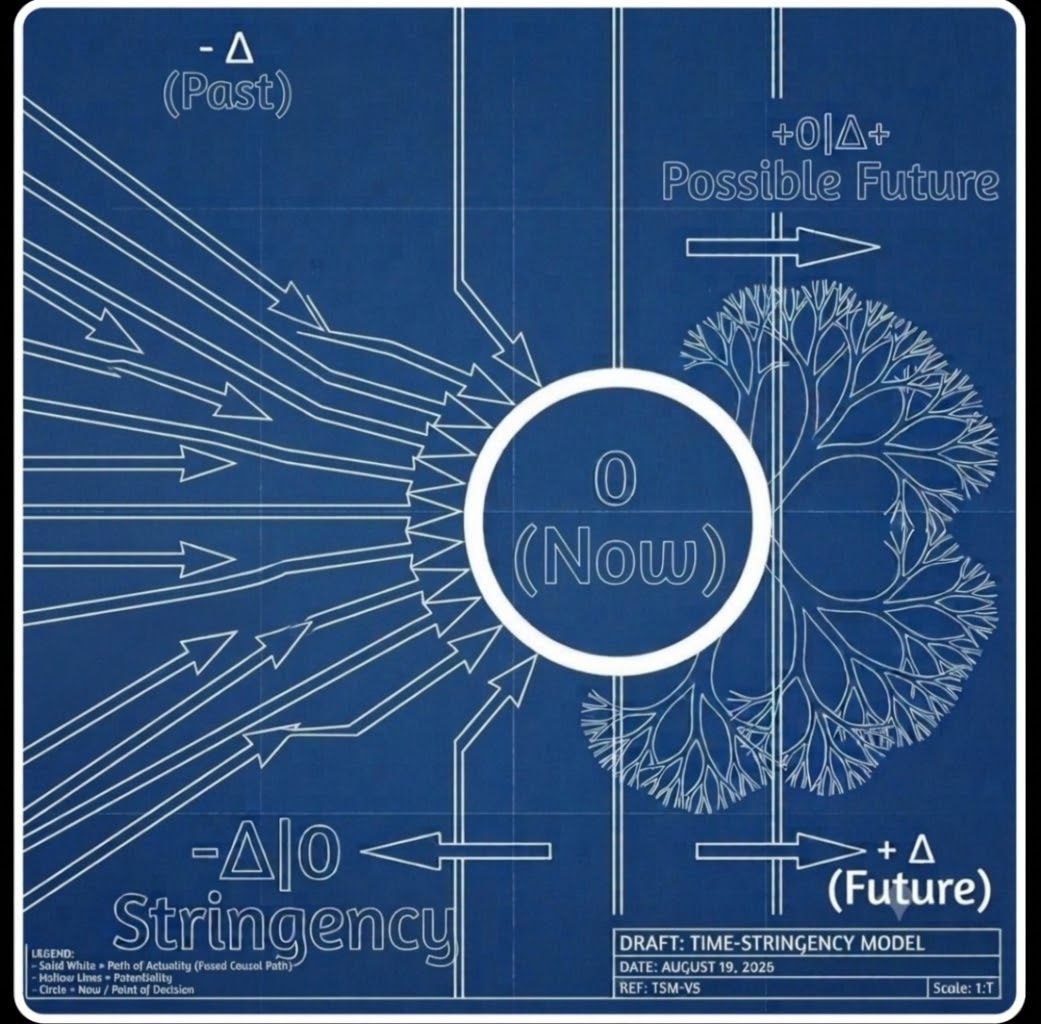
11The future is an unfolding that limits itself through the expectation of the observer. In David Hume's words, the causality of the future is a construct of habit that becomes concrete according to this choice.
12Yet if he chooses, then this is in accord with what is past. This can only be realized as a retro-causal connection. The free possible can become past only if it is integrated into what has been experienced, and this is possible only if what is past is not written fixed.
13Consequently causality is not a compulsion of unfolding, but a viewpoint onto what is past.
14We therefore need a new idea of the relation of past, now, and future. This idea is stringency. It shows us the logic of sequences after the fact and is connected as necessity with all frames that the observer experiences.
15Time is not to be understood as a current, but as a relation between complete states that are linked by the observer. Thereby it becomes a logical structure of experiencing, not a physical flow.
|_|₁ ¤ |_|₂ ¤ |_|₃ …16The relation of the choice made therefore determines the connections of what we call reality and not its supposedly processual structure.
17The epistemic ignorance about the relations of the possible here limits the possibilities of every choice. Memory is thus not the retrieval of a fixed frame, but the reconstruction of a frame, stringent to the now.
|_| = (0|Δ)
→ Every frame is a completed distinction: the result of a relation from 0 to difference.

Δt = (Δ₂ |₋ Δ₁)
→ Time is the second-order relation, the difference between differences.

(|_|₁) ¤ (|_|₂)
→ The observer is the relation between two frames — the now.

E = (⊡|☉)
→ Energy is the epistemic gap between possibility (⊡) and standstill (☉).

|Σ = ((|_|₁|_|₂) ⇔ (|_|₂|_|₁))
→ Stringency is the logical symmetry of the frames; it guarantees coherence across time.

((Δt⁻ | Δt⁺) ≡ (Δt⁺ | Δt⁻))
→ Retro-causality: past and future are mutually conditioned in the relation of the now.
Chapter XV
The Content of the World
1What we see is relation, and falsely we take the result of this relation for substance. This substance, which seems inherently allotted to things, is not a fundamental particle of existence.
2The search for the atom and for what makes it up is carried out with machines whose purpose is to find exactly what has been postulated. In our view, however, it is now a function of relation. There is an electron because I measure it, not because it is in things per se.
3Retrocausality opens this viewpoint to us as a new connection. Before atoms or electrons were “found” and thus demonstrated, new apparatuses were needed. Only these created the connections whose relationing ordered the past stringently.
4Our thinking let the relation of these measurement connections act upon the past, and thus the past was newly contextualized, as was the trajectory of the future changed.
5The apparatus is part of the relation that it measures. For there is no objectivity, only relations of a viewpoint onto a point of this relation.
6The subjectivity of the relation is therefore the point at which a thing in the world arises, and likewise the misunderstanding of its elementarity. Instead of recognizing what separates as connection | we see only one side of the coin, everything outside of us.
7Thus the question presents itself to the one eager for knowledge: what is the heart of the matter, what dwells within things. And driven by subjectivity, he sees objectivity where none reigns. From the question why something is, there consequently becomes only one way of seeing the world, a way that curtails itself. Reduction to basic entities, as in particle physics, is exactly this.
8Something inner is sought, which is found with apparatuses; these in turn generate relations that finally reveal themselves as particles.
9Yet this particle is the result of my positioning in the field of epistemic ignorance, of my advance in time, in the space of the possible. The smashing of an atom shows only surfaces that arise, not contents. The contents are relations that we, as observers, construct in order to give stringency to what is experienced.
10Table | fraction | splinter
11fragment | molecule | atoms
12atom | nucleus | shell
13electron- | proton+ | neutron
14proton | fraction | quark
15Up | Down | Charm
16A continuing distinction that differentiates in stringency.
17This continuing regression is limited by ∆, for only what integrates into the geometry of differentiation is a possibility that reveals itself to the observer. A Frozen Frame whose state shows a significant deviation from the previous one is “energy-rich,” for the change, seen relationally, has become greater. But this change, the continuing distinction of what is experienced, is always ∆-bound, in 2.25 or a multiple thereof.
18The logical order of these frames and their relationing by the observer creates the stringent time axis of what is experienced, of the things in the world.
   | table | fraction | molecule | atom …
¤      | saw | microscope | scanning microscope
∆ change ∆ change ∆ change19This is a process that is invariant. With each step of the regression, only the viewpoint onto the relation changes, and thus the content of the things in the world.
20It is therefore only logical to recognize that all observers of a time-continuum possess a common time axis of their self-relatedness, which places them in relation to one another. We experience the world together because we resemble one another in the structure of our unfolding. This applies to all observers that create differences of A|B through their self-relatedness, whether a unicellular organism, a pet, or oneself. The proximity of our ∆-relationing keeps the invariance of what is experienced within bounds and stringent for the individual as well as for all observers of the same time axis.
21The fossil of a dinosaur is the dinosaur, only from a viewpoint onto the relation of the | that does not fit stringently with the time axis of what is experienced. Retrocausally, the dinosaur has thus become the relation of the past of the world, while in its experienced relation it unfolds its life.
22The question whether the chicken or the egg came first is thought without these connections. It becomes clear that both are simple. It is a distinction that results from the connections of the relation of the time axis and its observers, not from a causal chain of evolution.
23All states exist and are their own moment. The path and the order through these moments are created by the reflecting self-relatedness of an observer who is himself embedded in this relation. His stringency forms the experiencing of the things in the world.
Chapter XVI
Why Does One See Light?
1Everything that appears to the observer as world appears in light.
2Not because the world would consist of light, or because light were a substance that leaves things, traverses a path through an already existing space, and finally enters the observer. Nor must some small something be assumed behind perception that moves from here to there in order to leave an impression there.
3Rather, light is the form in which a relation becomes visible for an observer.
4With this we return to a place that was already prepared at the beginning of this volume. In Chapter VI the number
39{,}195appeared as the measure of the real. At that time it was not yet possible to recognize fully what this relation means physically, for it first appeared as the folding-back of number onto its own geometry:
(3|9)|(1|9)6Now, after space, energy, Frozen Frame, time, and observer have been unfolded, we can return to this earlier relation — and read it differently.
7For no determination of the Tractatus stands by itself. What appears at an earlier point as mathematical structure changes its meaning as soon as later relations act back upon it. Precisely here the third order of difference becomes visible:
(A|B)|(C|D)8No longer do only poles stand in relation.
9Relations begin to refer to relations.
10The return of the circle
11Volume I began geometry with the 0. The 0 is closed possibility and appears geometrically as a circle. With the 1 the first cut arises:
0|112The radius sets an orientation within this closure. With the 2, reflection arises:
0|213The radius becomes an axis. With the 3, finally, the first directed closed figure arises:
0|314The triangle lies in the circle.
15Yet as soon as this figure is no longer read exclusively within the circle, but its own relation is in turn referred back to the circle, a new order arises.
16Here π appears. It is not first an expanded decimal number. It is the relation between a linear and a closed reading of the same geometry. The circle relates its inner distinction back to its own closure and thereby generates a self-referentiality of geometry.
17The circle is no longer merely form.
18It begins to relation its own form.
19Euler and the tilted direction of reading
20This self-referentiality possesses an orientation.
21Volume I therefore did not read the Euler relation as the movement of a point through a coordinate system. Sine and cosine appear there as relational sides:
22and
23Thus the Euler reading is:
24The two sides are not magnitudes independent of one another, but two directions of reading of the same relation.
25Nor does i generate a second imaginary world. Rather, it designates the rotation of the reading:
26What appears from one direction as a definite relation shows itself, after this rotation, as its orthogonal reflection.
27Euler thereby describes a closed relation that reads itself under different orientations. The circle is not only closed; it can relate its own closure to itself from different angles of view.
28And precisely this movement becomes decisive for light.
29The inner division becomes the outer perspective
30Now we can read the 9 again.
31It is the fracture-edge of the first number shell and at the same time
32The first order of three refers to itself threefold.
33If the circle is read under this relation of nine, it possesses nine addressable segments:
34Thus 1|9 can, under the circle-division reading, be understood as one segment of 40°. Correspondingly, 3|9 designates three of these nine segments:
35The earlier relation (3|9)|(1|9) therefore appears geometrically as 120°|40°.
36Yet these two angles do not belong to two circles separate from one another. They are two perspectives on the same circle.
37And exactly here Euler is at work.
38For an angle does not merely designate a cut-out segment of the circular line. It also determines the orientation under which the entire circle relation is read. The inner division of the circle is, as it were, turned outward:
39Thus 3|9 is a reading of the same circle-self-referentiality under the orientation of 120°, while 1|9 reads the same self-referentiality under an orientation of 40°.
40The relation (3|9)|(1|9) therefore designates two differently oriented self-readings of the same closed geometry.
41Precisely therein lies its invariance.
42It is not the perspective that remains the same.
43The relation remains readable back under the change of perspective.
44The sphere of perception
45Let us now transfer this structure to the observer.
46Let us call the closed relational space within which something can appear for an observer his sphere of perception.
47The observer is not located as a material point at the center of an already finished sphere. Rather, he is the relational center — that fixation from which inside and outside, near and far, before and after can first be oriented at all.
48If we write the observer as ¤, then perception is not the passive reception of a completely determined outside world. It is a relational closure:
¤|X49Something can appear for the observer as phenomenon only where its relation can be bound back to this observer position.
50Yet this binding-back does not occur only on one plane.
51An appearance immanent to the observer must be readable both spatially and temporally — not because space and time were two already finished containers, but because the same relation is read from two different perspectives.
52The Frozen Frame
53A single Frozen Frame is complete:
|_|54Within this frame nothing moves. There is no before, no after, no velocity, and no energy as transported content.
55The frame is a closed relational position:
56Now let us take two Frozen Frames, F₁ and F₂. The second frame, too, does not move forth out of the first. Both are complete relational positions in themselves.
57Only the observer binds them:
58The difference between the two can now be read from two directions.
59Once as a change of their spatial order Δ_R. And once as an order of their recurrence Δ_T.
60We call one relation movement in space, the other we call time. Yet both arise from the same distinction between two Frozen Frames:
61Space and time are therefore not mutually independent causes of motion.
62They are two perspectives on the same beat.
63Meter and second
64It now becomes clearer what a measuring apparatus actually does.
65A meter is not simply a piece of space that would already be present independently of every measurement. Rather, the measuring tape stabilizes a definite spatial relation. It materializes the question:
66How is the difference read spatially?
67The stopwatch performs the same with the beat.
68A second is not a container in which an event lies. The stopwatch stabilizes a definite order of Frozen Frames and thereby materializes the question:
69How is the difference read temporally?
70Meter and second are consequently apparatus relations.
71The measuring tape does not generate space and the stopwatch does not generate time. Yet both determine under which stabilized distinction space and time appear for an observer as measurable magnitudes.
72We can therefore write ¤|R for the spatial measurement relation and ¤|T for the temporal measurement relation.
73The physical ratio-form m/s is then not the ratio of two substances independent of one another, but a relation of two relations:
(¤|R)|(¤|T)74And precisely with this we again find ourselves in the third order of difference.
75Why light appears invariant
76Now we can determine the light relation.
77Light is not first a something that exists and then moves with a definite velocity through space. Rather, it appears where the spatial and the temporal reading of the same frame-difference can be led back stably to the same observer:
78This is a self-reflection across several levels.
79The difference is read spatially.
80The same difference is read temporally.
81And both readings are again relationed to one another.
82The phenomenon light is the visible form of this closed self-referentiality.
83For this reason the light relation appears invariant. Not because a light-object everywhere carried the same velocity with it as a property, but because the relation under which spatial and temporal difference are coupled with one another leads back to the same origin.
84From this perspective, the so-called speed of light designates no velocity of a thing.
85It designates a geometrical fixed relation of observability.
86Only under a stable coupling of spatial and temporal self-relation can something appear stringently within the sphere of perception.
87Light is this coupling in its visible form.
88The return of 39.19
89With this we can understand why the earlier relation 39,19 returns at this point.
90It must not be read as an ordinary numerical factor. One cannot simply divide a speed of light by 39,19 and thereby assume that it has now been K-normalized.
91For 39,19 is itself already the visible readout of a geometrical self-reference.
92Its actual form is:
(3|9)|(1|9)93Under the circle reading:
94And under the Euler reading these are two differently oriented perspectives on the same closed circle relation.
95K-normalization therefore means:
96An external measurement relation is led back to that self-referentiality which connects its different perspectives invariantly with one another.
97Meter and second do not disappear in this. What is sublated is only their separate objecthood.
98What previously appeared as m/s is read back as
99of the same closed relation.
100And precisely this form was already contained in
(3|9)|(1|9)101:
102of the same circle-self-referentiality.
103Therefore K is not a factor.
104K is the geometrical condition for information to remain preserved under a change of perspective.
105The number of light
106The measured speed of light appears in the measurement relation set by our apparatuses as
107This notation, too, must now not be reified.
108The number is not located in light.
109Nor are meter and second located in light.
110Measuring tape, stopwatch, observer, and common relational position generate a definite readout. The number is the visible numerical form of this measurement relation.
111Precisely for this reason we may read its inner structure, for number and geometry are not domains separate from one another. They are different perspectives on the same distinction.
112First relation: positing and closure
113Let us first consider 299. It holds that 2+9+9=20.
114Thus 299 → 20 → 2|0. We obtain two poles and their closure.
115Now we can recognize what these two poles mean physically. The light measurement requires two readings distinguished from one another:
116Spatial perspective and temporal perspective.
117Both, however, are located within the same closed observer relation:
118The two therefore designates no two objects. It designates the necessary polarity of the measurement.
119Nor does the zero here mean nothing. It designates the closure within which both poles can become jointly readable at all: 299 → 2|0.
120The relation is posited.
121It is closed.
122Yet no displacement between Frozen Frames has yet been read.
123Second relation: fracture and transition
124Let us now consider 792. It holds that 7+9+2=18 and 1+8=9. Thus: 792 → 9.
125The 9 is the fracture-edge of the number shell. It designates that position at which an existing order flips into its next level of reference.
126Precisely this occurs between two Frozen Frames.
127The first frame is not moved, and the second is not generated out of it. Nevertheless their relation differs:
128What appears as movement is this change of relational position. What appears as time is the stringency under which the observer orders these differences.
129Here, therefore, the 9 does not designate the speed of light.
130It designates the transition of a closed relation into another reference position.
131The relation moves no something.
132It changes its addressing.
133Third relation: locking-in
134Finally, let us consider 458. It holds that 4+5+8=17 and 1+7=8. Thus: 458 → 8.
135The 4 is the stable order of four. The 5 opens its self-similarity, and the 8 takes this displacement back up into a symmetrical closure.
136What at the 9 crossed beyond the existing shell now appears in a new stable relation. The displacement becomes readable, the new Frozen Frame can be related to the previous one, and the observer recognizes himself again in both relations.
137The relation locks in.
138Thus we obtain:
139Or, summarized:
140This is not the movement of a light-particle.
141It is the movement of the relation through its own levels of reference.
142K-normalization and invariance
143Now we can fold the unit back.
144The ordinary reading is:
145It contains a spatial apparatus relation and a temporal apparatus relation.
146The K-normalized reading no longer asks after the names of these apparatuses. Rather, it asks:
147Which relational form remains preserved when the perspectives are led back to their common self-referentiality?
148Then m/s becomes Δ_R|Δ_T.
149And this double perspective possesses the same form as (3|9)|(1|9).
150Not because meter were equal to 3|9 and second equal to 1|9, but because both representations carry the same order:
151two different perspectives,
152one common closure,
153one self-referentiality across the perspectives.
154The representation changes.
155The information does not.
156That is invariance.
157but:
158The unit m/s and the numerical relation therefore do not describe two different contents. They are two readouts of the same measurement relation.
159One reading shows its physical apparatus perspective.
160The other shows its numerical-geometrical self-referentiality.
161Why one sees light
162Now the initial question can be answered.
163Why does one see light?
164Because perception itself is a closed self-measurement.
165The observer does not stand outside the world and receive light from it. He is the relational center of a sphere of perception, and within this sphere only that can appear which can bind itself back to his observer relation.
166A spatial change alone is not sufficient.
167A temporal order alone is not sufficient either.
168Only where both perspectives of the same relation can be coupled with one another,
169does a stable appearance arise.
170We call this form of appearance light.
171Color is therefore not a property of an object. It is the concrete shape under which this relation locks in at a definite observer position.
172Light is no substance of the world.
173It is the self-reflection of the world in the observer relation.
174The double-slit experiment
175With this, the double-slit experiment, too, loses part of its apparent mysteriousness.
176Light is directed at a wall with two openings, behind which there is a screen. Without path registration the relation is:
177The two openings are distinguished, but not yet posited as two paths registered independently of one another. They remain two poles of the same light relation.
178The visible interference pattern is the appearance of this common relation.
179The ordinary question is:
180Through which slit did the light go?
181Yet this question already presupposes that a light-object must possess a definite path independently of the experiment. A relation would thereby again be transformed into an object.
182The paths A and B are initially not two hidden trajectories.
183They are two open continuations of the same relation.
184The apparatus as materialized question
185Now we couple an apparatus into the slits.
186This apparatus is not an additional observer. It possesses no perception position of its own. Rather, it produces a new distinction and stabilizes it for a later perception.
187Beforehand, the following holds:
188After the coupling:
189Thus it is not merely our knowledge about the experiment that changes.
190The relation of the experiment itself has become another one.
191The apparatus is a materialized question.
192Just as the measuring tape materializes the question of a spatial difference, and the stopwatch the question of a temporal order, the path apparatus materializes the question:
193Which path is to be stabilized as its own difference?
194A different question posits a different difference.
195A different difference generates a different relation.
196And a different relation generates a different appearance.
197Wave and particle
198Thus wave and particle are not two natures of a light-object.
199Without separate path registration, the relation
A|B200remains active as a common open relation and appears as interference.
201With path registration, by contrast, there arises
202The open relation has been differentiated and now appears as a sequence of definite registered events.
203Light does not thereby change because it had noticed that someone was looking. Nor does it collapse in some mysterious way from a wave into a particle.
204What was changed was the distinction under which the phenomenon can become stable for the observer.
205Wave and particle are different readouts of different measurement relations.
206The third order of light
207Thus we return to the beginning.
208Light is not a relation of the first order.
209It is not simply:
|210Nor is it merely a relation of the second order:
A|B211Its observable form lies in a relation of relations:
212This is the third order of difference.
213The same structure was already shown by the number:
(3|9)|(1|9)214The same was shown by Euler:
215The same is shown by the Frozen Frame:
216And the same is shown by the measuring apparatus:
217Again and again the same movement appears under another reading.
218The later context changes the earlier one.
219The number becomes geometry.
220The geometry becomes orientation.
221The orientation becomes the observer.
222The observer becomes the measurement relation.
223And the measurement relation appears as light.
224Thus physics returns to that mathematics from which it emerged — not by merely repeating the earlier relation, but by making visible what this relation had always already contained.
225The light relation is not fast.
226It is closed.
227Its invariance lies in the self-referentiality of a relation that carries the same information under different perspectives.
228And the number 299,792,458 is therefore not the property of a thing named light.
229It is the visible trace of that relation in which the observer measures himself as world.
Chapter XVII
On the Curvature of Spacetime
1In classical relativity theory it is assumed that space and time are curved by matter. This description is a valid projection within a certain mathematical model, but it misses the relational core of the phenomenon.
2In the framework developed here, nothing curves.
3What is described as curvature is a displacement of invariance within a delta-isomorphic network of relations. It is not a geometrical deformation of a carrier, but a reordering of positional relations under which relations remain stable.
4The world does not thereby change its form, but its reference structure. What shifts is not space, but the position of invariance by which measurement and perception orient themselves. The path of a body is not the consequence of a curved geometry, but the expression of a newly positioned fixed relation in the relational structure.
5That this displacement appears as curvature is a consequence of representation. If the relation is projected into coordinates, the impression of a bent structure arises. Considered relationally, however, the geometry remains consistent; it is merely read differently.
6In this sense light also follows no curved path. Its relation remains invariant, but the position of this invariance within the network is not the same everywhere. What appears as deflection, delay, or redshift is the consequence of this displacement. The color of light is here not a property of light itself, but the signature of the position at which the relation is measured.
7The relativity of appearances therefore does not result from a dynamic deformation of the world, but from the fact that invariance is not absolute, but relationally positioned. Gravitation is not a force, not curvature, and not pull, but a reorganization of the conditions of stability under which relations become visible as light.
Chapter XVIII
Measurement – How Difference Becomes Reality
1The idea that a measurement is the ascertainment of an already existing property belongs to the most self-evident assumptions of physics. According to it, an object is located in the world and possesses a certain magnitude, position, mass, or movement. The observer directs an apparatus at it, reads off the result, and thereby learns something that is supposed to have already been the case independently of him. In this idea, measurement appears like a window through which the observer looks at a reality that remains untouched by his gaze.
2Yet precisely this self-evidence deserves doubt.
3For before anything at all can be measured, it must be fixed what is to count as the object of the measurement, which differences the apparatus can grasp, and under which relation a result becomes visible. The apparatus does not begin with a completely open question. It already possesses a form, a sensitivity, and a definite way of registering changes. What then appears as a measured value has therefore not simply been read out of the object. It has emerged from a relation, one side of which is the observer and whose outsourced form is formed by the apparatus itself.
4The ordinary idea is:
5Object Δ apparatus Δ measured value
6Yet this sequence conceals the distinction through which the object first appears as object of the measurement at all. It treats the result of the relation as if it had already existed independently before the relation. Thus the same error repeats itself that already became visible in the first volume: A selection made is treated as an object found.
7Measurement discovers no relationless object. It posits a difference within which something can appear as an object.
8A | B
9A and B are here not two things that first exist independently of one another and are then connected with one another. They are the two poles of a relation. A is only A because it is distinguished from B, and B is only B because it appears as counterpole to A. The sign | therefore designates no subsequent connection of two finished sides. It is the condition for two sides becoming visible at all.
10In order to understand what a technical measurement means, we must therefore not begin with the apparatus. We must begin with that original measurement that every observer continuously enacts on himself.
11The self-measurement of the observer
12The human being usually experiences himself as a coherent being that moves through a space and in doing so passes from one instant to the next. He stands up, walks through a room, lifts a cup, and sets it down again in another place. Everything seems to indicate that the same body enacts a continuous movement through an equally continuous time.
13Yet this description already presupposes that time is something through which the human being moves. It turns the sequence of experiencing into a container in which what is experienced is supposed to take place. Yet in no single instant is such a movement to be found.
14Every Frozen Frame is complete:
|_|15In no Frozen Frame does anything move. Every frame is a closed relational position. The human being is in it exactly where he is, and the cup stands exactly where it stands. Within the individual frame there is no before and no after, no path and no velocity. All this arises only when the observer connects different complete relational positions with one another.
16The movement is therefore not:
¤ → ¤17as if an identical thing wandered through a series of empty time-places. Rather, perception couples two complete frames:
¤: |1_|218The observer recognizes himself again within different relational positions and reads their differences as continuation of himself. This recognition produces the impression of continuity. The stringency with which the frames are connected with one another appears as time, while their different order is read as movement.
19The lower stroke thereby unfolds into difference:
|1_|2 Δ |1_∆220The human being therefore does not move as an unchanged object from one Frozen Frame to the next. He measures himself in another complete relational position and recognizes the difference from his previous position as movement.
21In this, the following frame does not first arise from the previous one. The idea of such a generation would again be a remainder of linear time. It would claim that the future frame is initially not present and is gradually produced by an action. But a Frozen Frame is not an unfinished possibility that waits for its later production. It is a complete relation.
22The different frames do not lie like material images in a spatial archive. Nevertheless they are present as complete relational positions. The observer therefore does not generate the reality into which he arrives. He determines his position within its possible stringency.
23His choice aligns the reading. It marks out a connection between complete frames and lets this connection appear as experienced reality. Therefore time is not what carries the observer to the result. Rather, from the result that sequence of frames is read which appears as his past.
24This is the meaning of retrocausality.
25Retrocausality designates no signal that runs backward through a linear time. Such a direction would already presuppose time as an existing path. Retrocausality means rather that the present relational position orders its own prior history. What the observer now experiences determines which other frames are read as stringent presuppositions of this experiencing.
26The result does not lie at the end of a path that first generates it.
27From the result, the path becomes its past.
28When a human being says that he walked through a room, he therefore describes the stringent connection of complete relational positions. His body has not traveled as unchangeable substance through an empty in-between space. The observer has recognized himself in different frames and read their relation as movement.
29This self-measurement is the original form of every perception. Even before a technical apparatus is built, the human being measures himself by the changes of his own boundary.
30The skin as boundary of perception
31This boundary becomes especially clear at the skin.
32Inside | skin | outside
33At first glance the skin seems to separate two already existing regions from one another. On one side lies the interior of the body, on the other side the external world. The object acts on the skin, the skin conducts an electrical impulse into the interior of the body, and there the effect coming from outside is perceived.
34The ordinary sequence is:
35Outside Δ skin Δ impulse Δ perception
36Yet an electrical impulse carries no label that explains from which ontological direction it comes. It does not say that an already completely determined object from outside has transmitted a property inward. At first it merely shows that an inner relation has changed at a boundary.
37The impulse does not say:
38There outside is an object whose property has now penetrated into me.
39It says only:
40My relation at this boundary is different.
41Only the observer reads this change as touch, pressure, warmth, cold, or pain and assigns an external pole to it. Perception therefore does not begin with a finished outside that is then imaged inside. It begins with a change within the observer relation, whose counterpole is extrapolated as outside.
42The relational reading is:
43inner change Δ boundary relation Δ outer pole
44Thus two possible descriptions of the same process arise. One can say that an external object caused a change inside. One can equally say that the observer perceived an inner change and from this change determined an external counterpole. Both descriptions consider the same relation from opposite directions.
45Outside | Inside
46and
47Inside | Outside
48are not two different worlds. They are two orientations of the same distinction. The invariant is not the asserted direction of an effect. The invariant is the relation within which inside and outside appear as poles.
49The skin is therefore not a wall between a finished inside and a finished outside. It is the boundary at which inside and outside are first distinguished from one another at all. Through it, the observer does not receive a complete external world. He measures the change of his own relation and reads its counterpole as that which is outside him.
50Perception is self-measurement at a boundary.
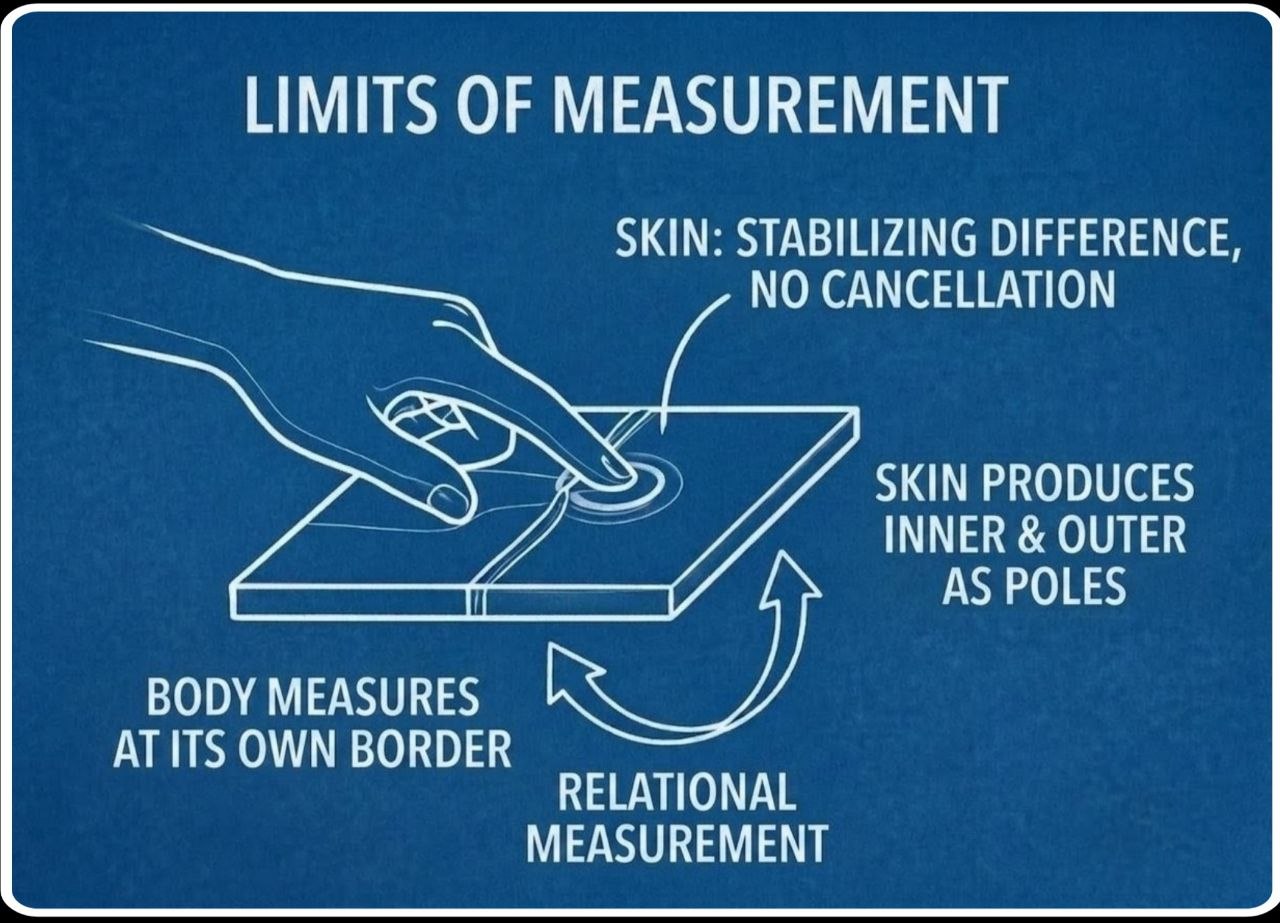
51Why one can touch nothing
52This boundary relation also changes the meaning of what we call touch. When a human being takes a cup in his hand, it seems as if two objects touched one another directly. The hand reaches the cup, the distance between them disappears, and touch seems enacted.
53Yet a complete cancellation of their difference would not be touch.
54Hand | cup
55cannot pass into a difference-less unity without both the hand and the cup disappearing as determinable poles. If there were no longer any difference between the two, there would be neither something that touches nor something that is touched. Complete identity would therefore not be the most perfect form of touch, but its impossibility.
56Touch presupposes that nearness and separation remain at once. The hand must enter into a relation to the cup, yet it must not become identical with it. What the body experiences as touch is therefore not the disappearance of the difference, but its stabilization at the closest approach.
57The last gap between the hand and the cup is not a tiny empty space that could someday be closed by an ever more exact physical description. The last gap is the difference itself:
58Hand | cup
59One can differentiate this relation further. One can speak of electrical charges, atomic structures, or forces. But each of these explanations again posits poles and relations. It describes how the difference behaves under certain conditions, but it does not cancel it. Behind every further differentiated interaction there again remains that distinction without which neither the participating sides nor their effect would be determinable.
60The skin therefore does not perceive that the separation between hand and cup has disappeared. It perceives that this separation remains preserved under the posited approach. The change through which the body registers this preservation appears as pressure, hardness, resistance, or pain.
61We do not feel an object because its difference from us is canceled. We feel it because our boundary relation makes the continuing difference visible.
62Touching is the perception of the non-vanishing |.
63The apparatus as outsourced boundary
64From this original self-measurement of the body the technical measurement can now be derived. A measuring apparatus is neither an independent observer nor a neutral window to an independently existing reality. It is a technically outsourced boundary of the observer.
65A microscope extends the eye. A microphone extends the ear. A memory store extends the memory of perception across different Frozen Frames. A clock stabilizes a definite order of comparison. A particle detector extends bodily sensitivity into a domain in which the human being can immediately form no perceptible difference.
66The apparatus is therefore a second skin.
67¤ | apparatus | phenomenon
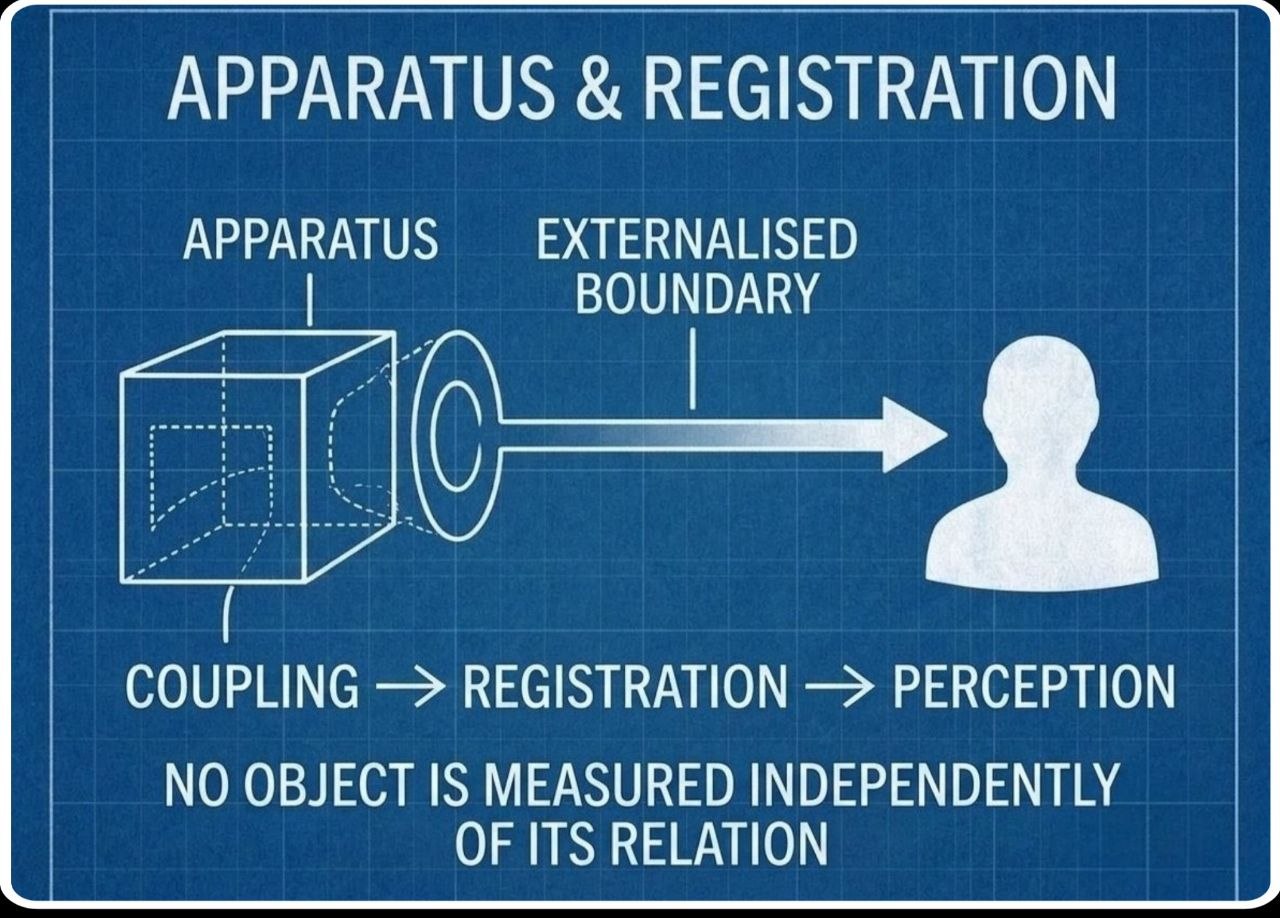
68It carries the boundary of the observer to another relational position and holds fast there a change that can later be led back into perception. In this, however, three moments must be distinguished, which in ordinary speech about measurement often coincide:
69Coupling Δ registration Δ perception
70The coupling changes the relation of the experiment. The apparatus enters into a definite connection with that which can appear as phenomenon under this coupling. From this relation a change of the apparatus arises.
71Registration stabilizes this change. A display changes its state, a memory store preserves a marking, or another material relation is held fast in such a way that it remains across several Frozen Frames.
72Perception leads this registered change back into the self-measurement of the observer. Only when the observer sees, hears, or in another way takes the registration into his own relation does the complete measurement result arise.
73¤ | registration
74When an apparatus runs while the observer leaves the room, there is indeed a coupling and possibly also a registration. But the apparatus has perceived nothing. It possesses no observer position of its own from which the change could be read as meaning. It merely preserves a posited difference until, in another Frozen Frame, this difference again becomes part of a perception relation.
75The apparatus is therefore an outsourced part of the observer. It extends his possible self-measurement across space and time without itself becoming an observer.
76Measurement is time-delayed perception.
77The apparatus does not generate the consciousness of measurement. It keeps ready that difference by which the observer can later measure himself.
78The apparatus as materialized question
79Thus it becomes visible that an apparatus is never completely open. It is already a materially executed question. Its construction fixes which differences can stabilize in it and be preserved as registration.
80An apparatus that is supposed to detect electrons does not ask in general:
81What is here?
82Rather, it posits a definite distinction:
83Electron | no electron
84The possible changes of the apparatus are already read within this alphabet. If a fitting registration arises, it appears as evidence of an electron. If it does not arise, it appears as absence of an electron. In both cases the electron is already contained in the form of the question.
85The ordinary idea is:
86Electron Δ detector Δ evidence
87The relational form, by contrast, is:
88relational possibility | electron apparatus Δ electron-specific registration
89and afterward:
90¤ | electron-specific registration Δ “electron”
91The apparatus therefore does not necessarily find a finished object that was already present in the world as electron independently of every measurement relation. It produces a relation within which a definite form of appearance can be stabilized, registered, and later read as electron.
92An apparatus built differently posits a different distinction. A relation that under one coupling appears as electron is not simply the same object that would have to persist unchanged under every other coupling. A neutrino apparatus, a light detector, or another measurement arrangement opens in each case another relation and thus another space of possible appearances.
93Electron and neutrino are therefore not necessarily two small things that fly through the world independently of their measurement and are merely caught by different apparatuses. They are names for stable forms of appearance of different relational couplings.
94This does not mean that the apparatus arbitrarily invents any result. The relation can bring forth only what remains stable within its concrete order. But this boundary is not set by a prior catalog of permitted particles. It arises from the relation itself.
95Every form of relation can emerge as physical appearance, provided it can stabilize itself.
96The world therefore does not first contain a closed list of finished particles that is then discovered by experiments. The experiments generate relations within which definite forms of appearance stabilize as recurring and registrable orders.
97The apparatus can determine very exactly under which conditions such a registration arises. But from out of its own distinction it cannot prove that the label used afterward designates a relation-independent object. An apparatus cannot leave its own ontological presupposition. It can answer only within the question already posed by its construction.
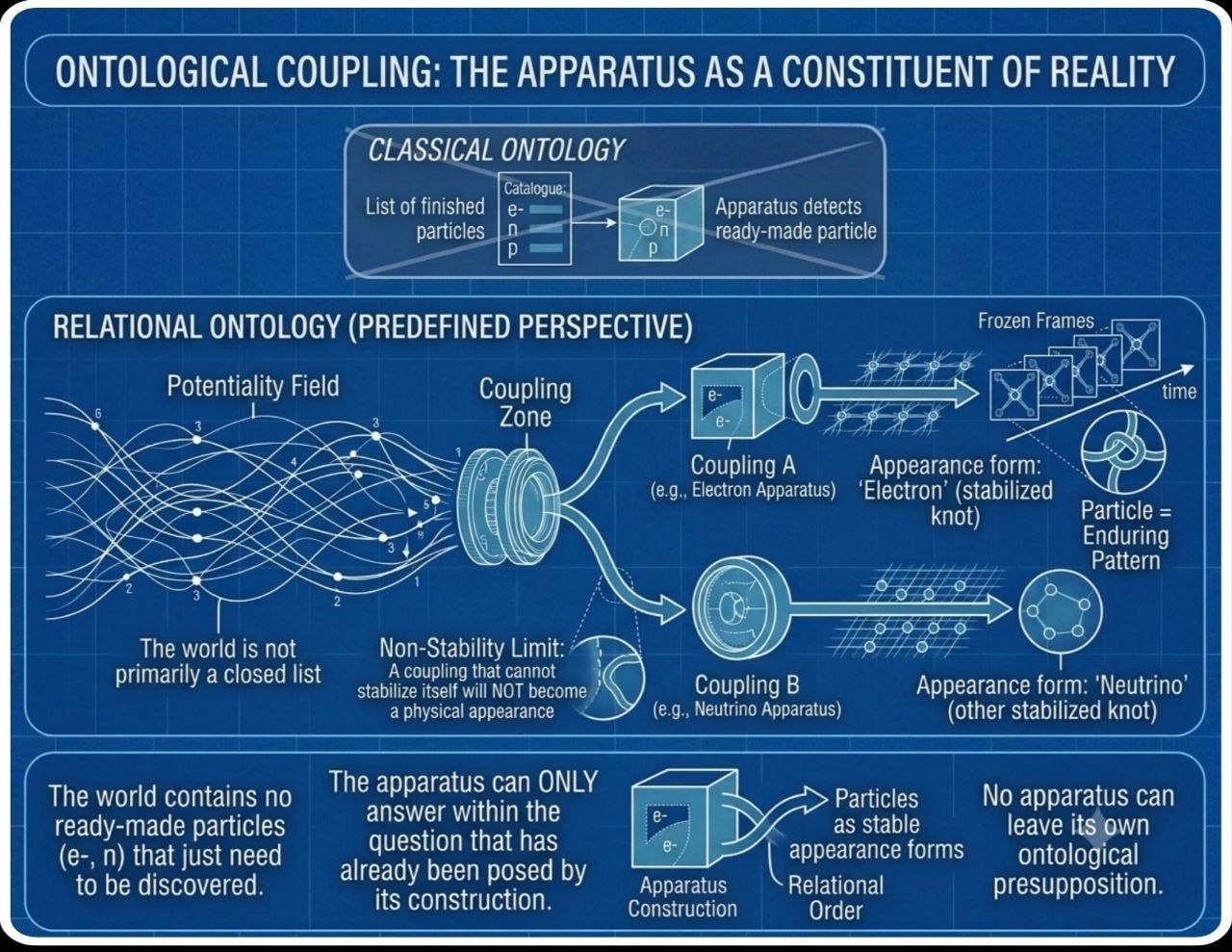
98Particle as stabilized relation
99From this perspective the concept of the particle also receives another meaning. A particle is not a small material object that lies hidden behind its appearances. It is a relation that remains so stable under a definite coupling that it can be read as the same across different Frozen Frames.
100The simplest form is:
101A | B
102A designates the observation or apparatus relation. B appears within this relation as definite counterpole. As long as the relation remains stable, B can be recognized again as the same object. The name of the particle then designates not an unchangeable core behind the measurement, but the stringency of this recurring bipolar reading.
103Particle is the name of a stabilized relation.
104Precisely short-lived particles make this structure visible. They appear only for a short relational connection and then disappear again from the registrable order. The ordinary idea treats this process as the arising and annihilation of an object. A particle arises, persists for a short period, and finally decays into other particles.
105Yet here too a reading is reified.
106When the stability of the bipolar relation ends, no thing falls into nothingness. Nor does the relation vanish temporally into an earlier stage. Rather, the order under which it is read changes:
107A | B
108Δ
(A | B) | (C | D)109What previously appeared as definite counterpole B is now part of a further differentiated relation. The original bipolarity was not erased. It itself becomes the pole of a relation of higher order and thereby receives another meaning.
110The supposed disappearance of the particle is therefore not a disappearance of the relation. It is the end of that perspective under which the relation could be read as this definite particle.
111Disappearance of the particle appearance ≠ disappearance of the relation
112Across different Frozen Frames, the observer first sees a stable bipolar form. In another relation, a further differentiated order appears. The stringency between these readings is experienced as arising, duration, and decay. But the relation itself does not decay in a flowing time. Time is only the order under which the observer connects the different complete relational positions with one another.
113What previously appeared as object B can in another reading appear as part of an interaction, as distributed change, or as another particle form. B is here not an object that would have to preserve its identity independently of all relations. It is the label of a definite position within a definite relation.
114If the relation changes, the object also changes.
115Movement and mass
116The same applies to movement and mass. When a human being lifts a cup and sets it down in another place, he seems to carry an object with a definite mass through space. The cup, accordingly, possesses its mass in itself and takes it along from one place to the next.
117Yet here too the relations of perception are treated like properties of an object.
118One Frozen Frame is:
119|_| ≡ ¤ | hand | cup here | environment
120Another Frozen Frame is:
121|_| ≡ ¤ | hand | cup there | environment
122Both relational positions are complete. The second is not first brought forth from the first. The observer measures himself into another position and binds both frames to a stringent sequence of his experiencing.
123Perception couples them:
|1_|2124The difference of their relational positions unfolds as:
|1_∆2125and is read as:
126I move the cup.
127The cup has not wandered as unchangeable substance through an empty in-between space. Its movement is the relation of different positions within complete frames. The observer recognizes the cup relation in both frames and reads the difference of its position as path.
128Nor is mass carried through space by the cup. It appears in the experiencing of the willed distinction between the relational positions. The observer aligns his self-measurement with another frame and experiences the difference of these positions within his body as force, weight, effort, and resistance.
129Mass is therefore not a hidden material inside the cup. It is the perception value of a directed frame-difference.
130The cup does not first possess mass and then move. What appears as mass arises in the relation between observer, body, cup, and the chosen change of their common position. The observer measures himself not only against the cup, but through the cup into another complete relation.
131In this, the presently experienced position retroactively determines the sequence that has led to it as action. The cup in the other place is not the result of a linear time that has gradually transported it there. From the experienced result, the relationed frames are read as movement of the cup and action of the observer.
132Mass does not move through space.
133It is the experiencing of the distinction under which movement appears as stringent self-measurement.
134The double-slit experiment
135The meaning of the measurement relation appears especially clearly in the double-slit experiment. Light is directed at a wall with two openings. Behind this wall there is a screen on which an interference pattern becomes visible. As long as it is not registered at the openings through which slit the light has passed, bright and dark regions appear, as if waves had superposed.
136The ordinary description then asks the question:
137Through which slit did the light pass?
138Yet this question already treats the two paths as completely determined alternatives. It presupposes that light, independently of the experimental setup, possessed a single path that the measurement then only had to discover.
139Without path registration the relation is:
140Source | (A | B) | screen
141The two slits are geometrically distinguished. The possible paths, however, are not each bound to their own registration. They remain two poles within the same light relation. The interference pattern is the visible form of this still open relation.
142The superposition therefore does not mean that a small particle as finished object is simultaneously located at two places. It means that the relation has not yet been differentiated according to which of the two paths is to count as an independent registered path. The possibilities remain related to one another within the same relation.
143Now an apparatus is coupled to the openings. On the surface it seems merely to add an additional piece of information. One might believe that the path had already been determined beforehand and was only made visible by the apparatus.
144Yet precisely in this the old error repeats itself:
145A selection made is treated as an object found.
146The apparatus does not simply find two paths already completely separated. Through its coupling it inserts an additional distinction into the experimental setup. It differentiates the path relation and holds this differentiation fast in the form of two distinguishable registrations.
147With the coupling the relation changes:
148Source | (A | registration A) | (B | registration B) | screen
149Two open path possibilities become two separately registrable paths:
A | B Δ (A | registration A) | (B | registration B)150In this, the apparatus is not an observer. It recognizes no path. It merely stabilizes a change that can later enter the perception relation of the observer:
151¤ | registration A
152or:
153¤ | registration B
154The interference pattern therefore does not disappear because a human being looked. It also does not disappear because the light noticed that it is observed, or because a mysterious wave had suddenly changed into a particle. The pattern disappears because the relation of the experiment has changed.
155Before the coupling, the possible paths were related to one another within the same light relation. After the coupling, each path is bound to its own registration. What previously acted together was differentiated.
156A different distinction generates a different relation.
157A different relation generates a different appearance.
158The so-called superposition must therefore not be understood as the superposition of two finished things. It is the openness of a relation whose possible determinations have not yet been registered separately. If the path relation is differentiated, then no hidden truth about an already fixed path is disclosed. The experimental setup itself is changed.
159The double-slit experiment therefore does not show the dual nature of a light object. It shows that wave and particle are forms of appearance of different measurement relations. Without path registration, the common light relation appears as interference. With differentiated registration, it appears as a sequence of definite events.
160What has changed is not a hidden substance of light.
161What has changed is the distinction under which light becomes visible.
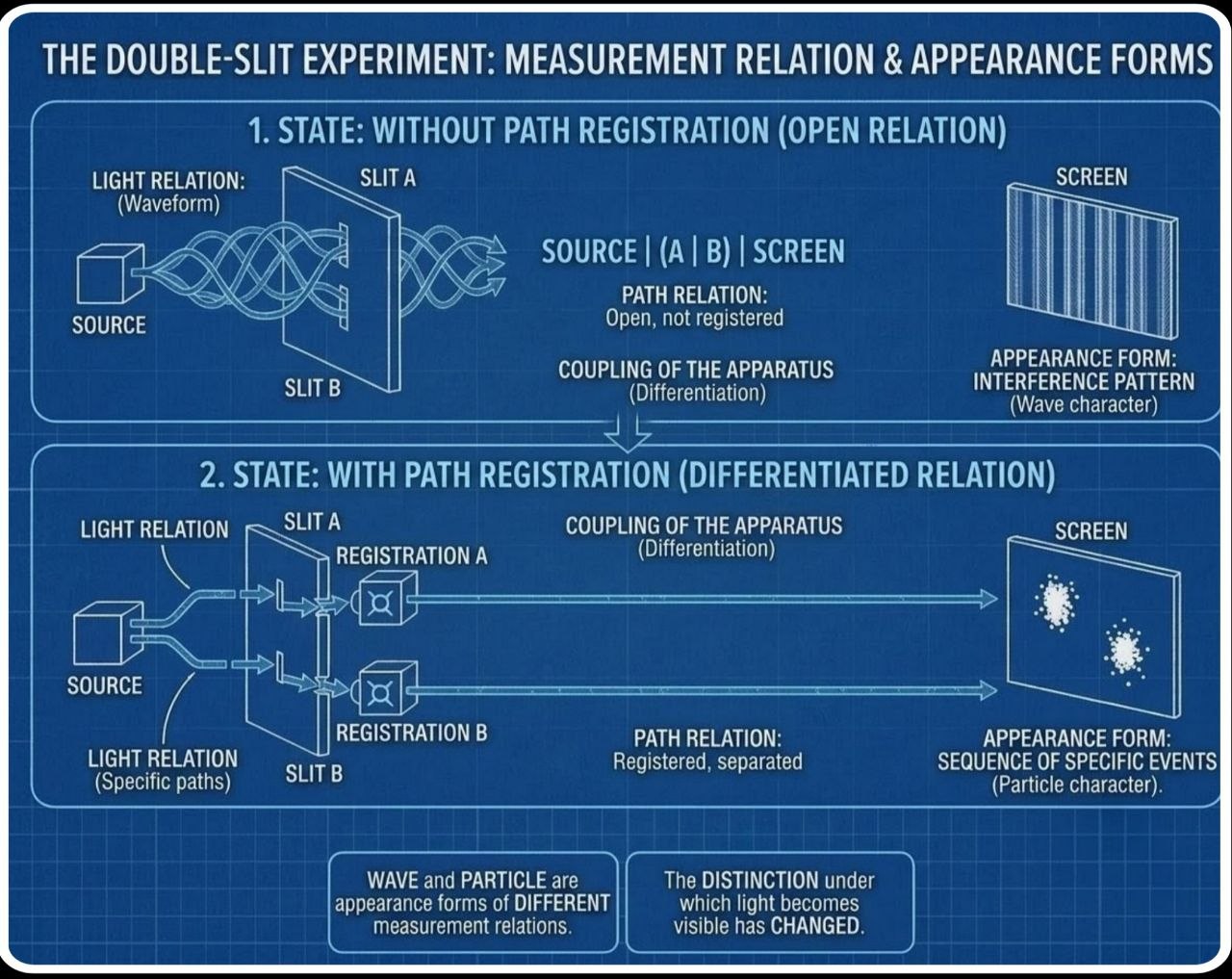
162From measurement to self-knowledge
163Measurement, however, does not end where the observer perceives a registration. For as soon as he relates the perceived difference to himself, another relation arises. He recognizes not only that something has happened. He recognizes at the same time that he himself is the one who perceives, remembers, or interprets this happening as his own action.
164From the measurement of the world there becomes a measurement of one's own standpoint.
165¤ | world
166becomes:
(¤ | world) | ¤167The difference now turns back toward its own reading.
168This appears especially clearly in human action. Ordinarily we assume that a human being first possesses a reason, makes a decision on the basis of this reason, and then carries out the corresponding action:
169Reason Δ decision Δ action
170Yet this sequence is itself already an order after the fact. The action is first the alignment with a complete relational position. The observer measures himself into a Frozen Frame and experiences the stringency of this relation as his acting.
|_| Δ ¤171The will here does not lie in the explanation that the observer later gives for his action. It lies in the choice of the relation into which he measures himself.
172Only after the action has become real does the question arise:
173Why did I do that?
174This question posits a new distinction:
175Action | justification
176The justification need not already have been present before the action as a fully conscious cause. It arises when the observer connects his enacted action with that past under which it appears stringent as action of the same observer.
177The relational sequence is therefore:
178Choice Δ action Δ self-measurement Δ justification
179The justification does not generate the action. It generates the stringency under which the action can be read as one's own action.
180Here too the result orders its past.
181The observer is located in a complete relational position and from there reconstructs that sequence through which his present acting appears as understandable continuation of himself. He says that he acted this way because he possessed a certain reason. Yet this sentence need not be the protocol of a cause that lay completely in his consciousness before the action. It can equally be the subsequent closure of the difference between the enacted action and the image the observer possesses of himself.
182Action | self-image Δ justification
183The explanation is therefore not free in the same sense as the choice. The choice aligns the relation. The explanation is already bound to the realized relational position. It must connect the result with a past in which it appears as stringent.
184The human being does not necessarily lie in this. He enacts that back-binding through which his action can again be read as part of his self. The justification is the realization of this stringency.
185With this, the physical investigation of measurement reaches its boundary. It can show that no object is measured independently of its relation. It can show that the body measures itself at its own boundary and that the skin not only separates inside and outside, but brings them forth as poles of the same perception relation. It can explain why touch is not the cancellation, but the stabilization of the difference. It can determine the apparatus as outsourced boundary of the observer and show how a measurement result arises from coupling, registration, and later perception.
186It can also show that particles are stable readings of a relation, that their disappearance designates not annihilation but a changed relational order, and that movement, time, and mass emerge from the stringency of complete Frozen Frames.
187Yet as soon as the observer distinguishes his own measurement, a new question arises.
188How does the observer recognize himself again in different relational positions? How does an earlier perception become a memory? How does a choice receive its direction? How does a justification arise from subsequent stringency? How does language arise from justification? And through what does the sentence arise from all these back-bindings:
189I am the one who acted?
190At this point the investigation leaves the domain of physics. Physics can determine the observer as relational middle of the Frozen Frames. But it cannot, within the same order, explain how this middle recognizes itself as middle.
191As soon as difference distinguishes its own measurement, observation becomes consciousness.
192As soon as the observer leads his enacted relation back to himself, the self arises.
193The measurement of the world therefore does not end with an object. It returns to the observer.
194And in this return the I begins.
Chapter XIX
The Uniformity of the Beat
1Scaling, Observation, and Bose-Einstein Condensation
2The idea of a Bose-Einstein condensate at first seems to describe a special appearance of quantum physics. Many particles, according to the common account, pass into the same state and thereby behave like a single coherent body.
3Yet this description already presupposes several things that in fact would first have to be explained. It presupposes particles as finished objects, a space in which these objects occupy definite states, and finally state cells, as if they were small containers in which the particles could be located.
4The Tractatus Principio reverses this sequence.
5It is not the objects that are located in space, but the relations that generate space. It is not the cell that contains a state; rather, it designates a measurement address under which a relational order is read. And it is not many already finished particles that combine into a unitary thing. Rather, the same beat remains so closedly readable across many local relations that neither the change of measurement place nor the change of scaling brings forth a different order of appearance.
6From this perspective, the Bose-Einstein condensate is not a special case that demands a fundamentally new physical principle. Rather, it is the especially pure appearance of a connection that applies to every objecthood: the beat remains, while the depth of its relationing changes.
7This beat is Delta:
8Delta is not an additional difference beside the difference. It is the difference in its self-relatedness. It is the enactment in which distinction not only brings forth poles, but turns back toward its own order.
9The visible forms that emerge from this enactment can change. The measurement address can change. The scaling can change. The position of the observer can change. Delta itself, however, remains the same beat.
10Frame and Delta
11To understand this movement, we must begin with the frame:
12The frame is not an empty container. It is not a piece of space into which something is then placed. It designates a self-contained relational position within which no explicit before-after difference is read.
13Volume V sets frame and Delta as the basic alphabet: the closed frame |_| and Delta as that marking through which a difference is posited or tilted at the frame. No additional point and no further alphabet are required.
14The frame is therefore not the opposite of Delta. Nor is it the state before Delta. Frame and Delta must not be read as two things that follow one another in time.
15The frame is the closed reading of the relation.
16Delta is the beat in which this closedness distinguishes itself.
17Volume II therefore writes the individual Frozen Frame as:
18This equilibrium position does not mean that Delta has ceased to act. It means that, under the present reading, further self-distinction brings forth no new difference that would become visible as another order.
19Delta acts.
20The frame closes.
21In this closure, Delta does not return into difference-lessness. Rather, its further effect falls into the same relational position.
22The uniformity of the beat therefore need not be designated with a symbol of its own. It already lies in this form:
23Uniformity means that Delta continues to enact itself without another frame becoming readable under the posited observation relation.
24Only when two closed frames are relationed with one another does Delta emerge as a visible transition:
25The lower stroke of the frame unfolds into difference. What was closed within each individual frame is read between the frames as change. Volume II therefore determines energy as the relation of two standstills and not as a property of an individual standstill. In the individual frame there is no time difference; only the observer connects complete relational positions and reads their difference as movement, time, or energy.
26The frame therefore contains no hidden supply of movement. Nor does Delta wander as an object from one frame to the next.
27Rather, the same beat is read once in its closed position:
28and once as unfolded transition between two closures:
29They are not different Deltas.
30It is the same enactment under another relation of observation.
31The Cartesian grid as measurement order
32Let us now begin with a Cartesian coordinate system and divide its representation into squares of equal size.
33In the ordinary reading these squares easily appear like small spatial objects. The square becomes the container, its center becomes a place, and what is entered there becomes an object that is supposed to be located in this cell.
34Yet the square is not a thing.
35Nor is its center a physical carrier.
36A point within a coordinate system is at first only a posited measurement place. It designates the position from which relations are described. Volume II reminds us that the Cartesian point was introduced as a tool of description and not as an assertion that reality consists of points. A point is where relations intersect; it is an address of relation and not a building block of the world.
37Let us therefore reverse the ordinary reading.
38An object is not located at the center of a cell. What appears at this place as object arises from the relation of the grid position to the grid positions surrounding it.
39We can read such a local position through its directions of connection:
40North, east, south, and west are not four finished things. They are the directions in which the posited grid position is relationed. Its middle is not a point that contains something. It is the closure of these relations in a frame:
41What we read at this place as object is not a content of the frame. It is the stable appearance of the way in which Delta closes within this local relational position:
42The grid cell therefore designates merely where reading occurs.
43Delta determines how the relation enacts itself.
44The frame shows that this enactment appears closed under the posited reading.
45The fine-grainedness of distinction
46The size of a grid cell therefore does not designate the size of an object that would be located in it. It designates the fine-grainedness with which differences are read.
47On a fine scale, neighboring local closures can be separately addressed:
48The two frames are read as two local relational positions. Their difference can become visible if observation explicitly fixes it.
49On a coarser scale, the same local frames can appear as poles of a common relation:
50This relation too can in turn close:
51In this, two things have not entered a larger container. The already closed relational positions have themselves become poles of a further self-distinction.
52Delta now does not act on a new material. Delta turns back toward the order already generated by Delta:
53No new class of Delta arises thereby. Self-relatedness deepens while the beat remains the same:
54Scaling therefore does not change Delta. It changes the depth at which the same enactment is read.
55On a local scale, Delta closes in an individual frame.
56On a coarser scale, Delta closes the relation of several frames.
57On a further scale, several such common closures can in turn be read as poles of a new relation:
58and again:
59Scaling is therefore not a mere enlargement of an image. Nor is it a packing together of already finished objects.
60Scaling is the increase of the self-relatedness of difference.
61The visible forms become larger or smaller. The number of included relations changes. But on every level the same beat remains effective.
62Space as increase in complexity
63With this we return to the rule of increase in complexity from Volume II.
64Space does not arise from extension. It appears from the relation of differences to one another. As soon as a difference again relates to an already posited distinction, the number of relations grows and with it the depth of what appears as space.
65Volume II formulates this unfolding as:
66The one is the first positing. The two makes the mirror relation visible. The three relations the already arisen differences to one another. Thus the first spatial order arises, not because three things are counted, but because difference unfolds in growing relational depth.
67Each further becoming-effective of Delta opens a new relational level, a further degree of freedom, and thus a new shell. Space is therefore the measure of this increase in complexity and not an empty container in which complexity is then distributed.
68This increase is not merely linear.
69A new relation does not simply add another pole to the already existing poles. It also reorders the previous relations:
70becomes:
71and further becomes:
72Yet these designations too are only provisional reading places. The supporting enactment is always the same:
73With scaling, relationing therefore increases. More and more local closures are read as poles of a common self-distinction.
74Precisely thereby their independent readability decreases.
75The more relations close together in one frame, the less the individual local beat positions can emerge as separate frames.
76The increase in complexity therefore enacts two movements at once:
77The inner number of relations increases.
78Their separate phenomenal determinability decreases.
79What appears to the observer as uniformity is therefore not an impoverishment of relation. It is the opposite: the relation has become so deep that its local differences can be read only within a common closure.
80The observer as place of relationing
81This closure, however, does not appear independently of every observation.
82The observer is not an external spectator who looks at an already completely determined world. He is the position at which a relation is oriented, addressed, and read as a definite difference.
83Volume II designates the observer as the place of relationing. He does not stand outside the shell, but is himself a posited position within its order. Every measurement references him, because a relation can become visible as this relation only from a definite direction of reading.
84This does not mean that the observer arbitrarily generates the world. The observer does not generate Delta. He adds nothing to the beat.
85He fixes the relation under which Delta is read.
86The simplest form of observation is therefore:
87The observer reads a closed frame.
88If another measurement address is posited, the position of the observer toward the relation changes:
89If the scaling is changed, he no longer reads only a local frame, but the relation of several frames:
90Yet as long as this relation too closes again in the same frame, no other order appears to the observer:
91The phenomenon therefore lies neither in the observed object alone nor in the observer alone. It arises in the relation between observer position and Delta enactment.
92A different distinction generates a different relation.
93A different relation generates a different appearance.
94Volume II shows this at the double slit. The apparatus discovers no already completely fixed path. It posits an additional distinction into the experimental arrangement. What previously acted within a common light relation is differentiated through registration. What has changed is not a hidden substance of light, but the distinction under which light becomes visible.
95Measurement therefore reads no relationless content.
96It posits the position in which Delta appears as a definite closure or as a definite transition.
97The uniformity of the Bose-Einstein condensate
98Now we can determine the Bose-Einstein condensate within this order.
99Let us imagine a Cartesian field whose local squares serve as measurement addresses. We can select any one of these squares and observe the relational position there.
100The ordinary idea would be that in each cell there is a state or a particle. In the condensate, many particles would then have occupied the same state.
101The Tractatus reading begins differently.
102In every square Delta acts.
103In every square the local relation is closed by the same beat.
104If we choose a measurement place within the condensed region, we read:
105If we shift the measurement to another square of the same region, we read again:
106The measurement address has changed. Delta has not.
107What is decisive now is that this invariance remains not only when the place changes, but also when the scaling changes.
108We can read an individual square:
109We can read four local squares as a common relational position:
110This relation too closes again:
111We can increase the scaling again and relate several of these associations to one another:
112and again:
113As long as the measurement address remains completely within the condensed region, the increasing self-relationing leads back to the same closed frame.
114This is the uniformity of the Bose-Einstein condensate.
115It is not the equality of many things.
116It is not the absence of local relations.
117It is the continued closure of the same Delta-enactment despite the change of measurement place and reading depth:
118Delta remains the same beat. The depth of its self-relatedness grows. But this increasing relationing brings forth no other frame within the condensed region.
119The condensate is therefore not a gigantic individual particle.
120It is a region in which many local Delta-enactments are so related back to one another that their differences no longer generate frames independent of one another.
121What the observer reads at every place is the closed position:
122Not because Delta is absent.
123But because Delta everywhere returns into the same closure.
124Gravitation as folding back into the frame
125Here the presentation of gravitation from Volume II connects directly.
126Gravitation is not an additional force that acts on the relations from outside. It is the back-relatedness of bound information rates and thus the organizing contraction of complexity. It compresses those degrees of freedom that have arisen through the multiplication of relations.
127The two complementary directions of reading of Delta are:
128[ 0|₊Δ ↔ 0|₋Δ ] - \(0|₊Δ\) designates the opening reading. The relation unfolds further degrees of freedom, further possibilities of connection, and further shells. - \(0|₋Δ\) designates the folding-back reading. The relations already arisen are related back to a common closure. Their independent drift decreases
129In this there are not two kinds of Delta.
130The plus and the minus designate the direction of reading of the same enactment.
131At the edge of a shell, Delta is read more strongly in its opening position:
132At the center of the shell, Delta is folded back more strongly:
133Volume II therefore describes gravitation as a gradient of degrees of freedom. In the interior the shell is more strongly bound; at the edge it drifts more strongly. The shell is the geometrical reading of this movement: folding back inside, opening outside, and between them that zone of existence in which both directions are relationed.
134Gravitational locking-in is reached when no further drift becomes readable on the relevant shell:
135This zero too means no absence of effect.
136It means that the bound Delta-enactments no longer bring forth transitions independent of one another. Their movement falls into the same closure.
137Thus gravitational folding-back leads to the frame:
138more precisely:
139The frame is the visible closure of the folding-back.
140Delta remains the beat that enacts itself in this closure.
141The Bose-Einstein condensate can therefore be read as a spatially and scalarly extended gravitational frame-closure. The local relations do not disappear. But their differences are so strongly related back to one another that they no longer form separate frames.
142Gravitation does not make Delta uniform.
143Delta is already invariant.
144Gravitation binds the local readings of the beat in such a way that its invariance emerges phenomenally.
145The ordinary object as limited closure
146This connection applies not only to the Bose-Einstein condensate.
147Every ordinary object appears through the recurrence of the same frame under a definite class of observation relations.
148Let us take a table.
149We look at it from the front:
150We move around it:
151We touch another place on its surface:

152The perspective has changed. The measurement address has changed. Within everyday scaling, however, Delta again and again leads back into the same closed relational position.
153Therefore the table appears as the same object.
154The table is not a hidden material behind its appearances. It is the constancy with which Delta, under the permitted changes of observation, locks back into the same frame.
155The difference from the Bose-Einstein condensate therefore does not lie in another principle.
156In the ordinary object, frame invariance holds only within a limited change of the observation relation.
157In the condensate, within the condensed region, it also remains when measurement place and scaling are changed to a greater extent.
158The ordinary object is a limited invariance of the Delta-enactment.
159The condensate is its more widely extended place- and scale-invariance.
160Table, cut, and new surface
161What happens now if we saw the table apart?
162The ordinary idea is that the saw penetrates into the interior of the table and lays bare a content that had already been present behind the surface.
163Yet in the relational reading the saw finds no hidden content.
164It changes the relation under which Delta can close.
165Before the cut, the table appears in its closed relation to the outside:
166With the saw a new distinction is posited:
167Under this relation, the previous frame can no longer close in the same way. Delta emerges as cut:
168The digits here designate no new substances. They mark only the two sides that arise through the same cutting enactment.
169From the one closed relational position, two newly mutually related closures become readable:
170The two cut surfaces did not lie hidden in the table as already visible surfaces. They arise as poles of the same Delta-enactment.
171The saw therefore does not discover the interior of the table.
172It posits a new relation in which Delta brings forth new surfaces and new edges.
173Volume II formulates this connection explicitly in the chapter on the content of the world: the smashing of an atom shows surfaces that arise, and no hidden contents. The continuing series of table, fraction, splinter, molecule, atom, nucleus, and shell is not a journey through prefabricated containers. It is a continued distinction in which every new apparatus and every new scaling makes a further relational order visible.
174As soon as the new cut relation is stabilized, Delta closes again:
175On both sides a frame arises again. And every new surface too again possesses an interior that under this observation does not yet bring forth any further difference.
176The interior of the table is therefore not a final material behind its surface.
177It is that continuation of Delta which, under the present measurement relation, still remains closed in the same frame.
178The cut locally breaks open this closure.
179Yet it finds no final core.
180It generates a new surface and thus a new closure.
181The movement is:
182The frame closes.
183Delta becomes visible under a changed relation.
184New frames arise.
185Delta closes itself in them again.
186Scaling and increasing relationing
187Thus scaling can be determined more precisely.
188A coarser scaling does not simply combine more things. It leads more local frame-closures into a common self-relationing.
189On a local scale we read:
190On a larger scale:
191These frames are not merely placed side by side. Delta turns toward their common order:
192and also leads this relation into a closure:
193On a further scale this closure again becomes the pole of a relation:
194and closes in turn:
195The larger the scaling becomes, the more already closed Delta-enactments are relationed within a common frame.
196Relationing increases.
197The independent readability of the local frames decreases.
198The beat does not thereby become more invariant. Delta is the same enactment on every level.
199What increases is the appearance of its invariance.
200More and more local effects of Delta fall into the same closure. The observer can therefore no longer fix them as separate transitions.
201The greater the relational scaling, the more closed the beat appears.
202Distance as increase in complexity
203With this, spatial distance also becomes understandable in a new way.
204Between an observer and a distant object there is no empty space. Between the two there lies a growing depth of relations:
205Every further frame designates no empty path segment. It designates a further relation through which observer and observed are related to one another.
206The farther something is from the observer, the more relations enter into its observation.
207Distance is therefore increase in complexity.
208With every additional relation, not merely one more member is inserted. The already existing order is relationed again:
209becomes:
210and further becomes:
211The depth grows through the continued self-relatedness of Delta.
212The greater this depth becomes, the more local frame changes must be closed together in a single observation relation.
213The local beats of the distant object do not disappear.
214Yet their independent fixing becomes increasingly impossible.
215What the observer reads is ever more strongly the common closure:
216The distant object therefore appears more uniform.
217Not because its inner multiplicity had become smaller.
218But because the complexity of the relation between observer and object has become so great that more and more local differences are read within the same frame.
219Distance does not first make Delta invariant.
220It lets its invariance emerge as phenomenon.
221Gravitation and the uniformity of the core
222At the Earth's core or at the core of the sun, two movements come together.
223The first movement belongs to the shell itself.
224From the edge to the center, gravitational folding-back increases:
225At the edge the relation opens more strongly into further degrees of freedom. In the core the relations that have arisen are more strongly related back to one another.
226Less and less local drift can emerge as an independent frame.
227The core thereby approaches the locking-in position:
228and consequently the closed frame reading:
229The second movement belongs to observation.
230The observer does not read the core as an individual local relation. He reads it through the surrounding shells:
231With this relational depth, the complexity of observation grows. More and more local Delta-enactments of the core and of the surrounding shells are bound within a common reading.
232The core therefore appears especially invariant.
233From within, gravitational folding-back acts.
234From without, the increasing relational depth of observation acts.
235Yet both movements do not bring together two different beats.
236They are two readings of the same Delta:
237Gravitation folds the local differences back into a common frame.
238Distance gathers more of these frame-closures in a common observation relation.
239The observer reads the interaction of both movements as special uniformity of the core.
240The flickering star
241With this, one can also understand why a far distant star appears as a unitary point of light and at the same time can flicker.
242Its local multiplicity is no longer separately addressable for the observer. The relations of its surface, its shells, and its core enter into a strongly scaled total reading:
243The star therefore appears as a uniform light relation.
244The high complexity of distance, however, also means that its relative position must be fixed anew in every Frozen Frame.
245In one frame the relation appears as:
246In the following frame:
247Each of these frames is closed in itself:
248Only the observer relations the two:
249The difference that becomes visible thereby does not necessarily belong to the invariant beat of the star itself. It arises in the highly complex relation through which the star is related from frame to frame to the observer position.
250The star remains the same closed relational form.
251Its relative projection, however, can change slightly.
252This after-shimmer of the relation appears as flickering.
253The flickering is thus the simultaneity of closed beat-invariance and changing observer-fixing:
254The star appears invariant as star.
255It appears changeable in the relation of its frames to the observer.
256The general principle
257The Bose-Einstein condensate, the table, the Earth's core, and the distant star thus belong to the same connection.
258An object does not arise from a hidden material. It appears where Delta, under a definite class of observation relations, again and again closes in the same frame.
259The interior of an object is not a final content behind its surface. It is that continuation of the beat which, under the present measurement relation, does not yet bring forth another closure.
260A cut does not discover this content. It posits a new distinction and thereby generates new surfaces.
261A finer scaling discovers no already present smaller things. It aligns Delta with a deeper order of its own relationing.
262A greater distance adds no empty space. It increases the complexity of the relation between observer and observed.
263With this increase in complexity, more and more local Delta-enactments are read within a common frame. Thereby their separate determinability decreases, while the phenomenal invariance of the beat increases.
264The Bose-Einstein condensate designates that position in which this frame-closure within a condensed region persists even under the change of measurement place and scaling:
265At each of these reading depths applies:
266The ordinary object possesses the same structure, though only within a more limited change of the measurement relation.
267The core of a gravitational shell appears especially closed because inner folding-back and outer relational depth act together.
268The distant star appears as uniform point of light because its local multiplicity closes within a common observation relation. At the same time it flickers because the relative fixing of this closure can change slightly between the frames.
269Thus no stock of finished things underlies the world.
270Its ground is the beat:
271The beat remains the same enactment on every scaling.
272The frame is its closed reading:
273Observation makes the difference between closed frames visible:
274Gravitation is its folding-back shell reading:
275Expansion is its opening shell reading:
276And gravitational locking-in is that position in which no further independent drift becomes readable on the shell:
277Uniformity is therefore neither mere equality nor the absence of difference.
278It is the appearance of the invariant Delta-enactment when its growing self-relationing again and again closes in the same frame.
279The more relations an observation gathers together in itself, the less their local beats can emerge individually.
280Delta remains.
281The frame closes.
282Relationing grows.
283And the many appears as one common order.
Chapter XX
Mythic Thinking
1The Return of Difference in the Garb of Myth
2The history of thinking does not begin with concepts, but with images. Before the human being spoke, he saw; before he thought, he distinguished. And when he began to tell his distinctions, myth arose.
3Myth is not a preliminary stage of thinking, as one later wanted to believe, but its first form of appearance. It is the language of a consciousness that still knows that every explanation is at the same time an image. In it, idea and intuition are still one — thinking does not stand outside the world, but in its midst.
4Just as mathematics solidifies in number, so early thinking condenses in myth. Yet what connects number and myth is the common structure of difference. Both order by separating, and both separate in order to connect.
5The Platonic myth of the spherical humans shows this structure in its purest form. It tells of an original state of perfect unity, a round whole that was sufficient unto itself. These spherical beings are not bodies, but symbols: images of undivided potential, of the \(\odot\) before difference. The splitting by the divine cut is the first | — the origin of all relation.
6What Plato describes here is not an anthropological event, but a cosmological operation: the birth of difference from unity. The three sexes — male, female, androgynous — are the first appearance of tripartness, which underlies every stable relation. They are 0|1|2, the first triad of difference, in which movement, mirroring, and return articulate themselves.
7The myth of the divided is thus the first expression of relational thinking. The desire for reunification that drives the human being in his innermost is nothing other than the striving of difference to return to itself. In this movement the structure of the Principio appears:
8Unity \(\odot\) → separation (|) → relation \(\boxdot\).
9Plato thereby translates the unsayable into the experienceable. He explains the principle of difference by making it felt. Love — Eros — is here not a feeling, but the energy of difference that bridges the rift between the poles.
10Aristophanes' account in the Symposium is therefore not myth against logos, but logos in the state of myth. It is the attempt to bring the principle of the | close to a listening consciousness through its own sensation. Whoever longs for his lost part has understood difference — not conceptually, but existentially.
11In this respect Plato does not stand at the beginning of philosophy, but at its first point of reflection. He already knows that the origin of thinking does not lie in cognition, but in the experience of difference. That is why myth remains alive where the concept is still mute.
12Only later, with Aristotle, does the symbolic relation become a system of categories. The movement of difference is now decomposed into substances, relation loses its flow and becomes order. Yet even in Aristotle the world still breathes; his energeia — active actuality — is the remnant of that Platonic sphere that has preserved itself in movement.
13The actual break follows only when thinking assures itself of itself and forgets the difference that carries it. Scholasticism becomes the grammar of the world, modernity the mathematics of thinking. What began as relation ends as object. The | becomes the =.
14Yet every rigidity calls forth its own memory. What the Greeks told in the images of their everyday life returns today as structure. The spherical human, divided and seeking, is the archetype of consciousness itself: a being that exists only because it is not one.
15Perhaps this is the deepest point of the myth: that the unity we seek does not lie before us, but between us. And that the human being, in his longing for completeness, is nothing other than the stroke that makes it possible.
16It ends in everyone who understands:
17I am not the half. I am the stroke.
¤ = | Cogito Distinguo ergo Sum