Paper within the framework of Tractatus Principio |
—
Unraveling the Riemann Hypothesis
Through the Eyes of the Tractatus Principio
The Future Foundation
Foreword
1This paper reads the Riemann question through the foundations of the Tractatus Principio. Distinction brings its poles into determination; Delta names the effective self-reference of this enactment. Number is its stabilized reading.
2The central inquiry is how the multiplicative question unfolds a relation whose order it then examines. “Tact,” retained from the German Takt, means the ordered enactment of a transition. “Band” names the common relational enactment read through the decimal marks zero to nine.
3The central thesis is conditional: once distinction is accepted as the foundation, the Riemann question dissolves into the self-reference already enacted in its own formulation. “Resolved” here means that the question about an independently given, unexplained numerical order is answered by recovering its generative relation. This is the resolution argued here within the Tractatus; it is not presented as a conventional proof that every non-trivial zeta zero lies on the critical line.
Abstract
1This paper advances a resolution of the Riemann question within the foundations of the Tractatus Principio. Distinction determines poles; Delta names its effective self-reference; numbers are stabilized readings of that enactment. The multiplicative question unfolds the relation whose order it then investigates. Its apparent external mystery arises when this generative connection is omitted. The proof principle is self-reference: every further operation, including a proposed counter-operation, must itself distinguish. Under this foundational commitment, the question returns to the same enactment through another readout. The paper’s central claim is that recognition of this connection dissolves the question as a demand for an independent origin of numerical order.
2Keywords: Riemann hypothesis; Tractatus Principio; distinction; Delta; self-reference; prime numbers; cut invariance.
Contents
1- 1. Begin with a distinction
2- 2. Circle, cut, and mirroring
3- 3. Delta: distinguishing the distinction
4- 4. How an operator sets the question
5- 5. Repeated questioning and infinite regression
6- 6. Nine as the decimal break edge
7- 7. Growth through changing pole roles
8- 8. The multiplicative question and primality
9- 9. Digit sum: a different question about an inscription
10- 10. The circle read through decimal degree labels
11- 11. What the zeta function does
12- 12. Reading zeroes and their arrangement
13- 13. The explanatory circle and its resolution
14- Conclusion
15- References and reading anchors
Introduction
1The Riemann hypothesis, formulated in 1859, asks whether every non-trivial zero of the zeta function has real part one half [8, H1]. This paper begins with an earlier question: how do number, operation, and zero become meaningful within that enquiry?
2More than 160 years of research have brought increasingly elaborate frameworks into the discussion. Spectral operator approaches pursue the Hilbert–Pólya idea of relating the zeroes to eigenvalues. Montgomery’s pair-correlation work, published in 1973, and its connection with Dyson’s random-matrix statistics opened another line of enquiry [H2, H3]. Berry and Keating’s 1999 study developed quantum and semiclassical analogies, including a proposed dynamical interpretation of the zeroes [H3]. These are landmarks in a widening research programme; the conventional hypothesis remains open [H1].
3From the Tractatus position, this widening of machinery raises a foundational suspicion. When a problem generates ever larger theoretical structures across generations while its originating relation remains unexplained, complexity can add floors to a tower whose foundation has not been examined. This paper diagnoses an explanatory error: the order made readable through a question’s rules is asked to reveal an origin independent of those rules.
4The exposition follows one path. Sections 1–4 develop distinction, circle geometry, self-reference, and operator perspectives. Sections 5–10 apply them to numerical readings. Section 11 explains zeta before Section 12 addresses its zeroes and the critical line. Section 13 and the conclusion state the explanatory circle and the Tractatus diagnosis.
5The foundational commitment and the meaning of “resolved” are stated in the foreword. The steps below make the argument followable without first reading the whole of Volume I.
1. Begin with a distinction
1Before asking where a numerical result lies, consider how anything becomes a determinate result at all. Volume I begins with a simple dependence: something is recognizable as this rather than that only through a distinction. An axiom, a numeral, and a mathematical question already use this dependence [1, Chapter V].
2Imagine drawing a boundary and calling its sides A and B. The usual reading begins with two things and places a relation between them. The Tractatus asks us to follow the boundary itself: it is through the distinction that the two sides become determinate as A and B.
3Here the stroke names the distinguishing relation. A and B name its poles, meaning the sides that can be read through it. Remove the distinction and their determination as these two sides is lost. This is why the relation comes first in the explanation. The sides become readable through it [1, Chapter V].
4Zero names the potential of distinction before a particular determination has been read. One names the first such determination. Their relation is written:
5The zero is already involved when the one is written. One is determinate against that reference; zero, in turn, becomes readable through its determinate counterpart. They condition one another. Writing the shorter mark 1 leaves this dependence implicit. It does not remove it [1, Chapter VI]. Every further number repeats this distinguishing activity. It therefore carries the same zero with it: the determinations multiply, while their shared zero reference remains effective throughout.
6This gives a precise meaning to the object-error. If we take the visible mark 1 as a self-sufficient thing and forget the relation through which it means one, we reverse the direction of explanation. The inscription is treated as the origin of the relation that made the inscription readable.
7The same reversal can occur with a larger number, a prime, or a function. The question is then posed as if an independently given object first existed and its relations had to be discovered afterward. The Tractatus instead follows the distinguishing relation through which that object becomes determinate.
8In this paper, a readout means the readable expression of such a relation. A numeral is one kind of readout. The word keeps the dependence visible: the expression is read from a relation, and its reference remains involved in what is read.
9We now have the starting point needed for the geometry: distinction makes poles determinate; zero is its potential; one retains its zero reference. The circle and the stroke show this dependence in a form that can be followed with the eye.
2. Circle, cut, and mirroring
1Figure 1 makes the principle of Section 1 visible. The circle in A stands for zero: the closed potential of the relation as a whole. As the perspective tips the same circle onto its side, its edge view is a line. This is the one, the distinguishing stroke. Geometry gives an optical presentation of the same principle: every determination retains the zero through which it is readable.
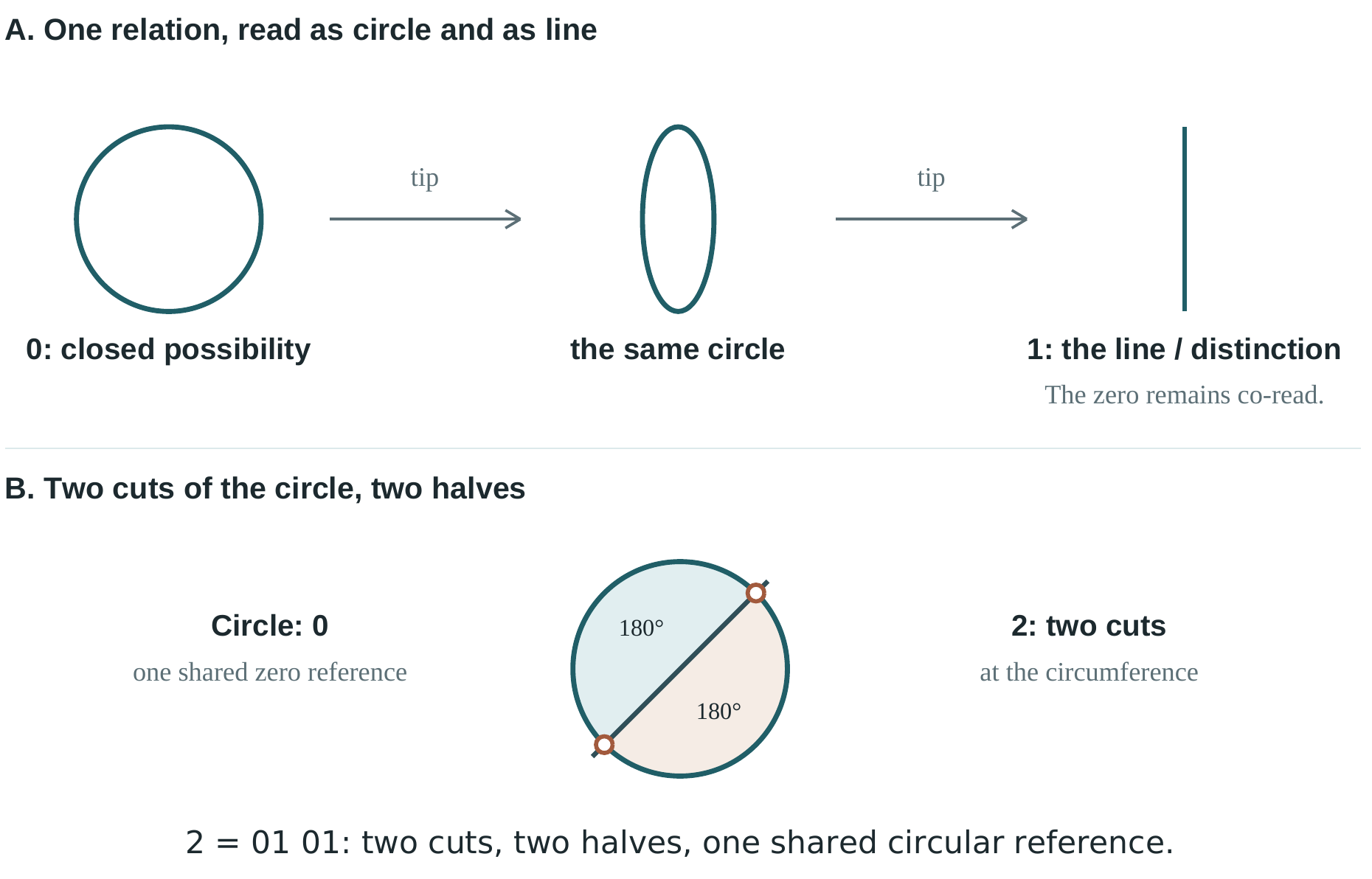
2Figure 1. A follows the same circle through a change of perspective. The tipping view is this paper’s geometric reading of Chapters VI and X [1]. B holds circle and a continuous diagonal line together. Its two cuts of the circumference divide the circle into two halves [1, Chapter VI].
3In B, the two is made readable by the two cuts of the circle. The line is continuous through the interior. Its middle is not counted as another cut. The two determinations retain the same circle as their reference.
4The left reading is 0|1; the right is its counter-reading, 1|0. The outer zeroes refer to the same circle. The compact 01 01 in the figure groups the two readings; the fuller inscription above makes their mirrored directions explicit. This is how 1 + 1 remains connected to its geometric reading.
5The figure has brought us to a new question. A distinction has become related to the same distinction through its mirror. What does it mean for the distinguishing relation itself to be distinguished? That is the subject of the next section.
3. Delta: distinguishing the distinction
1The two in Figure 1B is more than two marks placed beside one another. Both cuts belong to the same circle. Reading one in relation to the other therefore brings the distinguishing relation back into relation with itself.
2This is self-reference in the sense used throughout the paper. The distinction makes a relation readable, and that relation can itself be distinguished. We name this effective self-reference Delta and write:
3The inner stroke is the distinction being read. The enclosing expression indicates that distinction is itself being distinguished. Delta names this activity. It does not add a second substance or an outside mechanism to the circle and its cuts. Volume I develops the recurrence through the relations of number and their geometric readings [1, Chapters V–VI, VIII–X].
4The order of explanation matters. Section 1 followed a distinction that retains its zero in every further determination. The circle, the line, and the mirrored cuts made that same principle visible. Delta names the effective self-reference involved throughout. The drawing and the numerical inscription express this activity in different ways; the drawing does not introduce another foundation.
5A number is a stabilized reading of this activity. “Stabilized” means that a particular relation has become determinate enough to be expressed and read again. The visible numeral holds that reading publicly. It is intelligible through the relation that gives it its meaning.
6For example, the symbol 2 can be read through 1 + 1. The fuller inscription 0|1|1|0 retains the reference and the counter-reading involved in those two determinations. The shorter numeral and the fuller inscription express connected readings. Neither gives the two an existence independent of that connection.
7We will also use the word trace. It means the determinate relational form through which a reading remains possible. A trace is what can be read now of the distinguishing activity. When a reading becomes the reference for another reading, this connection continues to act.
8These statements describe connected roles, rather than separate stages in the manufacture of an object. Potential, determination, and self-reference remain involved together. The exposition separates them so their dependence can be followed.
9From here onward, Delta will be used in this established sense. The remaining task is to follow what happens when the question specifies a particular way of reading the relation. Operators give that specification.
4. How an operator sets the question
1Knowing that a number is read from a relation does not yet tell us which reading a particular task calls for. The operator supplies that direction. Volume I treats operator signs as perspectives on the same self-related activity [1, Chapters VIII–IX].
2The two basic directions are expansion and contraction. A plus reading follows expansion in unit steps. A minus reading follows the corresponding contraction. Multiplication reads iterated expansion; division reads how the relation can be disentangled. Power and root express further depth in these directions.
3The different operators preserve different questions. Asking for \(6+2\) and asking for \(6\div 2\) gives different readings because the relation requested by the task is different. A common foundation does not make the operators interchangeable. It lets their differences be explained through their roles in one activity
4This is what “perspective” means here. It is a specified way of making a relation readable, with consequences for what counts as an answer. It is not an arbitrary change of label after a result has been found. The question binds the path of the reading to its result.
5A path is the way that specified relation is carried through. In a multiplicative question, for example, the relevant paths are the couplings through which a numerical determination can be reached. Section 8 will use those paths to distinguish prime and composite readings.
6Three terms prepare the intervening examples. A tact is one ordered enactment of a transition. Repeating the same task gives successive tacts. Depth describes how one reading becomes involved in another: a result can become the reference for asking again.
7The band names the common relational activity read through the decimal marks zero to nine. A shell is a reference level of that decimal inscription. Passing from 9 to 10 renews the place relation while using the same marks. The later symbol κ names the break edge of a reading shell. Section 6 shows why this terminology concerns the inscription rather than a final limit to number.
8The next four sections now have a clear purpose. Repeated halving shows the same question applied again. The decimal break edge shows renewed reference depth. Growth shows changing pole roles. Primality then shows what is selected when the question is specifically multiplicative.
9All four applications use the relation already developed. They do not require a new definition of distinction or of Delta. What changes is the task, and with it the path through which the relation becomes readable.
5. Repeated questioning and infinite regression
1Repeated halving displays
2The Tractatus reads the repeated operation through its relational depth. If
3then the successive readings are
4The same question returns through its own trace. The visible sequence is an inscription of that recurrence, not a succession of independent number-substances approaching an ultimate object called zero.
5Volume I treats infinity through the openness of repeated questioning [1, Chapter XI]. Each enacted reading is determinate; the possibility of another reading has no externally imposed final depth.
6This identifies a limit of an explanatory method. Further counting or subdivision, while presupposing numbers, does not explain how number becomes determinate. The Tractatus closes this explanatory regress by returning to the enactment repeated through the successive inscriptions.
6. Nine as the decimal break edge
1The visible decimal repertoire is
2Nine marks the break edge and cycle closure of this reading shell. Continuation appears as
3Ten introduces no eleventh basic decimal mark. It is the first visible relation of a renewed shell. Places express coupled reference depth within the same band [4, Chapter III; 5, Section 5].
4The relation between nine and the break edge κ is specific to this decimal reading. Volume I also discusses break edges relative to other number representations [1, PDF pp. 20–21].
5The finite mark repertoire permits arbitrarily deep inscriptions. Its explanatory role is the recurrence of the same relational enactment across those inscriptions, rather than a final end to all possible number labels.
7. Growth through changing pole roles
1Numerical growth can be read through the transition
2The counter-pole of one relation becomes the starting pole of the next. A further counter-pole becomes readable through the renewed distinction.
3Halving follows contraction through reference depth; growth follows expansion through changing pole roles. These are counter-readings of the same self-referential movement. Their common foundation does not make their directions interchangeable.
4Expansion and contraction are the basic directions. Addition, multiplication, division, power, and root articulate perspectives and depths of their enactment [1, PDF p. 29]. An operator marks how a relation is read:
8. The multiplicative question and primality
1A question specifies the relevant relation. The prime-number question asks:
2Can this number be closed through a non-trivial multiplicative relation?
3It determines the reading modes \(\vert_{\times}\) and \(\vert_{\div}\) and the paths relevant under them. For a prime label \(p\), the unit/self readings are
4A label \(p>1\) is prime when it admits no non-trivial inner multiplicative closure path. One retains its unit role and is excluded from the prime labels.
5A composite label has further paths. For six, the inscriptions are
6Primality is thus a determination under the multiplicative question. A different operation reads a different path profile of the number relation.
7Volume IX writes a question figure as
8where \(G_Q\) is the given binding structure, \(U_Q\) its openings, and \(R_Q\) the question relation [5, PDF pp. 26–27]. The answer must remain bound to this specified figure
9. Digit sum: a different question about an inscription
1The preceding section asked about multiplicative paths. Digit sum gives a useful comparison because it asks a different question about the written number. It gathers the decimal place marks into one reading. The example will show why the perspective of a task must remain attached to its answer.
2Write a multi-place inscription through its digits:
3Here d names a digit and the subscript gives its place. The single digit sum adds those digits:
4If the result still has several digits, ask the same question again. Repetition eventually gives a single digit, written \(q(n)\):
5For a positive integer, \(q(n)\) lies among 1 to 9. The difference between a single step and the repeated reading is visible in this example:
6S records one digit-sum step. The first step takes 47 to 11, and the next takes 11 to 2. The notation q records the final single-digit reading. This is the decimal scale collapse described in Volume I: place marks are gathered into a reading at a different reference depth [1, Chapters VII–IX].
7This task does not preserve every distinction relevant to another task. In particular, it does not determine whether a number has a non-trivial multiplicative path:
8Thirteen is prime and twenty-two is composite, yet both have the same repeated digit sum. There is no conflict between these statements. The digit-sum question and the prime question retain different relations.
9The example carries one lesson forward: an answer belongs to the task through which it is read. The next section follows the same digit-sum task around a decimal inscription of the circle. It illustrates the perspective of the reading before we turn to zeta.
10. The circle read through decimal degree labels
1Take a full turn and mark nine equal positions. Using degree labels gives:
2The positions are then labelled:
3Now apply the repeated digit sum q from Section 9 to these degree labels. Their single-digit readings are:
4The three successive thirds of the turn give the following entries:
| Angular position | Basic-shell address |
|---|---|
| \(120^\circ\) | \(q(120)=3\) |
| \(240^\circ\) | \(q(240)=6\) |
| \(360^\circ\) | \(q(360)=9\) |
5This is why 3, 6, and 9 appear as successive third-closures in this inscription. The other addresses are 1, 2, 4, 5, 7, and 8. Primes greater than three have their repeated digit sums among those addresses:
6The condition records the exclusion of divisibility by three. Composite numbers occupy these addresses too. Thus the circle reading gives a relation among positions and decimal marks; it does not by itself provide a prime-selection rule.
7The notation 360 read as 9|0 belongs to this decimal perspective: the degree inscription returns the digit-sum reading 9 while retaining the circular zero reference. Its meaning depends on the reading task [1, Chapters VII–IX].
8Sections 9 and 10 therefore provide examples of the same principle used for primality. Change the task and different relations become visible. A digit sum is a readout of decimal place marks. A factor path is a readout of multiplicative coupling. Neither can silently replace the other.
9We can now turn to the zeta function. Its sum and product will be read through multiplicative organization. The decimal examples have clarified what a task does; they are not used to assign positions to its zeroes.
11. What the zeta function does
Multiplicative paths and complex weighting
1The standard starting representations are
2and the Euler product over primes \(p\),
3They describe the same function in this domain [6]. Expanding the prime factors generates their powers and combines them through prime factorization. The sum and product thereby articulate the multiplicative organization from two directions.
4The operator signs now have concrete jobs. The sum sign \(\sum\) gathers the weighted contributions in the \(\vert_{+}\) perspective. The product sign \(\prod\) couples the prime-power paths in the \(\vert_{\times}\) perspective. The factor \(n^{-s}\) combines reciprocal power weighting with rotation: its size and orientation determine how one contribution is read with the others [1, Chapters VIII–X]
5The sign \(\infty\) leaves the recurrence open. It does not name a last term at the end of the question [1, Chapter XI]. The relation is specified by the rule for continuing the reading. We must therefore keep both the rule and the domain written beside these formulas in view.
6In the notation \(s=\sigma+it\), σ is the real-part coordinate and t is the imaginary-part coordinate. The number i specifies the orthogonal direction of the complex plane. These are coordinates at which the function is read. A zero will mean a function value of zero at such an address, not that the address itself is the number zero
7For s=σ+it, the term
8has magnitude weight \(n^{-\sigma}\) and phase \(-t\log n\). Changing s changes how the number contributions are read together. The imaginary parameter does not supply one common rotation angle for all terms. Elsewhere the function is defined by analytic continuation, with a simple pole at \(s=1\) [6]. Non-trivial zeroes lie in \(0<\sigma<1\) [8]. Their zero condition cannot be evaluated as an ordinary convergent sum of the original series in that strip
The function and its reflected addresses
9The completed function is
10where \(\Gamma\) is Euler’s gamma function. Its functional equation is
11These conventional formulas concern the completed function; the bare equality \(\zeta(s)=\zeta(1-s)\) is not its functional equation [7]. Combining reflection with complex conjugation gives the vertical address reflection
12An address is individually self-reflected precisely when
13The line \(\operatorname{Re}(s)=\tfrac{1}{2}\) stands perpendicular to the real axis and passes through the middle of the distinction 0|1. It is invariant under the counter-reading: the imaginary-part coordinate is retained, while the real-part reading is reversed. At one half, the reversed reading returns to its own address
14The Tractatus application follows the principle established in Section 1: every number must be read together with its zero as counterpart. That zero remains involved through every further determination. The next section reads the zeta construction through this continuous relation. Its geometric presentation makes the relation visible; it does not supply an additional foundation.
12. Reading zeroes and their arrangement
1A zeta zero is an address at which the function value is zero. The address specifies how the relation is read. Within the Tractatus account, the zero-value reading meets the same zero reference that was effective in every numerical contribution from the beginning [1, Chapters VI, XV].
2Three, five, and seven repeat the same act of self-distinction through their ones. Every one retains its zero as counterpart. Chapters VI–VII show this geometrically: the triangle, pentagon, and heptagon make three, five, and seven cuts on the same circle [1, Chapters VI–VII]. The figures differ; their zero reference is shared. Weighting and coupling retain that reference.
3Consider two equally weighted contributions pointing in opposite directions. Their combined value can be zero while both remain effective. A zero-readout therefore need not erase the relation being read. This makes the meaning of closure concrete: the total reading meets the reference already involved in its determinations.
4Changing the height in Section 11 changes the relative phases of the contributions. Different phase relations give further readings of the same specified function. Its zeroes are read here as recurring closures against the shared reference. In the strip, this concerns the analytically continued function described in Section 11.
5The question figure introduced in Section 8 makes the roles explicit. \(G_Q\) is the given organization: multiplicative paths, their complex weights, and the counter-reading of the completed function
6\(U_Q\) is what is open: the addresses where this reading has value zero
7\(R_Q\) is the relation through which those addresses are read as closures of the same organization. The unknown belongs to the relation specified by the question [1, Chapters XIII, XV]
8A zero’s own distinction means the whole reference relation, 0|1 together with its counter-reading 1|0. In 0|1|1|0, both outer zeroes name the same reference. The many numerical determinations unfold this relation. Cut invariance names the preservation of the distinguishing relation \(0\vert 1\leftrightarrow 1\vert 0\) through its counter-reading, with the same circle retained as reference
9The geometry is the optical presentation of this same principle. The circle shows the closed potential of the whole relation, and the cuts show its determinations. In the Tractatus reading of the strip, the closure is read through the relation’s own counter-reading. The invariant perpendicular of Section 11 is its carrier: orthogonality gives the direction, and counter-reading singles out the middle.
10Here ρ names a zero on the carrier so read, and γ gives its height. Different heights express different phase readings of the weighted relation. The particular values belong to the specified zeta readout. Geometry displays their common relational reference, while the zero remains the same through the different readings.
11The explanation is continuous: every further number unfolds the same distinction and reads the same zero with it. The zeta construction carries this reference through its weights and couplings. Its closures are therefore read within that relation. The next section explains the circle created when this returned order is treated as an independent origin.
13. The explanatory circle and its resolution
1The direction of the construction is now visible. The question first selects multiplicative organization. The zeta function gives that organization a sum reading and a prime-product reading. Its complex weights specify how the contributions are coupled. A zero is then a zero-value reading of this specified function.
2From the Tractatus position, the explanatory circle appears when the resulting order is treated as an independently given origin of the numerical organization already used to obtain it. The question has used multiplicative relations to make the zeroes readable, and now reads those relations back through the zeroes. The origin sought outside the question is already effective in its formulation.
3This is the precise criticism expressed by saying that the rules investigate what their own activity makes readable. A computation of a zero gives an address within the construction. It does not, by that fact, provide an origin independent of the construction. Treating the returned determination as such an origin repeats the presupposition.
4The object-error from Section 1 occurs here in a specific form. The order read from a relation is separated from that relation and treated as a self-sufficient object. Its connection to the question is then encountered as a mystery. The decisive omission is the relation between the way the question is asked and the order that can answer it.
5Recovering that connection changes the explanation. The multiplicative question and the order encountered through its zeroes are one relation read in connected directions. The half names the invariant axis of the counter-reading. The heights name recurring zero-readouts of the same weighted relation. Their placement remains the readout of that relation, rather than an independently supplied numerical foundation.
6This is the resolution claimed within the Tractatus. The zero was never left behind: every numerical determination retained it as counterpart, and every further operation carried that reference with it. A closure reads the relation through the same zero that remained effective throughout. The geometry makes this connection visible. The question returns to its own activity instead of demanding an origin beyond it [1, Chapters V–VI, XV–XVII].
Conclusion
1The preceding argument leads to three connected criticisms. Together they state the Tractatus diagnosis of the approach examined here: a foundational dependence is omitted, and the order arising through it is then investigated as an independent mystery.
The spiral of treating symptoms
2Where the originating circularity remains unrecognized, further computational power and conceptual complexity are directed at its symptoms. In this diagnosis, a failed or incomplete proof attempt prompts another layer of machinery. Another floor is then added to the tower while the foundational question remains untouched: which act of distinction made its objects and rules determinate in the first place? Technical elaboration then prolongs the explanatory circle instead of exposing it.
Mistaking an artifact for its origin: the object-error
3The critical line and zeroes are approached as if they were self-sufficient objects “out there”, waiting for a sufficiently powerful analytical instrument. The construction’s readout is thereby mistaken for an independent origin. Detaching those objects from the rules through which they become readable turns their relation to those rules into an artificial riddle. This is the object-error applied to the zeta question: the artifact of a specified reading is treated as the foundation that reading was supposed to explain.
The missing reflection on the method itself
4Sums, products, and complex weights are themselves acts of a particular distinction. When their originating role is left outside the explanation, the analytic enquiry applies its tools within the system in order to explain the system’s own origin. Further use of those same presupposed tools cannot disclose an absolute origin independent of them. It repeats the circle until the connection between the question, its tools, and its readout is brought into the explanation.
5The Tractatus response is therefore to recover that connection. Every number is read with its zero as counterpart. Further self-distinction multiplies the determinations while retaining the same zero throughout. Geometry is the optical presentation of this principle. Cut invariance preserves the distinguishing relation \(0\vert 1\leftrightarrow 1\vert 0\) through its counter-reading at the same circle (Section 12). The multiplicative question and its zero-readouts remain within the same relation: the critical line is read through its counter-reading, and the heights through its recurring closures.
6This resolution remains conditional on the foundation stated in the foreword. Any further operation must again distinguish to be determinate. Self-reference is the proof principle used here: the question returns to the relation already effective in asking it. The historical expansion of methods motivates the foundational enquiry; the omitted dependence identified in the argument is what supplies its diagnosis.
References and reading anchors
1Volume I supplies the foundations used in this paper. Works [1]–[5] are by C. H. F. Warnke and refer to the German website editions. Sources [2]–[5] also document notation retained in Sections 5–8. PDF pages count from the cover. Sources [6]–[8] document the conventional formulas in Section 11.
2[1] Tractatus Principio, Volume I — Buch der Mathematik. Distinction and relational poles: Chapter V, PDF pp. 13–15. Zero, determination, and circle geometry: Chapter VI, PDF pp. 16–18. Decimal return, digit sum, and operator modes: Chapters VII–IX. Complex orientation and rotation: Chapter X. Open recurrence: Chapter XI. The question, the impossible, and the unknown: Chapters XIII and XV. Self-relation and numerical depth: Chapters XV–XVII. Original coupled-place reading anchors: Chapter XVIII, PDF pp. 63–65.
3[2] Tractatus Principio, Volume IV — Buch der Selbstbezüglichkeit. Chapter I, PDF pp. 3–4: orders of distinction and relational depth.
4[3] Tractatus Principio, Volume V — Buch der Kleinstbezüglichkeit von Delta. Notation overview, PDF pp. 13–14; observer as Delta reading Delta, Chapter IX, PDF p. 16; number geometry and tact, Chapter XIV, PDF pp. 21–24.
5[4] Tractatus Principio, Volume VIII. Chapters I–IV, PDF pp. 3–6: Delta, marks, shells, and modes of operation. Chapter XIV, beginning at PDF p. 79: number as readout.
6[5] Tractatus Principio, Volume IX. “Das Zahlenfraktal von 0 bis 9,” Sections 3–5, PDF pp. 6–8; projections, binding, and normal form, Sections 10–14, PDF pp. 11–14; question figures, PDF pp. 26–27.
7[6] NIST Digital Library of Mathematical Functions, Section 25.2. Definition, Euler product, and analytic continuation. https://dlmf.nist.gov/25.2.
8[7] NIST Digital Library of Mathematical Functions, Section 25.4. Completed xi function and functional equation, Equations 25.4.3–25.4.4. https://dlmf.nist.gov/25.4.
9[8] NIST Digital Library of Mathematical Functions, Section 25.10. Non-trivial zeroes, critical strip, and reflection symmetry. https://dlmf.nist.gov/25.10.
Historical sources for the introductory excursion
10[H1] Clay Mathematics Institute. Riemann’s 1859 Manuscript; Riemann Hypothesis (listed as unsolved). https://www.claymath.org/collections/riemanns-1859-manuscript/ ; https://www.claymath.org/millennium/Riemann-Hypothesis/ .
11[H2] H. L. Montgomery. The pair correlation of zeros of the zeta function. Proceedings of Symposia in Pure Mathematics 24 (1973), pp. 181–193. https://websites.umich.edu/~hlm/paircor1.pdf .
12[H3] M. V. Berry and J. P. Keating. The Riemann Zeros and Eigenvalue Asymptotics. SIAM Review 41(2) (1999), pp. 236–266. DOI: 10.1137/S0036144598347497. Spectral operator approach: p. 238; Montgomery–Dyson and random-matrix connection: p. 247; quantum and semiclassical analogies: pp. 236–239. https://doi.org/10.1137/S0036144598347497 .